
The Pilgrims Arrived on That Sad Day in Boston
In memory of Robin Williams, the man who inspired many
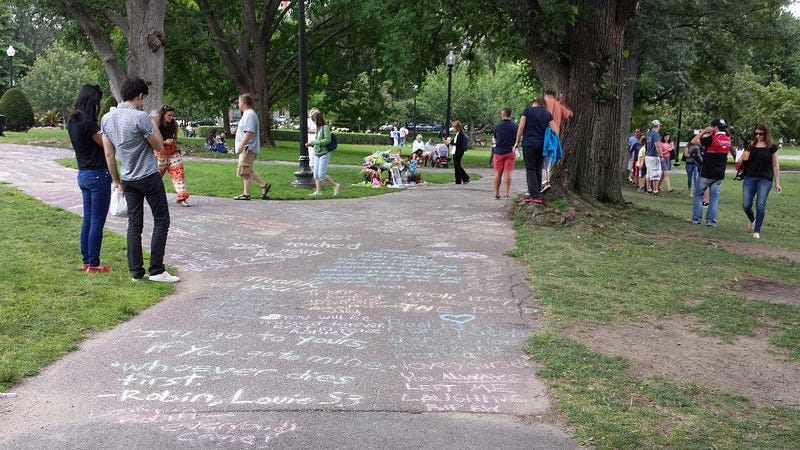
Those walking in Boston’s Public Garden were careful not to walk on the words. They tiptoed around the pastel blues, jumped over the lime green, and skirted by the hot pink chalk. They wished not to desecrate the spontaneous etchings on the concrete arteries. Such vital walkways radiated from a simple park bench next to the famous pond. It was made famous in the Robert McCloskey children’s story, “Make Way for Ducklings” — a story we had often read to our daughters.
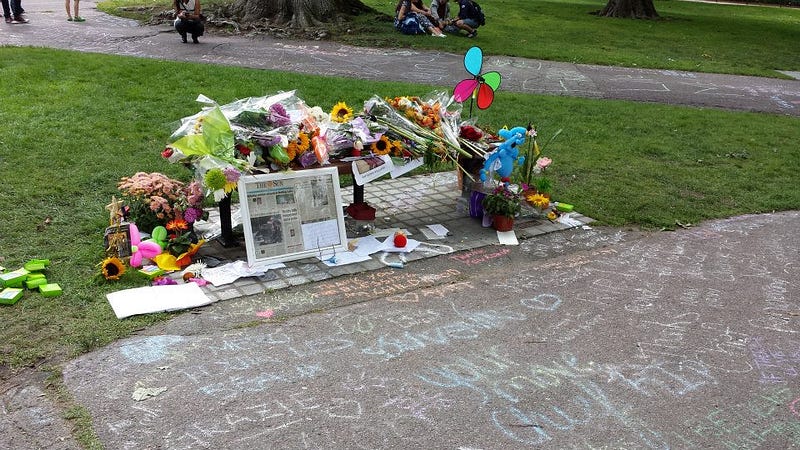
Someone left boxes upon boxes of chalk. Those large letters had whittled the thick, colored chalk to nubs. Some left notes by the bench, while others — left pictures — flowers. Many had written in languages I didn’t know.
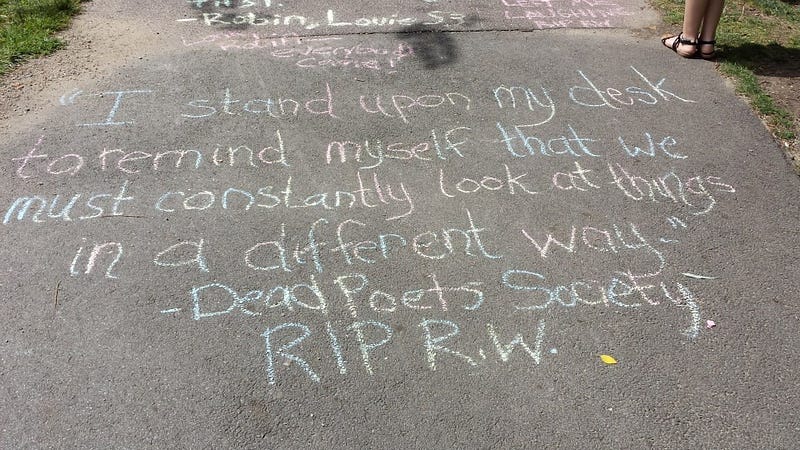
The quotes were familiar: some from “Peter Pan” — from “Aladdin” — but many from “Dead Poets Society.”
“Gather ye rosebuds while ye may.” “Carpe Diem.” “Oh Captain, my captain!”
On That Day in Boston
Of course, this was my second language, this language of poetry. I smiled when I mirrored the walks along the grass as if I had company in fellows I never knew existed.
I wasn’t the only one who was seduced by Robin Williams’ portrayal of young teacher John Keating.
It was August 11, 2014. I didn’t cry when I first heard about the death of Robin Williams. It was on the T heading to the Alewife station. My wife and my teenage daughters, Madeline and Nancy, sat across from me, excited to be in Boston for the week.
It had been a beautiful evening, not only to an introduction to Boston, but an early introduction to fall, all with a bright moon, gentle breezes, the lovers on the grass, and a man serenading us with an accordion. It felt like Paris.
But when I checked my phone for the news, I was shocked. I told those around me that Robin Williams was dead.
Two guys standing, swayed back and forth, clutching the handles for support. The taller one said, “I know. I just heard. That’s messed up.”
That Was So Unreal
We were all stunned. An older woman, who must have been returning from a long day, just shut her eyes in silent prayer. A younger woman didn’t believe me. She suddenly checked her phone. My pronouncement didn’t register as real. How could it?
But it turned real when we visited the makeshift memorial on The Boston Common. That memorable scene from “Good Will Hunting” with Matt Damon and Robin Williams on a park bench became a pilgrimage site.
It took some time to swell, but then the flood came, as it did for so many around me. My daughter Nancy, 13, disappeared with some yellow chalk. My older daughter Madeline, 16, talked with another girl about whether it was proper to take a picture of yourself at the memorial. They agreed it wasn’t.
“It’s amazing the confluence of so many influences,” I told my wife. I actually used that word. “Across so many centuries.”
I was reading quotes from Robert Herrick to Horace to Walt Whitman from a film made in 1989 in Boston in 2014 — and Robin Williams, an actor, was that simple conduit.
Oh Captain, My Captain!
What made that film, Dead Poet’s Society, and his performance so moving? Why did it so influence my decision not only to be an English teacher but to teach in the style of John Keating? After all, I stand on desks. I instruct my students not to read sanitized and condensed versions of masterpieces in textbooks.
Do I instruct students to tear out Introduction to textbooks? No. I simply do not pass out textbooks. I demand student presentations of poetry.
Is it any coincidence that in 1989, as a sophomore in college, I changed my major to English and Secondary Education?
In this Age of the Bean Counters, where everything in the classroom has to be measured and scored, and calculated in order for the lesson to be Common Core Valid, it was refreshing to read so many quotes from that film. It made me think of my own success and failures in the classroom.
After all, online courses will rarely inspire. I know that now, teaching remotely, as students hide behind black scenes, afraid of hitting the mic button to speak.
Computers shall not connect one soul to another. A Department of Education official (I call them Educrats) will not help draw out a shy student. A flesh and blood teacher, who knows and cares, however, has the greatest power and influence.
After all, I’m sure the greatest teachers, Aristotle, Jesus, and Anne Sullivan, never taught to the test.
When I look back at all my influences, and how I became a father, a husband, a teacher, and a writer, I don’t think of tests or quizzes or “measurements.” I think of human beings. And for me, Robin Williams was one of those human beings who spoke to the truth in my heart: often using my heroes like Walt Whitman and Henry David Thoreau.
Tear out that page. Filter all truths for yourself. As Emerson said, “To be human, you must be a nonconformist.”
Robin Williams Is There for You
We all have that one movie, don’t we? Maybe those two movies, a book, a play, a musical composition, or an artwork that changes us, motivates us, or inspires us. And it’s amazing how many of them in Boston on that delicious day in August included someone so special who is still no longer with us, after all these years.
But that’s a lie. Robin Williams will always be there to inspire.
Thank you for reading.
If you are interested to read more of my writings, you may read the following one published in The Masterpiece.


