
Tilt a Whirl — Memories I Will Never Forget
I remember my first pain on a local carnival
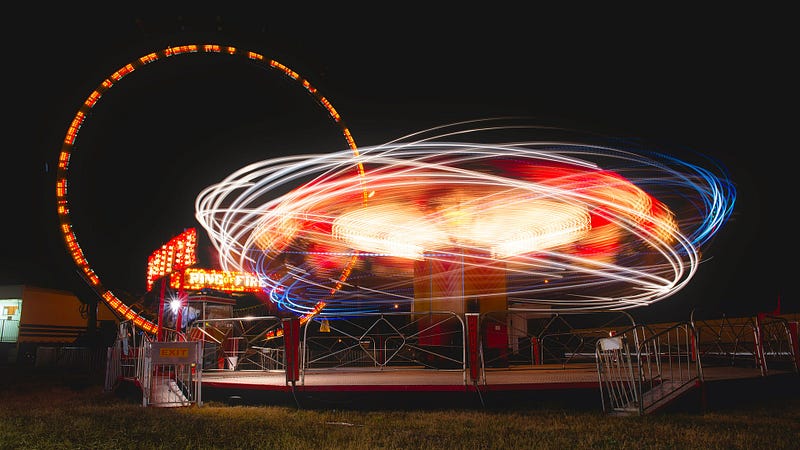
“Come on son, are you a man or a weakling? Yes you, step up here and test your strength Win your girl a stuffed koala bear (Come on baby) Come on son.”
~ The Beach Boys “County Fair”
Post-traumatic syndrome is perhaps better understood for soldiers on the field, but on the field of that local carnival, I remember my first pain.
The carnival appeared overnight. The smell of wet hay lingered above furrowed fields where black tarps served as slip and slides. I tripped and hurt my arm socket when my mom tried to steady me.
As my parents argued in front of the ticket booth, I rubbed my shoulder. My dad wanted an unlimited pass, but my mom said that it was too expensive.
He was young, but my mom was even younger at twenty-three. When judging the past, I often forget to acknowledge their youth.
There was this Fun House ride that rose up and down like a teeter-totter. Above the ride, a happy clown face howled a maniacal laugh with a mechanical red mouth. It terrified me because my mom said it seemed dangerous. My dad had wandered off.
“Which ride would you like to go on?” my mom asked.
The Tilt-a-Whirl frightened me. The swirling, twirling Octopus with the kids screaming also seemed scary. “I don’t think you’d like that,” she said. Her favorite was the Ferris wheel. It was only two tickets.
“We could see our house from up there!”
In my imagination, the wheel ripped apart and rolled through the carnival. Worriers have vibrant imaginations.
I once freaked out on July 4th, thinking the fireworks were shooting out of the earth, and so I raced headlong around the floral blankets, the plastic coolers, the metal folding chairs with the frayed plastic mesh, trying to avoid death.
Now, I was in line for death. One car, another car, and then another, the passengers vanishing, whisking away into the starless night, never again on earth returning. But she would sing to me, the treble in my ear giving me, what I now know as “frisson,” or aesthetic chills, her lips so close, as if she had fallen from one of those unseen stars, her voice a blue Paxil for all the anxiety in the world.
She commanded an alto voice that could have competed at Carnegie Hall, but her confidence resided only in the living room. Her repertoire consisted mostly of show tunes, South Pacific, West Side Story, Funny Girl. It was the antithesis of my father’s soundtrack.
She had what I would eventually value as one “cool” album, a vintage Sgt. Pepper. The rest of her collection consisted of Peter, Paul, and Mary and Barbra Streisand, and Broadway musicals. It’s the reason I can sing so many show tunes.
Finally, after the third song, perhaps it was “Bali High,” I see the carriage alighting and the rusty door opening for the two-seater. I refused to sit alone. My heart raced. I sat on her lap, tipping the scales of the carriage to the right, and nestled my head against her chest. It was the safest place. Her belly showed no signs yet of even more competition.
When she pointed in the direction of our house in Voorhees, I didn’t look but played with her long, brown hair. She was soft and lovely and beautiful. We dangled high above the carnival, the green and red lights blinking against the blackness, the distant carnival song barely audible. I counted the remaining tickets, folding them like a compressed accordion. There seemed more that way — all stacked together.
“We’ll be okay,” she whispered, soothing me, her arms scissoring across my back like safety belts. “Why are you crying? Don’t you like this? It’s fun. Isn’t this fun?” Then she sang “Sunrise, Sunset” and the fear dissipated for as long as she wondered if this was still the little boy she carried.
This carnival was, in fact, the first “scene” I remember, largely because of the trauma at the Games of Chance. It could’ve been a stupid duck game or a ring toss, but I see an arm in full motion tied to his love of baseball. The scene unfolds in my mind something like this:
My dad stands in front of a game that looks like a baseball stadium. He’s on the mound looking at the mitt. The goal is to hit the mitt five times. He misses all five targets.
He rubs his shoulder and stretches out his fingers as the Man says, “Good thing you’re not giving up now. You can’t win if you don’t play. You must have a special lady. You were just warming up there, my man. That was just practice.”
I ask for a swirled soft-serve cone with chocolate jimmies.
“Your dad is wasting our money,” she says to me.
“Which one do you like? ” my dad asks her, pointing at the stuffed animals.
“I don’t like any of them!”
“Let me give it another try,” my dad says. “I got three last time.”
It looks like fun. I ask if I could try it.
“Maybe another game,” he says. “This one is all mine.”
“We’re not playing another game,” my mom says. “It’s a waste of money.”
“I work hard for that money. This is fun. I want to get you one of those big stuffed white elephants.”
“Where in the hell would we put that?”
“On our bed.”
“Our bed? A toy on our bed? There’s barely enough room for the two of us!”
“Well, then, in, in the boy’s room,” my dad says. He turns to me. “Would you like to ride the big white elephant?”
The Man holds the long black hook ready to seize the prize. All it takes is five hits. He loses game after game.
“What are you trying to prove?” my mom asks.
The question freezes his arm in mid-throw.
“Don’t you know?”
There is no answer.
“This is so dumb!”
“What can I do?”
“Stop throwing the stupid baseballs.”
They’re yelling again. My mother says how much she could have bought at the grocery store. He throws his arm back and clearly misses the target, the ball hitting the canvas backdrop. The barker laughs.
“Baby doll, you want to eat this week, right?”
“Yeah, like ice cream.”
“You could’ve had ice cream.”
“I want to get you a stuffed animal!” my dad yells. “Is that so much to want?”
“It’s a stupid thing to want.”
“But don’t you see…?” She only talks again about the wasted money.
Through the crowd, my mom leads me across the muddy fields to the ’71 candy-apple red Torino as my dad must remain on his mound.
He stays, listening to the stadium cheers from the game, staring at the mitts, and focusing on the black plastic eyes of the hanging elephants. He charges after us, as if she is right, after all, yelling my mom’s name above the laughter and the music.
He never stopped charging, even after the divorce seven years later, even after two kids later, even long after the divorce. The details may have evaporated, but the consequences remain.
For detectives, it’s crucial to analyze the caliber of the bullet, to hunt for clues, and to ponder motives, but for those grieving, it’s all about the bodies there in your arms.
I don’t know if my tears back then were for the lack of ice cream or for the failure of confronting the fear of the Tilt-a-Whirl, a topsy-turvy terrain so many seemed to have crossed, not with fear, but with a smile.
I don’t know if I cried out of jealousy for all the happy juice-stained faces of the kids that swirled around me. I don’t know if I cried out of sympathy for a dad I did not know or understand.
I don’t know if I cried because I wanted to be understood — to hear my mother echo back my words and not her interpretation or her anticipation of my words. Every cent we spent as a family was entered in black ink in her Black Ledger, a book more essential to domestic harmony than the Bible.
My dad always wanted to spoil a little girl. She would arrive when my sister Noelle was born. The burden, after all, was worth the pain if the pain meant a girl’s happiness.
There was the kid magic of a medieval knight about my dad, the romantic faith of a grail that defied all logic. He often complained he would have had a better arm if he would’ve been allowed to play baseball after school. I heard this all the time.
When he bought me a bike, it was because he didn’t have a bike. When he bought me a Rush album, it was because he didn’t have enough music growing up. When I pleaded and pleaded for an Atari game system, he finally capitulated. It was the happiest day of my young life.
He wanted to give me all the stuff that he was denied because he had to work at the print shop. When he was sixteen he lost his mother.
He had older brothers and a sister, and a younger brother, and I seem to think he was lost in the middle, the kid who did all the work but received none of the glory. His dad the printer remarried a younger woman who roamed around the house in her underwear and it just drove him crazy. The temptation was everywhere.
So, just how many balls did he feel the need to throw? How many past injustices did he need to rectify, naked there before The Man and The Game? How many white elephants would it take to correct the balance sheet? He didn’t have the skill for strikes. He could’ve just bought the damn stuffed animal, but that was just a matter of handing over some money.
My earliest memories still swirl with his music, always in his apple-red Ford Torino with white leather seats, and almost always at night. Sitting bolt upright in the backseat like a staccato high B quarter note, I fumbled with the boxy 8-track tapes, amazed that such plastic could produce such sounds.
I played inside the cover art, holding the surfboard on that yellow jalopy or straddling the 10-speed in Cosmo’s Factory. It’s still some of my favorite music: all that bang, boom, crash, clank: the swamp riffs of Creedence, songs like “Born on the Bayou,” “Run Through the Jungle,” Bad Moon Rising” and “Fortunate Son.”
Perhaps Tennessee Williams was right. “In memory, everything seems to happen to music.”
I now imagine myself as a young boy, inert on my back, listening to that music on the short ride home from the carnival, my shoulder still tender, cold in the yellow glow of the dashboard, recording the dissident voices of those I dearly loved, wondering if I would ever be good enough.
I still don’t know. And that’s a long time to throw balls and miss.
It was years later, trying to repair the memories, that I played his old Beach Boys album. I was shocked to hear the song “County Fair.” I wondered if the song inspired my father’s failed feat of strength to win the fair lady a koala bear.
I tear up those ten tickets, for all of us, to make fine confetti.
Thanks for reading. Look for these stories on The Masterpiece:


