
The Philosophy of Ikigai: A Popular Yet Widely Misunderstood Japanese Concept
No, you don’t need to achieve “four components” to reach Ikigai

What is your reason for being?
There’s an age-old Japanese concept referring to our never-ending quest for “reason for being” called Ikigai.
As an ideology, Ikigai is often linked to the topic of self-discovery, as it helps you find your life’s values, meaning, or purpose. It helps you find the reason you get up in the morning.
I discovered Ikigai when I was at one of the lowest points in my life.
At that time, like the other 23-year-olds, I felt like I was destined to lose. I couldn’t find any good reasons to wake up in the morning. And I didn’t know who I was going to be.
Maybe I lacked clarity, vision, or goals. Or maybe it was a phase where I am forced by conditions and have chosen to grow as a person. I thought I was the most depressed person in the world. But now I know it was just normal teenage life.
Thanks to Ikigai (and myself), I was able to take the pressure off and get back on my feet.
However, it took me almost a year to find the real meaning behind Ikigai, in the price of losing myself.
If you ever feel like a failure, be it a quarter or mid-life crisis, remember that you’re bigger than your fears. And before you fall into the same traps as me, here’s what you need to know about the truth of Ikigai.
The misconception of Ikigai
Essentially, Ikigai is a term that embodies the idea of happiness in living.
A paper from psychologist Akihiro Hasegawa placed the word “ikigai” as part of the everyday Japanese language. It is composed of two words: iki, which means life, and gai, which describes value or worth.
Searching for your ikigai means searching for a sense of purpose in life based on your interests and talents.
Now, there’s the westernized version of Ikigai. It is based on the idea that there are four components one needs to complete achieving ikigai — passion, mission, profession, and vocation.
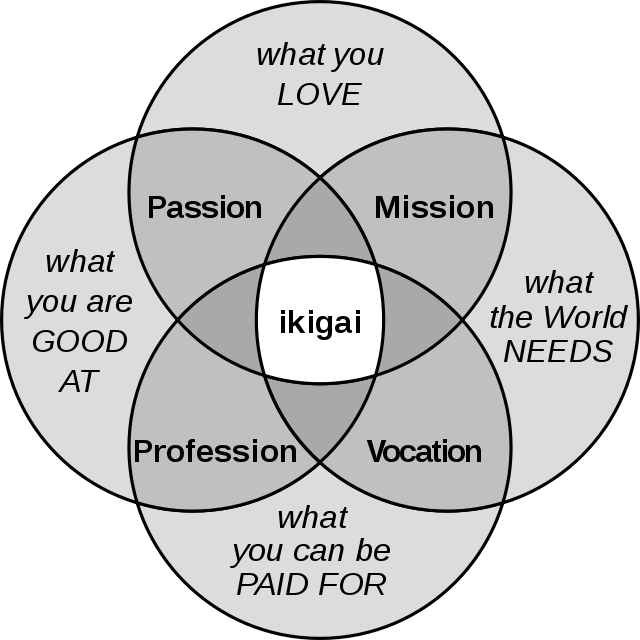
These four questions represent the four components of ikigai:
- Are you doing something that you love?
- Is it something the world needs?
- Are you good at it?
- And can you be paid for it?
These questions have been very helpful to guide people’s lives and have a massive impact on a lot of research on work-life balance — especially involving people’s life expectancy, which also relates to happiness and satisfaction.
But there’s only one problem about this westernized concept of ikigai: it’s wrong.
It’s not what ikigai is about.
Now, look at the diagram Venn above once again. From there, can you tell what’s wrong?
Yup, the whole thing about the diagram is exactly what’s wrong with this concept.
The misconception being perpetuated is that one can only achieve ikigai and true happiness by meeting all four conditions.
For example, if you are doing something you love, but it isn’t generating you money, then you haven’t achieved ikigai. Or, if you’re doing what you’re good at, but the world doesn’t necessarily need it — like playing Yo-Yo or juggling five objects at once — then you haven’t achieved ikigai.
This is where it became faulty and misleading.
Yes, it’s true that just because something is cool doesn’t mean it’s useful. Maybe you need to find new hobbies that could actually get you money because the fact is: you need money to be happy.
No, I’m not kidding. A new 2021 study says that more money indeed buys more happiness (even for the rich).
But even though ikigai is often associated with work, the Venn is not an honest representation of ikigai.
I don’t care if you’re doing something you love and generating tons of money from it. Plus, what you’re doing is super useful to the world, and you are freaking good at it.
What a perfect entrepreneurship life you have!
But that’s it. It’s a perfect entrepreneurship life. Not a perfect life. Besides, I think we’re on the same ground that nothing is perfect.
The diagram Venn makes an accurate “visual representation” of entrepreneurship, but not close to self-discovery. In fact, the Venn also helped me generate four streams of income in my 20s and be a freaking useful human being to my family and the people around me.
But is that the life I’m after? Am I happy with what I have? Maybe, but less because of that — and more because I've found my inner peace.
Self-discovery is never a one-time thing. It’s not about getting the perfect job, having the perfect partner, and living your life happily ever after.
Ikigai is not about “four circles.” It is more about one thing: a life worth living.
And how do you make life worth living? By living it. By taking action.
Yuko Takato, CEO of Probity Global Search, spends her days with highly qualified people who consider work as their ikigai. According to Takato, they all have one thing in common: they are motivated and quick to take action.
“If you want to start something but scared to dive into the unknown, go and see someone who is already doing something similar to what you have in mind.” — Yuko Takato
You shouldn’t wait for your ikigai to come and change your life. Take action first and then you will change your life. And seeing your plans in action will give you confidence that you can do it, too. You just have to start somewhere.
So how can you achieve ikigai?
In his wonderful TED Talk, Tim Tamashiro has talked about how to find your ikigai. He said ikigai is really like a treasure map. This treasure map can help you discover beautiful things about yourself that you can share with the world — and the world will say “thank you” for it.
Ikigai is what, day after day and year after year, each of us most essentially lives for. It’s a process that is always changing and unfolding.
If you wish to attain ikigai, understanding the diagram Venn can be a good start for you — as how it helped me. But at the end of the day, finding your reason for being doesn’t have to do anything with those four components. Perhaps, the real answer lies in one of the most ancient wisdom in human history: Carpe diem.
Take chances, live your life to the fullest, and make the most of what you have. That’s how you make life worth living. As to how Oscar Wilde put it:
“To live is the rarest thing in the world. Most people exist, that is all.” — Oscar Wilde


