
Self | Personal Growth
If You Want to Make Your Dreams Come True, Don’t Worry About the Outcome
How to *realistically* chase your dreams against all odds.

We’ve heard the cliches:
“Dreams don’t work unless you take action.”
“The surest way to make your dreams come true is to live them.”
“Don’t let your dreams be dreams.”
These are all words of wisdom. But all the pondering about dreams, goals, and happiness in general often leads me to one big question: Why?
I’m genuinely asking, why does it matter? Why should I chase my dreams? What if I don’t want to?
After a series of deep contemplations, I’ve figured out the answer is: I shouldn’t. Neither should you. Nobody should.
“Should” is an active form of self-criticism. It can be a healthy way to increase self-awareness, but using the word “should” implicitly suggests that we don’t accept who or where we are.
We all have our own reasons to do something — our values, goals, principles, beliefs, and unique experiences in life.
Therefore, since pursuing our dreams is not a “should”, we can shift our mindset to focus on accepting and actually taking action (using our own reasons) without thinking too much about the result.
You should not chase your dreams — but if you want to, here’s how to realistically chase your dreams (and live them) against all odds.
Stop fantasizing too much about the outcome
It is a trusted tool in the self-help industry; imagine and visualize yourself having reached your goals — whether it’s having your ideal weight, enjoying the view atop mount Everest, or walking down the aisle with the man or woman of your dreams.
Seeing yourself succeed on the specific goal helps you believe it can (and will) happen — it’s like you’re practicing for your success. It’s great to fantasize about the outcome, isn’t it?
But what if I told you fantasizing about achieving goals makes you less likely to achieve them?
A new study shows imagining successful outcomes saps our energy from doing the hard work it takes to get there. Positive fantasies are “de-energizing” — it drains the energy you need to pursue them.
Therefore, there are some caveats you need to keep in mind if you want to make your dreams come true. First, don’t imagine the result too much. Second, just stop fantasizing and start doing the thing.
It seems obvious, yet I know it’s easier said than done. And for a moment it’s like bullshitty advice said by non-humans. How can we not focus on the outcome? That’s the “motivation” that keeps us going.
Yes, that’s true. But motivation is not always equivalent to action. In fact, motivation is garbage. There, I said it. Actually, I didn’t say it—a well-known author and motivational speaker named Mel Robbins did.
And I am with her in this.
Don’t worry about your dreams come true, just “do something”
One day, all of your dreams will come true. How many times have you heard this phrase? I’m sure it must be more often than you think.
We are usually busy looking for inspiration to do something, but often we are caught in a vicious cycle of procrastination. Combine it with perfectionism, you’ll get a series of analysis paralysis monsters; you’re busy analyzing, not actually doing something.
To get over this invisible trap, let’s take a look at something called the “Do Something” principle. Mark Manson, in his book, came up with this principle.
It proposes one big question: Does inspiration lead to action? The answer is, not always. More often than not, it’s the action that leads us to inspiration — which leads us to motivation to take even more action.
Action → Inspiration → Motivation
Keeping this principle in mind will eliminate the “I have no motivation” excuse and turn it into a much better outcome — by taking action first.
It’s a similar approach to what Stephen Duneier said in his famous TED Talk. He explained that you have to break down big goals into minuscule tasks to reach your goals. He came up with the term “marginal adjustment.”
This unique approach has transformed him from someone who immensely struggled with simple tasks to someone who is now holding the Guinness World Record for the largest crocheted granny square.
When I started writing on this platform, I also applied this principle in my own life. Previously, I also unconsciously used this principle to build an online business since I was 18.
For both activities, I work for myself. I don’t have a boss telling me what to do and not to do. Oftentimes, I have to take huge calculated risks in which I’m personally invested — both financially and emotionally.
I’ve learned that forcing myself to do something — no matter how small — quickly makes bigger tasks seem easier.
If you lack the motivation on how to make an important change in your life (like how to pursue your writing dream without having to quit that boring 9 to 5 job), then do something — anything, really.
The simple act of moving at all will change how you feel about the entire process and serve to inspire you further.
And lo-and-behold, you will no longer be caught in the procrastination loop—you’re actually going ahead.
It’s okay if you turn out to fail, embrace the fact that nobody cares
Look, we all fail in life.
Some people fail once, some twice, and some “unlucky” ones fail 5.126 times. But what is the difference between a loser and a winner? You’re right, winners learn from their mistakes when losers give up.
What makes the difference is our perspective.
I know... It’s hard to face our mistakes. In this modern time with all the shining gadgets around us, we are often told that we are special unique snowflakes who can change the world with our own little hands if we want to. And as such, we try our best to achieve success and not fail in the process.
But here is the truth:
Very few people actually care about you because you’re actually not that “special.”
Chuck Palahniuk, in his novel Fight Club, said it even more exquisitely:
“You are not special. You’re not a beautiful and unique snowflake. You’re the same decaying organic matter as everything else. We’re all part of the same compost heap. We’re all singing, all dancing crap of the world.”
Now, before you leave abruptly and hit the back button on your browser, please read that again and consider just how liberating that is: No one gives a shit.
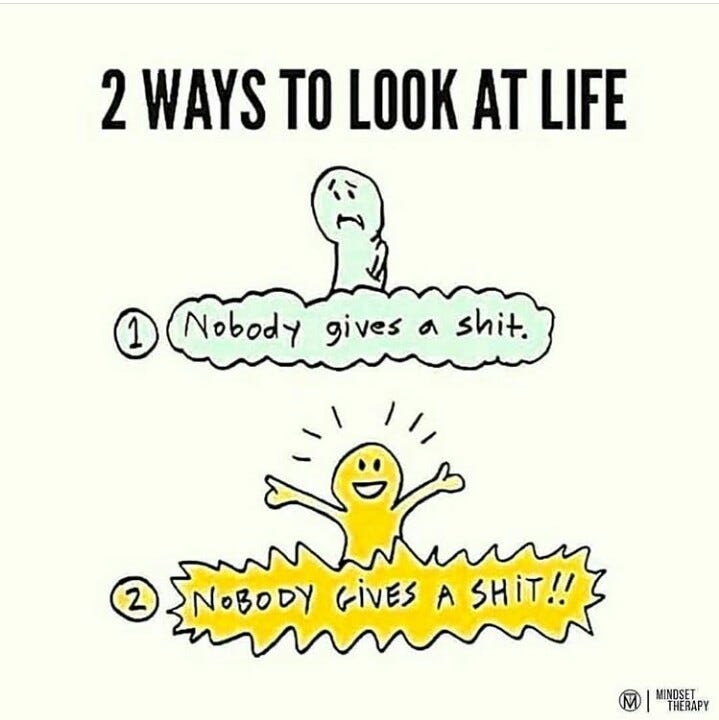
See? You are free to do whatever you want and no one will care — but you, of course, you have to care to keep going — if you fail spectacularly. If anything, other people will respect you more — for like, 3 seconds, and then they’ll go back to posting selfies on Instagram.
So what’s the deal? What’s stopping you? Just do something. Don’t wait for motivation or strive for inspiration. Instead, take action and strive for impact. And you know, you can do both freely knowing that very few people care.
Take care of yourself. No one is responsible for that but you.
What are you waiting for?
Do you want to live your dreams? Do you want to change your life? Do you want to become a better person, with a better life, a better future?
If the answer is yes, well, do something. Anything, really.
Many people get stuck when they try to chase their dreams because they don’t know “where to start” or “what to do”. The motivation to do something doesn’t just come from a magical and mystical place within you. Action is both the effect of motivation and the cause of it.
Let go of the imagined result — it’s not necessary. The fantasy and the dream are merely the tools to get you moving and start taking action. It doesn’t matter if they come true or not. If they do, good for you. If not, you’ve learned something — and now you can keep going.
As the saying goes,
“You are worthy of your wildest dreams.”
It’s true, but you can achieve them only if you stop procrastinating and start engaging with the world.


