
Why You Can’t Expect to Be Happy and Positive All The Time
It’s time to unsubscribe to the “always be positive” ideology and just let yourself be human.

Imagine a scenario.
You lose your job, your partner cheats on you, your business fails and you lose everything. Then, your friend comes up to you and says, “Don’t worry, it’ll all be fine!” and asks you to cheer up and stay positive.
Doesn’t that make you want to scream?
Happiness is now the default
We all want to be happy. I’m pretty positive nobody wakes up in the morning whispering mantra to themselves, “Be sad, cry, and feel miserable today.”
The concept of happiness has been a very fascinating topic since 2500 years ago. From Buddha to Aristotle, many brilliant thinkers have tried to find the pursuit of happiness. Myriad scientific studies have also shown the many benefits of happiness for us as individuals and society as a whole.
But as time goes by, things got more complicated. People are more depressed and anxious than ever. And many people have misunderstood the concept of happiness.
Happiness is now the default — either you’re happy or you’re depressed.
Nowadays, a lot of us think happiness means that we need to be happy all the time, or extremely happy. We expect to be positive under all circumstances. Then, following the crowd, we subscribe to the “always be positive” ideology (yes, including that popular “good vibes only” thing).
There’s a grey area in happiness. Just because we’re not happy, it doesn’t mean we automatically become depressed people.
But like many things in life, there’s a grey area in happiness. Just because we’re not happy, it doesn’t mean we automatically become depressed people. And of course, we can’t expect to feel happy all the time.
Negative emotions are necessary and healthy for maintaining stable baseline happiness in one’s life. In fact, if you deny these negative emotions, it will lead to more prolonged negative emotions and even emotional dysfunction.
You can’t be happy and positive all the time
At my first job, a friend of mine was getting unpleasant treatment from our senior. The senior was treating her like a useless human being by not “appreciating” any of her work.
There was one moment when she came up to me and cried due to the difference in behavior she received from this senior toward her — which she had been receiving for a couple of weeks that time. There, I found out that as it turned out; she indeed had some personal issues with the senior.
So I told my friend that she shouldn’t be so sad about it.
“Hey, just look at the bright side! He actually cared about you to neglect you this much!” I said to her. Then, I encouraged her to stay positive.
Oh boy, if only I knew how much I was wrong.
Not only I made her feel more like sh*t, but I also felt like sh*t for saying it.
My story is just one example of what we see in our everyday life. The term for this phenomenon is called “Toxic Positivity.”
Toxic positivity is the feeling of acting happy or cheerful when you’re really not. It is a form of inauthentic happiness and can cause damage in personal and professional relationships.
I’m sure you’ve experienced toxic positivity from someone you know in the past week, haven’t you? Or, you could also find toxic positivity inflict on yourself.
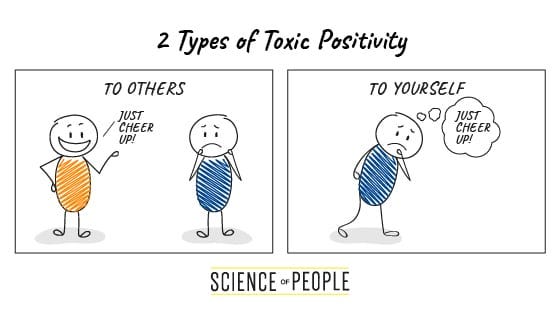
Don’t get me wrong, positivity is a good thing and is VERY powerful. I’m not saying you shouldn’t be positive or encourage your friends to be happy.
But just like anything done in excess, when positivity is used to deny or silence the human experience — in any kind possible — it becomes toxic.
Yes, I was being a very toxic friend when I told my friend to “just be positive” when she certainly felt like an awful human being (at that very moment when she cried to me).
Her emotions are valid, but when I ignored the existence of her negative feelings, I took part in letting her fall into a state of denial and repressed emotions that might result in even more sadness and hopelessness.
If anything can go wrong, it will
Toxic positivity is very real and is still happening a lot to this date. But let us take a little different approach to this phenomenon.
In a book called, “Murphy’s Law and the Pursuit of Happiness” by Dally Messenger III, the author explains one law of the universe.
It’s called Murphy’s Law.
Most people have heard of this law. But when referring to Murphy’s Law, many people think it is a rather pessimistic way of thinking. But that is certainly not the case. Murphy’s Law is actually a message of hope.
Murphy’s Law was named after Captain Edward Murphy in 1949. Captain Murphy was an engineer working on an air force project that was designed to see how much sudden deceleration a person can stand in a crash.
The mathematical statement of Murphy’s Law, as used in scientific communities — and top-notch movies such as Interstellar — is crazily complex. So let us not go there today (and trust me, I don’t want you to read this far just to fall asleep.)
In its simplest form, Murphy’s Law states that:
If anything can go wrong, it will.
The general form of the law about “everything that can go wrong will happen”, is more than adequate for most applications. You can use this phrase if you were talking about things going wrong before they did — or how they could have been avoided.
Learning from this law, we know it’s a simple reality of the universe that shit happens sometimes. But we can certainly “avoid it” to get worse.
What we can learn from this law is that it’s a simple reality of the universe that shit happens sometimes — things go wrong, people upset us, we make mistakes and negative emotions arise, and that’s fine. We don’t have to deny all these negative emotions. But we can certainly avoid it to get worse.
How to handle negative emotions better
To avoid negative emotions from getting worse, let’s list some of the most commonly felt negative emotions — they are fear, anger, sadness, melancholy, and loneliness.
When is the last time you feel these emotions? A week ago? 3 days ago? Yesterday? Or right now?
Congratulations, you’re a completely normal human being.
Even though negative emotions are unpleasant to experience, they are an inevitable part of life that you desperately need in order to have a full, rich life. Negative emotions give us a counterpoint to positive emotions; without the negative, would the positive emotions still feel as good?
As Tracy Kennedy from Lifehack.org points out:
There is a good reason for each of our basic negative emotions.
Fear is necessary to protect us from danger. We need anger to fight against problems. And we can’t truly connect with our loved ones without feeling melancholy or sadness (sadly, people die, and that’s life.)
Now, here are three simple steps to handle negative emotions better:
- Accept them
- Express them in a healthy manner
- Try to be reasonable and think of ways to make yourself feel better
For example, when you get mad at someone, accept and express that anger all you want, but be reasonable; throwing your computer out of the window or breaking things won’t let the problem go away. Instead, take a deep breath and try to relax by doing pleasant activities — take a walk, read something, make a cup of tea, or simply write out your anger.
This mental exercise can help you regain control of your uncontrollable emotions before they erupt and cause external damage.
The Golden Rule
It’s important for us to avoid spreading toxic positivity to other people as well.
The Golden Rule of toxic positivity is to give advice or opinions only when asked. You might feel like being the next Oprah or Dr. Phil, but many people actually just want to be heard and not offered advice or opinions. Otherwise, just try to sympathize.
Instead of shouting, “Everything will be alright!”, or “Be positive, look at the bright side!” in front of your jobless and currently broke up friend, you can give an empathetic response by saying, “How can I help you?”, or “Do you want to talk about it?”.
Or, you can try to say something along the line,
“It’s so hard to see the good in this situation, but we’ll make sense of it when we can.”
Let yourself be human
You can’t expect to be happy and positive all the time. Negative emotions are necessary for a healthier life. Stop denying these emotions, instead —accept them and act upon them in a healthy manner. You’ll find yourself feeling less stressed, less comparing yourself to others, and be more… human.
Just let yourself be human. It’s okay to feel waves of joy, sadness, fear, messiness, love, anger, frustration, exhilaration. They have their own values and purposes, anyway. As to how Amy Brodsky put it:
“It is important to remember, there are no ‘bad emotions’. All emotions are important. They inform us about our needs, safety, and our desires.” — Amy Brodsky