
The Perfect Rep Is the Secret to Maximizing Your Muscle Growth
Here’s exactly how to perform it

A rep is the most fundamental part of any workout yet most of us perform it wrong.
For years, I experimented with different exercises and workout styles. But never did my results improve as much as they did when I perfected my reps.
Your workout is nothing but the sum of the reps you perform. So, improving your reps alone can drastically improve your workouts.
You might not see any benefits immediately but over the long term, the benefits will add up to a mind-boggling level.
Here’s an Illustrative Example:
Take a hypothetical workout and let’s say you perform 5 exercises and 3 sets of 12 each. Let the quality of each rep be say 0.7.
Now the total “volume” of the workout would be = 5 X 3 X 12 X 0.7 = 126. With 5 such workouts in a week, the weekly volume would be 630. And the yearly volume would be 32760.
Now, let’s say you improve the quality of every rep to 0.9. It doesn’t seem like a huge jump, does it? 0.7 to 0.9 but wait, let’s do the math again.
The total workout volume would be 162, the weekly volume would be 1134, and the yearly one would be — 58968.
“Your workout is nothing but the sum of the reps you perform.”
Now, the increase is significant, isn’t it? — from 32760 to 58968. This is the beauty of tiny but fundamental tweaks — they pay off tremendously in the long term.
The Anatomy of A Rep
First, let’s dissect a rep and take a peek into its anatomy. Every rep has three distinct phases:
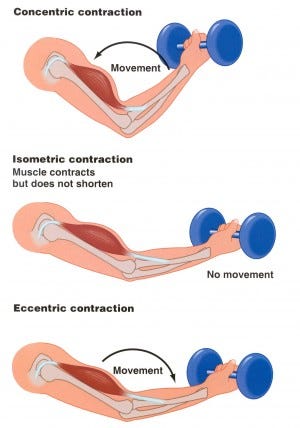
- The Concentric or The Positive. This is when the muscle is contracting and the weight is being “lifted” — so, curling a dumbbell up or pushing down during a tricep extension.
- The Eccentric or The Negative. This is when the muscle is lengthening and the weight is being “lowered” — bringing the dumbbell after a curl or releasing the cable after every rep of tricep extensions.
- The Transition or Peak Contraction. This is where the eccentric and the concentric meet. In this phase, the muscle completely shortens or is at its peak contraction — the top of a bicep curl or the bottom of a tricep extension.
Now, let’s go over another term — The Isometric: This is when the muscle length doesn’t change. Basically, if you pause a rep at any point and hold it, it’s an isometric.

The 4-Step Checklist to Perform the Perfect Rep
With these things down, let’s head right over to the checklist. As you might’ve expected, we’re going to see how to optimize every portion of the rep.
#1 — Explode Through the Concentric.
This doesn’t mean an uncontrolled jerk, but a controlled yet rapid movement. Basically — as quick of a concentric as possible without affecting your form. Here’s a video for reference.
What we’re trying to do here is generate maximum force — as Newton’s second law goes, Force =Mass x Acceleration.
By doing this, we ensure maximum fiber recruitment, especially Type-2 or the fast-twitch muscle fibers. And the more the fiber recruitment, the more is the muscle growth.
#2 — Squeeze at Peak Contraction.
In the transition phase, the muscle is completely shortened or is at its peak contraction. By squeezing you force more blood into the muscle which means more oxygenation — so the time to fatigue increases.
Moreover, deliberately squeezing the contraction helps you develop a better mind-muscle connection — which improves your ability to focus on and target the muscle.
#3 — Slow Down the Eccentric
Research has found that the eccentric involves higher muscle forces and stimulates more muscle fibers than the concentric.
By slowing down the eccentric, you not only involve higher muscle forces but also increase the Time Under Tension (TUT) which is one of the primary mechanisms of muscle growth.
So by doing this, we take advantage of two of the three main muscle growth mechanisms — Time Under Tension and Muscle Damage.
#4—Strategically Use Isometrics
As we saw earlier, isometric is pausing and holding at any point during a rep. This has two major benefits — increased time under tension and elimination of momentum.
As we saw earlier, the former increases muscle growth. The latter enforces strict form which again increases muscle growth.
But the problem is, pausing too many times during a rep can build up fatigue and reduce the total number of reps you can perform. So, you need to use isometrics strategically.
I’d suggest using a maximum of one or two isometric pauses during any rep.
To Summarize
A rep is composed of three distinct phases — the lifting or the concentric, the lowering or the eccentric, and the transition or the peak contraction phase.
And an isometric is when you pause and hold during any of these phases. Now, coming to the checklist:
- Make the concentric as explosive as possible while maintaining good form.
- Pause for a second and squeeze the muscle at the transition phase.
- Then slowly lower the weight under control during the eccentric.
- Optionally, pause and hold at one or more points of the rep to reap the benefits of the isometric.
That’s it! Keep this checklist every time you perform a rep and as I said earlier:
“You might not see any benefits immediately but over the long term, the benefits will add up to a mind-boggling level.”
Thanks for reading! If you enjoyed this, consider joining A Better Life. It’s free! You’ll receive my best posts and a weekly newsletter called Sunday Self-Scaler to help kick your week off to a good start. Also, here are a few similar articles you might enjoy,