
Writing
The One Piece of Writing “Advice” that is Holding You Back
If you only write about what you know, you are missing the point of writing

There is no shortage of bogus advice about writing out there. The reason that it is bogus is that it is usually predicated on having worked for someone else. Once.
Most of it is well-intentioned and is one author legitimately trying to help others out by sharing what has worked for them. There is nothing at all wrong with that. The problem is that some of the more generic advice often is repeated so much that it becomes a platitude.
One of those platitudes, without a doubt, is “Write what you know”.
I am pretty sure this one originated back sometime in a cave when the first author was poised, granite sliver in hand, ready to pen a masterpiece on the wall and had the first ever case of writer’s block. She (or he, we don’t know) probably turned to her friend and said, “What should I write?”
The answer has haunted us to this day.
What you know
The concept of writing about what you know isn’t universally bad advice, it is only bad when it is advice that is applied universally. What I mean is that if you are stuck and would otherwise walk away from that page, then, if writing about your experience at the seventh-grade dance is what gets you scribbling, it is actually good counsel.
If you are stuck, if you have knowledge and wisdom about something no one else does, or if you have an original spin on a topic then, by all means, write about it! But don’t limit your writing by ONLY staying inside the boundaries of what you know.
If you never go outside the personal knowledge confines you are severely limiting your ability to become a better writer.
There are two other gigantic arenas where you need to be exploring and testing out your writing chops. One is the areas where you know just a little, and the other is about topics you know absolutely nothing about.
Your subject matter should come in relatively equal parts from this trifecta of sources. I suggest a 30–50–20 percent ratio of know, sort of know, and don’t know topics.
Sometimes you absolutely have to write about what you know. There are times when topics are weighing so heavily on our being that the only way to set them free is by writing about them. But, once you write it down and release it to the world your soul becomes a little lighter and you can, once again, expand your horizons. I wrote a little bit about that experience yesterday here:
Or, sometimes you are simply stuck and need a kickstart. Getting that seventh-grade dance story out might be just the ticket. However, once you do, you need to write about stuff you don’t know.
What you don’t know
After you put out a piece on a known topic, I encourage you to then write about a topic which you know nothing about.
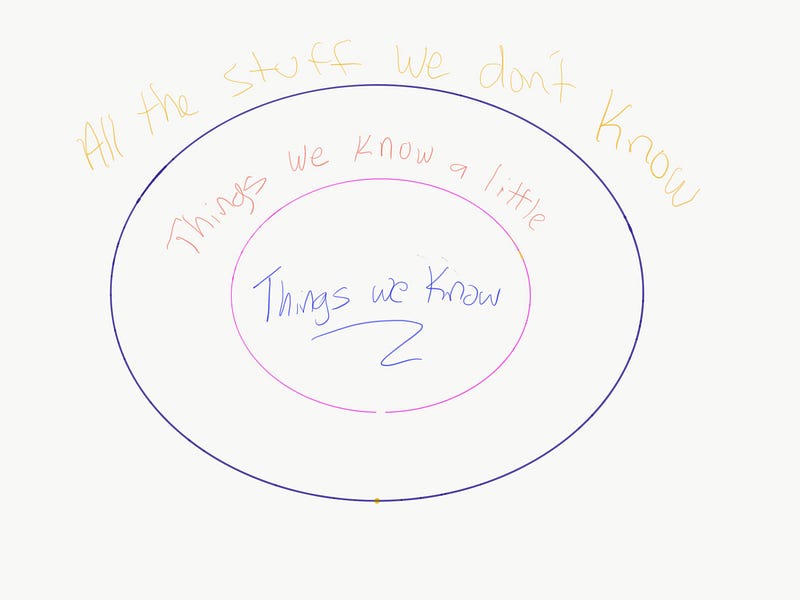
If you think about it, the things we know only represent a small circle of knowledge relative to the rest of the universe. The things about which we know little or nothing are vast, perhaps even limitless. So, there is a lot there to pull from.
You should get out there and find a topic and write about it. Recently I have used Wikipedia’s “Did you know” feature on their main page to pick a topic about which I know nothing. Then I have done a short piece relating the facts and pulling some common wisdom from out of the previously unknown.
It has been a great exercise, and I have learned a great deal. I believe in doing so, I have expanded the circle of things I know a little bit about outward into the vast realm of my unknown. That makes me a better-informed person, and a better writer.
I mean, who even knew that South Dakota was suing cats?
I didn’t, but now I do, and I also now know what a “jurisdiction in rem” civil case is all about. Perhaps in a future article I can write a story about the history, or the effectiveness, of this particular legal strategy?
What you sort of know
Personally, I think these are the topics where we should be doing the majority of our writing. There are two reasons: one is that if we don’t know much about something, chances are others don’t know much about it either; therefore, your writing can help solve that information deficiency.
The second reason, though, I think is more important. We expand the circle of what we know. We can take peripheral knowledge and convert it into fact. The reason this is important is that, too often, we assist in the spread of misinformation simply by being ignorant about a topic.
For instance, we might have heard a great writing tip like “write what you know” and, without taking time to see if that really has any merit, passed it on to others as solid advice. See how that works?
That is how society has ended up with such gems as:
Put on a hat, or you will catch a cold.
Wait 30 minutes after you eat to swim, or else you will drown.
Examples of a little bit of knowledge being spread as fact while doing no good for anyone whatsoever.
So, I believe it is a duty of ours as writers to take the little bits of things that we know just a fraction about, research them, and report our findings. Even if no one else reads our piece, we have made ourselves much more knowledgeable. And, in the end, that is all we can hope to control anyway.
Personally, I don’t know much about blockchain and cryptocurrency. That is why I wrote a piece on the differences between the two ideas. I did it so I can learn, and now I know a bit more.
Now I can write additional pieces that can incrementally become more in-depth and complex. My circle of knowledge is expanding.
I will end this by circling back to my assertion at the beginning that advice is just that: advice. Often advice we hear falls into that area we only know a little about.
It is up to us to take that advice, research it a bit, try it on for size, explore and finally come to a conclusion about its efficacy. We owe that to ourselves, and we owe it to everyone else as well.
So, take my advice. Write about things you only know a little or not at all. Give it a test-drive and then you will know for sure whether it is good advice or not!
If you liked this article, you may also like:
Timothy Key spent over 26 years in the fire service as a firefighter/paramedic and various fire chief management roles. He firmly believes that bad managers destroy more than companies, and good managers create a passion that is contagious. Compassion, grace and gratitude drive the world; or at least they should. Follow me on Instagram, Facebook, and Twitter, and join the mail list.


