avatarMichelle A. Cmarik

Free AI web copilot to create summaries, insights and extended knowledge, download it at here

3845

Abstract

stop focusing on my droopy eyelids.</p><p id="8a67">We read about Sister Madonna Buder, who at 91 has completed 350 triathalons and only started running at age 50.</p><p id="8a7c">There’s Wilhelmina Delco, an avid swimmer and politician in her 80’s who has served four decades in the Texas legislature.</p><p id="f04e">And then there is an 83-year-old woman named Barbara, a participant in one of Levy’s studies. Barbara doesn’t have an exceptional story of physical fitness.</p><p id="c08b">But after only three weeks of sessions where she was primed with positive age statements, Barbara’s physical mobility and confidence improved. She became more social and involved in her community. She expressed a notable change in her outlook on life.</p><p id="be81">What these women’s stories all have in common, aside from sharing a more positive outlook on aging, is that their life outcomes weren’t fixed.</p><p id="6fa8">None of these individuals’ lives got smaller as they aged: they expanded with new opportunities.</p><h2 id="59ee">The best thing about mindsets is that they can change</h2><p id="5b9f">It’s not that before reading this book I didn’t think people could be happy in old age. But my experience with older relatives made me think that aging usually did lead people’s quality of life to diminish rapidly.</p><p id="50bf">My older relatives became less mobile and took up less space as they aged, and they became less talkative.</p><p id="3e40">When my grandmother died, all of her possessions fit in a single box.</p><p id="6454">The idea that the end of our lives can be a time of expansion, of new opportunities, or of renewed passion somehow never occurred to me.</p><p id="b365">And yet Levy’s research suggests it is very possible, if we stop dreading old age and shut out the noise telling us that aging = bad.</p><p id="e76c">Unsurprisingly, societal beliefs about aging in the United States are pretty crummy. Older adults in the United States are often seen as a nuisance, and aging has long been the subject of jokes (picture the “Over the Hill” greeting cards with pictures of diapers and gravestones).</p><p id="5337">I know that I’ve been inundated with negative stereotypes of aging since I was a little girl.</p><p id="b2bb">These came from my own mother, who often complained about her wrinkles and her need for a face lift.</p><p id="b11c">These came from my bleak visits to nursing homes and healthcare facilities for dying relatives.</p><p id="87bb">And of course, these came from humor. I now joke about aging all the time, and I thought this gave me comfort.</p><p id="c812">Joking about my aching limbs (<a href="https://readmedium.com/we-are-your-local-plantar-fasciitis-support-group-6d3acbc2162c"><b>there is a support group for that</b></a>, btw) somehow lightens my mood about aging.</p><p id="4b9b">But now I wonder if this kind of age-related joking is more harmful than good.</p><figure id="1e36"><img src="https://cdn-images-1.readmedium.com/v2/resize:fit:800/1*hAUW_juiT8xbxUNFpiAQDA.jpeg"><figcaption>Photo by Nashua Volquez-Young: <a href="https://www.pexels.com/photo/woman-wearing-red-hat-and-sunglasses-1729931/">https://www.pexels.com/photo/woman-wearing-red-hat-and-sunglasses-1729931/</a></figcaption></figure><p id="5138">As I was reading Levy’s book, I couldn’t help but think of the 2015 skit by Amy Schumer on Comedy Central, “Last Fkable Day.”</p><p id="69d9">In her skit, Amy Schumer stumbles upon a gathering of women — Tina Fey, Patricia Arquette, and Julia Louis-Dreyfus — who are celebrating Julia’s last fkable day on earth. It’s brilliant.</p><p id="4b88">The premise: Actresses (and all women) reach a point in their lives when they are no longer considered f**kable. They start getting replaced by younger women, they become invisible, and eventually they’re fully disposa

Options

ble.</p><p id="d481">In celebrating her rite of passage into the land of the unfkable, Julia throws caution to the wind by downing a full pint of melted ice cream because she can do whatever the F she wants now.</p><p id="5405">This skit is satire. It’s a dig at our bullshit standards for women as they age and the unfair advantages men have in their own aging process (as Tina Fey says so perfectly, “men can be 100 and nothing but white spiders coming out, but they’re still fkable.”)</p><p id="ae09">But while reading Levy’s book, I realized that I had actually bought into all of the beliefs being joked about in this skit. I really had been operating as if a clock was ticking away the months or years I had left as a desirable woman.</p><p id="1f8f">Some of the angst leading up to <a href="https://readmedium.com/what-happened-to-me-when-i-opened-my-marriage-d6e7a9fdf0ad"><b>my open marriage</b></a> was based on this idea that my time was running out, that my time to be a sexually vibrant woman was limited.</p><p id="adc4">I still struggle with this. Of course, one book doesn’t erase four decades of life in a society that fears aging. But I have noticed a shift. I now have a clearer view of myself as that woman with a gray braid and paintbrushes. I can sense what that expansion of life might feel like.</p><h2 id="7e06">Moving closer to my own positive age beliefs</h2><p id="7c31">Levy’s book, combined with many stories I’ve consumed by writers on this platform (some standouts include <a href="undefined">Ann Litts</a>, <a href="undefined">Carole Olsen</a>, <a href="undefined">Martha Manning, Ph.D.</a>, and <a href="undefined">Annie Trevaskis</a>) have slowly changed my outlook on how I might think about the rest of my life. I now have a renewed sense of wonder about the coming decades.</p><p id="ce4f">In particular, I love this book’s ending.</p><blockquote id="3cd5"><p><b>“When older persons are no longer treated by society as strangers but are instead valued by themselves and their communities, aging can become a homecoming, a rediscovery, a feast of life.” (Breaking the Age Code<i>, pg </i>205)</b></p></blockquote><p id="e232">I want to work hard to embrace this idea of a “feast of life” as I age.</p><p id="f645">And I surely want to start buying into the idea that I have endless f**kable days before me.</p><p id="dbf5"><i>I’m curious to hear more of your own stories. What has shifted for you as you think about aging?</i></p><p id="4550"><i>If you enjoyed this, here are a few other stories of mine…</i></p><div id="eaf8" class="link-block"> <a href="https://readmedium.com/why-i-will-never-run-again-64cadc767b29"> <div> <div> <h2>Why I Will Never Run Again</h2> <div><h3>And why I’m finally okay with it.</h3></div> <div><p>medium.com</p></div> </div> <div> <div style="background-image: url(https://miro.readmedium.com/v2/resize:fit:320/1*GuDTDa-4Dllr6XRGWQs5jQ.jpeg)"></div> </div> </div> </a> </div><div id="a0c3" class="link-block"> <a href="https://readmedium.com/how-an-erotic-penpal-helped-me-survive-the-covid-19-pandemic-2c2631a10256"> <div> <div> <h2>How An Erotic Penpal Helped Me Survive the COVID-19 Pandemic</h2> <div><h3>Dave and I had a friendly arrangement that sustained both of us during the worst weeks of the pandemic.</h3></div> <div><p>medium.com</p></div> </div> <div> <div style="background-image: url(https://miro.readmedium.com/v2/resize:fit:320/1*4nms0l5BRdcMAs3_xi6qzA.jpeg)"></div> </div> </div> </a> </div></article></body>

SHIFTING MINDSETS

The One Book That Changed My Outlook on Aging

This is a must-read at any age
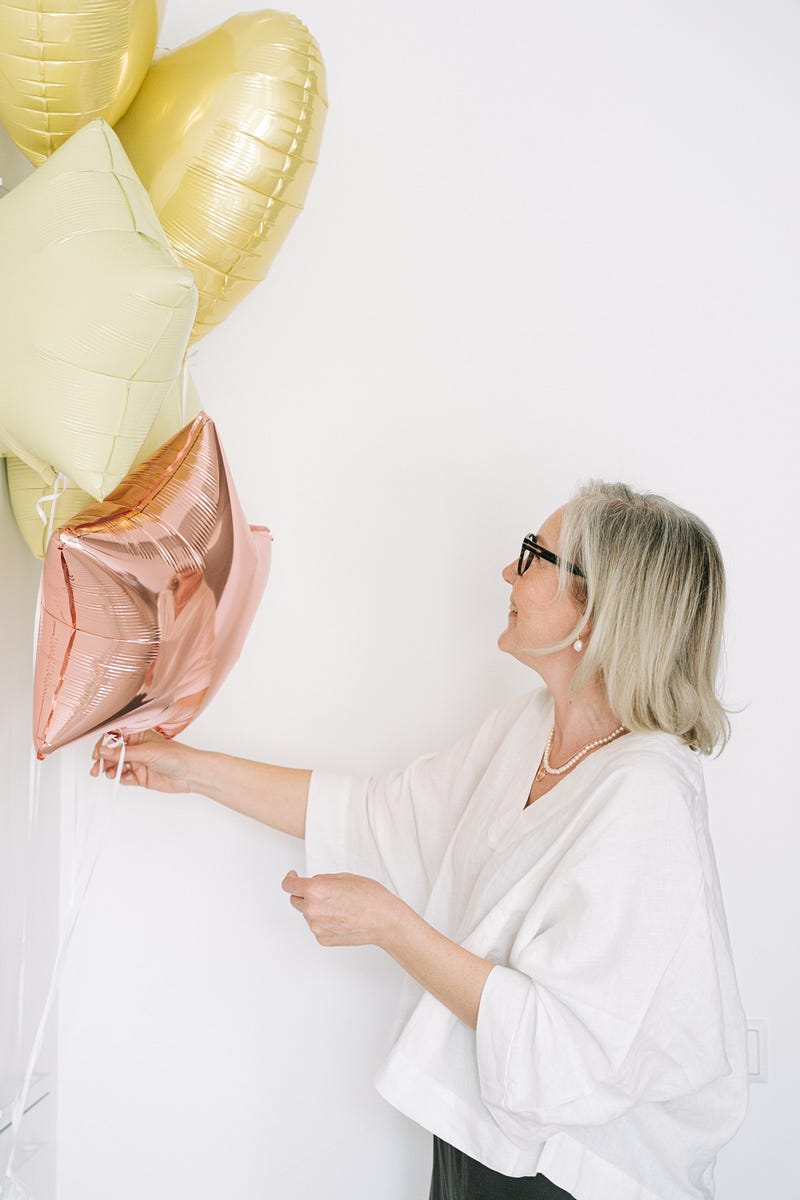
Photo by Ivan Samkov: https://www.pexels.com/photo/photo-of-an-elderly-woman-looking-at-star-shaped-balloons-7921424/

I’ve long felt a sense of dread about becoming a little old lady one day.

I want to be the kind of woman who celebrates aging, who wastes no useless energy fearing the passage of time.

I want to be an old lady who wears a long gray braid in her hair and dances around and makes things with her hands.

But as the years go by, I’ve lost sight of that lady and instead started fixating on previously-unnoticed body parts like my eyelids and the skin between my chin and my neck.

I worry that men will one day stop finding me beautiful.

Even worse than these fixations on my appearance is this itching feeling that time is running out. As I approach 40, I have felt an urgency to check things off my list before I become “old” one day, as if somehow all opportunity will vanish when I reach this endpoint.

This was my fear of aging for most of my adult life, until I read a book this month that helped change my mind.

The book is Breaking the Age Code: How Your Beliefs About Aging Determine How Long and Well You Live, by Becca Levy, PhD.

I saw the book advertised online (another win for the ad bots), and at first I dismissed it. I figured the book was going to tell me I needed to follow a new diet or get higher quality sleep to unlock some longevity genes in my DNA.

And that wouldn’t bode well for me, since I haven’t gotten high quality sleep since 2008.

But I couldn’t have been more wrong about this book.

Breaking the Age Code is actually a well-researched study on mindset. Becca Levy has dedicated her career to studying societal beliefs about aging and their long-term effects on the body.

And her research is pretty remarkable.
Photo by Lisa Fotios: https://www.pexels.com/photo/woman-with-skin-care-mask-13534426/

Research on Age Beliefs

Levy’s research suggests that a positive mindset on aging, confirmed through age-belief measures, has a notable impact on our longevity (as many as 7.5 years) and future quality of life.

A positive age belief can be measured by the words that come to mind when primed with the word “aging.” If someone says “wise, experienced, fulfilling” as their words, those are positive age beliefs. If someone says “old, decrepit, nuisance,” it indicates a negative view of aging.

In her research, Levy finds that positive age beliefs have a significant impact on later-life memory, as well as our ability to recover from physical injury. And they may even be a better indicator of future physical health than early exercise.

Her research is compelling. But the personal stories are what helped me stop focusing on my droopy eyelids.

We read about Sister Madonna Buder, who at 91 has completed 350 triathalons and only started running at age 50.

There’s Wilhelmina Delco, an avid swimmer and politician in her 80’s who has served four decades in the Texas legislature.

And then there is an 83-year-old woman named Barbara, a participant in one of Levy’s studies. Barbara doesn’t have an exceptional story of physical fitness.

But after only three weeks of sessions where she was primed with positive age statements, Barbara’s physical mobility and confidence improved. She became more social and involved in her community. She expressed a notable change in her outlook on life.

What these women’s stories all have in common, aside from sharing a more positive outlook on aging, is that their life outcomes weren’t fixed.

None of these individuals’ lives got smaller as they aged: they expanded with new opportunities.

The best thing about mindsets is that they can change

It’s not that before reading this book I didn’t think people could be happy in old age. But my experience with older relatives made me think that aging usually did lead people’s quality of life to diminish rapidly.

My older relatives became less mobile and took up less space as they aged, and they became less talkative.

When my grandmother died, all of her possessions fit in a single box.

The idea that the end of our lives can be a time of expansion, of new opportunities, or of renewed passion somehow never occurred to me.

And yet Levy’s research suggests it is very possible, if we stop dreading old age and shut out the noise telling us that aging = bad.

Unsurprisingly, societal beliefs about aging in the United States are pretty crummy. Older adults in the United States are often seen as a nuisance, and aging has long been the subject of jokes (picture the “Over the Hill” greeting cards with pictures of diapers and gravestones).

I know that I’ve been inundated with negative stereotypes of aging since I was a little girl.

These came from my own mother, who often complained about her wrinkles and her need for a face lift.

These came from my bleak visits to nursing homes and healthcare facilities for dying relatives.

And of course, these came from humor. I now joke about aging all the time, and I thought this gave me comfort.

Joking about my aching limbs (there is a support group for that, btw) somehow lightens my mood about aging.

But now I wonder if this kind of age-related joking is more harmful than good.

Photo by Nashua Volquez-Young: https://www.pexels.com/photo/woman-wearing-red-hat-and-sunglasses-1729931/

As I was reading Levy’s book, I couldn’t help but think of the 2015 skit by Amy Schumer on Comedy Central, “Last F**kable Day.”

In her skit, Amy Schumer stumbles upon a gathering of women — Tina Fey, Patricia Arquette, and Julia Louis-Dreyfus — who are celebrating Julia’s last f**kable day on earth. It’s brilliant.

The premise: Actresses (and all women) reach a point in their lives when they are no longer considered f**kable. They start getting replaced by younger women, they become invisible, and eventually they’re fully disposable.

In celebrating her rite of passage into the land of the unf**kable, Julia throws caution to the wind by downing a full pint of melted ice cream because she can do whatever the F she wants now.

This skit is satire. It’s a dig at our bullshit standards for women as they age and the unfair advantages men have in their own aging process (as Tina Fey says so perfectly, “men can be 100 and nothing but white spiders coming out, but they’re still f**kable.”)

But while reading Levy’s book, I realized that I had actually bought into all of the beliefs being joked about in this skit. I really had been operating as if a clock was ticking away the months or years I had left as a desirable woman.

Some of the angst leading up to my open marriage was based on this idea that my time was running out, that my time to be a sexually vibrant woman was limited.

I still struggle with this. Of course, one book doesn’t erase four decades of life in a society that fears aging. But I have noticed a shift. I now have a clearer view of myself as that woman with a gray braid and paintbrushes. I can sense what that expansion of life might feel like.

Moving closer to my own positive age beliefs

Levy’s book, combined with many stories I’ve consumed by writers on this platform (some standouts include Ann Litts, Carole Olsen, Martha Manning, Ph.D., and Annie Trevaskis) have slowly changed my outlook on how I might think about the rest of my life. I now have a renewed sense of wonder about the coming decades.

In particular, I love this book’s ending.

“When older persons are no longer treated by society as strangers but are instead valued by themselves and their communities, aging can become a homecoming, a rediscovery, a feast of life.” (Breaking the Age Code, pg 205)

I want to work hard to embrace this idea of a “feast of life” as I age.

And I surely want to start buying into the idea that I have endless f**kable days before me.

I’m curious to hear more of your own stories. What has shifted for you as you think about aging?

If you enjoyed this, here are a few other stories of mine…

Aging
Nonfiction
Women
Self Improvement
Books
Recommended from ReadMedium