
The Myth Of Normal, Part Three
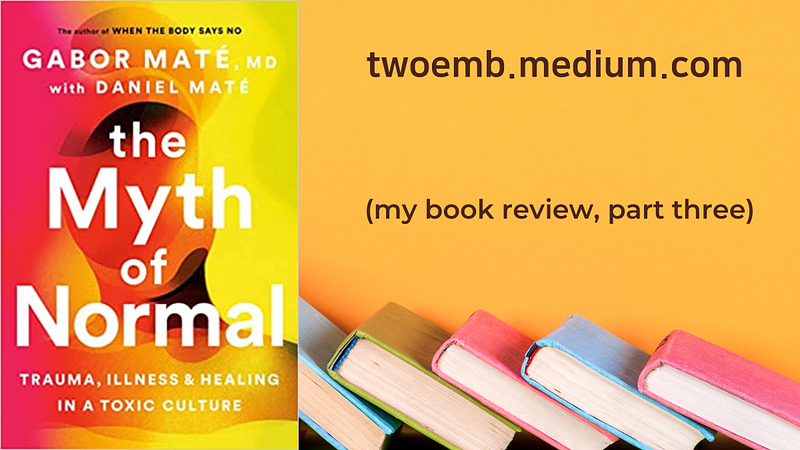
The final sequel in my three-part review of Dr. Gabor Maté’s new book
The last word
(for now anyway)
In my last piece, I had promised to discuss “Oppositional Defiant Disorder” (ODD) and Dr. Maté’s advice for dealing with the “toxic culture” he outlines throughout his book.
In true ADHD form, the article got away from me, and I ended up writing an entire article on his lack of attention to the connections between ADHD, Autism, and Substance Use Disorder (SUD — a.k.a. addictions). Thus, I needed a part three to cover all topics as promised.
Oppositional Defiant Disorder
Dr. Maté only references O.D.D. once in his book (on P. 243), but was probably one of my favourite pages in the book.
“Oppositionality, by definition, can arise only in the context of a relationship.” — Dr. Gabor Maté
Yes.
On this we can agree. Dr. Maté goes on to describe how any physical or psychological ailment will exist regardless of whether we are alone or surrounded by other people, yet O.D.D. is the only “mental disorder” we diagnose which requires interaction with others for symptoms to be present.
Why, then, is it only the child who is labelled defiant, and not the adult? A child cannot have a power struggle with themselves, that would require an adult to engage and to be equally oppositional.
“To call this ‘disordered’ says nothing about the child’s inner experience; it reflects only the perspective of the ones who find [the child’s] recalcitrance inconvenient. It is also completely obtuse about how emotional power dynamics work: there is nothing disordered in resisting authority figures that, for whatever reason, we do not feel confident in and safe with.” — Dr. Gabor Maté
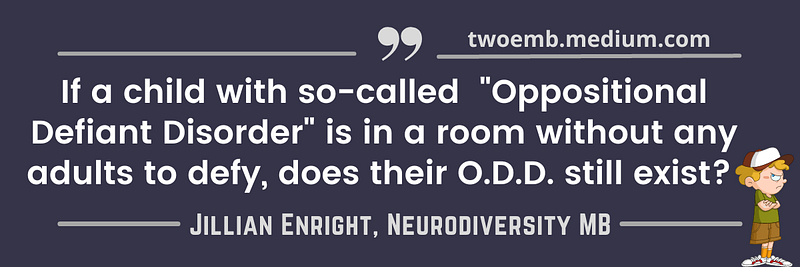
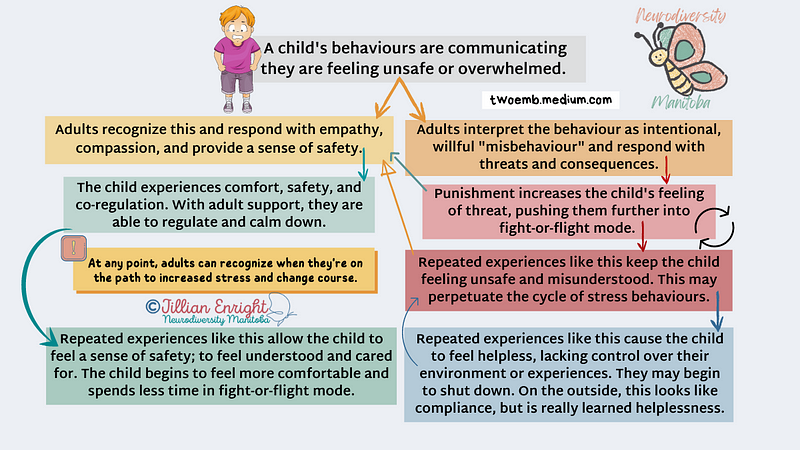
Often by the time a child has become “defiant”, they’ve already been sensitized by trauma, mistreatment, injustice, or other frustrations. Children are not born defiant, oppositionality is created in how we treat them, and it is perpetuated by how we address challenging behaviours.
When we have labelled a child as defiant, then every concnerning behaviour is viewed through that lens. How we interpret children’s behaviours and intentions significantly impacts how we respond to it.
If a child is refusing to do something asked of them and we assume they’re being oppositional, we’re more likely to threaten consequences if they don’t “respect our authority”. Threats are more likely to be met with resistance, which is further interpreted as defiance, and around we go.
Undoing self-limiting beliefs
I have to say, getting through the final section of the book (which contained nine of the book’s 33 chapters!) was a slog.
I love evidence-based psychology books, but I stop enjoying them when they start to sound like new-agey, self-help crap, which really are an extension of an entire “brand” the author represents — complete with “motivational speaker” bookings.
Speaking of which, according to All American Speakers, Dr. Maté charges up to $10,000 for a virtual event, and $50,000 for a live speaking engagement!
I’m not knocking the guy for trying to make a living, we’re all playing a part in capitalism. I don’t write on Medium or go to work for free, we all have bills to pay.
I was quite amused, however, when Dr. Maté wrote, without a trace of irony,
“Neuroscience, originally meant to unlock the mysteries of consciousness and the brain, has become another handmaiden of the profit motive… contentment sells no products.” — Dr. Gabor Maté (P. 298)
What does he think his books are? And his speaking events, not to mention “wellness retreats”? I took a peek at his website to see how much they cost. An upcoming retreat is $1,875 for the week, and that doesn’t include travel expenses or airfare.
For Dr. Maté’s upcoming speaking engagement in March, tickets are between $120-$250 for one evening.
On the very same page, recounting a conversation with Dr. Rob Lustig, Dr. Maté quotes him as saying,
“Their aim is to market happiness in a bottle.” — Dr. Rob Lustig
In a bottle, or in a book, sir?
© Jillian Enright, Neurodiversity MB
When you join medium, as a member you’ll have access to unlimited reads for only $5 per month. If you use my referral link, I’ll earn a small commission, and you’ll earn my undying gratitude.
If you’d prefer give a one-time tip, you can support my writing on Ko-Fi — also, it’s free to follow me on Facebook!
Related Articles
References
Hasin, D. S., O’Brien, C. P., Auriacombe, M., Borges, G., Bucholz, K., Budney, A., Compton, W. M., Crowley, T., Ling, W., Petry, N. M., Schuckit, M., & Grant, B. F. (2013). DSM-5 criteria for substance use disorders: recommendations and rationale. The American journal of psychiatry, 170(8), 834–851. https://doi.org/10.1176/appi.ajp.2013.12060782
Lipton, B. (2005). The Biology of Belief: Unleashing the power of consciousness, matter, and miracles. https://goodreads.com/book/90556.The_Biology_of_Belief
Mate, G. (2022). The Myth of Normal: Trauma, illness, & healing in a toxic culture. Knopf Canada.