
The Most Powerful Morning Routine I’ve Found After 3+ Years of Experimenting
A realistic, science-based, customizable, and aggressively self-tested morning system

This isn’t your cliche morning routine article.
This is the fruit of 2.5+ years of going down Reddit rabbit holes and self-experimenting with 20+ routines — then 6+ months of refinement and systemization once a permutation finally “clicked.”
This routine’s proven so powerful that ticking it off is my only daily focus now — everything else falls into place automatically (as you’ll soon see how).
I kid you not. This routine’s been the sole difference between doom-scrolling and“Blitz through a week’s work” days — countless times.
After all this hype, I won’t share 5 cliche habits, slap in some research, and call it a day. Instead, I will…
- Explain the core 5-dimensional philosophy — the secret to this routine’s incredible potency.
- Dive deep into every element of this system and share — the science-backed rationale, Level-1 to 4 progression scheme, and customization pointers.
- Outline 3 potent enhancements to go “beyond” the base routine.
- Share 3 minimizations for when you’re busy, lazy, or in a hurry — and explain the minimization logic.
- Finish with a 9-week roadmap to help you ingrain this routine without feeling overwhelmed.
This routine doesn’t do anything magical.
It only captures, capitalizes on, and multiplies the inherent power of mornings — the godly focus + motivation our smartphones vaporize.
This morning system has transformed my productivity, well-being, and happiness beyond belief.
I hope it proves equally life-changing for you. A few things before we dive in:
- Don’t reorder the routine— each step fuels and eases the next, creating powerful synergy. Disrupting the synergy will handicap the routine’s power — and make it harder to stick to.
- This article is long and I wouldn’t encourage skimming — The nuances, customization, and progression are as crucial as the actual steps. If you can’t spare 15 minutes now, bookmark this article and return later.
- This isn’t a set-in-stone routine — it’s a flexible, customizable system. Mold the routine to your lifestyle and needs with the minimizations and customizations. Then, build it at your own pace with the progressions and roadmap.
- The table of contents below isn’t for first-time reading — it’s to simplify navigating through this guide for post-read clarifications and rereads.
Disclaimer: I’m not a certified health/mental health expert — all my knowledge stems from self-experimentation, personal experience, and research. Consult a doctor or psychiatrist if necessary to ensure all aspects of this routine suit you.
Table Of Contents
· The 5 Crucial Dimensions This Routine Is Built Upon · Step 0 — The Unsexy Habit Modern Society Ignores ∘∘ You don’t “have to” wake up at 5 AM. · Step 1 — Invigorating the Body and Heart ∘∘ Before you say, “This workout routine is too extreme!” ∘∘ Working out needn’t be just building muscle or strength · Step 2— Jolt-Awakening The Mind and Body ∘∘ Instead, use the cold-shower progression: ∘∘ The #1 thing we’re aiming for with cold showers · Step 3 — Put Your Self-Awareness on Steroids ∘∘ Step 3.1 — The easiest way to control your mind ∘∘ Step 3.2 — Expanding into the infinite ∘∘ If 30 minutes of breathwork + meditation seems impossible… ∘∘ Before you say, “I can’t (aka don’t want to) spend 30 minutes”… · Step 4 — The Easiest (And Fastest) Step of Them All ∘∘ Progression for a 2-minute habit? · Step 5 — Time to Eat the Frog · 3 Minimizations If This Routine Sounds Elaborate ∘∘ The 4-Step “Lazy Lad” Minimization ∘∘ The 3-Step “Rush-Hour” Minimization ∘∘ The 2-Step “Zero-Time” Minimization ∘∘ Bonus: The “I’m Sick!” Minimization ∘∘ How to Create Your Own Minimized Routine(s) · 3 Potent Enhancements To This Routine ∘∘ The $33K “You 2.0” Mindset Folder ∘∘ Prefix Your P0-Task to The Routine ∘∘ Leverage Andrew Huberman's Secret Superpower · Final Words (and 9-Week Roadmap)
The 5 Crucial Dimensions This Routine Is Built Upon
Work. Body. Mind. Breath. Soul.
P.S. By “Soul”, I don’t mean an ethereal white ghost that floats out of our body when we die — I mean “that” we call our inner voice, conscience, or intuition.
Loosely speaking, at a high level:
- Mind + Body “Go Beyond” Work — Kobe Bryant detecting that the basketball rim was a quarter inch off during practice is a solid example.
- Breath + Mind “Go Beyond” Our Body — Bruce Lee’s 1-inch punches and Wim Hof’s naked Arctic dives are testament.
- Soul + Breath “Go Beyond” our Mind — the Buddhist monk Quang Duc’s sculpture-still lotus position as his body burned to death proves this.
So Soul > Breath > Mind > Body > Work.
But society worships work, ignores the body, stresses the mind, breathes shallow, and pretends the soul doesn’t exist!
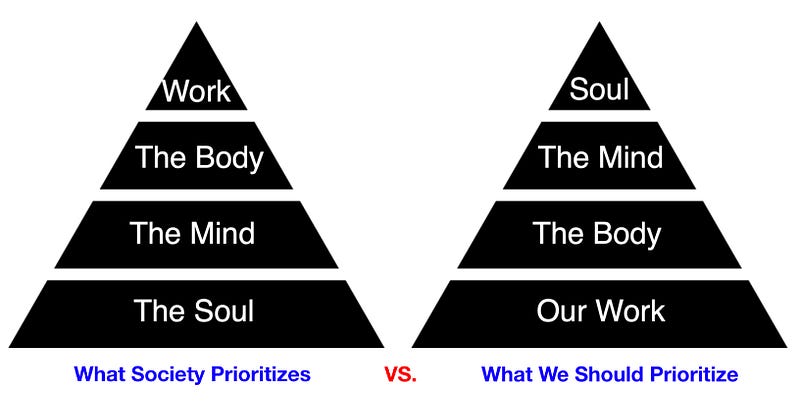
By awakening the body, mind, breath, and soul in order, our routine unlocks peak synergy — and sets up each habit to feed into the next.
Step 0 — The Unsexy Habit Modern Society Ignores
Even the best morning routine is worthless without good sleep.
Glamorizing 12 AM hustling, 2 AM partying, and 5 AM mornings, we’ve become a sleep-deprived society.
The effects are far from glamorous — fatigue, foggy memory, irritability, disturbed hormones, frail focus, obesity, high blood pressure, anxiety, and mortality risk.
2 hellish bouts of insomnia hammered sleep’s crucialness into my skull.
Scrambling down the sleep-optimization rabbit hole, I fixed my sleep and distilled the steps into a free checklist — here are 9 of its best tips:
- Be it 7 PM or 12 AM, sleep (and rise) at the same time daily — to rewire your circadian rhythms. Ensure to get 7 to 8 hours of sleep.
- Ditch electronic screens an hour before bed — their blue light disrupts the sleep hormone. Grab a book or ambiently-lit Kindle instead.
- Establish a calming night routine — read light fiction. Banter with your family. Splash cold water on your face. Meditate. Journal. Box breathe in Ujjayi.
- Avoid heavy meals 2 hours before bed — the resulting gut activity, heartburn, and acid reflux can disrupt sleep.
- No caffeine after 2 PM — as it's potent for 4–6 hours after consumption.
- Empty your bladder before bed — called Nocturia, bladder pressure is a known sleep deterrent. It can also trigger nocturnal emissions in men.
- Optimize your bedroom for sleep — with blackout curtains, a comfy mattress, an AC/cooler, and ambient lighting. Scented candles and binaural beats can also help.
- Use a gentle alarm ringtone — not one that jolts the living lights out of you. Nature sounds work best.
- Consider supplementing Melatonin, ZMA, or Ashwagandha — while they’re science-backed and time-tested, consult a sleep specialist first.
Don’t scramble to execute all these tips — implement 2–3 at a time, see what works best, and stick to those.
You don’t “have to” wake up at 5 AM
While it helps, rising early isn’t compulsory — rising at the same time is.
7 PM early worm or a 12 AM night owl, choose sleep-wake timings that suit you — but stick to them. But ensure you cover the 11 PM to 3 AM sleep window — to maximize the deeply recharging NREM sleep.
Make sure you sleep/wake ±30 minutes within your daily schedule to optimize your circadian rhythms.
On days you fall short of sleep, take a power nap — limit it to 20 minutes to avoid disrupting your circadian clock.
Step 1 — Invigorating the Body and Heart
Recharged by 8 hours of sleep, your waking self’s perfect for a workout.
While one study reported superior performance in morning workouts, another found higher oxygen consumption. Yet another study found better abdominal fat reduction.
But first, the pre-workout routine. Mine’s simple:
- Down 3 glasses of water — to awaken your metabolism and bowels.
- Splash my face with cold water — to wash away the night’s grime, sebum, and sleepiness.
- Down a salted black coffee — the natural caffeine + sodium combo puts pre-workout supplements to shame.
- Devour an apple or banana — simple carbohydrates to fuel the workout.
- Empty the bowels — for obvious reasons.
- Foam-roll — to warm your joints, dissolve knots, and pump blood into your muscles.
Coming to the workout, I alternate Muay Thai and modified P.H.U.L — for strength, aesthetics, and lethality.


A typical week:
- Monday: Muay Thai — Heavy bag volume work.
- Tuesday: Gym — Legs Power
- Wednesday: Muay Thai — Stretching + Strengthening work.
- Thursday: Gym — Upper Power
- Friday: Muay Thai — Intensity work.
- Saturday: Gym — Legs Hypertrophy
- Sunday: Gym — Legs Power
Before you say, “This workout routine is too extreme!”
Working out transformed my life — so it’ll always have a special place in my heart and life. You don’t have to work out as hard — or as much.
Start with the progression below and stop once you reach your desired (sustainable) level:
P.S. If you already have an effective workout routine you enjoy, stick to it and ignore this progression.
- Level-1 (L1): Start with the 15-Minute-Bod home workout — progress from 3 days a week to 5x. Increase the sets and weights as recommended.
- Level-2 (L2): Hit the gym with Alpha Destiny’s FB-3X program.
- Level-3 (L3): After 3-6 months, switch to Reddit PPL (6 or 5-day variants), Layne Norton’s 5-day PHAT, or my 4-day P.H.U.L routine.
- Level-4 (Advanced): After a year or two, move on to Lvysaur’s 5-day routine — or rotate the other routines of The Aesthetic Vault. If lifting gets boring, squeeze in a sport or martial art.
At any level, you can choose to stop — consistent, self-motivated L1 workouts will beat inconsistent, forced L3s.
Working out needn't be just building muscle or strength
The goal is to get the body moving, the heart racing, and the blood pumping — how you do it is 100% up to you:
- Want to work out at home? Start with the 15-Min Bod and advance to customized home workouts.
- Want to lift weights? Start with Alpha Destiny-FB-3X. Then, rotate the Aesthetic Vault’s routines every 3-6 months to avoid stalled progress.
- Want to hit the gym but hate lifting weights? Book a trial Zumba, Kettlebell, aerobics, yoga, CrossFit, or Cult class — stick to the one(s) you enjoy.
- Prefer sports instead? Run, swim, roller-skate, cycle, jog, rock-climb, or even brisk walk. Plenty of options.
- If nothing, drop down to bang out a few pushups or burpees. Watch prison workouts for motivation and ideas.
Exercising right in the morning energizes you and ensures “life” doesn’t sweep it away later in the day.
P.S. If you enjoy working out later in the day, activate your body and heart with a 5-minute full-body circuit. Too intense? A 5-minute stretch or a hard set of pushups will also work.
Step 2— Jolt-Awakening The Mind and Body
Working out leaves you with a warmer core, rapid blood circulation, and sweat-cooled body— ripe conditions for otherwise torturous cold showers.
Of all the proven benefits of cold showers, the Vagus nerve activation is the king — it elevates joy, injects positivity, and reduces stress. To quote Mindd.org,
“Optimal Vagus Nerve function, or ‘high vagal tone index,’ is associated with strong social connections, positive emotions, and better physical health. Individuals with low vagal tone index experience depression, heart attacks, loneliness, negative feelings, and stroke.”
Though exercise eases the cold, going “Lightweight baby!” under a chilling torrent isn’t optimal — if not a cold shock, it’ll sap your finite willpower.
Instead, use the cold-shower progression:
- L1: Transition showers — Gyrate the shower knob from hot to cold. Progress by decreasing the starting temperature and turning the knob faster.
- L2: Pre-wet showers — Wet your body with a few jets of warm water before stepping into the cold. Progress by decreasing the jets’ temperature.
- L3: Direct cold showers — Take a deep breath, hold, and step under the deluge. The longer you delay or hesitate, the harder cold showers feel.
- L4 (Advanced): Enter the Brave New World of Wim Hof, ice-cold immersion, and cryotherapy.
The #1 thing we’re aiming for with cold showers
Our #1 goal is Vagal activation — the initial “shock” that triggers an avalanche of calm.
- In a hurry? Go for a 2 to 3-minute chilly shower (10 to 15° Celsius — any lower can be unsafe)
- Have time on hand? Muse under a 6 to 8-minute 20° Celsius cold shower. Bonus: Brainstorm ideas, recite multiplication tables, and reflect on the previous day.
- Prefer showering later in the day? Replicate the Vagal shock by splashing cold water on your face.
- Want to try something new? Alternate the knob from cold to hot every 30 seconds. Contrast showers trigger a series of mini-Vagal activations.
- Want to “upgrade” your cold showers? Try enhancements like controlling the shock reflex, solving math, and increasing the cold.
A bonus benefit of cold showers?
They save time — that you’d waste whistling in orgasmic pleasure under a steamy shower.

Step 3 — Put Your Self-Awareness on Steroids
With body and mind invigorated, it’s time to dive into the infinite ocean of pure consciousness. For the non-spiritual, this is the superconscious state of peak self-awareness.
But meditation alone won’t cut it.
Step 3.1 — The easiest way to control your mind
Our minds are uncontrollable monkeys.
Try not to think of blue — and blue whales squirting blue water amidst blue waves will swim in your mind.
This is where breathwork comes in. A live example — take a deep breath into your belly. Pause for 2 seconds. Exhale slowly. Repeat once more.
Feel the calm? I bet you didn’t think of blue whales, either. That’s the power of your breath.
Besides being a preparative step for meditation, breathwork has proven benefits like — reduced stress, improved immunity, stronger lungs, and detoxification.
To get started:
- Find a silent, distraction-free place with good ventilation.
- Sit easy with a straight spine — in Sukhasana, lotus pose, half-lotus, or Vajarasana. Use a cushion and/or chair if need be.
Then, it’s time for Art Of Living (AOL)’s Sudarshan Kriya — one of the most powerful breathing techniques on Earth:
- 3-Stage Pranayama (8,8,6 breaths) in Ujjayi.
- 3 rounds of 15 to 20 Bhastrikas.
- 3 rounds of chanting Aum.
- The actual Sudarshan Kriya — 3 rounds of (20 long breaths + 40 medium breaths + 40 rapid breaths). All breaths are circular.
Use the guided video below if you find the steps and counts confusing:
P.S. It’s best to learn the Kriya directly from a certified teacher in a nearby AOL center — they can spot and correct posture/breathing mistakes that video tutorials can’t.
Step 3.2 — Expanding into the infinite
Swept clean by breathwork, your mind’s ready to jump from yourself to your Self.
“Meditation is nothing but a device to make you aware of your real self — which is not created by you, which need not be created by you, which you already are. You are born with it. You are it!
— Osho, The First and Last Freedom
Like most, I struggled to meditate consistently until I learned Sahaj Samadhi, or “Effortless” meditation — the art of letting go till meditation happens on its own.
Keeping your eyes shut, transition into Sahaj after the Sudarshan Kriya:
- Uncurl your palms and let them loosely face the sky.
- Silently chant, “I Want Nothing. I Do Nothing. I Am Nothing.” — and visualize yourself dissolving into nothingness.
While the guided Sahaj meditation by Yogini Bhanumati covers it all, the high-level steps are:
- Breathing deeply and easily, relax your body parts one by one.
- First, the prime stress accumulators — shoulders, neck, and traps. Focus on them as you inhale, and relax as you exhale.
- Eyebrows. Cheeks. Eyelids. Forehead. Lips. Scan your face for stiffness. Then, let go.
- Neither fight bad thoughts nor force positive thoughts. Let them be. You are not them. Breathe. Let go.
- Continue locating tensed-up spots and letting go. Pinched lips? Let go. Throbbing feet? Let go. Pressed eyelids? Let go.
Receding to the witness position, calmly observe your thoughts, mental drama, and bodily sensations.
Then, let go.
P.S. Again, Sahaj Samadhi is best learned from a certified AOL teacher — the special initiation with a private mantra can greatly deepen your meditation.
If 30 minutes of breathwork + meditation seems impossible…
Forget meditating; My anxious past self couldn’t sit still for 5 minutes. Anyone can meditate — with the right progression:
- L1: 3-Stage Ujjayi Pranayama with 4,4,3 counts + 5 minutes of Sahaj meditation
- L2: Full 3-Stage Ujjayi Pranayama + Bhastrika + 10 minutes of Sahaj.
- L3: Full Pranayama + Sudarshan Kriya + 15–20 minutes of Sahaj.
- L4 (Advanced): Try the 10-day Vipassana silent retreat or AOL’s Intensive AMP
The subtler the breath and the lesser the effort, the deeper the meditation.
Before you say, “I can’t (aka don’t want to) spend 30 minutes”…
Fair enough. You can customize breathwork as it’s mainly a preparatory step for meditation:
- Have 3 minutes? Repeat simple cycles of Ujjayi Pranayama.
- 5 minutes? Go for half 3-Stage Ujjayi Pranayama (4,4,3 counts).
- 7.5 minutes? Half 3-Stage Ujjayi Pranayama + 3 rounds of 10 Bhastrikas.
- 10 minutes? Perform the full 3-Stage Ujjayi Pranayama (8,8,6 counts).
But don’t skimp on meditation — be it 11, 12.5, or 13.6875 minutes, soak in cosmic consciousness for at least 10 minutes.
Step 4 — The Easiest (And Fastest) Step of Them All
As you return from the bliss of deep consciousness, your self-awareness is at its peak — ripe for mind-dumping with journaling and daily planning.
But filling page after page or whiteboarding can feel tedious, sap your willpower, and make consistency challenging.
This problem led me to bullet journaling — and crafting my own 2-minute template. When the Notion template went viral with 4500+ downloads, I had to put it out as a paperback:
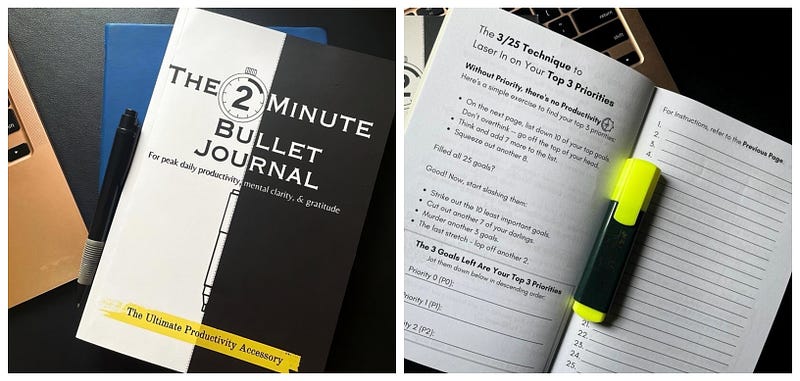
P.S. Interested in the 2-minute paperback journal? Learn more about it here.
While my 2-minute template covers the process in detail, the TL;DR is:
- Discover your top 3 (P012) priorities using the 3/25 rule.
- Then, every day — jot down your P012 priorities, plan 2 P0 + 1 P1 + 1 P2 tasks, and recall 3 things you feel grateful for.
- If it takes you more than 2 minutes, come smack my face.
Progression for a 2-minute habit?
- L1 — Start with only the P012 planning section of the 2-minute journal.
- L2 — Start gratitude journaling as well.
- L3 — Play around with the template — add/remove sections. Modify the number/structure of the ToDos. Get creative.
- L4 (Advanced) — Optimize the living lights out of your template. Share it as a Notion template. If it shows promise, publish it as a print paperback on Amazon. I’ll be your first customer :)
Step 5 — Time to Eat the Frog
“If it’s your job to eat a frog, it’s best to do it first thing in the morning. And If it’s your job to eat two frogs, it’s best to eat the biggest one first.”
Symbolic for tackling the day's most dreaded and complex task first, “Eating The Frog” is a productivity game-changer:
- The more you delay eating the frog, the more you dread and delay it.
- The momentum and sense of accomplishment from downing the frog lets you cruise through the rest of the day.
- Even if you slack after eating the frog, the day will remain a win.
Fortunately, our routine’s mind + body + soul activation reduces the croaking frog into a pill-sized tadpole. Here are 5 more tips to protect your focus and avoid procrastination:
- Put your phone on DND and place it facedown on the far end of the desk or room.
- Head to an isolated room. Block “Focused Time” on your calendar. Pop a pair of headphones and play “Limitless Productivity.”
- Use gray-scale mode unless your work needs those dopamine-stealing pixels.
- Block distracting apps, websites, and searches with the free ColdTurkey blocker. For writing, check out ColdTurkey Writer — until you hit the set word or time goal, it turns your laptop into a typewriter.
- Have a filled water bottle within hand’s reach — to avoid dehydration and breaking your focus circuit.
As you burp after eating the frog, relish the waves of accomplishment and relief that wash over you.
In a few morning hours, you accomplished way more than most do in a day.
3 Minimizations If This Routine Sounds Elaborate
Be it a choking deadline, nosy relatives, or a skull-eating headache — when life ticks us off, we fail to tick off our elaborate routines.
That’s when we tick off parts of our routine — the trick lies in choosing the parts that maximize synergy and minimize the loss in impact.
Minimizations aren’t substitutes for the base routine — reserve them for the rare occasions you’re short on time, patience, or energy.
The 4-Step “Lazy Lad” Minimization
- A 15 to 30-minute workout — use my 15-minute home workout or bang out a quick 1-set full-body workout at the gym.
- A 7.5-minute cold shower
- Full 3-Step Ujjayi Pranayama + 3 Bhastrika rounds of 15–20 breaths
- 7.5 minutes of Sahaj meditation
The 3-Step “Rush-Hour” Minimization
- A 15 to 30-minute workout.
- A 5-minute cold shower.
- 3-Step Ujjayi Pranayama with half-counts (4,4,3 instead of 8,8,6).
The 2-Step “Zero-Time” Minimization
- A 15-minute home workout — no time? Drop down and pump 10–30 pushups.
- A 3-minute cold shower — still no time? Splash cold water on your face.
Bonus: The “I’m Sick!” Minimization
When sick, eliminate the steps that strain your body, breath, or mind — so exercise, cold showers, and Bhastrika are out. The routine then:
- Full Sudarshan Kriya — crucial as the Kriya’s rhythmic breathing has healing potency.
- Full Sahaj meditation (15 to 20 minutes) — Sometimes, recovery from sickness is a mind game. There’s a reason placebos are so powerful.
How to Create Your Own Minimized Routine(s)
While the Soul > Breath > Mind > Body > Work in terms of control, the order of activation is the opposite:
- Activating the body → 10% mind/breath arousal → 1% soul-awakening.
- Arousing the mind/breath → 10% soul awakening.
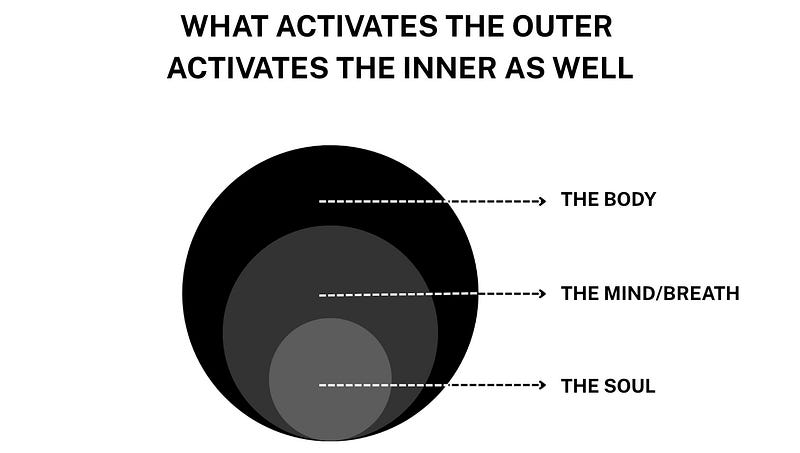
Armed with this insight, the prioritization for minimization becomes Work > Body > Mind > Breath > Soul.
- Last-minute deadline? Dive directly into work.
- Some breathing space? Workout + Work.
- More time? Workout + Cold shower + Work.
- Calm, no-bustle day? Workout + Cold shower + Breathwork + Meditate + Work.
P.S. For all minimizations, bullet journaling is a constant — taking only 2 minutes, you can journal physically, on your iPhone’s Notes, or mentally. No excuses.
3 Potent Enhancements To This Routine
Skip this section until you develop and stick to the full base routine for at least 21 days. Enhancements that hamper your consistency defeat the purpose.
Base routine consistency >> Enhanced inconsistency.
That said, let’s dive into it.
The $33K “You 2.0” Mindset Folder
Tej Dosa is a wizard at wielding spiritual intelligence to achieve massive business and personal success.
So when I stumbled upon his mind-bending “How I Easily Manifest $33,000+ Days (profit)” guide, I got to work building the “You 2.0” Mindset Folder.
Since Tej teaches how to craft this folder as a free 7-day email course, you’ll need to invest 30–45 minutes a day for a week.
But once built, you only need 5 daily minutes post-meditation— in only 2 inconsistent weeks of using this, my subconscious feels way different.
100% recommend.
Prefix Your P0-Task to The Routine
Since caffeine takes 30 to 45 minutes to kick in, you can leverage the gap to squeeze in a work session — way more effective than exercising right away.
But I stopped doing this for 2 reasons:
- My work (writing) often stretched way past 45 minutes
- Screentime first thing in the morning triggered my migraines
If neither happens to you, no better way to start your routine than with your day’s top priority (P0) task.
Leverage Andrew Huberman's Secret Superpower
Andrew Hubermann is religious about getting sunlight in your eyes after waking up — to dial in your circadian rhythm and trigger wakeful alertness.
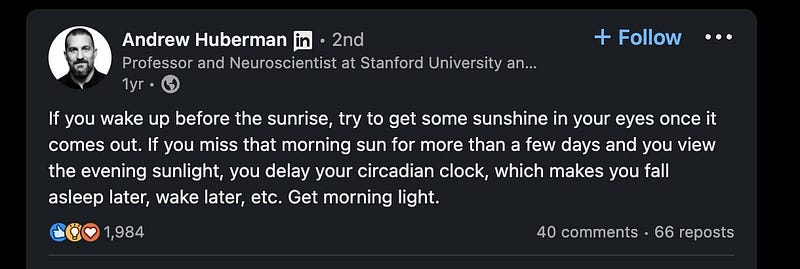
Since I wake up earlier than Bangalore’s winter sun shows its grace, this isn’t possible — I compensate by walking to the gym 45 minutes later.
If opening the windows and curtains doesn’t prove enough, go for a 15–20 minute walk as Hubermann does.
Final Words (and 9-Week Roadmap)
Don’t let the progression roadmaps, customization options, minimizations, and enhancements overwhelm you.
Take your sweet time to build out this routine — bookmark this guide and keep returning to it as you do so. Here’s a sample 9-week roadmap:
- Week 0 — Forget about this routine until you fix your sleep.
- Week 1 — Begin with the 3-step Rush-hour minimization. Customize each element using the pointers I’ve shared. Start with the L1 progressions.
- Week 2 — Upgrade to the 4-step Lazy Lad minimization. Progress through L1 to L3.
- Week 3 — Advance to the base routine.
- Weeks 4 to 6 — Don’t change anything. Continue being consistent.
- Week 7 to 8 — Kudos on building your morning routine! Experiment with the enhancements and L4 progressions now — one at a time.
- Week 9 — Finalize and religiously stick to your enhanced routine. Don’t hesitate to fall back on the minimizations and lower-level progressions when busy/lazy/sick.
If all this sounds like work, it is — at least until you build the routine. Once momentum kicks in, you’ll reap daily productivity, energy, and success returns on autopilot.
If not 9, take 12 or 15 weeks. Start with the 2-step routine. Move slower from L1 to L3. Delay the enhancements — forget speed and enjoy the process.
Consistent rocky 6-month progression >> 6-week inconsistency that sputters out.
Now, go build (potentially) the highest ROI asset of your life.
Want this routine as a downloadable PDF along with Excel/printable routine-tracking sheets? Click here to grab your free copy of God-mode Mornings.


