
The Most Fundamental Concept
Reality could not possibly exist without this fundamental concept!
What‘s a “Fundamental Concept?”
I contend that there’s a single concept (a mental abstraction, principle, idea, notion, conception) that’s fundamental to the reality we experience. The concept is fundamental because it is the :
- Essence of our Universe’s creation and evolution
- Primary requirement for the emergence of everything from nothing.
To identify this fundamental concept, let’s begin by examining the very earliest moment of our Universe.
In the Beginning: Cosmic Inflation and the Big Bang
The Cosmic Inflation theory states that, in the early Universe, the Big Bang was preceded by very brief period when the fabric of space was bound up with energy:
…the very early Universe underwent a period of time where all of the energy that would go into the matter and radiation present today was instead bound up in the fabric of space itself. That period, known as cosmic inflation, came to an end and gave rise to the hot Big Bang, but never created an arbitrarily hot, dense state, nor did it create a singularity. What happened prior to inflation — or whether inflation was eternal to the past — is still an open question, but one thing is for certain: the Big Bang is not the beginning of the Universe! https://readmedium.com/the-big-bang-wasnt-the-beginning-after-all-81844b973333
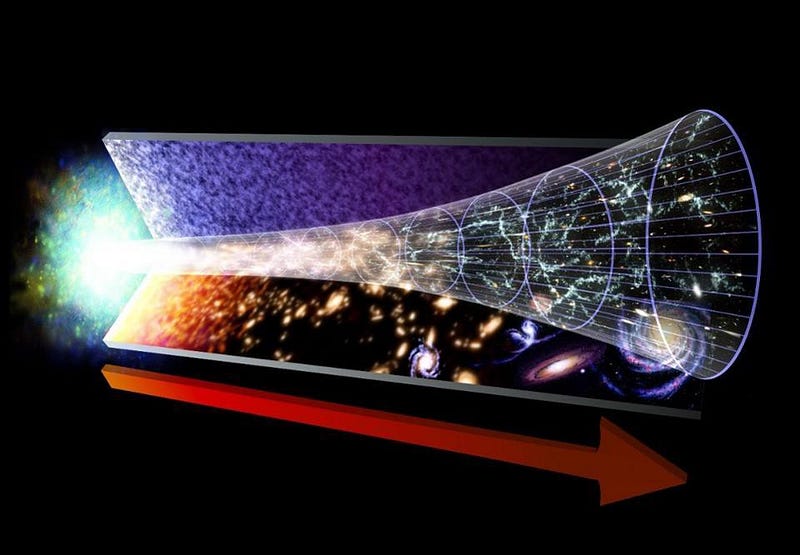
Thus, the energized space of cosmic inflation led to the Big Bang, which gave the Universe its spacetime, matter, energies, forces, and eventually the existence of life.
I have no reason to dispute this theory, yet I want to have some understanding of what came before the period of cosmic inflation, i.e., before the beginning of our Universe.
Before the Beginning
If there was no Universe prior to the moment of cosmic inflation, it means there was no:
- space and time (spacetime)
- matter (objects and particles)
- energy/radiation (e.g., thermal, electrical, chemical, nuclear)
- forces (e.g., gravitational, electromagnetic, nuclear)
- existence.
So, before our Universe existed there was just nothing(ness).

Concept of Nothingness
The concept of nothingness has different meanings:
- A common materialist theory states that apparently empty space (nothingness) contains virtual particles formed from the energy of (vibrating) quantum field fluctuations.
- I don’t reject such materialist theories, however, I’m defining the nothingness as the lack of space itself. It’s a concept that implies a static, timeless, void without the particles, energies, quantum waves, nor anything else needed for there to be an existing reality.
Thus, prior to the creation of our Universe, there was just nothing(ness), but the story doesn’t end there. It’s logical to infer that the nothingness — from which cosmic inflation and the Big Bang emerged — must have had a creative quality (characteristic, capability) that enabled it to become the Universe.
This raises the question: What fundamental quality of nothingness enabled the cosmic inflation to create our Universe and give rise to the Big Bang?
Creative Quality of Nothingness
Science can’t answer that question because it needs something to observe and measure, but nothing exited before the cosmic inflation. Religion has its answers about creation, but blind faith in ancient stories is inadequate and dissatisfying to an inquisitive mind demanding explanations based on science and/or sound logic.
There is, however, a way to find a rational answer to this daunting question about nothingness, cosmic inflation, and the Big Bang: Use a logical reasoning process that systematically identifies and examines all concepts relevant to the creation of reality.
I’ll now apply such an explanation process to find a logical answer. It begins with describing the most fundamental quality of the nothingness that enabled cosmic inflation and the Big Bang to exist.
What could that enabling quality of nothingness be?
I assert that it could be only one thing: Potential.
Concept of Potential

The concept of potential has multiple meanings; I’m defining it as possibility.
Potential, therefore, is a latent (unexpressed) ability that — when realized (actualized, manifested, developed, materialized, conceived) — can create and/or influence anything (including space, time, matter, and energy).
A logical assumption is that the nothingness, which preceded the Universe, had the potential (ability) to create and influence cosmic inflation and the Big Bang. That means this creative potential made the Universe possible.
As such, I assert that potential is the most fundamental concept because it’s the quality of nothingness that enables reality to emerge from nothing.
To strengthen this assertion, I’ll now examine two additional related concepts: Potentialized Nothingness and the Laws of Nature.
Potentialized Nothingness
Nothingness with the potential to become something real is “Potentialized Nothingness.”

If there was nothingness, but no Potentialized Nothingness, then there would be no ability to create the Universe from nothing. This raises the question: Can nothingness ever lack potential?
A reasonable answer to this question isn’t possible since we can’t observe nor measure unchangeable (immutable, invariant) nothingness. Nevertheless, if we imagine a nothingness without potential, then another the question is: How would nothingness “acquire” potential? Again, we don’t know.
One answer that can be logically inferred, however, is: Are there limits to what potential can become when realized or are its possibilities infinite? Well, in our Universe, potential does not appear to have infinite capabilities due to the constraints imposed by the Laws of Nature.
Laws of Nature
The concepts that constitute the Laws of Nature are a set of requisite conditions (rules) that guides (directs, controls, regulates, manages) the processes by which potential is realized. These universal laws guide both the:
- Creation of everything that in existence through the emergence of their constituent components and the development of those components into more organized (low entropy) states/forms.
- Destruction of all things by decomposing (disintegrating) them into increasingly disordered (high entropy) states/forms.
It’s logical to conclude, therefore, that the:
- Concepts of Potentialized Nothingness and the Laws of Nature are both essential to experience of the perceivable aspects of reality.
- Laws of Nature constrain the possible realizations of Potentialized Nothingness in our Universe. In another universe with different Laws of Nature the possible realizations may be very different.
This leads to two other core concepts: Experience and Reality.
Experiencing Reality

There are ongoing debates about the experience and reality. For the current discussion, I’m defining three primary components needed for a terrestrial life form to experience reality:
- Physical elements and structures of our universe (including spacetime, energy, and matter that emerged through the realization of Potentialized Nothingness)
- Existence of life forms (that do the experiencing)
- Subjective experiences of existing life forms — based on their awareness, perceptions, senses — which I contend is the fundamental purpose of life.
These three components enable reality to be experienced.
Experience Makes Reality Real
The objects and forces a living thing experiences emerge when some Potentialized Nothingness is realized by a life form’s perceptions/sensations. This realization occurs, however, even though the molecules, atoms, and quantum particles/waves from which the perceived objects and forces emerge are not directly detectable by sensory perception.
Instead, the foundation of all matter at its most basic level is nothing…just a concept of probability which somehow becomes infinitesimally small elementary particles with very strange qualities that we perceive as reality. These particles coalesce into material forms with boundaries that [are] somehow perceived as real things (including people and other life forms). https://readmedium.com/reality-and-the-mystery-of-physical-boundaries-9ae4b6f9e8fd
It’s as if the act of experiencing is required to makes reality real to living things. This raises yet another question: How was reality experienced BEFORE there was life in the Universe?
To answer this question about experience and the nature of reality in a lifeless universe requires exploration of three other concepts: Consciousness, Mind, and Experience.
Consciousness, Mind, and Experience
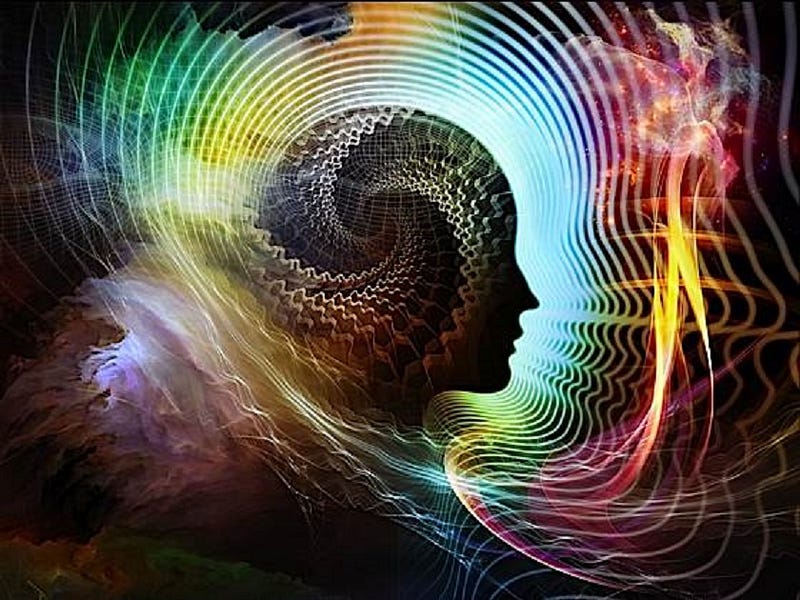
Although all living things may have consciousness, minds and experiences, I will focus on humans (and other terrestrial animals).
One point of view claims that consciousness and mind are nothing more than biological functions of a person’s brain and sense organs which somehow emerges one’s experiences.
Another point of view is metaphysical, which I will now address. This perspective does not negate the role biology plays in experience, but the concepts it explores go beyond physical constructs. I realize that some people will reject the premises and conclusion of metaphysical explanations that follow, even when reasonably logical, because they cannot be supported (nor refuted) by definitive scientific evidence.
Nevertheless, I will now provide an answer the metaphysical question about experience without life. The answer I propose is a logically inferred conclusion based on the following four premises.
Premises and Conclusion

Premise 1
Potential is a concept related to other concepts that constitute the Laws of Nature. In our Universe, these concepts enable the Potentialized Nothingness to be transformed into a physical state that life forms experience as matter and energy.
Premise 2
All concepts are created, understood, and used by another concept: Mind.
Premise 3
Mind is a characteristic/quality of still another concept, Consciousness, from which all experiences emerge.
Premise 4
The concepts of Consciousness and Mind come in two types:
- Cosmic Consciousness has an omniscient (all-knowing, ever-aware) Universal Mind that created the Universe through its realizations of Potentialized Nothingness, and it has been experiencing the Universe in some way since the beginning of time.
- A life form has an Individual Consciousness whose lesser mind emerges experiences that require biological components (e.g., sense organs and possibly a brain) which constrain its awareness and what it can perceive. In animals, these experiences are based in part on electrical current in the brain that passes through neural connections to form complex patterns of electrons. Information produced by these ever-changing energy patterns ultimately produce experiences in one’ mind. These informational patterns (and others) may be basic building blocks of the cosmos.
Logically Inferred Conclusions
Based on the four premises, it can be logically inferred that cosmic inflation and the Big Bang were events initiated by the Universal Mind of Cosmic Consciousness.
To enable cosmic inflation and the Big Bang, Cosmic Consciousness had to conceptualize (imagine, envision, create) all the concepts related to potential, realization, awareness, and experience, as well as the concept of Potentialized Nothingness.
It can also be inferred that the Cosmic Consciousness operates outside of spacetime. That’s because spacetime is an inherent characteristic of the Universe and Cosmic Consciousness created our Universe.
Another inference is that when life emerged in our Universe, the constrained minds of the living forms began perceiving portions of the Universe they were physically equipped to experience. Prior to the existence of life, however, only Cosmic Consciousness had awareness of the Universe and only its Universal Mind could experience the Universe for billions of years.
Concepts to Matter
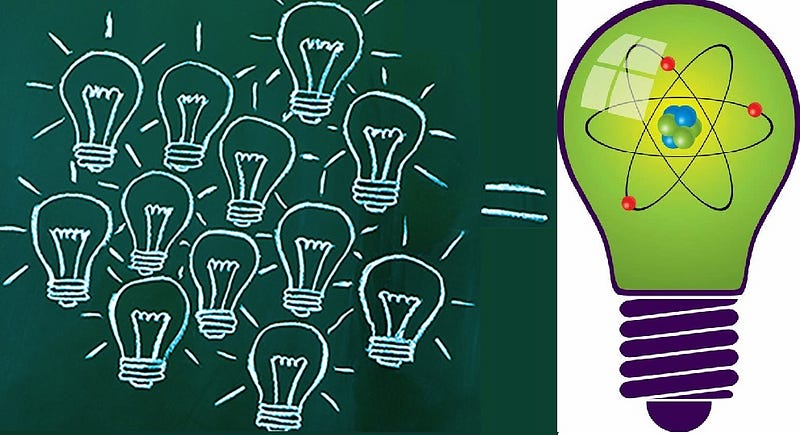
Another logical conclusion is that our experiences of reality consist of concepts — originated by the Cosmic Consciousness — which are non-physical (immaterial) mental abstractions that are experienced by living things as physical (material) reality.
Life, therefore, is reducible to nonphysical minds, realizing the potential of nonphysical concepts (abstractions), that emerge the physical reality life forms experience through their perceptions/sensations…Mysterious indeed!
So, in summation, it can be inferred that a set of concepts conceived by Cosmic Consciousness created our Universe and enable Potentialized Nothingness, guided by the Laws of Nature, to be realized as matter and energy through the experiences of the minds of life forms.
Unanswerable Questions about our Universe
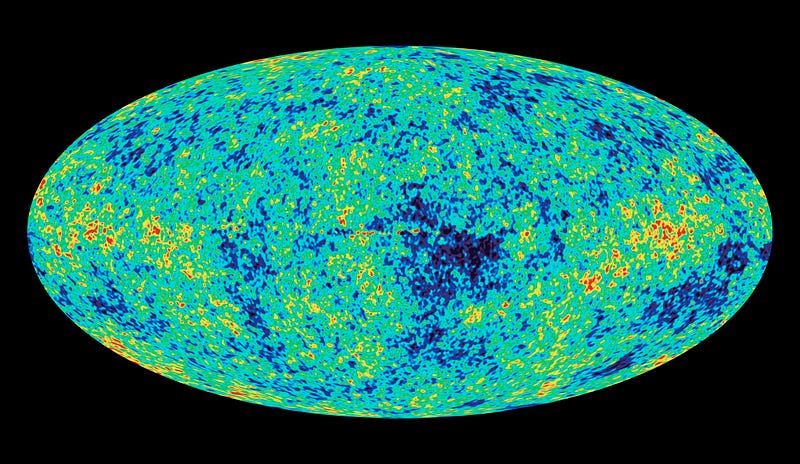
The following are questions I’ve been pondering that neither logic nor science can answer:
- Is our universe surrounded by a vast nothingness at its perimeter which is devoid of potential (i.e., static/timeless nothingness from which nothing can ever be); or does our universe expand into potentialized nothingness that can then be realized from within the expanded boundaries of our universe?
- Could dark matter and dark energy be types of be potentialized nothingness with attractive (gravitational) or repulsive (energetic) qualities that have been realized by Cosmic Consciousness, but cannot be perceived by the bodies and minds of life forms for unknown reasons?
- Why did Cosmic Consciousness create a Universe that supports life? Could it be to enrich its Mind with data it receives as feedback from the experiences of the lesser minds of living things, which is stored forever as patterns of quantum bits in the Universe?
Footnote: For anyone interested, Ethan Siegel recently added another article about cosmic inflation at https://readmedium.com/how-physics-erases-the-beginning-of-the-universe-2f2a4a90e6d3


