
Reality and the Mystery of Physical Boundaries
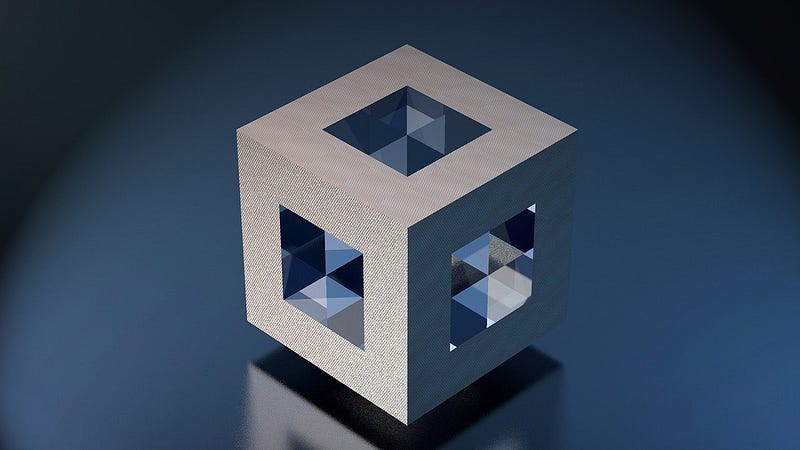
Material (physical) entities cannot exist without boundaries (borders, perimeters). Sounds simple, but a deeper look into physical boundaries is key to understanding essential elements of our reality and existence. This article presents a thought experiment that examines reality to reveal an incredible mystery science cannot explain.
Mystery of Hand on Table
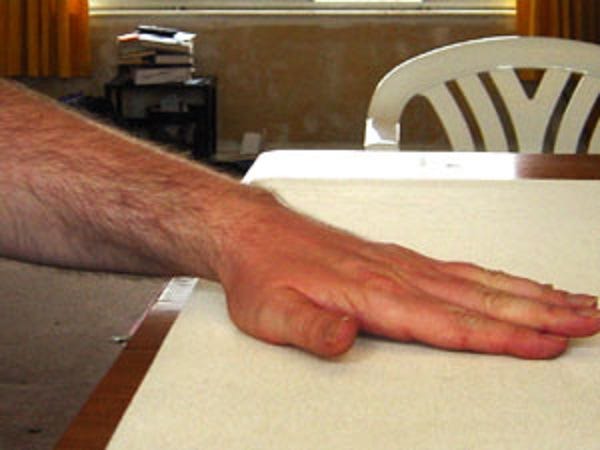
Imagine a hand on a table, like the image above. The hand and the table appear to have clear boundaries. The hand’s skin is a biological organ and the material of the table’s surface is an inanimate object, both of which have distinct boundaries that separate them. We instinctively know where the top of the table and the bottom of the hand meet, not only with our eyes but also by feeling the hard surface of table through our tactile sense of touch.
From a materialist perspective, it’s just two material forms (one a living form and the other not) with the living forms’ sense organs (nerves in the skin) sending impulses to the brain where the sense of touch is perceived. This process informs a person that the hand is resting on a solid object.
Shrunk to Atom Size
Now imagine that you could shrink down to the size of an atom and you crawled to where the hand and table met.
Atoms
An atom is an extremely small unit of ordinary matter that constitutes a chemical element. Atoms, which are only around 1/254,000,000 of an inch, are the basic building blocks of chemistry (they make up the Period Table of Elements). Most of an atom is empty space [More about atoms].
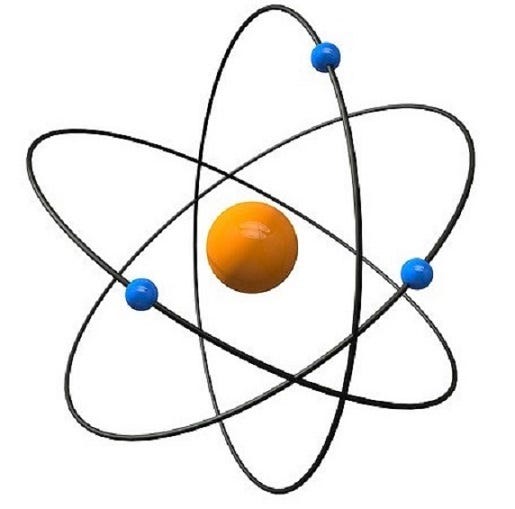
So, what would your atom-sized self see?
Looking Inside a Cell
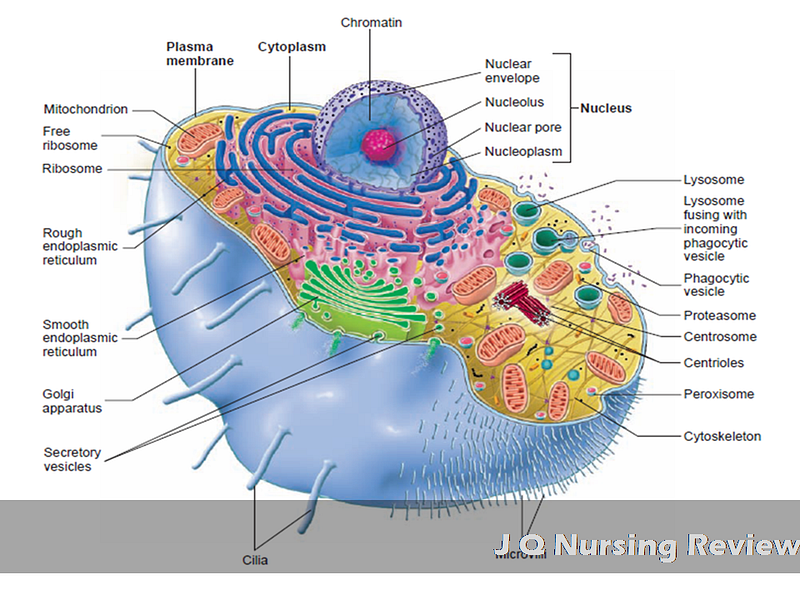
If you looked up and could see inside a skin cell of the person’s hand, you’d notice its many smaller components as depicted below.
Looking at the Cell’s Molecules
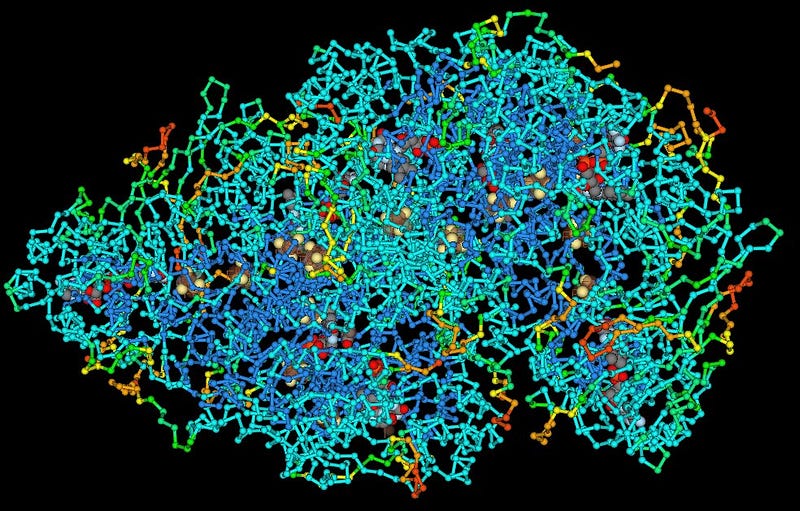
If you took an even closer look at one of the skin cells, you would see groups of interconnected atoms which create the many molecules that form the cell (as depicted below). Molecules create all the components of cells.
Looking at the Table’s Cells and Molecules
If you then look down toward the table’s surface, you would see its atoms and molecules.
Distinguishing Hand from Table
Being that the cells and molecules in the hand differ from the those in the table, you would be able to distinguish the boundaries of each based on these differences.
Shrunk to Subatomic Particle Size
Now let’s assume you were even smaller than an atom, that is, you were the size of a subatomic quantum particle of which there are over a dozen types (see image below).
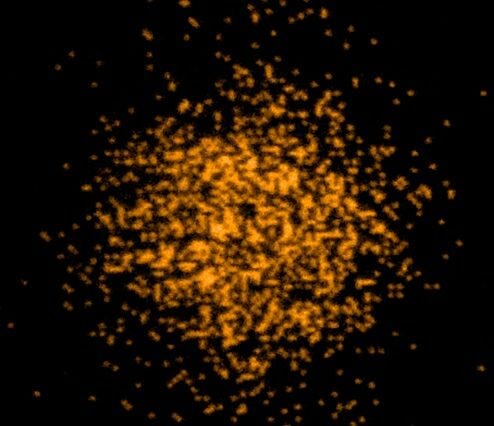
These quanta are elementary particles — the building blocks of all matter in the Universe — which are spread out across space as waves of probability called the quantum wave function. As I understand it, a wave is just abstract concept based on a mathematical formula that helps determine where a particle is most likely appear when observed/measured (at which time the waves “collapse” to become a material particle).
So, when a quantum is a wave (i.e., in its “wave state”) it’s not anything real. It becomes real when it pops into existence (materialize) via very complex principles science does not understand. When it pops out of existence it turns back in the nonmaterial waves.
Role of Consciousness
There’s long been a debate on whether the consciousness of a living thing plays a role in the existence (materialization) of the particles; here’s one video that disputes it. On the other hand, here’s an article about the strange link between mind and quantum physics and another article (that’s rather dense), which asserts that consciousness — defined as the “life force” — does have an important role to play. What actually makes all this happen? No one can be certain.
Regardless of any effect of consciousness on quanta, under the right conditions, the quanta clump together to produce the components of atoms that build molecules. The molecules create cells and organs of living forms, as well as the substance of inanimate objects.
So Where Are the Recognizable Boundaries?
Despite all this weirdness and uncertainty about subatomic particles, one thing seems clear: There are no apparent boundaries between the hand and table at the quantum level. There are just invisible conceptual waves of “nothingness” that interact to somehow produce infinitesimally small particles of matter which combine to create forms with boundaries.
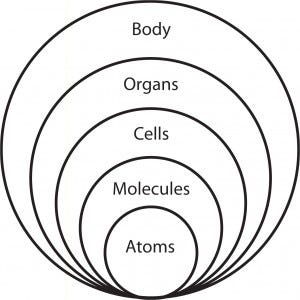
I therefore claim that, as shown in the figure below, the boundaries of matter become detectable by instruments only after clumps of quanta form groups of atoms, which then compound into molecules. And those boundaries cannot be detected with the naked eye until organs (or inanimate objects) have been created.
What this means to me is that the reality we experience has no material/physical aspect at its core. It’s built on a foundation of quanta that lacks the boundaries needed to separate the insides of material things from everything else. As such, at it most fundamental level, the Universe is just an indistinguishable blob of formless subatomic particles that appear and disappear from existence based on some formula of chance (whatever that means).
Conclusions
Putting this all together, it seems logical to conclude that preceding the moment of the Big Bang there was just nothingness that had the latent potential to be manifest as material forms with distinct boundaries. This nothingness may have been the precursor to quanta and have shared similar “wave state” qualities, no one knows.
It also points to the conclusion that the material Universe we experience — vast space containing solid physical forms (and the energy it contains) — is not really as we perceive it to be. Instead, the foundation of all matter at its most basic level is nothing…just a concept of probability which somehow becomes infinitesimally small elementary particles with very strange qualities. These particles coalesce into material forms with boundaries that our consciousness somehow perceives as real things (including people and other life forms).
Science has no useful answers about the how’s and why’s of these aspects of our subjective experience of reality, as well as immaterial consciousness and mind. It’s a true mystery that transcends science and enters the metaphysical.
One important understanding is that only our physical forms (bodies) can die and return to the “potentialized nothingness” from which it became. These forms are not what we ARE…they are just things that we HAVE and USE (for a while). The aspect of what we truly are — our core essence—is the bodiless, ethereal, formless, immaterial, nonphysical, spiritual, intangible force that experiences our experiences.