
What Is the Fundamental Purpose of Life (Part 1)?

In the midst of a worldwide threat to our ways of life, it’s a good time to ask meaningful questions about our existence, such as the purpose of life.
There are two perspectives by which to define the fundamental purpose of all life: Logic only and logic plus metaphysics, while embracing relevant scientific knowledge. I’ve been pondering the question of life purpose for decades and present a proposal below that defines it from both perspectives.
Logic Only Perspective
From a purely logical point of view, the fundamental purpose of life is the one thing all forms of life have: Experiences.
The concept of experience is closely related to the concepts of awareness, focus, and attention:
- Every moment of awareness occurs in a fleeting instant in the immediate NOW. For example, if you were thrown a ball and you followed it with your eyes, you would be aware of its position moment-by-moment.
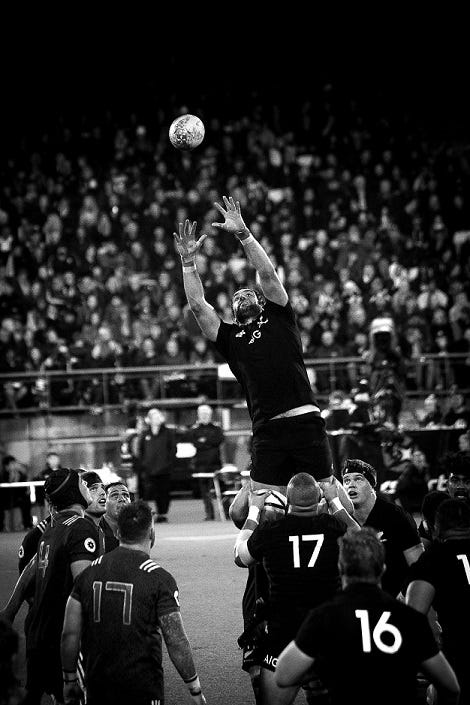
- To have these moments of awareness, you would have to be focused on the ball and pay attention to its movements until you caught it.
- The moments of awareness during which you remained focused and attentive on the ball is your ball-catching experience. If the experience was stored adequately in memory, you could recall salient aspects of it, think about it, judge your performance and possibly have an emotional reaction, all of which would enrich the experience with additional details.
- Some people believe learning is the purpose of life, which is a necessary function of many/most life forms. However, if learning is defined as knowledge acquired through experience, study, or being taught, then not every living thing learns. For example, a person without a fully functional brain that prevents cognitive processing or storage of experiential information does not learn, or a living entity that operates purely on inflexible instinctive responses need not learn.
Different Life Forms: Different Experiences
It seems reasonable to assume that all the kingdoms of life and viruses have some sort of awareness and all, except viruses, have species-specific experiences. Viruses are excluded because they aren’t living things.
The experiences of living things with a brain and sense organs are capable of certain sensory perceptions (vision, sound, touch, etc.), as well as mental processes such as thoughts, memories, and the ability to recognize and discern/discriminate. These experiences may be conscious (with knowledge of what happened) or unconscious (with only subconscious awareness).
More basic life forms, without an animal-like brains, would have experiences limited to simple sensory inputs, e.g., being aware of (sensing) a source of nourishment/nutrients and consuming it.
Note that I’ve not to this point addressed personal purpose(s) of human life. These are beliefs people have about the way they should live their lives based on religious/spiritual teachings about morality and virtues, as well as beliefs acquired based on cultural mores and societal norms. These types of life purpose focus on what individuals consider important and the right (or righteous) things to do. These are not fundamental purposes of all forms of life.
Metaphysical Perspective
Additional support for the proposal that experience is the fundamental purpose of all life comes from metaphysics. This line of reasoning relates to philosophical assumptions about nonmaterial (immaterial) aspects of life that are “beyond” that which is physical, e.g., the mind-body problem.
Key metaphysical concepts are Cosmic Consciousness and Universal Mind.
Consciousness, Mind, and Experience
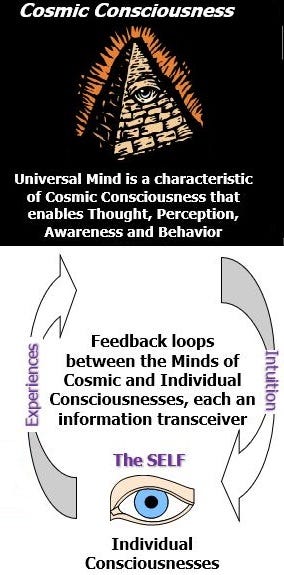
I hypothesize that Cosmic Consciousness (CC) is a nonmaterial “life-force” from which all forms of life are materialized following the Laws of Nature. Each life form, on the other hand, has an Individual Consciousness (IC) that gives it the ability to have awareness and experiences.
I also hypothesize that CC (which some may call God) has a Universal Mind that’s connected in some way with the individual minds of all ICs. These nonmaterial minds functioning as “transceivers” that exchange information through feedback loops. Intuitive information is transmitted from the CC to each IC, which provides ICs a form of understanding without reasoning (instinctive knowledge). And ICs’ experiential information is transmitted to the CC (and to other ICs).
Experience as Information Patterns
Think of it this way: When you have a visual experience, for example, electricity passes through the neural connections in your brain (see image below) and forms complex patterns of electrons where your brain exists (in space).
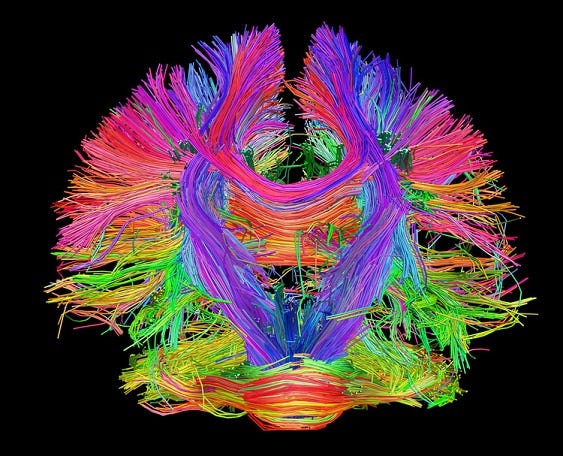
Information produced by these ever-changing energy patterns ultimately produces visual experiences in your mind. These informational patterns describe aspects of the particles (quanta) that make up the Universe.
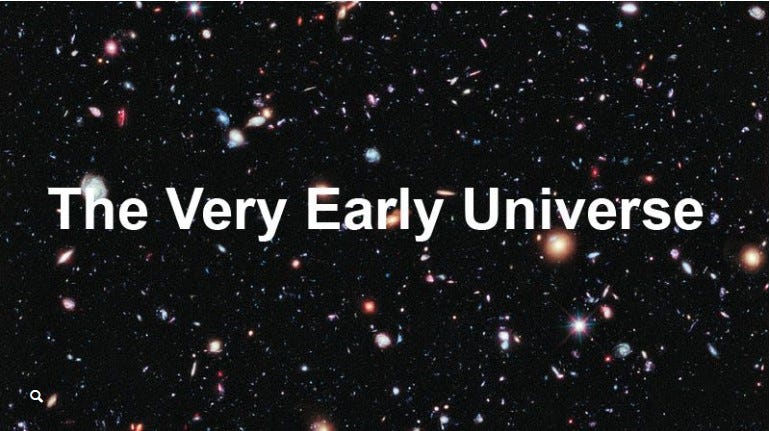
Furthermore, the bits of information the patterns contain are never destroyed. Case in point is the fact that information from the very early Universe is available to us as it existed over 13 billion years ago (see image below).
Information Patterns: Dual Functions
I propose that these patterns of information serve two functions:
- An IC’s mind interacts with its brain (and/or nervous system) to transform the patterns into perceived (or subconscious) experiences.
- CC’s Mind is “enriched” by that information. I envision CC’s Mind as containing all the information in the expanding Universe, and the information patterns of life-based experiences have exceptional complexity thus provide greater enrichment.
Thus, the fundamental purpose of life from a metaphysical perspective is, once again, to experience.
Conclusion
Whether using logic alone, or logic plus metaphysics, I contend it’s reasonable to conclude that experience is the fundamental purpose of all life. Being alive and experiencing, therefore, is a minimal, though adequate achievement for humanity to fulfil its most basic life purpose.
However, for our species to thrive long-term, we must have a purpose that exceeds the bare minimum. It’s important to adopt meaningful personal purposes, which I explore in Part 2 at this link.


