
FUTURE
The Mathematical Superformula Shifts a Lot in Our World Right Now
What is the Superformula? It is a Rainbow Formula!
As a biomimicry professional, I try to keep track of many changes in our world and spread the news so more people in all kinds of sectors will be able to jump the bandwagon and be part of the wave of nature-inspired change that our ugly, angular, grey world needs so badly.
In 2013, I discovered the mathematical Superformula, given to science by the Belgian professor Johan Gielis. If I’m completely honest, maths isn’t really my biggest talent, I’m a wordy person. But I immediately felt there was something I needed to find out about it. And it turns out my gut feeling was right.
At the beginning of this year, Johan Gielis contacted me and asked me: “How can we explain the Superformula in a simple way so more people can transform the world with it in line with nature’s laws?”
I had no clue back then. I always want to understand things myself first and embed them into what I already know about the world. So, we had regular conversations together. I listened to wonderful explanations about bamboo rhizomes (the roots of bamboo), the modern philosophy of Deleuze and Guattari, and read stories from the South American writer Julio Cortazar.
And now, celebrating the 20th anniversary of the Superformula, I’m ready to tell you what I personally understand. I’ll try to explain the workings of the Superformula, why I think it’s so special, and where the formula is used already. It has been tested on 50,000 plant forms and still holds true. One formula for all shapes of nature. Amazing!
Our world is shifting. Our world is finally understanding that our Planet has emergent properties when we include dynamics. We finally are learning how to deal with that in science, technology, business, and daily life.
I’m curious to know what you think about all of this. Let’s talk…
The Worldview
It’s good to know upfront that the Superformula has been created from a Gaia Hypothesis worldview. Complexity patterns and living systems. Biomimicry.
Not Etherea or Immortalia (humans may control nature). Not Habitiania (limiting progress and still polluting and wasteful sustainability).
Gaia is the worldview of people who know that people are an intrinsic part of nature’s web of life. Not above it, not trying to control it. That our planet Earth is a self-regulating system and nature has the capability to be regenerative. Self-healing. Creating. Becoming. A worldview that has the confidence that people can design our human systems and inventions to include all this and be regenerative, self-healing instead of destructive, as an automatic result.
If you want to read more about these different worldviews, have a look at Reon Brand’s co-emerging futures. He describes the differences clearly.
The Superformula Itself
What is the Superformula? It’s one bio geometry formula for all shapes of nature.
What do we need to know about current ways of defining the world of human technology and engineering to understand its huge implications?
- Human technology has been reductionist so far and doesn’t know how to make complexity practical in design and thought patterns. Only in biomimicry, technology combines material minimalism with expansion in space to fulfill a function
- We know so much about nature, our planet, and quantum physics right now that new methods of science might well bring humanity much quicker in line with planetary laws of evolution. And that will bring regeneration quickly closer
- Power in physics and methods in geometry are all based on the old formula of Pythagoras. A²+B²=C². Circles and lines. Although this formula was accredited to the Greek, it is way older. According to the Brittanica, it stems from India, the cradle of Vedic geometry (sacred geometry) too
- Nowadays, however, the Pythagoras formula doesn’t fit anymore with the knowledge of quantum physics that atoms can be particles and waves at the same time
- After Pythagoras came the Lamé curve, the Superellipse. Now, the extension of that is the Superformula. This new approach fits very well into the paradigm of quantum physics replacing old-school physics
- Pythagoras has an (often hidden) influence on many other areas of our technology as well. E.g. distances in statistics and data sciences are always measured in linear steps. That’s why they are so little compatible with modern complexity insights
- Electricity, light, and sound are always measured in circles and lines with the Pythagoras formula too. The old physics theories have become ‘the only truth’ in engineering and business. Sadly, quantum physics stays limited to quantum mechanics because of it
- Dynamic processes shape our world. Human technology now is only static, not dynamic. It only looks at the matter. It doesn’t involve air, ether, vacuum. Flow, emergent properties, and dynamics are seldom included in our mathematics, physics, chemistry, biology, neurosciences, or data sciences so far
“Heraclitus, I believe, says that all things pass and nothing stays, and comparing existing things to the flow of a river, he says you could not step twice into the same river.”
— Plato
- In the past twenty years, since Johan Gielis gave the Superformula to science, more than 50,000 biological shapes have been tested. The Superformula still stands firm as the explanation for all shapes of Nature
- In biology, there are no circles. Even no near-circles. So circles and lines can never approach the reality of nature
- Circles and spirals are exceptions to the rule. The rule is the existence of super circles, super ellipses, and super shapes in general
I personally think we need a new fundament for science, based on biology and planetary insights. If we would have that, it wouldn’t be so hard to create regenerative technologies in all sectors that define human life on earth. We could easily build living systems, combining the smallest with the interconnected bigger shapes in organisms.
Johan and I agree on this view, and his teams are now developing a new scientific language based on nature, planet, and biology. The new language will refer to the old physics and mathematics as exceptions to the rule.
Why Is the Superformula so Special?
Many people ask me this question. They hear my enthusiasm. I’m really to the core of my bones excited about the progress the Superformula now makes in our reductionist, blind, and often super-arrogant sciences and engineering based on old-school physics laws.
To be honest, I don’t always think highly of sciences. Quantum physics is often robbed of clear proof like the observer in the double-slit experiment. Or robbed of thought experiments, like the Schrödinger Cat quantum superposition, how to be particle and wave at the same time.
Where’s the curiosity and stretching of imagination that so characterized Nobel prize-winning quantum physicist Richard Feynman?
Why do we stay so reductionist and materialist?
Just to make it fit into old-school physics ideas that matter is more important than the 99.9% space, air, ether, vacuum, anti-matter between the molecules of what we can see and touch?
To prove that matter is more important than dynamics and interconnecting flows? We reduce complexity to make it fit into something that doesn’t even begin to resemble our real world. And that makes me sad.
It’s time to question the still widely held belief that one cause has one effect. And that measuring needs to be done linearly and in steps. If we don’t move on from that belief, quantum physics will always be reduced to quantum mechanics. And remain a mere shadow of the real possibilities to shape our world in line with planetary laws.
Please read my explanations of the Superformula with an open mind and let the torrential rain of opportunities sink in before you tell us what you see.
My Explanations
I would personally have liked to call the Superformula the Rainbow Formula because it doesn’t need steps to merge from one color to the next. We can merge in all kinds of multi-dimensional directions. And do not have to combine different shapes to come to a new shape.
Physics focuses on Newtonian colors (quantitative colors measurable with Pythagoras), and they mock Goethe for his colors (he based his science on observation and it’s how I studied complexity science at Schumacher College).
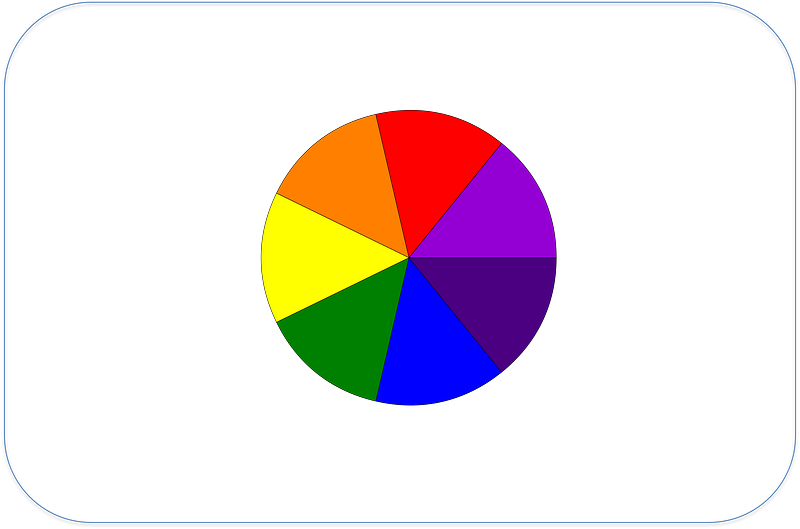
Newton saw the world like above. I, and Leonardo da Vinci, Goethe, and many other scientists in different fields, including Johan Gielis, see the world like below. We start from Nature. And deduct without limiting our views.

Geometrically, however, both types of colors, Newton and Goethe, fit in the same framework. They all exist along with each other. They can transform into each other, in the same way as the Superformula can morph shapes, colors, and sounds without steps.
What do I mean with steps? Have a look at exponential growth. This is the mathematics of nature. We have long thought that one cause has one effect. But of course, that’s not true. There are always factors like accumulation. And then growth suddenly starts to happen exponentially.
1+1 = 2
2+2 = 4
4+4 = 8
8+8 = 16
16+16 = 32
In 5 steps we have gone from 1 to 32. We increased with accumulation.
Can the Superformula help us to finally combine exponentiality with merging shapes? Will we find the formulas for interconnectedness? And make quantum leaps forward in the ways to get complexity thinking into engineering and organizational thinking like logistics and business?
Will we finally be able to think like organisms? Evolving in spirals of birth, growth, death, and decay?
Very simply said, the Superformula makes it possible to merge shapes. We can go back to the middle before we make a new shape. It doesn’t work with static opposites like normal mathematical and technological formulas but can easily create all colors of the rainbow in between.
In my opinion, there are a few things that make the Superformula unique and simple:
- The Superformula is one formula for all shapes of Nature. But it goes way further than shapes. It has the possibility to quantify flow and dynamics. It can play a huge role in the emergent properties of becoming
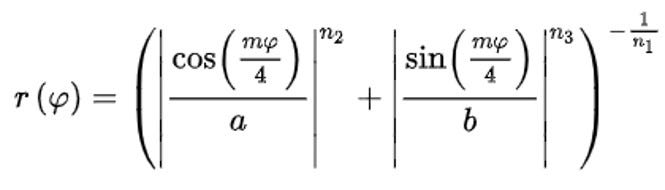
- By choosing different values for the parameters a, b, m, n1, n2, and n3 different shapes can be generated
- The sinus and cosinus are well-known in current mathematics. In the Superformula, they bridge the shape of an even-sided triangle with the immense possibilities of all shapes in dynamic forms.
- The Superformula is a Pythagoras+ formula. The Superformula evolved via the Superellipse of Gabriel Lamé, therefore its name. And of course, the first fans of the Superformula, who suggested the name, might well have been racing fans
- Supershapes (link explains the software) are generated by the Superformula. Not only superellipses and supercircles are special cases, but also circles and ellipses
- It is not only a grand generalization of the circle to include starfish, polygons, and more. It is also a deep specialization, generating unique shapes, their development, and evolution. The smallest and the biggest. Zooming in and zooming out
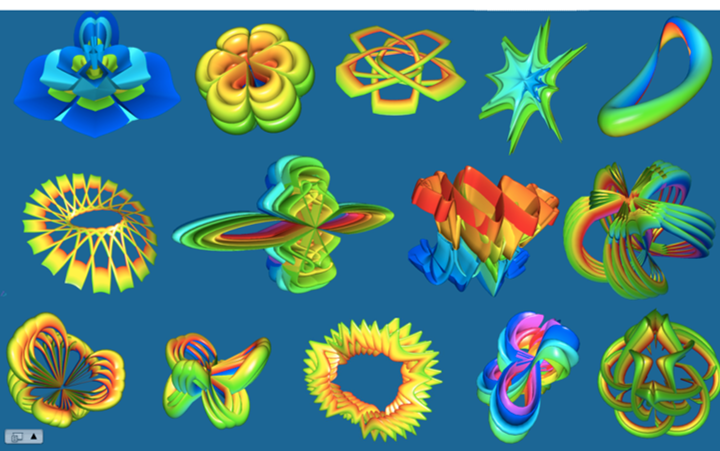
- When juxtaposing spheres, cubes, and the complex shapes in the figure (top picture), by any measure, all these shapes are very complex, not easy to draw, make or think. From a Superformula perspective, they are simple, actually as simple as sphere and cube, just a different set of parameters.
How Do I Work With the Superformula?
As I said earlier in this article, I cannot completely understand formulas like this with my rational brain. I need to involve my arational brain to get a feeling for what formulas can do. This is how I explain it to our grandchildren, my friends who shout at me “I don’t understand mathematics!”, and my old mum and her friends.
We start with an open dot. A core.

Then we blow air into the core, so the outer ring expands. The outer ring is not static, however. This ring is flexible, like an elastic band.

All shapes of nature can emerge from the dot. And the core stays in the middle. Every time another shape is needed, the outer ring contracts and becomes a core again. We can go back to the middle and blow new air in. Another shape can emerge.
It’s like breathing lungs. Expanding and contracting with air coming in and going out.
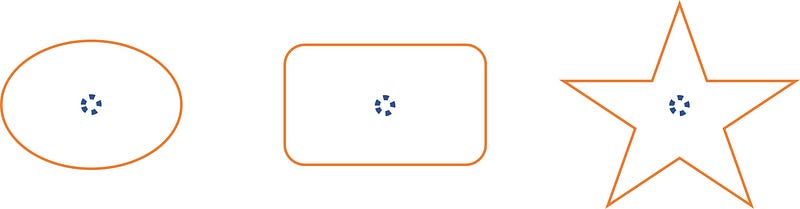
In my illustration, the star is too angular though. A starfish isn’t angular. And years of scientific testing prove that the Superformula has been used to make her skin.

Where Is the Formula Already Used?
Johan Gielis gave the Superformula to science 20 years ago. And in those 20 years, many things happened. Luckily, the Superformula is now taught in many schools and universities. And I really hope many more will follow.
The Superformula is one of the most cited papers in science nowadays, so it seems that lots of scientists are starting to see what I see and developing their own fields with the knowledge. Finally including dynamics into our so far mostly statically explained world.
Areas of use are:
- MRI scanning devices
- Data sciences
It would solve a lot of energy issues with data centers if there would be a Superformula protocol for designs sent over the internet. I envision an extension like .jpg for Superformula. Or does it already exist and I just haven’t been able to find it (yet)?
The Superformula saves a factor of 1 million data sending and the size of files. Instead of sending 30,000 triangles for a 3D printing design, we can send one dot and transform it on the other side into the right shape and form.
Huge progress for additive manufacturing. All biomimicry professionals are super enthusiastic about 3D printing and local production with minimal material use. We know Nature 3D prints all her shapes. Not with a printer of course, but in the air. In ether. In space.
Neri Oxman, a professor at MIT, just did the most exciting research, viewing for the first time how a butterfly prints her own wings in her cocoon. 3D printing in ether. We will figure out how Mother Nature does it sometime soon and then we can do it too…
For me, the biggest advantage of 3D printing is that we can create futures of modern, local manufacturing in communities. Small, interconnected, distributed solutions with benefits for all people and all other species, but that’s for another story.
Other uses of the Superformula are in:
- Neurosciences. Especially the emergent properties of becoming are interesting
- Antennas. All shapes of nature are antennas. Our whole skin is a receiver. And now we can use this knowledge for technology and inorganic materials too
- Architecture. Here is a building envisioned with the Superformula. Flow can finally enter buildings in ways they never could before
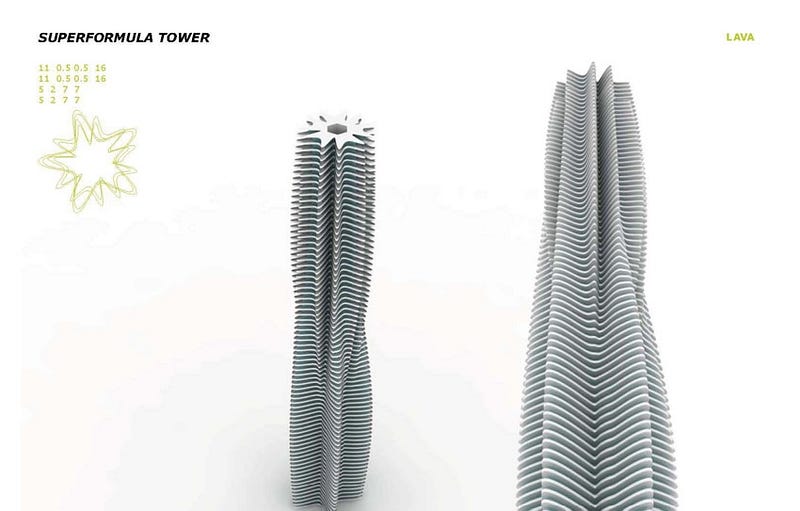
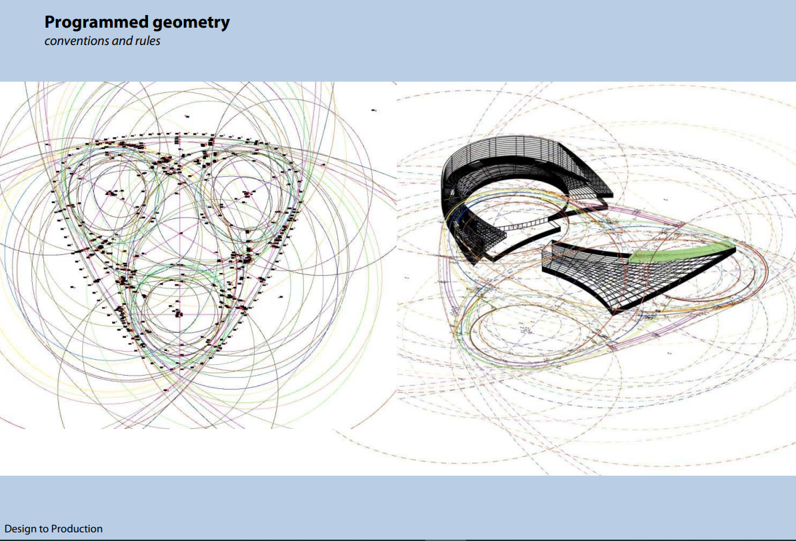
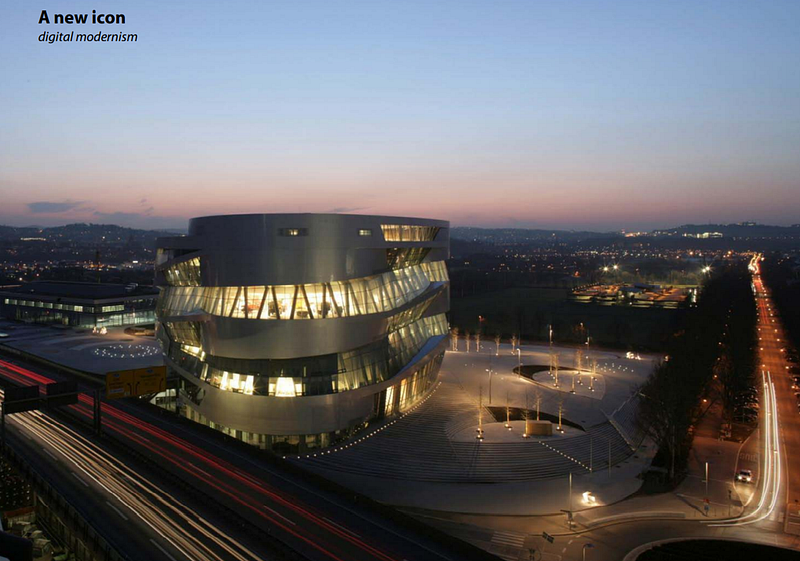
Of course, as a permaculturist and biomimicry professional, I want to add the remark that we should please build these new buildings as healthy buildings. Without off-gassing materials. Designing for maintenance during its lifetime. And reuse or composting after lifecycle completion.
What’s Next?
Just keep an eye on Johan Gielis’s teams. They are now working on more Gielis Transformation formulas and are preparing a new breakthrough with a formula that brings quantum physics closer. They are currently proving how music works through air, ether, point zero, vacuum.
Space filled with information. That kind of stuff. Very quantifiable.
Perhaps you can imagine the scientific earthquakes as soon as he will publish that formula. I’m getting excited already. It might just help Resonance Science to become widely recognized and valued too. It might merge the Unified Field theory with the Morphic Field theory and finally include the views of cell biologist Rupert Sheldrake.
And that’s a personal wish of mine. I want us to quantum leap beyond reductionism, beyond materialism, into the future of spacetime. And I feel it in my bones that humanity is getting closer…
Science Methods
As a last remark, I want to tell you why not only the mathematical formulas of Johan are shaking our hardcore sciences. Also, his method of performing science and approaching research is remarkable for beta sciences like mathematics, physics, chemistry, biology, ecology, and others.
We all know that in the earlier days of science, polymaths like Leonardo da Vinci, Von Humboldt, Goethe, Viktor Schauberger, and Nikola Tesla combined observation with experimentation. It’s my method too.
But in science, polymaths are not that popular. We are considered ‘not rational enough’. Too much about quality whereas science wants quantity, quantity, quantity, and matter, matter, matter only.
In our current scientific world, we believe deep experts and quantity more than deep generalists and qualitative methods, who recognize that beauty exists but cannot objectively be measured. So our work is often not believed. Especially not by physics people and hardcore engineers.
Therefore, we need new methods in hardcore science, quantity, and biotechnology too. Combining observation with measuring, testing, and statistically proving. Johan’s teams are combining deep observation of the natural world with making a crack in what we already know to be true.
There’s always more to know. It never stops with one theory. The universe is expanding too quickly for that and there’s still soooooo much we don’t know yet… So, Johan Gielis and his team widen the space in the crack and prove their theories quantifiably.
In the seemingly empty space of the crack, new insights happen. And the crack opens wider again. It’s a hardcore, scientific method completely in line with the thought of emergent properties, evolution, and becoming. And I like that.
All organisms, also our human bodies, are 99,9999999% space. It isn’t empty space. We know that this space is full of information. It is how Nature does technology, as Julian Vincent has proven.
Can we finally create a human world in line with our planetary laws? A world that knows entropy is only part of the story? After all, the Poincare Recurrence Theorem is finally combined with quantum physics and proven in 2018. If complex, quantum many-body systems are left alone, they will return to their initial state with almost perfect precision.
So much is shifting now in our sciences. I get excited only thinking about it. But that’s for another story…
Will you let me know what you think? Do you understand a little more about the Superformula now and why I’m so excited? Tell us. Let’s talk…
Thank you, Mike, for adding your wise energy to my words on Abundanism, Simple Abundance. © Désirée Driesenaar, 2021


