
The Interstate Of Things
Highways to Hell or Freeways of Love? Interstate Highways — the Roads Most Traveled (*Includes Fun Facts!)
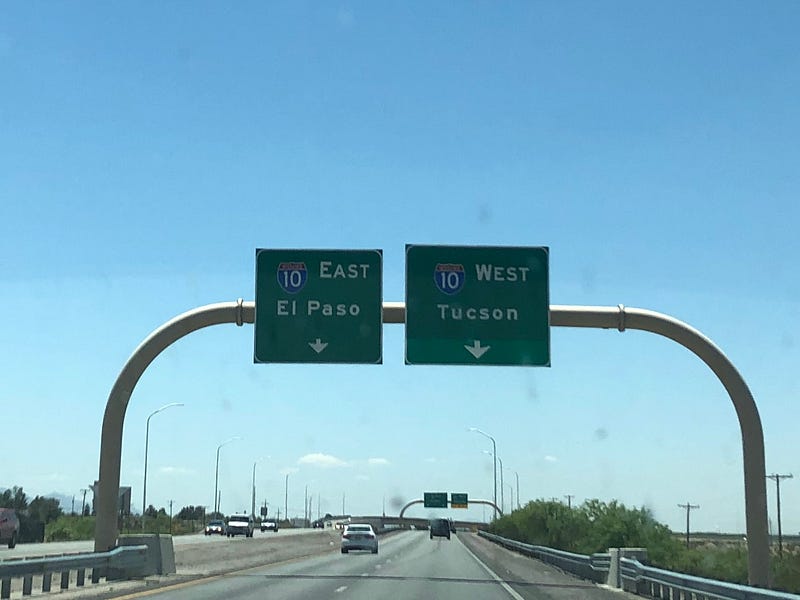
Millions of Americans use Interstate highways every day to commute to work. They’re the roads we love to hate. Long commutes to work in a car in bumper-to-bumper traffic are the bane of our existence.
But when they’re wide open, we know we can get away with going at least ten mph over the speed limit without a bruise. And for getting us out of town quickly, we love them.
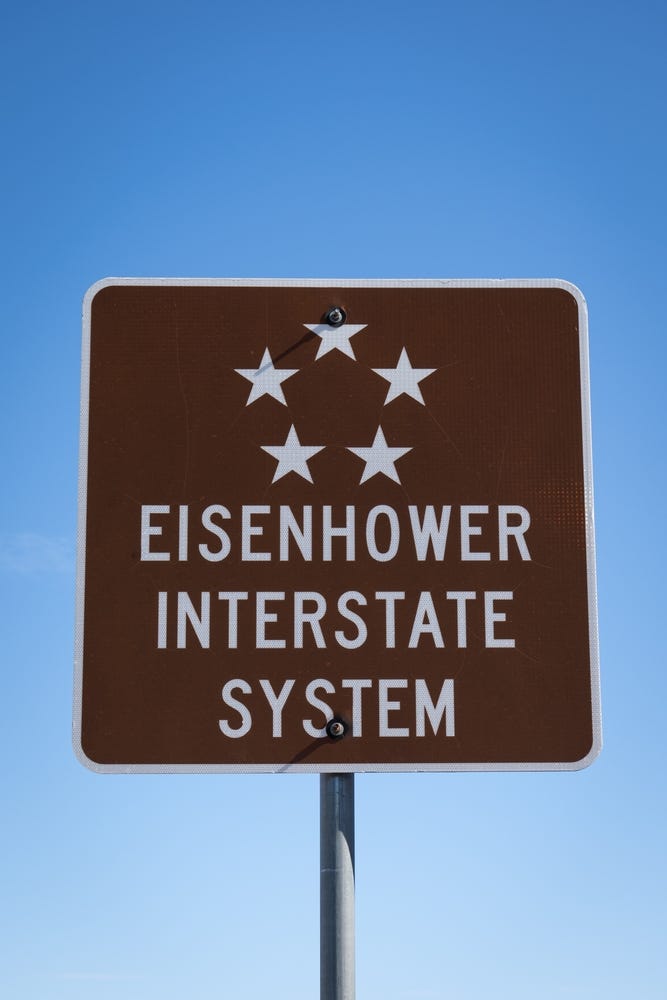
Like we have today, a national highway system was first conceived as far back as the 1920s. However, it wasn’t until the 1950s that the Interstate highway system began construction under the Eisenhower administration. Thus, it is officially named The Dwight D. Eisenhower National System of Interstates and Defense Highways. One of the main reasons for building it was to give U.S. troops and artillery the ability to be anywhere quickly and safely in the event of domestic disturbances. In other words, war.
Before the Interstate system was built and completed, traveling by car was a little slower and much more picturesque. Every town you’d pass through was different and had its own flavor.
Now, at least in the rural areas, we go around towns, not through them. That not only helped alleviate congestion in those towns and cities, but it also eliminated it! So much so that businesses had to shut down for lack of traffic. Some towns died altogether. A good example is I-40 taking over Route 66.
Interstate highways carved whole neighborhoods in half, leaving noisy and undesirable ones in their wake. Areas like this were redlined, suburbs popped up, and white flight began, made possible by the Interstates.
Progress is not always pretty. But does it always have to be so plain?
The Interstate Highway System has homogenized America.
Everything is the same!
There might be six fast-food restaurants at this exit, but let’s wait for the next exit, where there will be six more. Surely you will find what you’re looking for between the two. Unfortunately, there are few regional restaurant fast-food chains now. In-N-Out Burger was once a novelty when traveling the far west. Then they go and open restaurants in every state around us (Texas, Utah, Colorado), and Oregon. Why not New Mexico?
Excuse me, but New Mexico is right between Arizona and Texas! All you’d have to do is make a stop on I-10, I-40, or I-25 on your way to that forsaken land known as Texas. Drop off some burgers and potatoes and go! Once again, we get passed over.
Sorry, I just got a little personal there.
I miss Howard Johnson’s [fried clam strips!] and Stuckey’s. I miss stopping at Bob’s Big Boy in Flagstaff because that meant we were halfway to somewhere. But I especially miss small diners and cafes.
Let’s move on to…
FUN FACTS!
Fascinating tidbits most of which most people aren’t aware.
Did you know:
- According to the original numbering scheme in the U.S., north-south highways would be odd-numbered, and east-west roads would be odd-numbered. Before there were Interstates, we had, for instance, U.S. 1 straddle the East coast, with U.S. 101 going up and down the West as the main coastal highways.
- The Interstate numbering system is the exact opposite. For north-south routes, they start with a low number in the West (i.e., I-5) and go up as you head east (I-95, for instance). For east-west, I-10, the southernmost transcontinental highway, starts in Santa Monica, CA, and ends in Jacksonville. In the north, At 3,021 miles, I-90 from Seattle to Boston is the nation’s longest Interstate.
- The shortest interstate in the contiguous U.S, I-87, is in North Carolina and is just 13 miles long. But the H-2, on the island of Oahu in Hawaii, is only eight miles.
- There are Interstates with numbers above and below those mentioned above. For example, I-4 exists entirely within the state of Florida. I-2 is a yet-to-be-completed road extending from Harlingen, TX, to Laredo.
Do these numbers make sense? Can you relate? Maybe if I put it into today’s words, like “the 10” or “take the 101 north”. Make sense now?
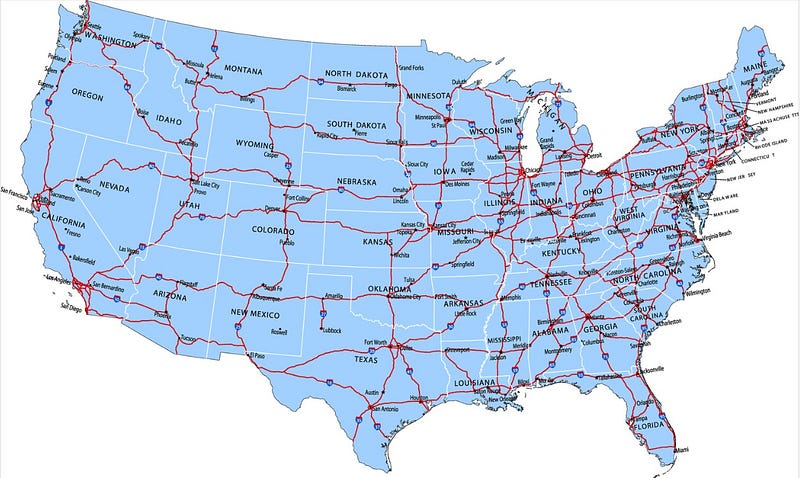
- Why is there no I-50 and I-60? I thought you’d never ask. I’ve been dying to know myself! Interstates with those numbers would likely pass through states with US 50 or US 60 already running through them. To have both highway numbers in one state is generally disallowed under highway administration guidelines.
- Take I-50, for instance. It would have to be north of I-40 and run through Nevada. US 50 already runs through that state from border to border, so having an I-50 would confuse many people.
- The lowest-numbered Interstate, I-2, mentioned above, follows the Rio Grande Valley along the Texas/Mexico border. It is so new it’s not even on most maps.
- Although an I-98 is planned for upstate New York, I-96 is currently the highest-numbered Interstate, at 192 miles long and entirely in Michigan.
- Three-numbered Interstates are either spurs (odd first digit) or loops (even first digit) that connect to a “mother” road. For instance, I-180 runs from I-80 south to downtown Lincoln, Nebraska, about 3.5 miles.
- The most congested piece of Interstate in the country is hotly debated. If you’re stuck in traffic, your city is the most congested! But by volume of cars daily, the winner goes to I-5 in Southern California, between Euclid Avenue and the 605. You could listen to “Interstate Love Song” three times between those exits! In all, Los Angeles takes the prize for the overall most congested.
- The least congested Interstates? It depends on how it's quantified, but among them are I-95 from Bangor, ME, to the Canadian border. Segments of I-25, I-29, I-70, I-90, and I-94 are also known to be light on traffic.
- Of course, Texas has the most Interstates (17) and the most miles of Interstate highway. After all, it is the second-largest state and the second-most populous.
- Finally, I-69 is the most disjointed Interstate in the country. (Of course, it would be 69.) When finished, it will extend from the Canadian border to the Mexican border, but presently it only goes as far south as Indianapolis. There are ten unconnected segments from Indy to the Mexican border. Pieces of I-69 exist in Indiana, Kentucky, Tennessee, Mississippi, and Texas, but none have been completed in Arkansas and Louisiana. Funding is the major stumbling block for the completion, and the states in question are cash-strapped.
Final Thoughts
The American Society of Civil Engineers (ASCE) gives the Interstate highway system a grade of D. They estimate the backlog of repairs would cost about $420 billion. The Federal Highway Administration puts the price tag at about $136 billion/year.
The ASCE gave the 616,096 bridges in the U.S. a report card of C+. The FHA estimates that 7.6% or 47,054 bridges are in poor shape. Doesn’t that give you a sense of comfort?
To invest in our highways is to invest in our safety and the future of commerce. Part of the “Build Back Better” plan was to provide funding for the projects mentioned above and to provide jobs for thousands of workers. Unfortunately, it was derailed primarily by two democrats: Joe Manchin (D-WV) and Krysten Sinema (D-AZ). Personally, I despise both of them for doing what they did, and neither one deserves their office.
The Interstates are congested-ridden eyesores in our urban areas and are constantly getting band-aids because we won’t provide the proper funding for their upkeep.
But, The Interstate Highway System is perfect for getting from point A to point B fast. However, to see the real America, take the next exit.
Related stories by Arthur Keith:
If you like what you’ve read, why not become a Medium member? It’s just $5/month and gives you access to all of my stories and those of all the other fine writers on Medium. Plus, I get a small commission which helps a lot! Just click on the link below. Thanks for being a member!


