
This is the Middle of Nowhere
It‘s Interesting if You Let it Be
It’s very humorous how some people define the middle of nowhere. Especially city folk.
Back in Chicago, people might call Aurora being in the middle of nowhere. Aurora, with nearly 200,000 residents, is not in the middle of nowhere. It is a city unto itself and is only 45 minutes east of “the city.” That doesn’t qualify.
Let’s say you go a bit farther west, to Rochelle, Illinois, population 10,000. Look, you’ve got every fast food restaurant you could want, two interstate highways in proximity, and a Speedway on every corner. Nope. Not even close.
What about the middle of Illinois, in a cornfield, miles from the nearest town? In my mind, as long as you can see some form of civilization, such as the farmer’s house (and you’re bound to see others too), you’re not going to die.
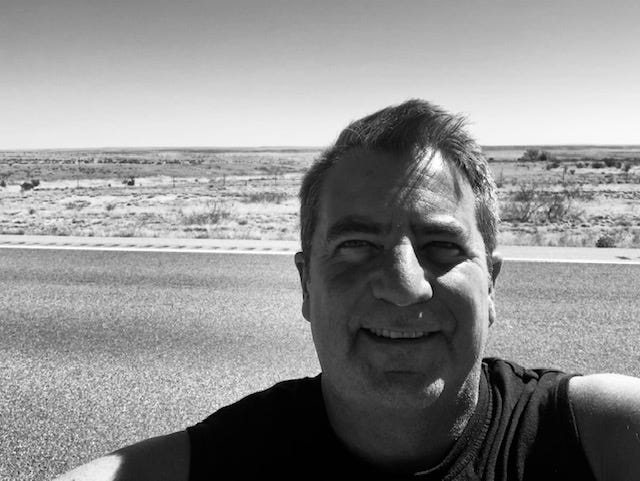
To me, the middle of nowhere is a place where you can see no sign of civilization as far as the eye can see. Such as the photo above. One could say, “there are power lines, and that’s a form of civilization.” But let’s not get nit-picky. A power line can’t help you with food and water.
Right now, I’m visiting my Mom in a city in West Texas that many would call the middle of nowhere. There could be some substance to that. It is off the grid in that it’s close to 90 miles to the nearest Interstate highway. But still, it has nearly 100,000 people, with an airport and everything. It just happens to be — remote.
I derive great pleasure from isolation. It’s important to know that there are still places in these United States that are pristine, even if they’re not all particularly memorable.
I took the above selfie between Santa Rosa and Fort Sumner, New Mexico. There were two forms of civilization at hand: a two-lane U.S. highway and power lines. But nothing else as far as the eye could see. I mean nothing. Not a farmhouse in sight. I guess the land wasn’t even good enough for grazing as there was no livestock. The only lifeform I saw was turkey buzzards eating away at the carcass of a jackrabbit.
I find it fascinating and comforting to know that areas such as these still exist in our country. And they’re accessible! If you drive hundreds of miles. It was an unusually calm day for the high plains. (Fun Fact: Amarillo, Texas, also on the high plains, is the third windiest place in the U.S.)
Sometimes I look just for quiet. I even drove a few miles off of the main highway just to get to a place that was quieter. Now and then you’d hear the faint sound of jet engines cruising eight miles high above you. That was it--nothing else.
I set out on this trip looking at eight hours of pure misery. Yet, I was constantly mesmerized by something in the distance. Sometimes it turned out to be nothing of substance or a mirage. (I did eat some marijuana gummies on the way.)
But then I opened my eyes and began to think. Imagine that.
The first town of any size I drove through was Clovis. If you had to use a definition of how or why New Mexico is always one of our most impoverished states, I’d use Clovis as an example. (Sorry to offend any Clovinians — if that’s a word.)
Entering Texas, you feel like something definitely changed. Irrigation perhaps? It is greener. The Ogallala Aquifer, the largest in the world of its kind, feeds this panacea. Oil pump jacks are surrounded by cotton fields that stretch over land that is flat as a pancake.
After that, you begin to see perfectly formed mesas in the distance, and then boom! All of a sudden, you’re descending from the Panhandle through small canyons and even badlands. Now you have arrived in the Permian Basin, one of the largest oil-producing regions in the world.
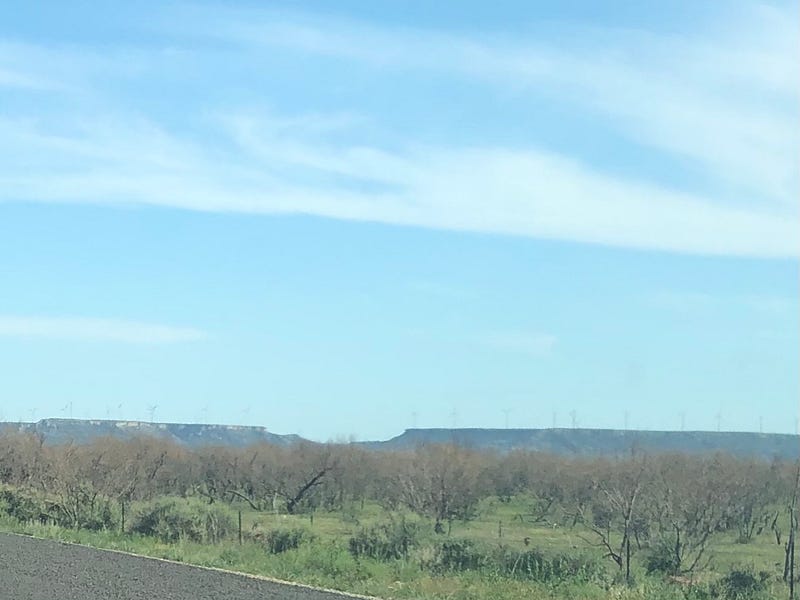
The Permian Basin is not particularly easy on the eyes. Still, if you look at it with some knowledge of basic geology, you’ll see millions of years of the earth’s evolution on one hillside. The vegetation is largely mesquite and cactus. Mesquite trees are some of the worst invasive species on the planet.
A single mesquite tree can consume nearly 21 gallons of water per day. It prevents grass from growing, harming farmers and ranchers. It is helping to suck up the Aquifer. They are trying to be controlled through poisoning and burning.
You can’t drive through this part of the country without mentioning wind farms. Hundreds, if not thousands of windmills dot the landscape as far as the eye can see. Texas is harvesting all the energy they can out of this hellhole. (Now I have to apologize to the Texans.)
Finally, you amble through the gentle hills and valleys of West Texas, through forests of mesquite, until you hit the oasis that is San Angelo. I call it that because a river runs through it, one of the few in this part of the country that doesn’t run dry. Part of the three forks of the Concho River is spring-fed. The confluence of all three forks is in San Angelo.
As we all know, Texans are very proud of their state and their land. I often make fun of it, but maybe this is how you have to look at where you live:
If you can’t be where you want to be, honey, love the place you’re at.


