
The Inherent Value of a Godless Universe
How aesthetics trumps morality in the search for objective values
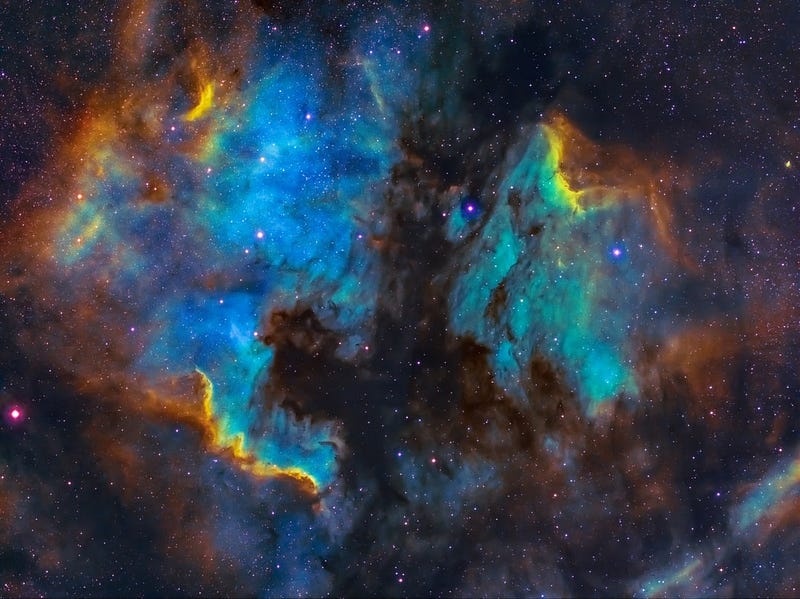
In our age of scientific progress, philosophical skepticism, and secular humanism, it’s become commonplace to assume that the objective world is perfectly amoral. Nothing in nature is inherently valuable. Our value judgments are subjective and meaningful only within a social context.
The skeptical philosopher David Hume pushed this line of thinking when he observed that descriptions and prescriptions have different logics, so that a prescription never follows only from a set of descriptions.
To take an extreme example, just because one person murders another as a matter of objective fact, doesn’t by itself entail that the act is wrong. The negative word “murder” entails the value judgment, but an objective description of the killing, such as the coroner’s account of the mechanics of death, will be morally neutral. And from purely descriptive statements, you can’t automatically derive a prescription or an evaluation of the facts.
Can Knowledge be Good if the Objective Facts are All Neutral?
One puzzle we’re left with on this view of nature’s neutrality is why we should continue to think of philosophical inquiries as being based on the traditional love of knowledge. If the objective facts are neutral, why should knowledge of those facts be good or lovable? Shouldn’t the facts’ neutrality be transferred to their mental representations?
Presumably, knowledge is worth having because it enables us to exploit nature’s neutrality or passivity. The world of objective facts would be like a dumb brute or a gullible victim that can be pickpocketed by a crafty schemer. We study how the world works and can use that information to our advantage, and although the external world remains indifferent to our exploits, our knowledge is important in the human domain that stands apart from the wilderness.
This isn’t the full story, however. We might think, on the contrary, that if rational inquiry discovers that the world is neither good nor bad and doesn’t care about us or our preferences one way or the other, we should dread rather than cherish knowledge. Doesn’t philosophy subvert the myths and mass hallucinations that sustain the social order? Doesn’t philosophy establish that most people’s happiness is sustained by fictions and illusions, and that the inhuman, objective facts can burst their dream bubble at any moment?
Why love “Sophia,” then, the goddess of Wisdom? Why was the Greek word “philosophia” coined in that fashion, as philo-Sophia, as the love of wisdom? The ancient Greek intellectuals evidently cherished knowledge despite that conflict with mass culture that led in part to Socrates’ execution by the state. But they did so because they took philosophy to have revealed a metaphysical duality.
Plato especially distinguished between the flawed world of materiality, impermanence, and natural changes, and the perfect world of intellectual abstractions and mathematical order. That dichotomy is implicitly teleological since our life’s purpose becomes the Orphic one of seeing through the fallen order that corrupts our senses, of escaping from that prison for our mind, and of understanding reality from a God’s-eye perspective to redeem the drama of cosmic evolution.
Although there were also atomists and skeptics in ancient Greece and India, most ancient philosophy and religion didn’t entail that the real world is amoral and pointless. The prevalent moralistic dualism — as in the duality between seeing the world the right and the wrong ways — informs Gnosticism, the Mystery Religions, Taoist mysticism, the ascetic renunciations of the Indian religions, and the monotheistic faiths with their contrast between fallen Creation, on the one hand, and Heaven, Paradise, or the Kingdom of God on the other.
The point is that knowledge in the philosophical tradition, which branches off into perennial spirituality or into the shamanic enterprise was beloved only by the enlightened few who had reconciled themselves to the conflict between the esoteric and the exoteric, the intellectual elites and the hoi palloi, reality and the realm of misleading appearances.
Perhaps, however, this philosophical theodicy isn’t metaphysically grounded but is just another myth that matters only to social creatures like us. Even if there are levels of being, as even theoretical physics seems to imply with its accounts of how the macrocosm emerges from less familiar microcosms, perhaps neither is inherently good or bad. Perhaps philosophers only label them so to dream up a grand purpose, to alleviate their alienation and allay their despair.
The Objectivity of Aesthetic Values
What could it even mean to say that something is intrinsically or objectively valuable? If a deity created nature, that God might deem the universe to be good, but that evaluation would be subjective. To be sure, God’s value judgment would transcend our thinking, but it wouldn’t transcend thinking as such.
Or if nature were good because it derives from a Creator who is intrinsically good, this would only push the problem back a step. What would it mean to think of the Creator as inherently good? God might be the fundamental, eternal basis of reality and of creativity, but those would be only descriptions. Why think that they entail the value judgment?
A major source of confusion here is that when we talk about these values, we’re thinking of morality, and morality is a social affair. Suppose the human world ends in a cataclysm and only one person survives the extinction event. Would that survivor have any conceivable moral imperative? I think not. Morality is about what you owe to others; it’s about treating others with respect to maintain peace in society. If there’s no society, the principles of morality no longer apply, and natural laws reign unchallenged. The world would return to its pristine, wild conditions.
But there’s another kind of value which seems especially relevant even to purely natural, asocial circumstances. This kind of value judgment is the aesthetic one, and it applies directly to creative acts. Notice, then, that even according to the most disenchanting, objective, scientific explanations, the facts at issue are supremely creative. The objective facts of nature overflow with creativity. Even if there’s no God, the universe would evidently be creating itself in some abominable mockery of the pretensions of intelligent designers like us.
From subatomic fluctuations to atoms and molecules, to plasma and nebulas, to galaxies and stars, to planets and life and civilizations, there is no objective description of the facts without an acknowledgment that every natural cause or emergent order is a step in a palpable, sublime creative process. The process evidently involves colossal destruction, as in the cases of entropy and black holes for example, but the net effect at present, at least, is the magnificent product of godless creativity that we call the (rationally explained) natural universe.
The question, then, is whether the aesthetic value judgments — not about human art but about natural evolutions and biproducts — are themselves objective. Are natural events good or bad in strictly aesthetic terms, or are aesthetic judgments confined to the sphere of intelligently designed art? We say, for example, that some stories or movies or songs are original rather than clichéd? Can the same be said for natural productions? Can we speak of novel solar systems and hackneyed moons?
Certainly, the aesthetic discourse would have to change because intelligently designed products are intended whereas nature’s mindless ones aren’t, at least not according to objective philosophical and scientific explanations. Still, the essential value dichotomy would remain between beauty and monstrous ugliness.
And those values are independent of the perceivers in the case of nature’s aesthetic status. Even if no life evolved to appreciate what nature has been doing, the natural order would be beautiful or hideous because that judgment would attach to the objective description of nature’s causes and effects which amount to nature’s creative process.
In so far as it’s objectively true, that description is supposed to refer to facts which are so regardless of whether they’re known. The moon would still be round even if no one ever saw that satellite. And the universe’s unfolding would be rapturous or grotesque even if no one witnessed the cosmic cycles, evolutions, and regressions.
The Aesthetic Judgment of the Universe
Suppose you’re convinced, then, that aesthetic values are objective when applied to natural causes and effects. Which aesthetic value would be paramount? Do we know how to judge the aesthetic merit of natural productions?
Popular religions typically assume that for all its “fallenness,” nature is at least indirectly good because God says it’s so or because God’s somehow using Creation to achieve a worthwhile purpose. But in anthropocentric fashion, those religions construe the cosmic purpose to be moral, which conflicts with the implicit madness of monotheism and of monistic mysticism. (The lone God of consciousness would be fundamentally asocial, to the detriment of his sanity and of his creation.)
Nature worshippers likewise typically feel that nature is beautiful, whereas Arthur Schopenhauer combined pantheism with the ascetic upshot of Indian religions, construing nature as fundamentally monstrous. Yet either monolithic judgment seems meaningless without the contrast with the opposite value.
In short, not enough attention is paid to this aesthetic implication of pantheism. We would have to begin by divesting ourselves of our mere human aesthetics, since natural products aren’t like artificial artworks. Next, we’d have to view nature with such supreme irony that even to entertain this perspective would invite a graduation to a transhuman mental state. That is, we’d have to deaden our mentality to imagine what nature’s creativity amounts to it in the cosmos’s mindless terms, while retaining, of course, our sentience and preferably our sanity.
We’d have to adopt a paradoxical perspective whereby we’d suspend our personal preoccupations and meld with the natural art. As when we’re thinking objectively, we’d detach from our parochial frame of reference, and entertain a broader viewpoint. But instead of having promethean instrumentalism as our ulterior motive, as in the case of technoscientific inquiries, the pantheistic aestheticist would attempt to digest the universe’s aesthetic import.
What is the meaning of a godless creation? Is the universe an accidental triumph of blind matter and energy or a hideous, doomed perversion? Are there untold aesthetic values to be found by further exploring this paradoxical outlook? And could the aesthetic appreciation of nature’s creativity be more existentially grounded than the wily crafting of scientific or philosophical theories to trap nature and to bend it to our will?


