
The Dread of Pantheistic Enlightenment
Animism, decadence, and transhuman vision
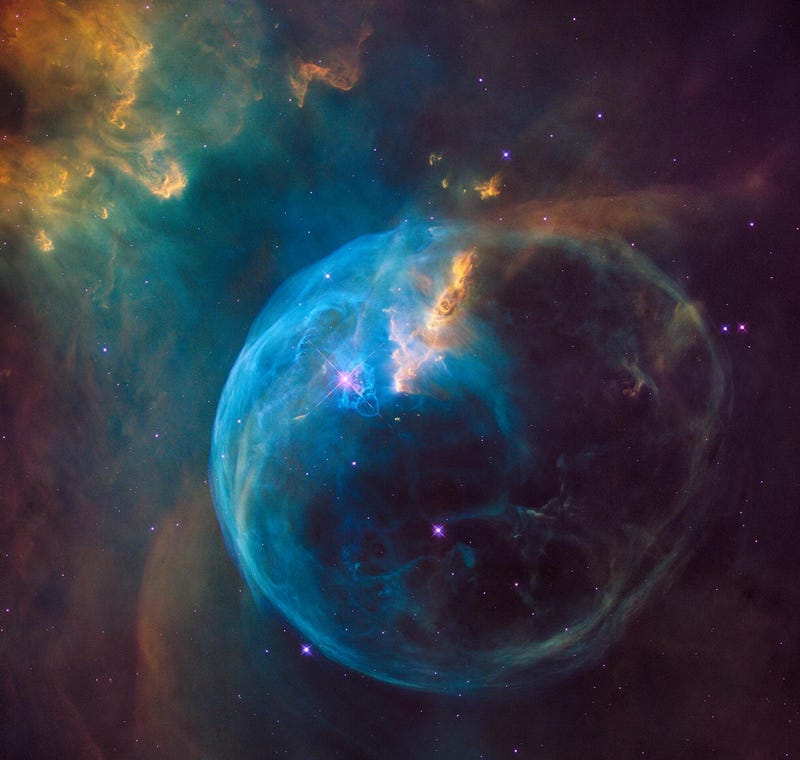
When I was a child, some friends and I squeezed the air and joked we were pinching God, because we must have heard from somewhere that God is everywhere. The omnipresent deity must have great stamina, we assumed, to withstand so many creatures crawling around on him for so long, unintentionally slapping him or bumping into him.
Of course, our fallacies, in that case, were plentiful, the most damaging and childish of which was the assumption that God, the ultimate aspect of reality that transcends human comprehension would be alive on Earth, capable of feeling pain.
Life is what happens when certain chemicals interact to evolve organic hosts of a genetic code that simulates the selfish urge to maintain itself across the ages and the transformations of environments. Life is not the principle that ensures there’s something rather than absolutely nothing, nor the cause of the “fall” of pure simplicity and symmetry into a state of material complexity.
Suppose, then, we start from a position of existential humility, and refuse to entertain any longer the self-serving assumption that human nature reflects ultimate reality. Suppose we reject the notion that the source of the natural universe (or of what there really, objectively is) might end up being something that thinks or feels or that has plans. Suppose we dismiss the conceit that we’re made in God’s image.
In that case, the word “god” might be dispensed with as meaningless. Certainly, that word would be tainted by thousands of years of archaic misconceptions. Talk of gods would be wrongheaded in so far as “god” has become a mere name, “God,” and thus also an aspect of our vain efforts in humanizing our environments.
However, we’d be hard-pressed to set aside the concept of divine, awe-inspiring power and creativity, because even atheists are confronted with the divinity that hides in plain sight, namely with the self-created and evolving natural universe.
Animism and Decadence: From Prehistoric Infancy to Civilized Infancy
Assuming the prehistory of the world’s religions was comparable to the religions of the primitive societies studied by anthropologists, religion developed out of a conceptual looseness in the relation between what we moderns think of as subject and object. Our prehistoric ancestors deemed objects to be alive or “animated.”
We can see why this would have been so just by reflecting on what it would have been like to live in the Paleolithic era, with no clear separation between the nomadic clans of hunter-gatherers and the rest of nature. The oldest known Neolithic settlements go back to around the eleventh millennium BCE, the oldest city being Jericho, originating around 9,000 BCE.
But art and culture are much older: there are cave paintings as old as a Neanderthal one, from around 64,000 years ago; the earliest European figure paintings are from the Upper Paleolithic and are earlier than 30,000 years old. The oldest known burials are from 35,000 to 26,000 years BCE; language probably dates from 150,000 to 200,000 years ago, and Homo sapiens emerged from Africa 300,000 years ago.
This means humans had at least the cognitive capacity to perceive the world as a magical place long before religious practices developed, according to the archeological record — rather like how children experience the world as strange, playful, and as revolving around them long before they can do anything about it. A child must grow into an adult before he or she can contemplate organizing his or her thoughts and practices with others. Collectively, too, religious experience may have predated religious practice.
In any case, behavioral modernity dates to at least the Upper Paleolithic, to around 40,000 to 50,000 years ago. That includes tens of thousands of years before the agriculture revolution and the emergence of sedentary societies. For at least tens of thousands of years, then, nomadic tribes of hunter-gatherers would have followed their prey, found shelters where they could, and foraged for food in the wilderness. They would have viewed themselves as part of nature — and nature was an animated place.
Think of the changing weather patterns, the shifts between night and day, the brilliance of the night sky (with zero light pollution from electric lights), the cycles of life and death, the noises and smells of the flora and fauna.
When humans formed permanent settlements, we walled ourselves off from the wilderness and became preoccupied with our social hierarchies and specialized functions. We became less self-sufficient and more dependent on technology and on social conventions. The upper echelons had the luxury of becoming infantilized by their decadence, thanks to their control of large populations of slaves.
The hunter-gatherers, however, were more childlike in a different respect, since their cultural memory would have been meager compared to that of the much later generations that could look back on thousands of years of recorded history and on the uncovered evidence of millions of years of life’s evolution. The minds of Paleolithic people likely occupied mainly the present moment, not their distant past or future.
Most importantly, however, civilized people surround themselves with artificial reflections of their mentality in cities that displace the wilderness and in social functions that replace nature’s rhythms. Thus, the later cultures are more self-centered and anthropocentric, as we became hubristic and alienated from the nonhuman world. The polytheistic religions that arose in the early kingdoms and empires codified and rationalized their regimes by projecting their social hierarchies onto the imagined order of fully-personified reifications of natural processes and of their political ideals, namely onto the social order of gods.
By contrast, the hunter-gatherer mentality would have been absorbed in the immediacy and bizarreness of what we think of as natural events. To survive, prehistoric people would have had to attempt to understand the patterns around them, especially those that pertained to their food, shelter, and reproduction. But their concepts would have been childlike, not “sophisticated,” to use the pejorative, positivistic term that presupposes the idea of historical progress.
We assume the childish experience of the world is based purely on ignorance, error, and desperation, and that just as adults have a superior grasp on what’s going on than do children, the later generations in the development of our species understand the world better than did the much earlier stages, because the later ones have accumulated so much more information.
And that’s correct with respect to our technical mastery and crystalized (symbolic) knowledge. But it’s possible we pay a price for those advances, namely overfamiliarity with what’s hiding right in front of us, with the divine otherness of natural being.
As Max Weber put it, the more we rationally understand and control nature, the more we “disenchant” what was once perceived as magical. This isn’t entirely correct, mind you. Erik Davis explains in Techgnosis how artificiality becomes a new magical realm. And as Peter Watson points out in The Age of Atheists, science has revealed nature to be more mysterious than we ever could have imagined; see, for example, quantum mechanics, black holes, and the sheer astronomical scale of the known universe.
Still, knowing something is strange isn’t the same as being able to perceive or to feel it as such. Watson thus emphasizes the late-modern need for poetry, since poets defamiliarize us with the particular and reacquaint us with the preverbal otherness of our so-called ordinary, dominated environment. A new atheist, for example, may know all about quantum weirdness, but be hubristic enough to dismiss every hint of the numinous as a hangover of wayward ancient superstitions.
We moderns know the universe is inhuman in its godlessness, but have we reckoned with the full implications of that fact and developed a culture to honour and explore this return of cosmic dread and awe?
Pantheism and Monstrous Divinity
Enter pantheism, the worship of nature that harkens back to prehistoric animism and that was revived in Eastern mysticism (Daoism, Shinto), Wicca, the philosophies of Spinoza and Schopenhauer, and the neo-platonic theorizing of physicists such as Albert Einstein, Roger Penrose, and Paul Davies.
Suppose someone says, “Nature is divine.” Would that statement be regressive and obscure? Would it be as arbitrary as saying that nature’s beloved and awesome since it provokes an overpowering emotional reaction when we recognize our helplessness in the face of natural forces? What would be the use of thinking of nature as the true God, as it were?
We can begin to answer these questions by setting aside the possibility that nature is personal and intelligent. Some mystical naturalists, such as panpsychists and proponents of the Gaia hypothesis do the contrary, but there’s no need for their speculations.
Raw, hard science provides all the evidence we need of nature’s divinity, since every physical explanation, for example, is about a type of supreme creative destruction. Causation, complexification, evolution — these are the very features of the face of “God,” of the only awe-inspiring superhuman creative power there’s likely ever been.
To wonder whether nature’s divine is to ask whether we ought to recapture an aspect of children’s experience of the world, to refresh our memory of how cosmically pitiful even our Luciferian mastery over nature is. The duration of our species will be negligible in relation to deep time. An ocean of alien, inhuman events will wash over all our accomplishments as though none of us had ever lived. That sea of natural events, which stretches from the Big Bang to the winking out of the last star a Lovecraftian eon from now is the true “God,” a self-creating and self-destroying order that encompasses all life the way we might accidentally brush a speck of dust into our rear pants pocket.
Natural divinity may be impersonal, but this insentient deity seems perfectly monstrous, which is to say that certain aesthetic and existential evaluations are implied by science and by philosophical naturalism. What is a godless order of creativity but the paradigm of all the ghastly, shambling monsters we invent in our horror stories? This is the cosmicist horror that inspired H.P. Lovecraft, the biblical leviathan, dragon, or behemoth that simulates and bastardizes life by acting in some orderly fashion, but without any mere human mentality or mammalian direction.
The fictional monster’s body is alien and horrific, symbolizing ultimately the otherness of nature, and the wilderness that includes not just jungles, deserts, and tundra, but the vastness of outer space is the primal terror and the final wonder. From zombies and werewolves to dragons and chimeras, we imagine an inhuman, animated form that isn’t supposed to work but that somehow exists all the same to terrorize us with its indifference and with its motions towards an alien end.
In so far as this is supported by scientific theories, the monstrousness of nature provokes a fear that might as well be called the fear of God. The thought of nature’s divinity isn’t arbitrary, therefore, but an implication of the lack of any god in the naïve, theistic (human-centered, non-cosmicist) sense; perhaps, also, this pantheism foreshadows a form of transhuman enlightenment.
The Prospect of Pantheistic Enlightenment
Enlightenments or spiritual/existential revolutions proceeded from the dawn of abstract thought to the childlike, prehistoric wonder of animism and to the juvenile pride in a civilization that produced the polytheistic reflection of our elaborate dominance hierarchies; to the Axial Age’s mystical monism and globalized cosmopolitanism; and to science-centered modernity’s liberation of the individual from Western Christianity’s systematic betrayal and suppression of the Axial enlightenment.
Perhaps the next round of existential insights will return us to a child’s appreciation of the world’s mystique. We’ll have the godlike power from technologies that apply cutting-edge knowledge of how matter and energy behave, but also the humility and poetic intensity to enshrine nature’s majestic strangeness. We would be in the position of the sorcerer’s apprentice, but with no sorcerer to guide us or to clean up after the bumbling abuses of our wizardry.
The problem, though, is that all experience is addictive — and not just the kind that threatens polite society. Our childhood seems magical because in it we have our first experiences which provide the context for all our subsequent ones. A child can barely contain her joy or disgust when tasting something sweet or bitter for the first time.
Everything is magical at that point because the child’s brain is working overtime to comprehend the strange new sensations. With little in the way of background understanding, each childhood experience stands as a paradigm, as a weird, totemic particular. As we age, we more easily lump our encounters under some rubric: it’s all just another dessert, game, folly, theory, animal, thunderstorm, day, night, or whatever else.
Just as the drug addict can’t easily recapture the initial high and tragically is reduced to overdosing or to settling for milder stimulations, most adults become jaded compared to the child’s naïve wonder for the unfamiliar world. We’re all junkies in that sense since the adult brain no longer struggles as it once did and doesn’t automatically reward us with joy or punish us with horror for settling into a routine.
Thus, the prospect of pantheistic enlightenment calls for a transhuman leap in consciousness. Anyone who could feel in her bones the inhuman power of every natural event would be a Lovecraftian saint. She’d laugh maniacally at our Faustian conceits, at our conceptual schemes, technological constructs, and religious boasts. In Spinoza’s terms, she’d perceive everything from the “perspective of eternity,” as being “blessed” in its metaphysical context, as an outgrowth of nature’s “substance.”
Inverting the optimism of Spinoza’s medieval formulation and opting for the more fitting, hypermodern, and cosmicist diction, we should say this saint would be struck with horror at the futility of every organic fluxing in the “pants pocket” of nature’s monstrous appendages, given the enormity of this quasi-divinity that mocks our barbarous personifications.


