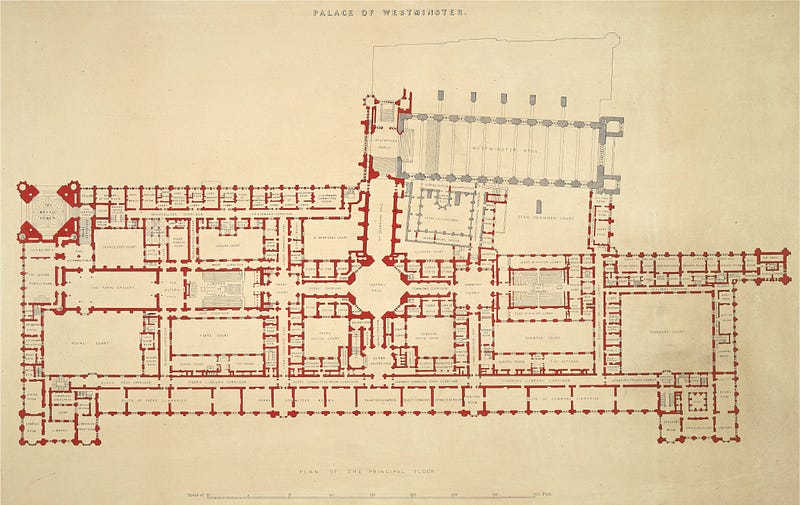
The House of Pugin
How three generations of one family defined the Gothic Revival and changed the face of nineteenth-century Britain and beyond.
The name of Pugin has become synonymous with the revival of the Gothic style in the late-eighteenth and early-nineteenth-century, although he didn’t start it… and was more than one person! I’ve often read in the accompanying literature for a stately home or grand public building that a certain feature was ‘a Pugin’. It’s always proudly proclaimed, though it’s often unclear which Pugin they refer to… I find it helps to think of the Pugins as one of the earliest ‘design houses’.
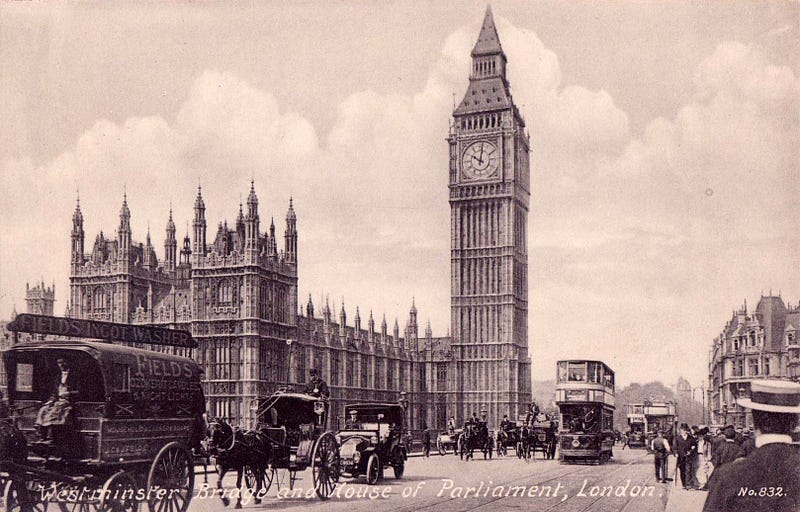
Probably, the most famous of the design dynasty was Augustus Welby Northmore Pugin, famed for his Gothic restyling of the Palace of Westminster in London — better known as the Houses of Parliament — and for designing its iconic clock tower — widely known as ‘Big Ben’ in reference to the huge bell it accommodates. But it all really started with his father…
Augustus-Charles Pugin was born and raised in Paris, but fled to what was then Great Britain where, by 1792, he’d enrolled at London’s Royal Academy. There’s a probably romanticised account of his leaving France to escape the consequences of a duel he’d, presumably, won. It’s more likely, though, that he left to escape the mounting violence of the French Revolution that culminated in The Reign of Terror in the early 1790s.
As an immigrant, he found it difficult to gain employment in England in his chosen field of architecture. Eventually, he joined the firm of John Nash but, due to the prejudice of clients, he was rarely credited for the many significant commissions he contributed to. It’s now thought that Augustus-Charles may’ve had a hand in many of the significant works that Nash built his reputation upon and is recognised as one of the most influential instigators of the Gothic Revival.
Horace Walpole’s novel of 1764, The Castle of Otranto, is cited as the earliest expression of the Gothic Revival, written under the influence of the early Romantic movement. Walpole’s own house at Strawberry Hill, completed in 1776, was perhaps the first grand example of the Gothic Revival in architecture that set the trend. Unlike preceding renovations of medieval structures it was built, from scratch, in a deliberately Gothic style with an attempt to reference historically authentic features.
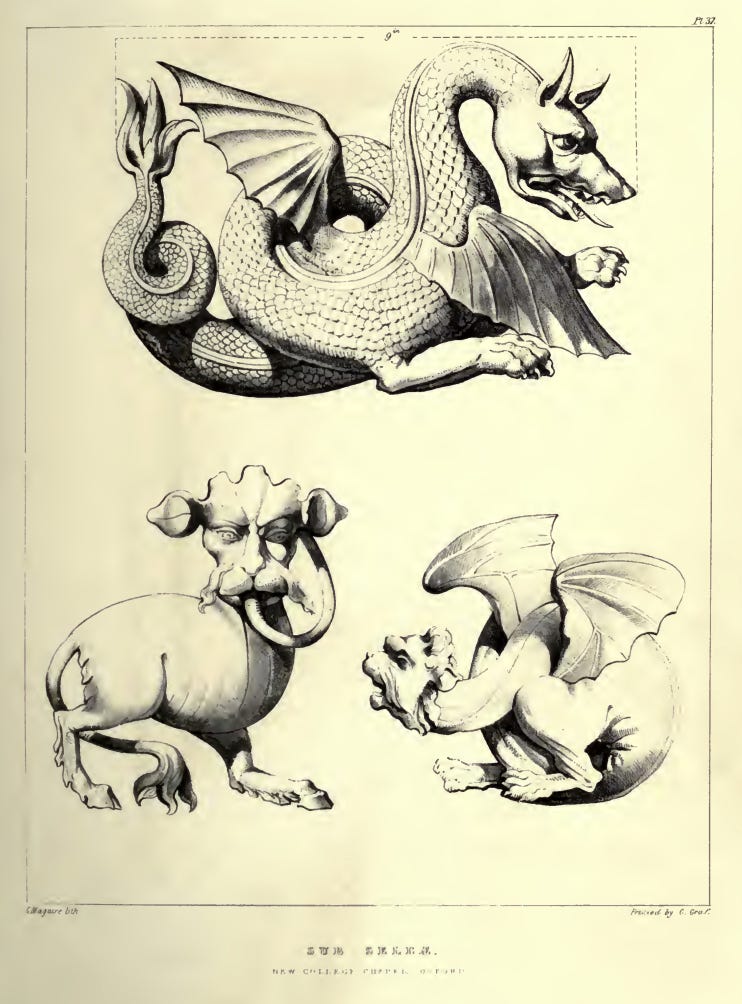
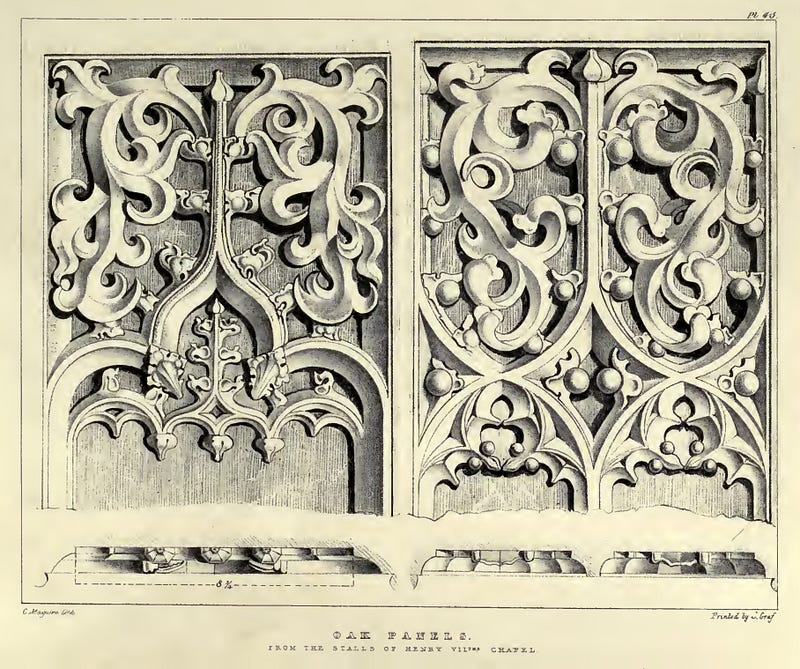
Augustus-Charles Pugin was to capture the zeitgeist at a time when that Romantic notion of a medieval ‘golden age’ of chivalry had become fashionable. His employer, John Nash is known for a series of grand houses styled after medieval castles, the first of which was his own residence, East Cowes Castle on the Isle of Wight, erected over four years at the turn of the century, 1798–1802.
The influence of Augustus-Charles Pugin was spread through his many beautiful, and meticulously researched, illustrations of Gothic ornament. These he published as collections of lithographs, and were later collected into sourcebooks used as definitive reference by the eminent architects of the era. His designs were hugely popular, not simply due their clear yet delicate style and quality, but for their authenticity.
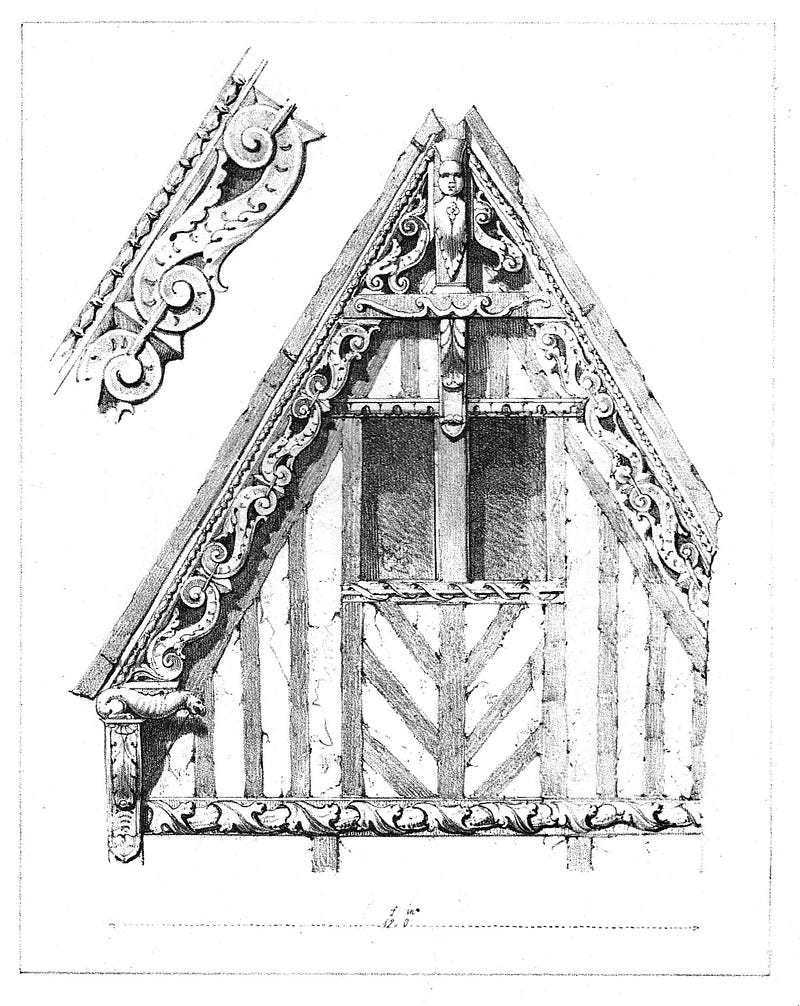
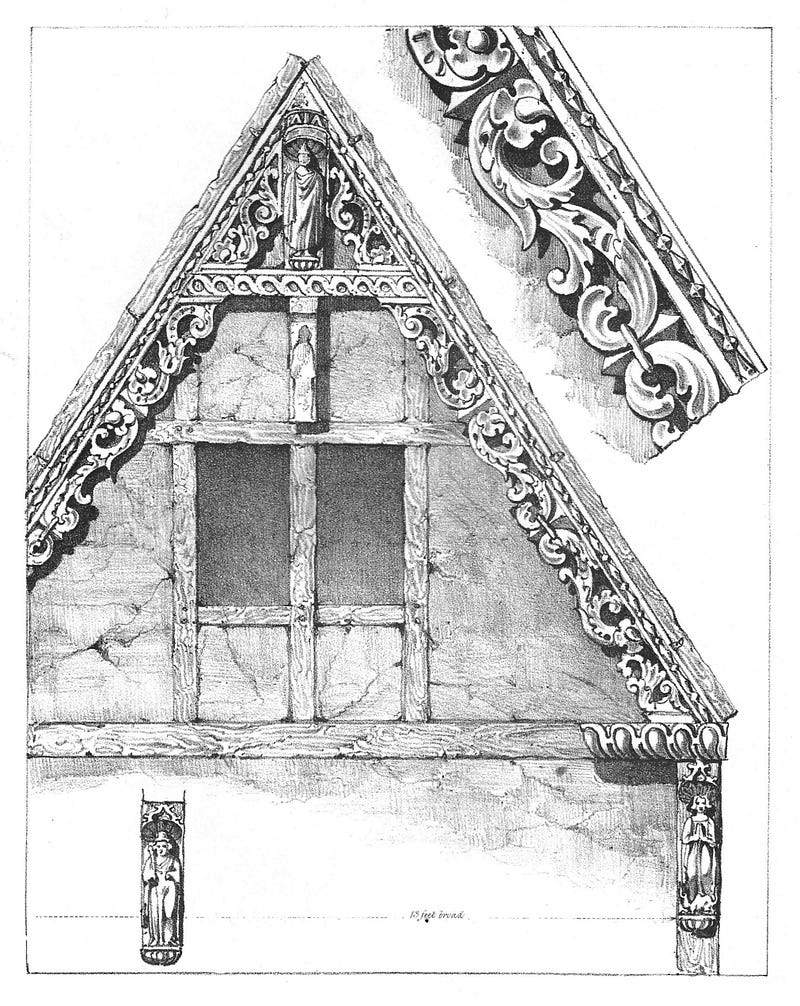
Rather than fanciful reinterpretations of what the Gothic may’ve been, he made a sustained effort to record the real thing. Following the example of the pre-Romantic poet and visionary, William Blake, he began with meticulous studies of the statuary in Westminster Abbey before travelling far and wide — including a return to France to study the architecture of Normandy — searching-out surviving examples of Gothic buildings and their original, unaltered decorative details. His son, Augustus Welby Northmore Pugin, accompanied him on some of these foreign forays as he too trained as an architect…
Whilst working in the offices of John Nash, Pugin also trained various apprentices who are thought to have helped him prepare and compile his visual reference drawings. Among them were Benjamin Ferrey, Thomas Talbot Bury, and Joseph Nash, all of whom were to became prominent artists and architects that would carry the Gothic heritage of Pugin forward in their own work.
After the original Palace of Westminster was destroyed by fire in 1834, a competition to design the new building was advertised. Augustus W.N Pugin, just like his father, also faced prejudice even as he built a professional reputation with his furniture and theatrical set designs. He knew that as the son of a French immigrant, and a recent convert to Catholicism, he wouldn’t stand a chance of winning the Westminster commission. However, his colleague, the architect Charles Barry, submitted the designs on his behalf. Despite the brief being to rebuild in the classical English Renaissance style, Pugin’s overtly Gothic designs were, rather surprisingly, selected.
Around this time Augustus W.N Pugin also produced an illustrated treatise intended to promote the use of authentic Gothic design and equate it with a higher moral standard he thought had become severely eroded. He believed that most of the new so-called Gothic-style churches springing up across England were of shoddy, inauthentic design. So, he fervently championed the genuine Gothic buildings exemplified by the great Notre Dame Cathedrals of medieval Europe.
In his series of prints titled Contrasts, he juxtaposed sixteenth-century Gothic examples with the contemporary equivalents he saw as a blight on society. Their message was ostensibly humanitarian, though also a thinly veiled critique of what he saw as the failings of the Anglican Church, when compared to the Catholic.
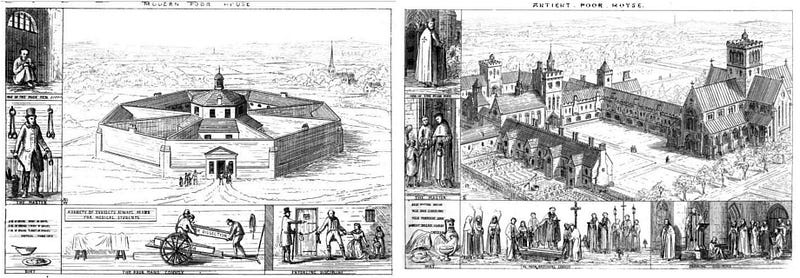
In Contrasted Residences for the Poor, he showed the terrible conditions experienced in a ‘Panopticon’ style workhouse with those of a medieval monastery dedicated to caring for the poor. The former was a hell-hole where the poor were underfed, exploited, beaten, and used for medical experiments after death. The latter showed scenes of a caring environment, with nutritious food, education, and a ‘good Christian burial’.
Pugin and Barry collaborated on the prestigious project to rebuild The Palace of Westminster as the New Houses of Parliament in the grand Gothic mode. With Barry operating as overseer and coordinator, Pugin was mainly in charge of designing the interior structure and décor. The final contribution made by Augustus W.N Pugin was the design for the new clock tower that we now know as ‘Big Ben’. That part was completed posthumously, after his early death in 1852, and was inaugurated in 1859.
He was survived by two sons, Edward Welby Pugin and Peter Paul Pugin, who continued to run the successful architectural practice known as ‘Pugin and Pugin’.
So, that makes four Pugins!