avatarSadie Seroxcat

Free AI web copilot to create summaries, insights and extended knowledge, download it at here

7996

Abstract

e horrors of the unconscious mind</h3></div> <div><p>medium.com</p></div> </div> <div> <div style="background-image: url(https://miro.readmedium.com/v2/resize:fit:320/1*9U8X-hMx1WbbS0Fz1IaMwA.jpeg)"></div> </div> </div> </a> </div><p id="6401">Also this one, written by <a href="undefined">Kamna Kirti</a>:</p><div id="aef7" class="link-block"> <a href="https://readmedium.com/lady-godiva-the-nude-who-rode-a-horse-a99df89f7aed"> <div> <div> <h2>Lady Godiva — The Nude Who Rode a Horse</h2> <div><h3>5 sensual interpretations of ancient women by John Collier</h3></div> <div><p>medium.com</p></div> </div> <div> <div style="background-image: url(https://miro.readmedium.com/v2/resize:fit:320/1*GcpRwdmJ76sgC2sUsXwClA.jpeg)"></div> </div> </div> </a> </div><p id="b475">The beautiful poetry of <a href="undefined">Arthur Dewson</a> also references a lot of the things I’m interested in:</p><div id="2a94" class="link-block"> <a href="https://readmedium.com/averno-c9c40a940ba9"> <div> <div> <h2>Averno</h2> <div><h3>Canto I</h3></div> <div><p>medium.com</p></div> </div> <div> <div style="background-image: url(https://miro.readmedium.com/v2/resize:fit:320/1*[email protected])"></div> </div> </div> </a> </div><div id="390b" class="link-block"> <a href="https://readmedium.com/averno-2a3a5ae70ec6"> <div> <div> <h2>Averno</h2> <div><h3>Canto II</h3></div> <div><p>medium.com</p></div> </div> <div> <div style="background-image: url(https://miro.readmedium.com/v2/resize:fit:320/1*gLLT0AI6JrtbsY0Zu1nNhA.jpeg)"></div> </div> </div> </a> </div><p id="a2e8">….particularly (for the purposes of this piece) Persephone and Lilith — and of course, <a href="undefined">Asterion</a>, the Minotaur.</p><figure id="c276"><img src="https://cdn-images-1.readmedium.com/v2/resize:fit:800/0*GJN-BEZqqrZlyH3q"><figcaption>Photo by <a href="https://unsplash.com/@eyesofmuk?utm_source=medium&amp;utm_medium=referral">Mukul Kumar</a> on <a href="https://unsplash.com?utm_source=medium&amp;utm_medium=referral">Unsplash</a></figcaption></figure><p id="444e">Modern understanding of goddess worship sees Lilith as synonymous with Inanna, Ishtar, Asherah, Anath and Isis. Some would include Kali in this list, goddess of creation and destruction, goddess of the dark moon. According to certain learned minds, Lilith was originally the Sumerian, Babylonian and/or Hebrew mother goddess of childbirth, children, women and sexuality.</p><p id="7cda">Historians and mythographers like <a href="https://www.marinawarner.com/">Dame Marina Warner</a> claim that early Christians in the Middle East assimilated elements into what became a cultish following of the Virgin Mary; and compare Syrian laments which describe Mary’s compassion for her son on the cross with terms found in Ishtar’s lament over the death of Tammuz.</p><p id="adc6">Astarte is the Hellenic form, possibly influenced by the Ancient Greek Aphrodite — goddess of love, lust, pleasure, passion and protection; her associative symbols include myrtle, roses, doves, sparrows and swans — and of course, Aphrodite also connects with Venus.</p><p id="ec42">The accounts and representations of Venus are also diverse- though at root, the basic mythology does always remain recognisable.</p><figure id="9115"><img src="https://cdn-images-1.readmedium.com/v2/resize:fit:800/0*_h1FRXv136hkmw-h.jpg"><figcaption>‘Nascita di Venere/The Birth of Venus’ — Sandro Botticelli (1483–1485)</figcaption></figure><blockquote id="b996"><p>“Things do not start well. Venus — or Aphrodite as she was originally called by the Greeks — was a primordial creature, said to have been born out of an endless black night before the beginning of the world. Ancient Greek poets and myth-makers told this ghastly story of her origins. The earth goddess Gaia, sick of her eternal, joyless copulating with her husband-son, the sky god Ouranos (sex which left Gaia permanently pregnant, their children trapped inside her), persuaded one of her other sons, Kronos, to take action. Gathering up a serrated flint sickle, Kronos frantically hacked off his father’s erect, rutting penis and threw the dismembered phallus and testicles into the sea. As the bloody organs hit the water, a boiling foam started to seethe. And then something magical happened. From the frothing sea-spume rose ‘an awful and lovely maiden’, the goddess Aphrodite. This broiling, gory mass proceeded to travel the Mediterranean, from the island of Kythera to the port of Paphos in Cyprus. But despite her violent and salty start, the young goddess, as she emerged from the sea on to the barren, dry land, witnessed a miracle: green shoots and flowers springing up beneath her feet. The radiant, enigmatic creature, followed by ‘comely desire’, was quite a sight to behold:…..</p></blockquote><blockquote id="115f"><p><b><i>She set on her skin the garments which the Graces and the Seasons had made and dyed in the flowers of spring-time, garments such as the Seasons wear, dyed in crocus and hyacinth and in the blooming violet and in the fair flower of the rose, sweet and fragrant, and in ambrosial flowers of the narcissus and lily’</i></b> (Kypria, Fragment 4, transmitted in Athenaeus, 15.682D–E, trans. Breitenberger)</p></blockquote><blockquote id="40cb"><p><a href="https://www.goodreads.com/book/show/50358527-venus-and-aphrodite">Hughes, Bettany. ‘Venus and Aphrodite’</a> (pp. 7–12). Orion. Kindle Edition.</p></blockquote><p id="e1fe">(<a href="https://www.bettanyhughes.co.uk/">Bettany Hughes</a> is an incredibly engaging professor of history who writes excellent books and presents an array of documentaries).</p><p id="0979">Even though the old Mesopotamian religions faded as Assyrians converted to Christianity, the worship of Venus persisted in parts of upper Mesopotamia (which were to become Arabic states) right up until the dawn of the Islamic period.</p><p id="ba70">It is recorded that Isaac of Antioch says the Arabs worshipped ‘the Star’, also known as <a href="https://www.britannica.com/biography/al-Uzza">Al-Uzza</a>, which many historians identify as Venus. He also mentions a deity called Baltis, most likely yet another variation on Inanna/Ishtar. In pre-Islamic Arabian inscriptions it seems that Allat was also a Venusian goddess.</p><figure id="6990"><img src="https://cdn-images-1.readmedium.com/v2/resize:fit:800/0*uYiB56UmiuPgP0Hq"><figcaption>Photo by <a href="https://unsplash.com/@bradleycdunn?utm_source=medium&amp;utm_medium=referral">Bradley Dunn</a> on <a href="https://unsplash.com?utm_source=medium&amp;utm_medium=referral">Unsplash</a></figcaption></figure><p id="6332">Many goddess-based myths, from scattered locations across the globe and throughout time, involve an underground cavern, a portal, a tree of knowledge, a priestess and a serpent.</p><p id="b22a">Inanna/Ishtar is known to have been considered to be the Queen of Heaven, but one of the most well-known stories from her mythology is about the descent into and return from the Underworld.</p><p id="8b7e">The Mesopotamian/Sumerian underworld was called Kur.</p><p id="2d53">There is only one surviving account in Sumerian, telling a tale of Inanna’s descent to the Underworld, in which we find her described as the ‘Destroyer of Kur’.</p><p id="348e">Inanna was worshipped as the Goddess of both Warfare and Love (combined we could say Conquest). She was not the goddes

Options

s of marriage though and had no children. In this I am again reminded of Lilith - and also Kali. As a war goddess she was often depicted as dimorphic/androgynous/gender ambiguous/nonbinary. A ‘feminine’ figure with ‘masculine’ presentation — and here I can’t help but get drawn back to another childhood fixation, with the story of Jeanne d’Arc….also known as Joan of Arc, St. Joan, the Maid of Orleans and/or the Maid of Heaven.</p><figure id="3a8d"><img src="https://cdn-images-1.readmedium.com/v2/resize:fit:800/0*FkMBAQ3ff-yQhFbM.jpg"><figcaption>‘Joan of Arc’ — <a href="https://www.wikiart.org/en/john-everett-millais">John Everett Millais</a> (1865)</figcaption></figure><p id="f9e4">I’m sure many readers will be at least vaguely familiar with this story, but if you’re not, go <a href="https://www.history.com/topics/middle-ages/saint-joan-of-arc">here</a>. There’s also a film about her, starring Milla Jovovich:</p> <figure id="09af"> <div> <div> <img class="ratio" src="http://placehold.it/16x9"> <iframe class="" src="https://cdn.embedly.com/widgets/media.html?src=https%3A%2F%2Fwww.youtube.com%2Fembed%2FaCbMOQIs45s%3Ffeature%3Doembed&amp;display_name=YouTube&amp;url=https%3A%2F%2Fwww.youtube.com%2Fwatch%3Fv%3DaCbMOQIs45s&amp;image=https%3A%2F%2Fi.ytimg.com%2Fvi%2FaCbMOQIs45s%2Fhqdefault.jpg&amp;key=a19fcc184b9711e1b4764040d3dc5c07&amp;type=text%2Fhtml&amp;schema=youtube" allowfullscreen="" frameborder="0" height="480" width="854"> </div> </div> </figure></iframe></div></div></figure><p id="257a">I saw the play <a href="https://gutenberg.net.au/ebooks02/0200811h.html">‘Saint Joan’</a> written by George Bernard Shaw when I was eleven, I think, possibly twelve. The main part was being played by <a href="https://www.imdb.com/name/nm0487743/">Jane Lapotaire </a>and I was mesmerised. Of course at that point in my life, the Christian religion I had been raised with was important to me, though that was soon to change drastically (another story for another day perhaps).</p><p id="d763">Greta Thunberg has been likened to Joan, by the author Margaret Atwood, because of her youth, gender and shear gritty tenacity.</p><p id="c0e2"><a href="https://www.irishnews.com/magazine/entertainment/2019/11/06/news/margaret-atwood-greta-thunberg-is-joan-of-arc-of-the-environment-1758341/">Margaret Atwood: Greta Thunberg is Joan of Arc of the environment — The Irish News</a></p><p id="3474"><a href="https://www.telegraph.co.uk/environment/2019/09/28/greta-thunberg-first-saint-cruel-new-environmental-religion/">Greta Thunberg is the first saint of our cruel new environmental religion (telegraph.co.uk)</a></p><p id="9c02">If you’re still not getting the whole Saint Joan vibe, try thinking along more contemporary pop/film culture lines and picture Gwendoline Christie as Brienne of Tarth in the TV series ‘Game of Thrones’:</p> <figure id="5e10"> <div> <div> <img class="ratio" src="http://placehold.it/16x9"> <iframe class="" src="https://cdn.embedly.com/widgets/media.html?src=https%3A%2F%2Fwww.youtube.com%2Fembed%2FdPoJzk8yDZY%3Ffeature%3Doembed&amp;display_name=YouTube&amp;url=https%3A%2F%2Fwww.youtube.com%2Fwatch%3Fv%3DdPoJzk8yDZY&amp;image=https%3A%2F%2Fi.ytimg.com%2Fvi%2FdPoJzk8yDZY%2Fhqdefault.jpg&amp;key=a19fcc184b9711e1b4764040d3dc5c07&amp;type=text%2Fhtml&amp;schema=youtube" allowfullscreen="" frameborder="0" height="480" width="854"> </div> </div> </figure></iframe></div></div></figure><p id="e24d">It seems that people who also went against the gender binary in some way were heavily involved in the cult of Inanna — and it’s a natural fit, they no doubt flocked there, looking for a place to belong. There were priests in Sumerian temples who adopted feminine names and speech. Similarly, during the Akkadian period, male servants of Ishtar dressed in female clothing and danced in the temples. In one Akkadian hymn, the words tell of the goddess Ishtar turning men into women.</p><p id="c260">Anthropologists have suggested there would be a similarity between these temple servants and the hijra community in India.</p><p id="f48c" type="7">“In the Indian subcontinent, Hijra are eunuchs, intersex people or transgender people. Also known as Aravani, Aruvani, Jogappa, the hijra community in India prefer to call themselves Kinnar or Kinner, referring to the mythological beings that excel at song and dance. In Pakistan, they are known as Khawaja Sira, the equivalent of transgender in the Urdu language.” — Hijra (South Asia) — Wikipedia</p><p id="866f">Duality is also involved when we see Venus described in some cultures as both the ‘morning star’ and the ‘evening star’, rather than realising that Venus was a single celestial body which moved across the sky. By the time of the Sumerians it is thought that this was better understood, so Inanna — in association with Venus as one of her ‘alter egos’ — was talked about as being dual-natured, rather than twins. So perhaps there actually wasn’t a brother called Utu at all, not one male twin and one female, but in fact this was the representation of the gender fluidity of Inanna.</p><p id="43e9">The symbol most commonly associated with Inanna/Ishtar is a star, eight or sometimes six pointed, obviously generally associated with the heavens, but by the Babylonian era specifically associated with the planet Venus. This symbol was used within a disc to act as a seal, with which they branded property (including temple slaves). The star symbol is also often found alongside a crescent moon and a solar disc, showing it’s importance to the Babylonian people and their worship of the goddess.</p><p id="cd5d">Similarly, the story of Inanna’s descent into the Underworld is in modern times often recognised as referring to Venus in retrograde, when the planet disappears for a time.</p> <figure id="5df6"> <div> <div> <img class="ratio" src="http://placehold.it/16x9"> <iframe class="" src="https://cdn.embedly.com/widgets/media.html?src=https%3A%2F%2Fwww.youtube.com%2Fembed%2F_z1pTvnlGqE%3Ffeature%3Doembed&amp;display_name=YouTube&amp;url=https%3A%2F%2Fwww.youtube.com%2Fwatch%3Fv%3D_z1pTvnlGqE&amp;image=https%3A%2F%2Fi.ytimg.com%2Fvi%2F_z1pTvnlGqE%2Fhqdefault.jpg&amp;key=a19fcc184b9711e1b4764040d3dc5c07&amp;type=text%2Fhtml&amp;schema=youtube" allowfullscreen="" frameborder="0" height="480" width="640"> </div> </div> </figure></iframe></div></div></figure><p id="6bc3">The stories of the gods and goddesses can and should also be seen as representing something other than it might seem on a superficial level. If you watch the video above, in which the story of Inanna is told, you might be left with the conclusion the this is actually the story-tellers way of explaining aspects of psychology. We are told that different gods and goddesses are actually different aspects of the one, Inanna. Essentially, her ‘higher self’ in the Heavens and her base instincts and low emotions are her Underworld.</p><p id="8200">Thank you for reading. Stay safe. Stay well. Keep reading at Counter Arts and Rainbow Salad!</p><div id="8653" class="link-block"> <a href="https://sadieseroxcat.medium.com/membership"> <div> <div> <h2>Join Medium with my referral link - Sadie Seroxcat</h2> <div><h3>As a Medium member, a portion of your membership fee goes to writers you read, and you get full access to every story…</h3></div> <div><p>sadieseroxcat.medium.com</p></div> </div> <div> <div style="background-image: url(https://miro.readmedium.com/v2/resize:fit:320/0*wVZ6FpaFcIuzARMi)"></div> </div> </div> </a> </div></article></body>

‘The Gift’: Part One (i)Introduction

They say watching TV is ‘passive’, that our brains vegetate as we stare blankly at the screen - but programmes often send me off down rabbit holes of curiosity and research! Join me for a guided tour of a whole warren…(including links to follow to get the full effect)
Still from titles for ‘Atiye/The Gift’

‘The Gift’ is a Turkish television drama series, originally titled ‘Atiye’, which is the name of the central character and means ‘gift (of god/Allah)’. The series is based on a book, ‘Dünyanın Uyanışı’ (‘The World’s Awakening’) by Şengül Boybaş.
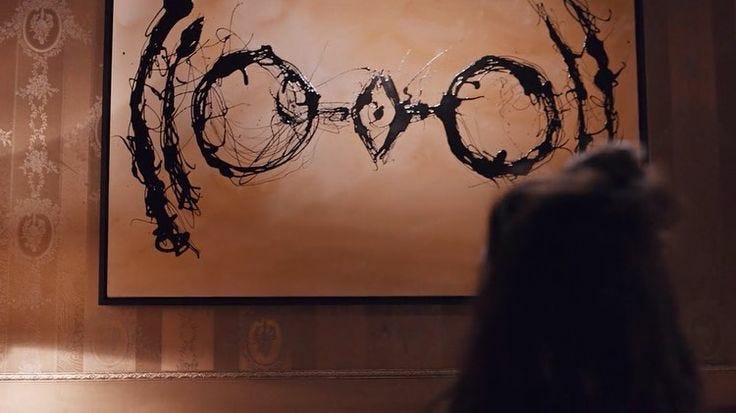
‘Atiye’ is an artist who has drawn and painted the same fertility symbol (see still from the show above) all of her life, but has no idea what it is or what it means — until the same image is discovered by an archaeologist, ‘Erhan’, working on a dig at Göbekli Tepe (‘Potbelly Hill’), a real life, pre-pottery Neolithic archaeological site in south-eastern Anatolia, Turkey. The site’s original excavator, Klaus Schmidt, considered it to be the “world’s first temple”, built by nomadic hunter-gatherers, though other archaeologist’s have challenged his interpretation of this as a sanctuary with no permanent inhabitants.

This series is really good!

Watching it set off a whole flurry of thought, memory and further research. I’ve always had an interest in symbolism and mythology, particularly regarding all aspects of: fertility; angelic/Enochian script; fallen angels; the mythological significance of underground spaces; Gaia; symbolic snakes; ‘belly hills’ - which brings us back to fertility, Mother Earth; the story of the Garden of Eden from the Christian Bible; acquisition of knowledge (often involving trees); pre-Hellenic counter parts to later beliefs, such as stories akin to that of Delphi - the Oracle, the Pythia …..
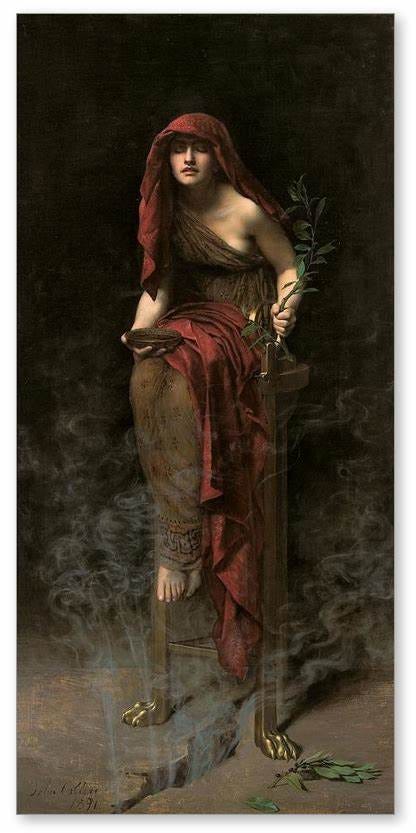
‘The Priestess of Delphi’ — John Collier (1891)

“The old Pythia had warned me of this the night she gave the Oracle to me, placing the laurel and the round bowl of water in my hands there in the deep adyton with the great Python herself coiled between us. Your love belongs first to her, now. And to her mother, the mountain, the stone, the Earth, the one whose oldest name is Ge. It was true. I could not understand it until I made my first prophecy alone. I became the Snake, the Earth, the Stone. I saw as though through their eyes. I was not myself, but only Pythia, she of the Python, she of Ge, my skin no longer human, my womb no longer mother of my boy but a limestone cavern filled with stars. I felt what it was to be a great serpent in those depths, the current of my body running sinuous through the dark between fault lines, between mountains, between ages and seas, through underground springs, among the dead who carry all the seeds of Earth in their gentle arms. In the sanctuary on my tripod, I was the Snake and Earth and they were I, and thus I saw the round of things, the shedding skin, the beginning as end, the end become seed. I knew every root of every plant and tree, the bones of every creature. I do not know what I looked like to human eyes when I entered the chamber of prophecy, but in my own eyes, my inner sight, I was the Python herself, vast and scaled, with eons on my tongue.”

story in ‘Lady of the Dark Country’ (Sylvia V. Lindsteadt), called ‘The Pythia’ . - as mentioned in this piece: https://link.medium.com/yOCvuEE2Tlb

Coincidently, I’d just read the story which the excerpt above was taken from, only minutes before settling down to watch the first episode of ‘The Gift’ on Netflix.

The Pythia was the original priestess and oracle of Delphi, until Apollo decided he wanted to take control — and took it via violence and bloodshed. Obviously this is not a retelling of the same story as we see unfolding in ‘The Gift’, as they are set in different places , aside from anything else — yet as with major patriarchal religions, matriarchal origin myths and legends tend to replicate detail, or at very least have a general feel, an air of similarity.
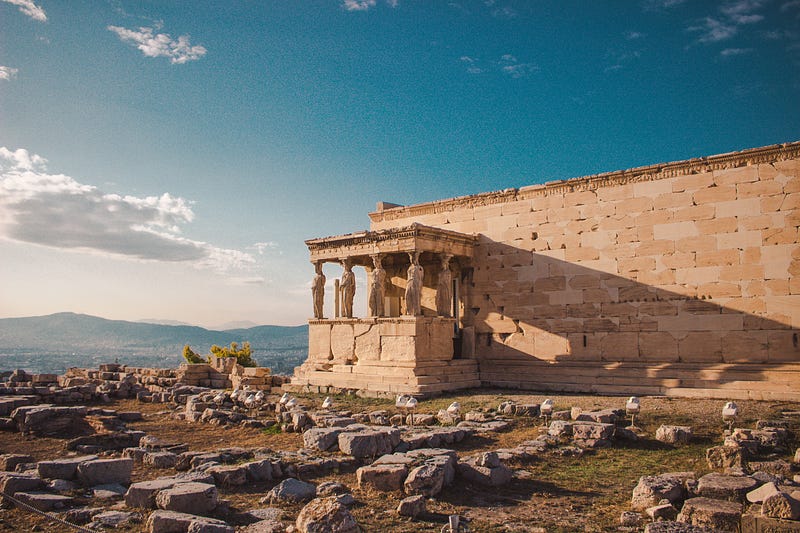
Photo by Arthur Yeti on Unsplash

When I was a child I was always drawn to the Greek mythology, particularly that which tells the story of Persephone, daughter of Demeter and Zeus, who became queen of the Underworld after her father sanctioned her abduction by Hades.

Sean Kernan wrote about this story recently:

As an adult I’ve had a fascination with Lilith, who in Jewish mythology was Adam’s first wife: Lilith — Wikipedia

And the Serpent, the Woman of Harlotry, incited and seduced Eve through the husks of Light which in itself is holiness. And the Serpent seduced Holy Eve, and enough said for him who understands. And all this ruination came about because Adam the first man coupled with Eve while she was in her menstrual impurity — this is the filth and the impure seed of the Serpent who mounted Eve before Adam mounted her. Behold, here it is before you: because of the sins of Adam the first man all the things mentioned came into being. For Evil Lilith, when she saw the greatness of his corruption, became strong in her husks, and came to Adam against his will, and became hot from him and bore him many demons and spirits and Lilin. (Patai81:455f) Jacob and Isaac Hacohen, Treatise on the Left Emanation
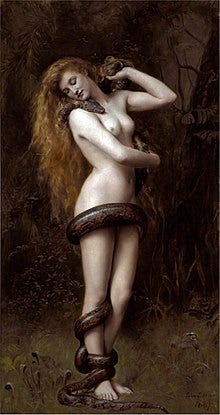
‘Lilith’ — John Collier (1889). Held in the Atkinson Art Gallery, Southport (UK)

Both of the above Collier paintings are also featured in this piece of writing by A Renaissance Writer, which I read on The Collector (and thoroughly enjoyed):

Also this one, written by Kamna Kirti:

The beautiful poetry of Arthur Dewson also references a lot of the things I’m interested in:

….particularly (for the purposes of this piece) Persephone and Lilith — and of course, Asterion, the Minotaur.
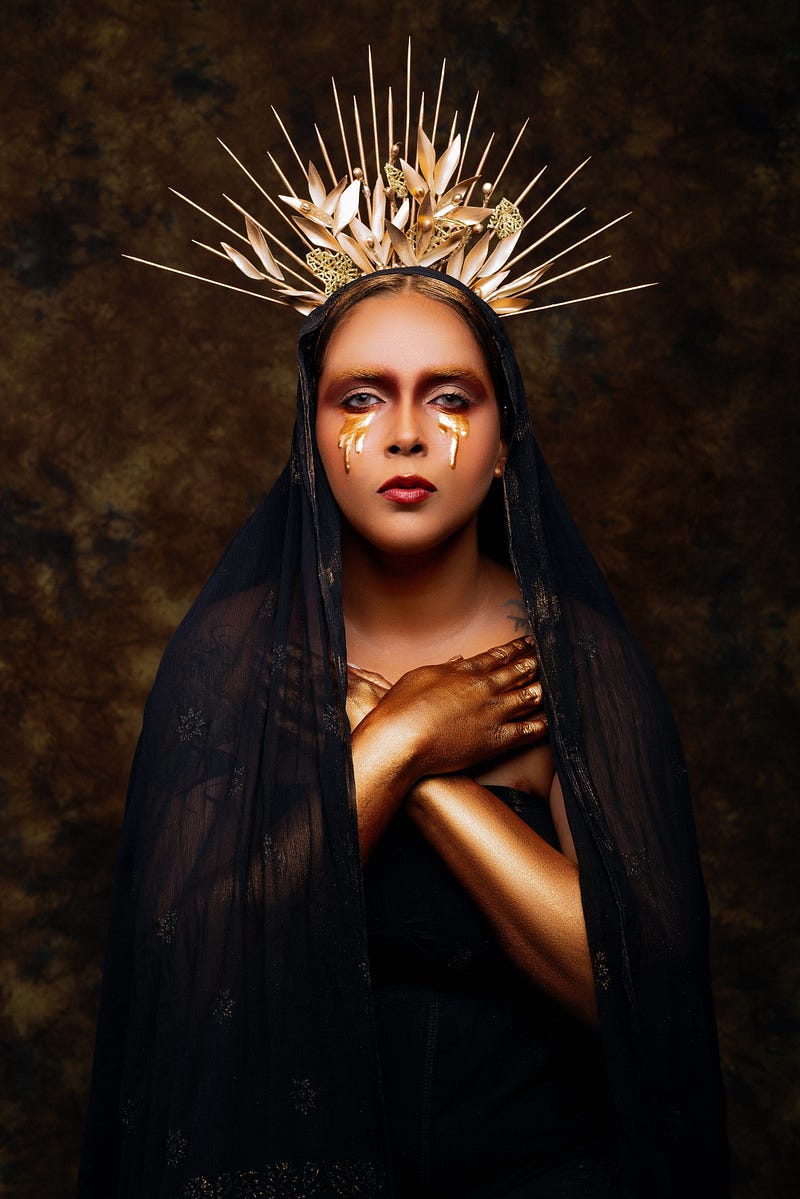
Photo by Mukul Kumar on Unsplash

Modern understanding of goddess worship sees Lilith as synonymous with Inanna, Ishtar, Asherah, Anath and Isis. Some would include Kali in this list, goddess of creation and destruction, goddess of the dark moon. According to certain learned minds, Lilith was originally the Sumerian, Babylonian and/or Hebrew mother goddess of childbirth, children, women and sexuality.

Historians and mythographers like Dame Marina Warner claim that early Christians in the Middle East assimilated elements into what became a cultish following of the Virgin Mary; and compare Syrian laments which describe Mary’s compassion for her son on the cross with terms found in Ishtar’s lament over the death of Tammuz.

Astarte is the Hellenic form, possibly influenced by the Ancient Greek Aphrodite — goddess of love, lust, pleasure, passion and protection; her associative symbols include myrtle, roses, doves, sparrows and swans — and of course, Aphrodite also connects with Venus.

The accounts and representations of Venus are also diverse- though at root, the basic mythology does always remain recognisable.
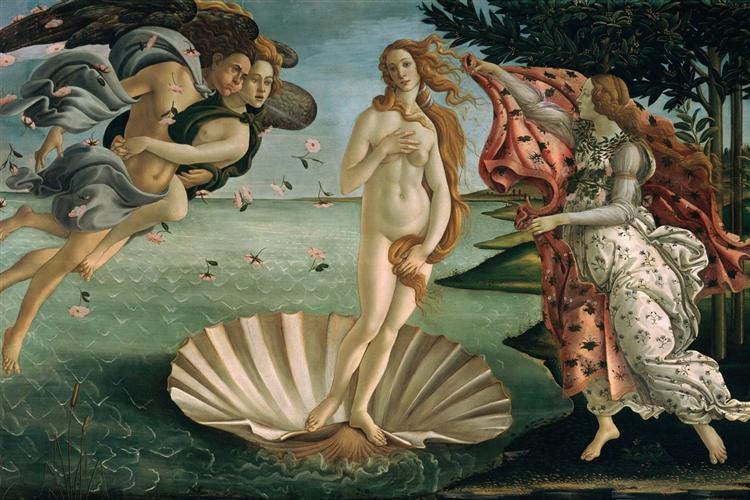
‘Nascita di Venere/The Birth of Venus’ — Sandro Botticelli (1483–1485)

“Things do not start well. Venus — or Aphrodite as she was originally called by the Greeks — was a primordial creature, said to have been born out of an endless black night before the beginning of the world. Ancient Greek poets and myth-makers told this ghastly story of her origins. The earth goddess Gaia, sick of her eternal, joyless copulating with her husband-son, the sky god Ouranos (sex which left Gaia permanently pregnant, their children trapped inside her), persuaded one of her other sons, Kronos, to take action. Gathering up a serrated flint sickle, Kronos frantically hacked off his father’s erect, rutting penis and threw the dismembered phallus and testicles into the sea. As the bloody organs hit the water, a boiling foam started to seethe. And then something magical happened. From the frothing sea-spume rose ‘an awful and lovely maiden’, the goddess Aphrodite. This broiling, gory mass proceeded to travel the Mediterranean, from the island of Kythera to the port of Paphos in Cyprus. But despite her violent and salty start, the young goddess, as she emerged from the sea on to the barren, dry land, witnessed a miracle: green shoots and flowers springing up beneath her feet. The radiant, enigmatic creature, followed by ‘comely desire’, was quite a sight to behold:…..

She set on her skin the garments which the Graces and the Seasons had made and dyed in the flowers of spring-time, garments such as the Seasons wear, dyed in crocus and hyacinth and in the blooming violet and in the fair flower of the rose, sweet and fragrant, and in ambrosial flowers of the narcissus and lily’ (Kypria, Fragment 4, transmitted in Athenaeus, 15.682D–E, trans. Breitenberger)

Hughes, Bettany. ‘Venus and Aphrodite’ (pp. 7–12). Orion. Kindle Edition.

(Bettany Hughes is an incredibly engaging professor of history who writes excellent books and presents an array of documentaries).

Even though the old Mesopotamian religions faded as Assyrians converted to Christianity, the worship of Venus persisted in parts of upper Mesopotamia (which were to become Arabic states) right up until the dawn of the Islamic period.

It is recorded that Isaac of Antioch says the Arabs worshipped ‘the Star’, also known as Al-Uzza, which many historians identify as Venus. He also mentions a deity called Baltis, most likely yet another variation on Inanna/Ishtar. In pre-Islamic Arabian inscriptions it seems that Allat was also a Venusian goddess.
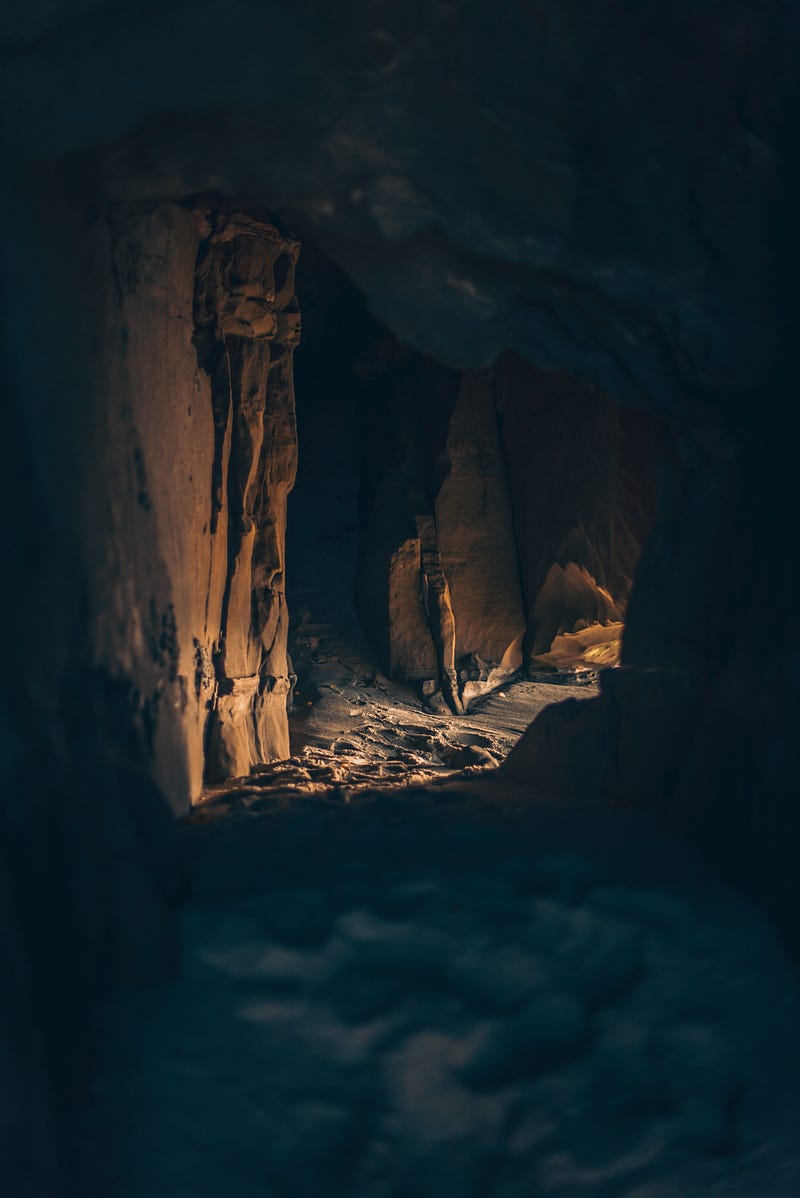
Photo by Bradley Dunn on Unsplash

Many goddess-based myths, from scattered locations across the globe and throughout time, involve an underground cavern, a portal, a tree of knowledge, a priestess and a serpent.

Inanna/Ishtar is known to have been considered to be the Queen of Heaven, but one of the most well-known stories from her mythology is about the descent into and return from the Underworld.

The Mesopotamian/Sumerian underworld was called Kur.

There is only one surviving account in Sumerian, telling a tale of Inanna’s descent to the Underworld, in which we find her described as the ‘Destroyer of Kur’.

Inanna was worshipped as the Goddess of both Warfare and Love (combined we could say Conquest). She was not the goddess of marriage though and had no children. In this I am again reminded of Lilith - and also Kali. As a war goddess she was often depicted as dimorphic/androgynous/gender ambiguous/nonbinary. A ‘feminine’ figure with ‘masculine’ presentation — and here I can’t help but get drawn back to another childhood fixation, with the story of Jeanne d’Arc….also known as Joan of Arc, St. Joan, the Maid of Orleans and/or the Maid of Heaven.
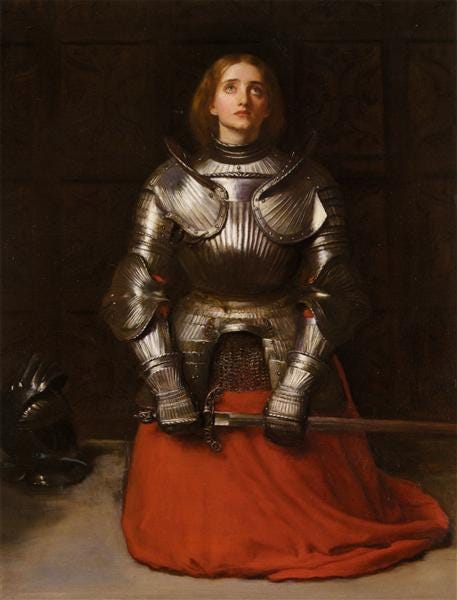
‘Joan of Arc’ — John Everett Millais (1865)

I’m sure many readers will be at least vaguely familiar with this story, but if you’re not, go here. There’s also a film about her, starring Milla Jovovich:

I saw the play ‘Saint Joan’ written by George Bernard Shaw when I was eleven, I think, possibly twelve. The main part was being played by Jane Lapotaire and I was mesmerised. Of course at that point in my life, the Christian religion I had been raised with was important to me, though that was soon to change drastically (another story for another day perhaps).

Greta Thunberg has been likened to Joan, by the author Margaret Atwood, because of her youth, gender and shear gritty tenacity.

Margaret Atwood: Greta Thunberg is Joan of Arc of the environment — The Irish News

Greta Thunberg is the first saint of our cruel new environmental religion (telegraph.co.uk)

If you’re still not getting the whole Saint Joan vibe, try thinking along more contemporary pop/film culture lines and picture Gwendoline Christie as Brienne of Tarth in the TV series ‘Game of Thrones’:

It seems that people who also went against the gender binary in some way were heavily involved in the cult of Inanna — and it’s a natural fit, they no doubt flocked there, looking for a place to belong. There were priests in Sumerian temples who adopted feminine names and speech. Similarly, during the Akkadian period, male servants of Ishtar dressed in female clothing and danced in the temples. In one Akkadian hymn, the words tell of the goddess Ishtar turning men into women.

Anthropologists have suggested there would be a similarity between these temple servants and the hijra community in India.

“In the Indian subcontinent, Hijra are eunuchs, intersex people or transgender people. Also known as Aravani, Aruvani, Jogappa, the hijra community in India prefer to call themselves Kinnar or Kinner, referring to the mythological beings that excel at song and dance. In Pakistan, they are known as Khawaja Sira, the equivalent of transgender in the Urdu language.” — Hijra (South Asia) — Wikipedia

Duality is also involved when we see Venus described in some cultures as both the ‘morning star’ and the ‘evening star’, rather than realising that Venus was a single celestial body which moved across the sky. By the time of the Sumerians it is thought that this was better understood, so Inanna — in association with Venus as one of her ‘alter egos’ — was talked about as being dual-natured, rather than twins. So perhaps there actually wasn’t a brother called Utu at all, not one male twin and one female, but in fact this was the representation of the gender fluidity of Inanna.

The symbol most commonly associated with Inanna/Ishtar is a star, eight or sometimes six pointed, obviously generally associated with the heavens, but by the Babylonian era specifically associated with the planet Venus. This symbol was used within a disc to act as a seal, with which they branded property (including temple slaves). The star symbol is also often found alongside a crescent moon and a solar disc, showing it’s importance to the Babylonian people and their worship of the goddess.

Similarly, the story of Inanna’s descent into the Underworld is in modern times often recognised as referring to Venus in retrograde, when the planet disappears for a time.

The stories of the gods and goddesses can and should also be seen as representing something other than it might seem on a superficial level. If you watch the video above, in which the story of Inanna is told, you might be left with the conclusion the this is actually the story-tellers way of explaining aspects of psychology. We are told that different gods and goddesses are actually different aspects of the one, Inanna. Essentially, her ‘higher self’ in the Heavens and her base instincts and low emotions are her Underworld.

Thank you for reading. Stay safe. Stay well. Keep reading at Counter Arts and Rainbow Salad!

Nonfiction
Culture
Mythology
Television
Counter Arts
Recommended from ReadMedium