
History | Mythology | Fiction |
My Favorite Mythology Story: Persephone And Hades
Why I love this story and what it teaches.

I have always wanted to retell a mythology story in my own words as so many have before me (while keeping the key facts in place, obviously).
I am only a writer today because I fell in love with mythology at a young age. Stories of Zeus and Hercules were my gateway drug.
This is the story of Hades and Persephone.
It’s a love story, but not the type you think
The goddess Demeter has a daughter with Zeus.
Demeter names the baby Persephone. However, she is immediately concerned about this young child. Demeter sees into the future and realizes Persephone will have uncanny beauty, unlike any that mortal men have seen.
Demeter grew fiercely protective of her young daughter. Demeter had lived as a beautiful goddess within this savage and divine kingdom. She had seen the harm Gods cause to beautiful females.
Demeter also knew that a mortal man's love was destined for heartbreak, as the man would shrivel in the passage of time before her.
Indeed, Persephone grew into the most beautiful woman Demeter had laid eyes upon.
Greek historians described her as having fair skin, dark hair and eyes, shapely legs, and breasts. She often wore long flowing, colorful dresses.
As years went by, Demeter tightened her watch on Persephone, “You cannot leave my side.”
Persephone said, “Why not? I wish to go out into the world and live.”
Demeter said, “It is not safe. You must trust me. Some mistakes cannot be undone.”
Persephone began to rebel as she grew. Her curiosity about the world led her to sneak out of sight more and more.
The dark suitor
Hades, the god of the underworld, had sensed Demeter’s fear.
He had seen into her mind and grew curious to lay eyes upon Persephone. Was she as beautiful as any mother believes her child to be?
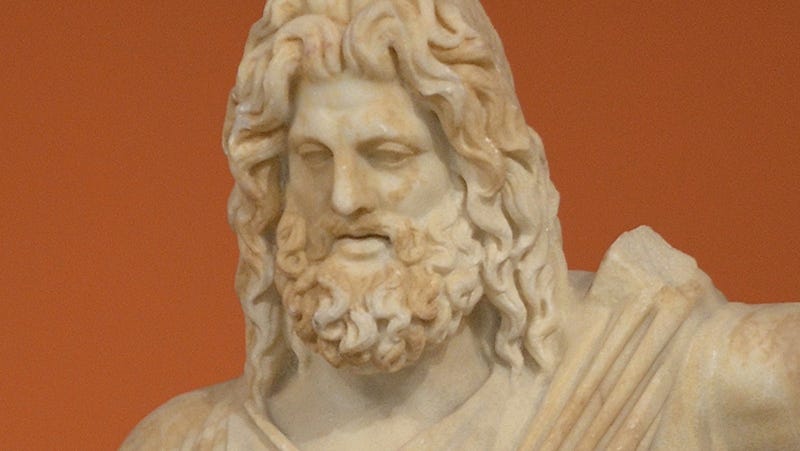
Hades ventured out into the woods, seeking Persephone. He finally spotted her out in a clearing, wandering in a field of flowers. He was taken aback by her beauty.
Persephone would become the Goddess of nature. She was drawn to gardens and fields of flowers. Hades knew she would return to these fields. And so he did as well.
Hades’ admiration for Persephone grew into dangerous fascination. Persephone had an aura of vitality and life that enraptured him into a deep longing for her.
Hades had lived alone and without love. This would change.
The abduction
Hades continued to lurk in shadows, within holes in the earth, letting his desire for Persephone grow. Among his godly powers were persistence and deception.
One day, while Hades viewed Persephone through a fissure in the ground, his yearning overcame him. He opened the fissure wide, splitting the field, shaking the ground, sending her tumbling down into his arms.
This moment is depicted in one of the greatest sculpture’s ever completed, “The Abduction of Persephone” by Gian Lorenzo Bernini:
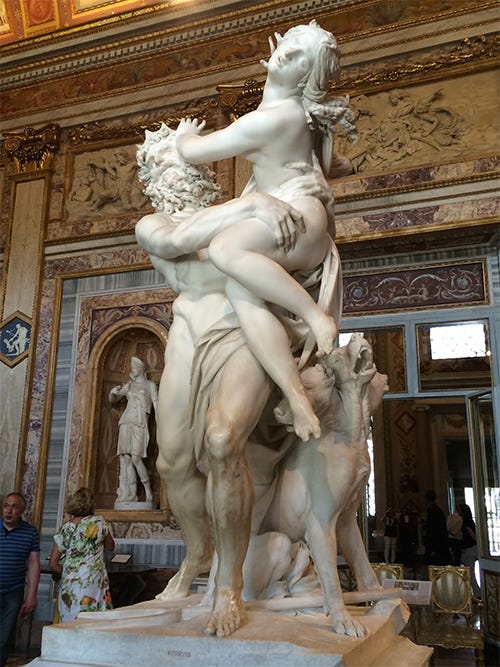
When they arrived in the underworld, Hades expected Persephone to welcome this new home with joy and gratitude.
“Do you not love what you see?” He gestured, seeing the sunken look in Persphone’s eyes.
The underworld was cold and dark. Smoke and shadows adorned the skies.
Hades showered Persephone with gifts, undead servants, jewels, and dying plants. It was of no avail.
After months went by, he concocted a proposal. He knew Persephone was intelligent and capable. He said, “Rule beside me. Take a throne next to mine and we shall rule this kingdom together.”
With reluctance and longing for her home, she accepted the offer.
She slowly grew to enjoy her responsibilities. She made changes too.
Persephone watched as pitiful souls wandered into the underworld to live out their eternity in terrible conditions. And so she created Elysium, special heaven within the underworld for souls who weren’t actually bad.
In a perverse twist, she found the autonomy she had long sought in hell. Yet she still missed her mother and the surface. She was unable to leave or communicate with outsiders.
The great revenge
After Demeter learned that her daughter had gone missing, she went into a panic. She wandered the Earth looking for her. Years went by.
Demeter did not know if her daughter was alive or happy but suspected another god has stolen her.
She went to Zeus, who said he could not help her. In anger, Demeter retaliated.
She was the goddess of agriculture. In her anger, she caused all of the crops to begin dying off. Famines swept across the land.
Mortals cried out in suffering and starvation. They protested in anger against the gods, vandalizing temples.
They urged Zeus to solve the crisis. They knew he ruled over the gods and was the only one who could help.
As their sorrows and protests grew, Zeus knew he needed to act.
The great compromise
Persephone stood in the royal garden in the underworld.
She accepted a pomegranate offered to her by Hades. She ate it and then relaxed amongst the rare glimmers of life and nature in the abyss.
Hermes, the messenger of the Gods appeared. He said that she was being summoned before the Gods. A tribunal was being held.
Moments later, Persephone stood in the halls of Olympus amongst the most powerful of all gods.
Zeus said, “You are to return to your mother. You are needed back within your home.”
Just as this happened, Hades appeared from the shadows behind a column.
He held up a partially eaten pomegranate. Zeus and Demeter stared at it in shock.
Hades said, “She has eaten pomegranate from the underworld. As is law, she cannot leave. She must stay on her throne beside me.”
Demeter was filled with rage. She turned to Zeus, “You cannot let this stand.”
Zeus knew this rule was in place. But also knew that Persephone had been tricked into eating it.
Zuess, torn between the law of the pomegranate, and the misconduct of Hades, struck a compromise.
Persephone would rule the underworld for three months each year and return to her mother and the world for the other nine months. The compromise satisfied neither Demeter nor Hades. But that was the deal that remained in place.
You now know how winter is explained in Greek mythology. Persephone's return to the underworld each year represents the death and shriveling of life that accompanies the arrival of the cold.
The story of Persephone and Hades is an allegory for the cycle of life and death. Each represents one side of the same coin. Their union is one of both necessity and love, but not of choice.