
The future of NoCode
During the NoCode Summit 2022, our presentation about the “Future of No code” got a lot of success. Due to a lack of place in the room, we promised to publish a blog post summarizing the session. Here it is. You can still download slides here.
At code.store we help large companies navigate No/Low-code space by providing consulting, architecture workshops, custom applications development, and support.
A legitimate question to any NoCode editor
When faced with the option to go for no code, IT Directors and CTOs of companies often have legitimate questions for the editor.
- Will they be alive in 5 years?
- How pricing will change over time?
- Where are they heading?
- Will I be blocked?
- Can they scale?
We’ll try to answer them in this post, by analyzing the roadmaps and community forums of 4 editors of no-code platforms. Contact-us if you need help with your no/low-code projects.
We divided them into 2 categories:
- Marketing: tools that help you create client-facing, marketing-oriented websites
- Internal: tools where you can build internal business applications or portals
Marketing no-code tools
Webflow
The first tool we’ll analyze is Webflow, mainly used to build:
- Corporate websites
- Landing and product pages
- Any site, with a number of pages < 500
- And the ones that require no backend
Webflow is an absolute leader in the no-code space (this site runs on Webflow too), existing for 10 years, claiming more than 3.500.000 users, and raised almost 350M$ for a massive 4B$ valuation.
Webflow clients include famous brands like:
- Dell
- Pwc
- Upwork
- Vice
Membership
One of the major features Webflow is releasing this year is the support of Membership. The membership feature of Webflow allows you to create content that is only accessible to members. This is a great way to offer premium content or courses unavailable to the general public. You can also use this feature to build a member portal where members can manage their accounts and access all of your content in one place.
What does it say about Webflow growth plans? First, it’s a clear attack on the creative / influencers industry, and platforms like Gumroad, Memberstack, Onlyfans, etc… The big difference? Webflow does not offer a marketplace therefore no reach. It means they target established content creators with large audiences. They will provide a strong competitive advantage to those who don’t count on marketplaces for reach:
- Much more flexible content forms (leveraging the power of Webflow Designer)
- Very low transaction fees (e-commerce goes from 2% to 0% we can imagine that membership will follow similar levels)
Our analysis is that Webflow will remain in the SMB space for a while.
Logic
That was a logical feature (sic), everybody was asking for for 10 years. Finally, Webflow decided to introduce workflows and actions. Logic offers a set of features similar to what Bubble or Appfarm do:
- Workflows management
- Triggers, conditions, and actions
- Calls to webhooks and external APIs
- Forms management
The fact that there are no enterprise features (Git support, versioning, log audits, JS/SQL injections) indicates that Webflow sticks to its core audience: SMBs. It’s low-hanging fruit for them, trying to stop their user switch to more advanced platforms like WeWeb, Softr, or Bubble.
Most wanted Webflow features
When analyzing their community forums, we can see that the most wanted Webflow features are:
- 🇪🇺 European Hosting to comply with GDPR (their reach in the EU is quite limited in corporations because of lack of that feature)
- 🌍 Multi-language sites and CMS fields (yes, Webflow is still not supporting multilingual sites or localization)
- 🎓 Webflow University Certification (mostly wanted by agencies, as Webflow becomes more and more popular, professionals feel the space starts to get overcrowded)
- 🛍️ Component Marketplace (Important to grow their community and direct new streams of revenues to agencies investing in Webflow. Seems that templates/themes are not enough anymore)
- 🔍 Faceted navigation/Search (why the hell it’s still not there?!)
Our predictions for Webflow
We think that the community will become a strong driver of future growth for Webflow, it’s a part that they constantly put aside in their growth strategy so far. It will change in 2023. Weblfow will become more international, finally crossing the chasm of localization and winning truly global markets. Webflow will become more flexible, with better integration of IT infrastructure (SSO, APIs, Workflows, E-Commerce), without changing its dominant position in the SMB market. Therefore there is a large opportunity for Webflow challengers to attack the most difficult, enterprise market. Finally, Webflow will start to dominate the web space, slowly eating WordPress's market share.
We think that within 5 years an M&A event may happen for Webflow, and the potential buyers for us are Adobe, Intuit, or Hubspot. Adobe because they just acquired Figma and Magento, attacking the SMB market (they already have a player in the enterprise market with AEM, but nothing in the self-serve / SMB). Intuit, because they address exactly the same segment as Webflow and have Mailchimp. Finally, Hubspot will need to expand its offering to imitate Salesforce's success.
WeWeb
WeWeb is our hidden gem. You will hear more and more about them. It’s a relatively small startup, that went to YC and raised around 4M$. They build a Webflow competitor, but targeting the enterprise market and offering the beauty of Webflow on top of APIs and Databases. Basically, they beat out Webflow on every single feature, their execution is just perfect.
What WeWeb is good for:
- Dynamic websites
- Web applications
- Front-end for e-commerce (in a headless / MACH e-commerce architecture)
- API/Database-driven portals
Look how easy it is to connect an external REST API with WeWeb. Truly amazing.
Important features WeWeb is working on
Analyzing their open roadmap we noticed some important features:
- 📦 NPM libraries include (it’s a major step enabling them to leverage millions of existing NPM libraries, and avoiding building everything by themselves, it’s a very bold move)
- 🍱 Containerization (it will be possible to launch WeWeb on private networks, which means a huge competitive advantage compared to Webflow or Bubble, letting them into the enterprise world).
- 📏 Grids (supporting modern grids will help those who build portals and internal apps)
- 👤 OpenID (important SSO feature, to support their enterprise customers)
- 🌐 Integration Partnerships (No editor succeeded without a strong network of integrators like us, Capgemini, or Accenture). From internal sources, we know they already work with Accenture.
- 🦈 Catching on Webflow
Our predictions for WeWeb
Almost profitable and very smart, WeWeb should double or triple its user base within a year as the feature gap with Webflow is filled. But, unlike Webflow, they will go for the enterprise market and will totally dominate it within 5 years. To do so, WeWeb will launch an integrators-fueled, indirect sales program.
As for Webflow, there is a huge risk of early acquisition from Google, Adobe, or even AWS.
From our point of view, it is the most promising no-code startup on the market right now, with Xano.
Internal Business Applications with no code
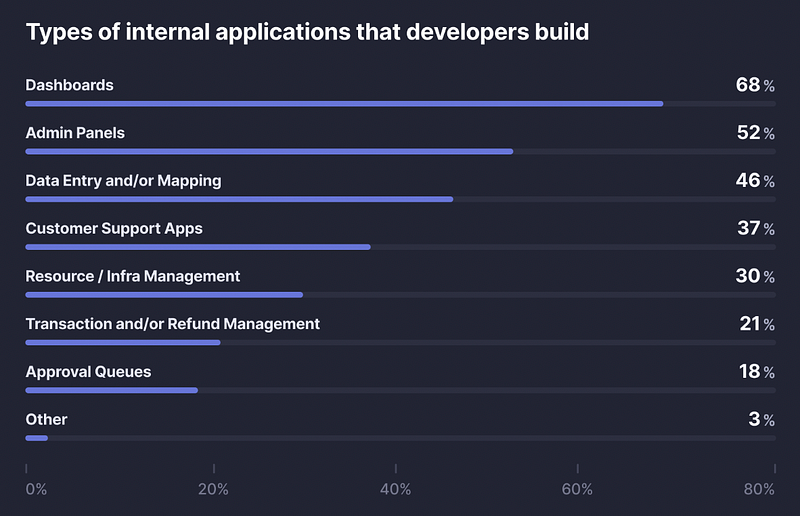
This category optimizes internal usage. Millions of applications fuel internal business process optimization and digitalization. The internal applications survey conducted by Retool gave us a good understanding of the different kinds of applications their users are building:
Bubble
Bubble is the current most known no-code platform, and probably one of the oldest (10 years) if we exclude low-code platforms like Mendix, Outsystems, and Microsoft. They raised over 100M$ for a valuation of around 500M$. With more than 2.000.000 users, Bubble is also known for its very active and loyal community of “bubblers”. Some agencies are 100% dedicated to the tool (ex.: Cube).
Bubble can be used to build almost anything in the web space: marketplaces, social networks, dynamic websites, and applications for very small and medium-sized businesses. For us, Bubble is not suited for enterprise or large projects for the following reasons:
- Slightly outdated builder/developers experience
- Integrated Database makes it almost useless for the Enterprise
- Inability to run it locally
- Recurring performance issues
- Lack enterprise-grade features
- Overwhelmed support
- Lack of partnerships with agencies and integrators
What Bubble works on currently?
We spent some time analyzing their monthly updates, and it seems they currently are focused on the following:
- Training and education (it’s a major problem for Bubble, their learning curve is steep and their UX is outdated)
- Responsive design engine (again, they pay here their slow pace of innovation for 10 years, forcing their team to refactor major parts of their stack to support a responsive engine).
- Version control and SOC2 compliance
Our predictions for Bubble
Bubble will experience no growth in large companies, but will continue growing in the SMB space. Templates will be the dominant way to build applications. Very few will be started from scratch. Bubble will struggle with performance and support for a few years more.
Finally, Bubble will be forced to make peace with agencies and launch certifications & partnership programs, or die trying. Raising 100M$ is a cursed gift, as Bubble will now have to show growth of their customer lifetime value and try to go for the enterprise market, where they will have to compete against Microsoft, Mendix, Outsystems, and newcomers like Appsmith or Retool.
Retool
Retool is our absolute favorite and game changer in the business applications industry. It’s a front-end-only, low-code tool to visually build internal apps and connect them to different back-ends: SQL Databases, NoSQL Databases, REST and GraphQL APIs, etc. To create an app, you simply put your ready-to-use components from a library of over 90 and connect them to queries. At any moment you can write plain javascript to enhance and modify the behavior of each component or alter query results.
Mobile apps!
Retool is launching native mobile app support. It’s a bold and natural move from Retool team. There are still a lot of questions about the offline mode and local storage, but they are aggressively attacking mobile apps with no-code tools like Glide, Flutterflow, or Appgyver (acquired by SAP).
Here is more about this new feature rollout:
What features Retool team is working on?
Aside from working on mobile app support, Retool is working on the following major features:
- Better styling of components (to try to bypass the major con of Retool: limited stylization options of their front-end)
- Versioning (important features around logs, versions, deployments, and git branches
- Components marketplace (it’s a very important feature to leverage Retool’s community and make Retool more sticky)
- Tables rabbit-hole (Tables support is amazing in Retool, but there are still tons of improvements to beat out custom-made ones)
- More components (to add to an already impressive catalog of more than 90)
As you may see nothing very exciting there, it seems like Retool’s team need to stabilize their current backlog and growth, before rolling out anything major.
Our predictions for Retool
Retool will jumpstart community-driven initiatives as a components/templates marketplace. They start to feel fierce competition from their open-source equivalent: Appsmith. Therefore the need for community leveraged features is important. Retool could provide some ETL capabilities through acquisitions, as they still entirely dependent on the format of data structures provided by the back-ends they connect to. Retool will heavily invest in mobile applications support. Retool will become more and more developer friendly/oriented. Unlike other no-code tools, still promoting the citizen-developer or builder/maker, Retool makes it clear: they love developers and you need to be a developer to build complex applications with Retool. We love that!
Google, SAP or Amazon could acquire Retool within 5 years.
If you’re interested in building internal business applications with Retool, check our guide here.
No-code in 5 years, our vision
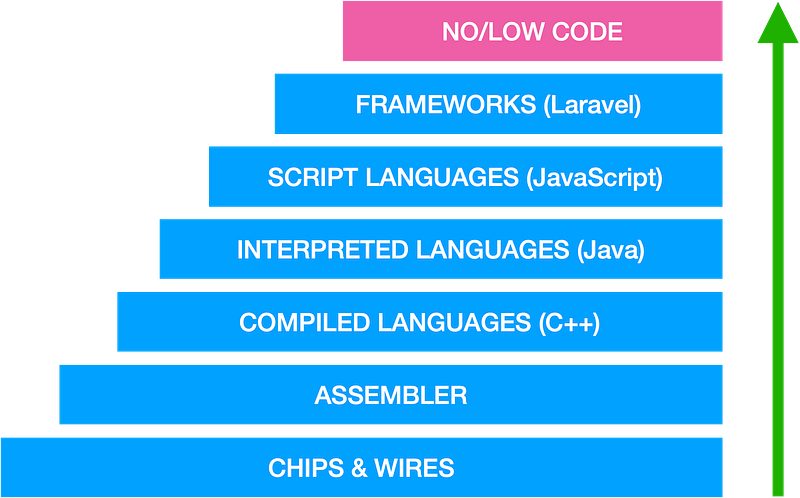
No code is just the last brick on the abstraction pyramid
The no-code industry is here to stay. It could not really shine before today. It needed the following key innovations to be widespread before getting attention from developers and large companies:
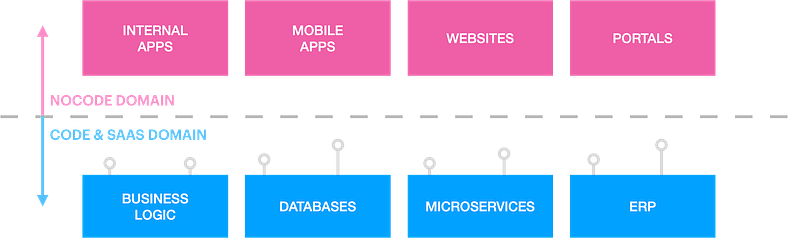
- APIs and Headless architectures. We think that no code's sweet spot is in front-end applications. So until headless, MACH and APIs were everywhere it was quite complicated for the NoCode platforms to overtake the world. It’s now feasible.
- Powerful browsers and advanced front-end frameworks like ReactJS, AngularJS, or VueJS. It was impossible to build a real no-code tool until we had those frameworks.
- Usage and UX Stability: did you notice that in 2022 all the websites and applications look more or less the same? That’s because digital is now a commodity and users wants stability in the components they interact with. That’s why you have burger menus, top-right corner “Sign-in” buttons, and 3–4 columns of tables presenting pricings.
So as we said Nocode is a perfect match today for front-end applications consuming data from back-ends through APIs. That’s why we think bundled platforms like Bubble will have a limited future inside medium and large corporations:
Big guys entering nocode industry
We foresee major players entering the nocode game either by building internally or through external acquisitions. The most potential players from our point of view would be:
- Intuit (very strong in SMBs, massive sales forces, already present with Quickbooks and Mailchimp)
- Adobe (present in design with Figma, the next logical step would be acquiring a no-code platform to integrate)
- SAP (already experimented with Appgyver, buying Retool or Appsmith would make perfect sense for them)
- Google (it would be the less obvious move, but their work on simplifying the life of developers shows their interest in low/no-code movement and they already tried with Appsheet)
The very best no-code tools in 2027
For us, we see profound changes in no-code / low-code landscape in the future years:
- Retool & Appsmith for internal tooling
- WeWeb building everything else
- Xano for backend as a service
- Webflow for SMBs
- Flutterflow for mobile apps
5 major no-code trends for the next 5 years
Enterprise
Large companies will embrace no-code slowly but as strongly as they did for cloud hosting. Fueled by billions raised in 2021 major NC players will integrate Enterprise kit: Authorizations, Security, containerization, indirect/enterprise sales flow, auditability, traceability, and integration with enterprise software.
Once Retool, Appsmith or WeWeb will sign their first large enterprise deal, all the Fortune 500 will follow within a few years. Banking and insurance are the hottest verticals for those tools.
Natively mobile
We think that native mobile support will be progressively implemented in every single nocode platform. The separation between web and mobile NC tools will be thinner than ever. It will also add a lot of competition to the market of mobile NC tools like Glide, Flutterflow and Appgyver.
Retool already started the war with its Retool Mobile feature.
Marketplaces everywhere
To compete against open-source tools, and keep pace with a very demanding and growing user base, tools will have to open plugin/component marketplaces and let external developers interact with their tools. Managing a marketplace is a tremendously capital-extensive job and only the most solid/smart will succeed. But the winners will completely destroy the competition who did not launch their marketplace yet.
When we see successes like Shopify, WordPress, or Bubble, the path to NC marketplaces is here. Marketplace will accelerate features expansions of tools and will require more experts and agencies to select and build NC apps. A whole economy of ready-to-use components and plugins will arise. Many SaaS tools will create dedicated connectors eating on Zapier / Make market-shares.
AI-Powered
AI-powered features will integrate NC pretty soon. We could have Text 2 Component features in Retool or WeWeb leveraging OpenAI’s GPT3. The success of GitHub co-pilot, shows GPT3 capabilities in quite an open code space, meaning a lot of potential in a more discreet environment like NC.
Another possibility is automatic, AI-powered ETL. These features will be quite transparent, but it will be possible to connect any API or Database to components without mapping and transformations on data structures.
Design-2-App
We’re almost touching the Design-2-App: the possibility for UX/UI designers to create in their favorite tools like Figma and then connect their design to workflows/APIs and data collections to generate applications. We see some incumbent start-ups working towards Figma 2 React connectors, which means that the step is not that big. Who will make the first move? Probably Adobe. When? Within 3 years, they will launch a new version of Figma that will integrate nocode features or WeWeb that will offer a Figma plugin to initiate the app from Figma.
4 survivors of the nocode consolidation

The 4 places for Nocode war survivors
There are too many tools doing the same, but nocode platforms are operating systems, where millions of applications will run. While we might see some niche/vertical nocode platforms, there will be 4 major players occupying:
- SMB / Marketing addressing all marketing/customer facing sites and apps. The place occupied by Webflow and WordPress now
- SMB / Internal tools to help companies build internal tools fast. Place occupied by Bubble, with serious pressure from Retool/Appfarm/Softr/WeWeb
- Enterprise / Marketing to build customer-facing platforms. There are no players here yet from NC (Adobe / Sitecore / Contentstack are going there probably adding simpler interfaces and page builders)
- Enterprise / Internal tools: large companies building internal tools is the Graal of each NC tool. Retool & Appsmith is good candidate to replace Outsystems, Mendix, or Microsoft and their PowerApps.
No code creates new jobs and destroys software verticals
As no code will become widespread, more and more complex applications will be built. Design patterns and architecture patterns will emerge. The professionalization of the industry will erase the need of citizen developers, as web professionals replaced webmasters.
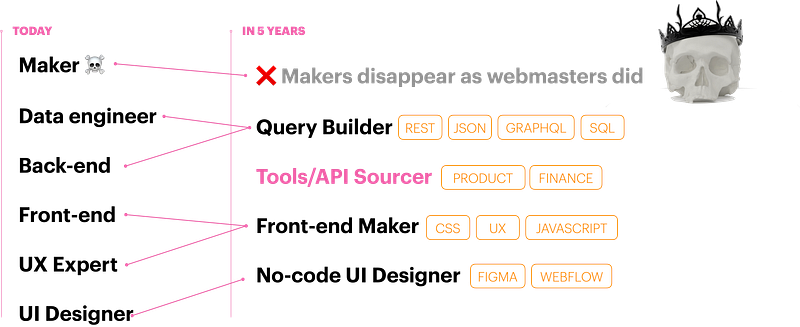
On the other hand, new jobs will appear:
- Front-end Maker (a mix of UX and Front-end no-code engineer, building interfaces using no-code tools)
- UI No code designer (an art director working on designs directly inside no-code apps like webflow)
- Query builder (a mix between back-end engineers and database admins working on connecting apps to back-ends)
- API / Tools sourcer (mix of product and purchaser, working on identifying, assessing and selecting external API and SaaS tools integrated into a no-code application.
Our secret wishes for the nocode
To finish this long post, we would like to share our secret crazy desires about nocode industry. So if you’re running a nocode platform, please add those in your future roadmap :D

Slides from the NoCode Summit 2022 conference
PS: Feel free to ping us, we can help build your next application with no/low code tools.



