
The Future of AI in Europe: A New EU Regulation on the Horizon
As part of its digital strategy, the European Union (EU) plans to regulate Artificial Intelligence (AI) to improve the conditions for the development and use of this technology.
The European Commission is currently preparing the first EU regulatory framework for AI. It aims to address the challenges posed by the rapid development of AI technologies.
With the rise of generative AI like ChatGPT from OpenAI or Bard from Google, and the acceleration of AI development in recent months, the EU has felt compelled to expedite its legislative process to keep pace with the evolving AI landscape.
This article explores the background, progress, and potential implications of this upcoming regulation while drawing parallels with the significant impact of the General Data Protection Regulation (GDPR) on data privacy.
Background
Since 2021, the EU has been diligently working on drafting regulations to address the ethical, legal, and societal challenges associated with AI.
The aim is to establish a framework that ensures AI technologies are developed and utilized in a manner that aligns with fundamental human rights, privacy, and data protection principles.
With such regulations, the EU intends (or pretends) to enhance accountability, and safeguard individuals and society from potential harms arising from AI applications. There might be also geopolitical aspects involved.
Drawing Parallels with GDPR
In examining the potential impact of the forthcoming AI regulations, it is worth reflecting on the “success” of the General Data Protection Regulation (GDPR).
The GDPR, which celebrated its fifth anniversary recently, changed radically the data privacy landscape by setting strict standards for the collection, processing, and storage of personal data.
The GDPR’s impact has been significant : greater transparency, increased user control, (and major fines for non-compliance).
By following, somehow, the path of the GDPR, the EU wants to create a similar framework that will enable responsible AI development and deployment.
Related reading:
Progress and Negotiations
At present (as of July 2023), the new AI regulation is still in the negotiation phase and has not yet entered into force.
The EU is engaging in discussions with various stakeholders, including industry experts, AI researchers, and policymakers, to refine and finalize the regulation’s provisions.
This phase should allow for a thorough examination of the proposed regulations, providing an opportunity to refine and enhance the legislation. The goal is to strike a delicate balance between safeguarding fundamental rights and enabling innovation via IA, while also ensuring the act’s practicality and enforceability.
What regulation to expect
While the AI Act is not yet rolled out, the following AI usages are very likely to be banned (Source: Notes from European Parliament):
- “Real-time” remote biometric identification systems in publicly accessible places.
- “Post” remote biometric identification systems, with the only exception being for law enforcement for the prosecution of serious crimes and after judicial authorization.
- Biometric categorization systems using sensitive characteristics like gender, race, ethnicity, citizenship status, religion, political orientation.
- Predictive policing systems based on profiling, location, or past criminal behavior.
- Emotion recognition systems in law enforcement, border management, workplaces, and educational institutions.
- Untargeted scraping of facial images from the internet or CCTV footage to create facial recognition databases.
AI systems considered as high-risk now include those that can significantly harm people’s health, safety, fundamental rights, or the environment.
This also includes AI systems used to influence voters and elections and recommender systems used by social media platforms with over 45 million users.
Regarding general purpose AI, the following guidelines are expected:
- Assess and mitigate potential risks to health, safety, fundamental rights, the environment, democracy, and rule of law.
- Register models in the EU database before their release on the EU market.
- Comply with transparency requirements and ensure safeguards against generating illegal content.
- Make detailed summaries of the copyrighted data used for the training publicly available.
To encourage AI innovation and support small businesses, the law should offer exemptions for research activities and AI components provided under open-source licenses.
Additionally, the EU aims to strengthen citizens’ rights to file complaints about AI systems and receive explanations of decisions based on high-risk AI systems.
Next Steps
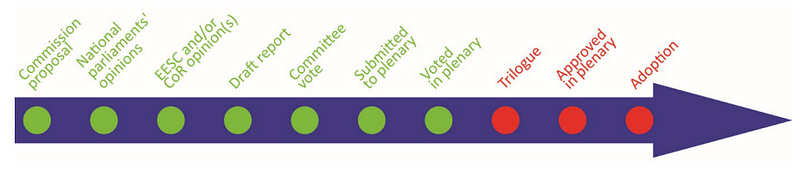
As of 14th June 2023, Members of the European Parliament (MEPs) have approved the negotiating position on the AI Act. Now, the EU countries will start talking in the Council about the final form of the law.
The objective is to reach an agreement on the AI Act by the end of this year (2023).
Closing thoughts
While it is important to establish guidelines and safeguards, there should still be room for experimentation and exploration.
Striking the right balance is crucial to ensuring that Europe can compete on a level playing field with regions that may have looser regulations. Also, Europe “rigid” regulations might limit access to new innovations.
It is essential however to support an environment where responsible AI practices are encouraged (and enforced) while avoiding overly complex and counter-productive regulations that hinder innovation.
Europe priority should be to create a regulatory framework that promotes both innovation and ethical AI development, ensuring its continued competitiveness in the global landscape. The framework should also be strong enough, to avoid creating a “Shrems” situation with loopholes that might make it (quickly) obsolete.
Have you ever tried hitting the clap button here on Medium more than once to see what happens?
Feel free to share your thoughts, comments and feedback! You can also follow me on Twitter and LinkedIn. If you want to learn about AI, join my course!