avatarAlex Philippe

Free AI web copilot to create summaries, insights and extended knowledge, download it at here

2267

Abstract

t the clock, for example, I like the <a href="https://readmedium.com/the-forest-app-get-focused-while-growing-trees-fbddf472b9c1">Forest Application</a></li><li>I do body doubling with a friend (you can also use <a href="https://www.focusmate.com/">Focusmate</a> to find a partner online)</li><li>I work in a Coffee Shop</li></ul><p id="742a">All those techniques help to raise your level of arousal, which gets you closer to the focus sweet spot: the flow state.</p><h1 id="4552">What to do when you are stressed?</h1><p id="2f7e">Now let’s say you have too much stimulation. In other words: you feel stressed out. This can happen when you have a hard task to do.</p><p id="7d49">In this kind of situation, here’s what I tend to do:</p><ul><li>I work alone in silence</li><li>I meditate on the task (I call it <a href="https://betterhumans.pub/focus-hack-plunging-into-your-work-8051fe81c1e5">plunging into my task</a>)</li><li>I break down the task and work on it step-by-step (see the <a href="https://readmedium.com/attention-bubbles-a-french-technique-to-stay-focused-at-work-3b238c5de1c9">Attention Bubbles Technique</a>)</li><li>I just get out of my desk and do something physical like doing the washing up (a breakthrough pause).</li></ul><p id="9fde">This will calm you down and get you absorbed deeper in your task.</p><h1 id="9237">How do you know you are in the flow?</h1><p id="b7d4">Once you have tweaked your arousal level, you will be ready to enter the flow state. How do you know that you are in the flow state?</p><p id="1a2d">There are a couple of indicators:</p><ul><li><b>Cognitive absorption</b>: you feel you have control of your task, and that the difficulty of your task is adequate to your skills level.</li><li><b>Losing the notion of time</b>: you are totally focused on the present moment and lose track of time.</li><li><b>Ego suppression</b>: you are no more concerned about yourself.</li><li><b>A great sense of well-being</b>: the task itself becomes the reward.</li></ul><p id="5b77">In fact, it is only at the end of the flow period that you are aware that you have been there. And it feels really good!</p><h1 id="5809">The impacts on management</h1><p id="a53f">One thing you need to know is that there’s a clear difference betwe

Options

en simple “mechanical” tasks and complex unfamiliar tasks.</p><p id="490d">Just look at this graph, taken from the <a href="https://en.wikipedia.org/wiki/Yerkes%E2%80%93Dodson_law">Yerkes-Dodson Law Wikipedia page</a>:</p><figure id="b1cd"><img src="https://cdn-images-1.readmedium.com/v2/resize:fit:800/1*NrIQOoVZUSitF7-wPJxMOQ.png"><figcaption><a href="https://en.wikipedia.org/wiki/File:OriginalYerkesDodson.svg">Public domain image from Wikimedia</a></figcaption></figure><p id="190c">With the simple “mechanical” tasks, you can apply a lot of pressure on a person, and they will still be productive. That’s how you can run fast, even under the most incredible amounts of pressure.</p><p id="6f2c">But with an intellectual task, you better be careful with how much pressure you apply to someone. And this has important implications for management. In particular, someone who works on short deadlines or inflexible orders can choke under pressure.</p><p id="24ff">Even if they manage to do the work, their solutions will be much less innovative than those from people who have a better margin of action. That’s why companies with flat hierarchies or participative leadership usually perform better than companies that simply motivate their employees with carrots and sticks.</p><p id="2da9">— A fundamental way to improve your productivity is to tweak your arousal levels while you are working. When you are working on simple tasks, it’s an advantage to get more stimulated, while complex tasks require lowering your arousal levels. That’s what I call the Focus Rudder.</p><p id="819c">If you do this properly, you get into a flow state, where you are totally absorbed by your task. And by maximizing the time you spend in flow, you become incredibly productive.</p><p id="511d">Today, we’ve seen a couple of strategies you can use to accomplish that. And we’ve also discussed the impact of management on your performance. In particular, you will produce the most innovative solutions if you are not overly pressured while performing your tasks.</p><p id="8f4a"><i>On February 1st, 2022, I embarked on a <a href="https://readmedium.com/my-war-of-art-100-days-of-writing-d27476534e11">100 days writing challenge</a>. This is post number 77.</i></p></article></body>

FOCUS

The Focus Rudder: Fine-Tuning Your Focus at Work With the Yerkes-Dodson Law

A fundamental tool to get totally absorbed in your tasks

Photo by Maximilian Weisbecker on Unsplash

Did you know the amount of stimulation in your brain plays a major role in your ability to focus? That’s right.

When your brain is not aroused enough, you are bored to death and you lose interest in what you are doing. On the other way, if you are over-aroused, you are stressed and you lose the ability to solve complicated problems, such as mathematical equations. Academics call this phenomenon the Yerkes-Dodson Law. To focus properly, you need to find the sweet spot between too little arousal and too much arousal. Once you find it, you hit the jackpot! You get into the “flow state”, a state of optimal focus where you are totally absorbed in your task. Researcher Mihaly Csikszentmihalyi also calls it “optimal experience”. And it’s the recipe for happiness in his opinion. The implications on your productivity are huge. This means that you can tweak your arousal levels throughout the day to get optimally focused on your tasks.

Let’s see how you can do this …

What to do when you are bored?

First, let’s see what you can do when you are bored with your task. For example, let’s say you have to fill your timesheet or work on other kinds of routine paperwork — don’t tell me it’s your passion!

For me personally, here are a couple of things I like to do when it happens:

  • I listen to some focus-friendly music, like for example: “The Trout” by Franz Shubert.
  • I use a timer and try to beat the clock, for example, I like the Forest Application
  • I do body doubling with a friend (you can also use Focusmate to find a partner online)
  • I work in a Coffee Shop

All those techniques help to raise your level of arousal, which gets you closer to the focus sweet spot: the flow state.

What to do when you are stressed?

Now let’s say you have too much stimulation. In other words: you feel stressed out. This can happen when you have a hard task to do.

In this kind of situation, here’s what I tend to do:

  • I work alone in silence
  • I meditate on the task (I call it plunging into my task)
  • I break down the task and work on it step-by-step (see the Attention Bubbles Technique)
  • I just get out of my desk and do something physical like doing the washing up (a breakthrough pause).

This will calm you down and get you absorbed deeper in your task.

How do you know you are in the flow?

Once you have tweaked your arousal level, you will be ready to enter the flow state. How do you know that you are in the flow state?

There are a couple of indicators:

  • Cognitive absorption: you feel you have control of your task, and that the difficulty of your task is adequate to your skills level.
  • Losing the notion of time: you are totally focused on the present moment and lose track of time.
  • Ego suppression: you are no more concerned about yourself.
  • A great sense of well-being: the task itself becomes the reward.

In fact, it is only at the end of the flow period that you are aware that you have been there. And it feels really good!

The impacts on management

One thing you need to know is that there’s a clear difference between simple “mechanical” tasks and complex unfamiliar tasks.

Just look at this graph, taken from the Yerkes-Dodson Law Wikipedia page:
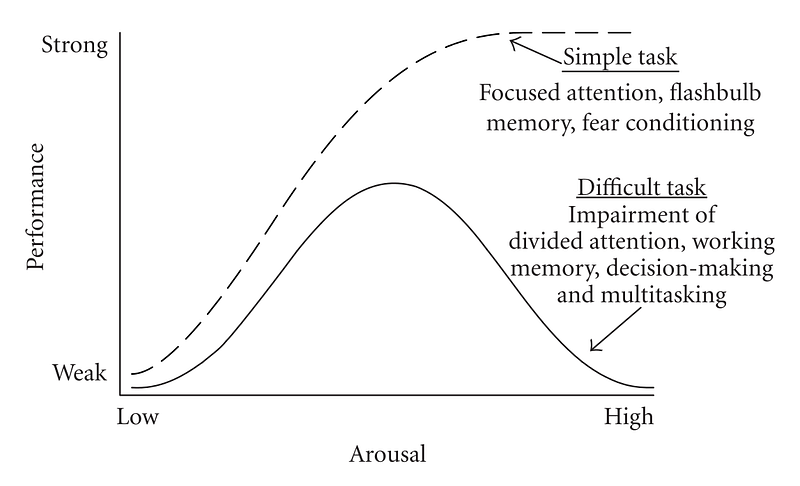
Public domain image from Wikimedia

With the simple “mechanical” tasks, you can apply a lot of pressure on a person, and they will still be productive. That’s how you can run fast, even under the most incredible amounts of pressure.

But with an intellectual task, you better be careful with how much pressure you apply to someone. And this has important implications for management. In particular, someone who works on short deadlines or inflexible orders can choke under pressure.

Even if they manage to do the work, their solutions will be much less innovative than those from people who have a better margin of action. That’s why companies with flat hierarchies or participative leadership usually perform better than companies that simply motivate their employees with carrots and sticks.

— A fundamental way to improve your productivity is to tweak your arousal levels while you are working. When you are working on simple tasks, it’s an advantage to get more stimulated, while complex tasks require lowering your arousal levels. That’s what I call the Focus Rudder.

If you do this properly, you get into a flow state, where you are totally absorbed by your task. And by maximizing the time you spend in flow, you become incredibly productive.

Today, we’ve seen a couple of strategies you can use to accomplish that. And we’ve also discussed the impact of management on your performance. In particular, you will produce the most innovative solutions if you are not overly pressured while performing your tasks.

On February 1st, 2022, I embarked on a 100 days writing challenge. This is post number 77.

Focus
Productivity
Flow
Business
Self Improvement
Recommended from ReadMedium