
FOCUS
Attention Bubbles: a French Technique to Stay Focused at Work
Probably the most efficient focus technique you’ve *never* heard about

Do you often struggle to stay focused on your tasks throughout your day?
I bet you often get this urge to check your personal emails or Twitter notifications, or you have wandering thoughts that keep distracting you.
But today may be the start of a new era for your productivity, as I’ll tell you about a focus technique that has improved my focus in a big way and, to my best knowledge, is unknown in the English world.
Stumbling upon the Attention Bubbles technique
But before I tell you about this technique, let me stress out a couple of things.
This article targets distracted people, right? So you’ll agree with me there’s a good chance you overlook this technique.
Maybe you’ll find it too simple. Or perhaps you’ll dismiss it because of its similarity to other focus techniques.
But let me tell you why it deserves your attention.
I’ve been looking for ways to become more productive since 2007 when I created my French productivity blog, and I’ve been mainly influenced by English productivity literature.
But every once in a while, I found a gold nugget in French literature.
That’s what happened when I stumbled upon the “Attention Bubble” technique in a 2013 book called “Le cerveau attentif” (“The attentive brain” in English), written by attention expert Jean-Philippe Lachaux.
Not a productivity toy
If you are a productivity enthusiast like me, you are probably accustomed to experimenting with multiple productivity techniques.
You would play with a productivity toy, then replace it with the next shiny one. I’ve done it many times with productivity apps.
But the Attention Bubbles technique has been an exception for me, as it is one of the rare tools I’ve used consistently over the years.
Let me illustrate that.
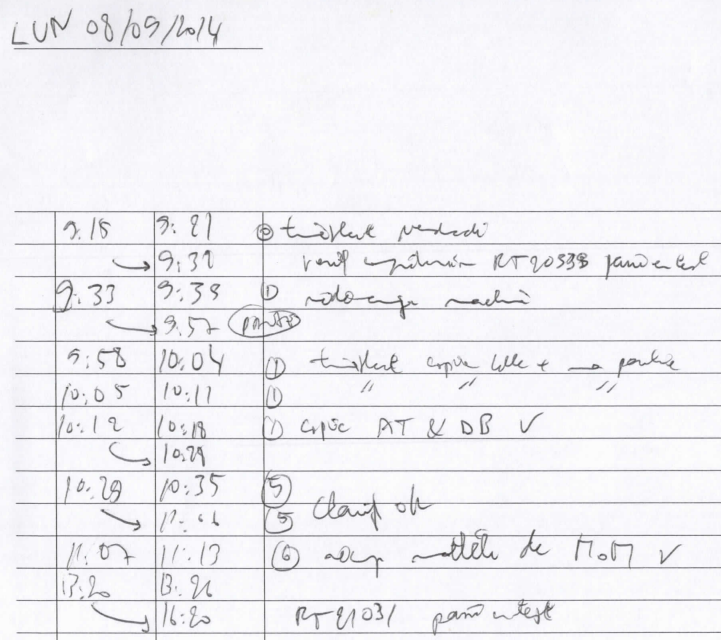
Here is one of my first experiments with the Attention Bubbles technique in 2014 (in paper format):
Now here’s how I’m using it in 2022 (in digital form):
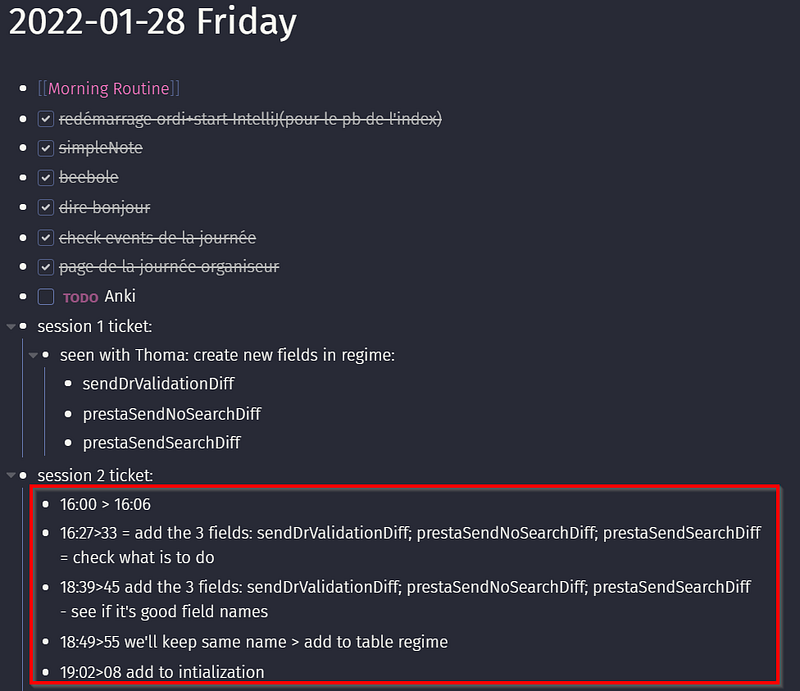
It might look messy, but the bottom line is I still find it useful these days.
That’s why I think this technique belongs to a few fundamental techniques you need to know to improve your focus.
However, there’s a good chance you’ve never heard about this technique because Jean-Philippe Lachaux’s works have not been translated yet into English.
Your 6 minutes Attention Bubbles
Ok, enough languishing, let me explain how it works.
The Attention Bubbles is as simple as it sounds. The idea is to give yourself 6 minutes of focused attention on something small. Break down your current task and find a “small mission” you can do in 6 minutes.
Here’s my way of doing it:
- Take a piece of paper or a digital note-taking app.
- On the left, write down the beginning time of the Attention Bubble (the current time) and the ending time of the Attention Bubble (current time+6 minutes).
- Then, on the right, write down what you’re going to do. This needs to be a very specific and practical little step on your current task.
For example:
09:41>47 Open Excel and create a new report from my template
Then you start working on the task.
Don’t use a timer
By now, you might say: this is just a variation of the well-known timeboxing technique.
You could even compare it to the Pomodoro Technique, except that we use 6 minutes instead of 25 minutes.
The subtlety is that the Attention Bubbles technique requires no timer.
This means you will do your best to go back to your piece of paper or note-taking app by yourself at the end of the Attention Bubble.
That is 6 minutes after you started work.
Then you write down what the next Attention Bubble will be and resume your work.
Here’s how it looks like with the previous example:
09:41>47 Open Excel and create a new report from my template 09:48>54 Fill the report with yesterday’s data
What if your Attention Bubble bursts?
Unfortunately, after the 6 minutes, there is a good chance you don’t come back to your piece of paper or note-taking app because you have become distracted.
Maybe you got distracting thoughts, realized the time has passed and you have achieved nothing. Maybe you have been interrupted by a notification on your mobile, or you gave in to a tempting urge.
Don’t feel bad about it, as this is precisely why we use the Attention Bubble technique in the first place. The most important here is to notice what happened without getting upset about it.
Just like for meditation, instead of judging yourself, you simply observe yourself in a detached way and become aware of what distracted you.
If you notice that the small mission you gave yourself was too vague or confusing, tweak it a little bit.
Then give it another try.
What if your Attention Bubble inflates?
The second reason you wouldn’t return to your piece of paper or note-taking app after the 6 minutes is that you got carried away by your task.
You became totally absorbed by your work, and you lost the notion of time. Legendary psychologist Mihaly Csikszentmihalyi would say you are in a “Flow” state, a very enjoyable state in which nothing else seems to matter.
This is an excellent situation to be in since you probably made significant progress in your work.
At this point, you might decide that you are now sufficiently engaged in your task that you don’t need to continue using the Attention Bubble technique.
Or you might go on with your next “Attention Bubble” if you feel that you need more guidance.
It is totally up to you.
In my experience, the “Attention Bubble” technique can’t be used throughout the day. Instead, use it as temporary help, every once in a while, to get into the flow state when you are struggling to focus.
When not to use this technique
Finally, let’s see when not to use this technique.
In the words of machine learning expert Herbert L. Roitblat, there are two categories of problems: path problems and insight problems.
Path problems are problems where you can follow a path to solve them.
Insight problems generally can’t be solved by a step-by-step procedure, or if they can, the process is extremely tedious. Most notably, it is impossible to see where you are with an insight problem unless the problem is essentially solved.
Path problems are perfect for the Attention Bubble technique as you know most of the steps to solve them.
But with insight problems, mind wandering is a better strategy.
Instead of using the Attention Bubble Technique, do a manual activity such as walking in nature, doing the washing up, or taking a nap to help your subconscious mind come up with interesting ideas.
Takeaways
- The Attention Bubbles Technique is a focus technique where you work during 6 minutes intervals on practical steps to progress on your work.
- This technique requires no timer. After 6 minutes, you have to go back to your sheet of paper or note-taking app by yourself to write down the next step you’ll take.
- Sometimes, the bubble bursts: you get distracted and fail to advance on your task, in which case you may adjust your task and try again.
- Other times, the bubble inflates: you get carried away in your task and enter a flow state, which is actually a good thing.
- The Attention Bubbles technique works well for familiar problems where you know a path to the solution. For insight problems, it’s best to let your mind wander to find a creative solution.


