
The Farce of Vox Day’s Alt-Right Case Against Atheism
The supposed irrationality of atheists, according to a Christian nationalist

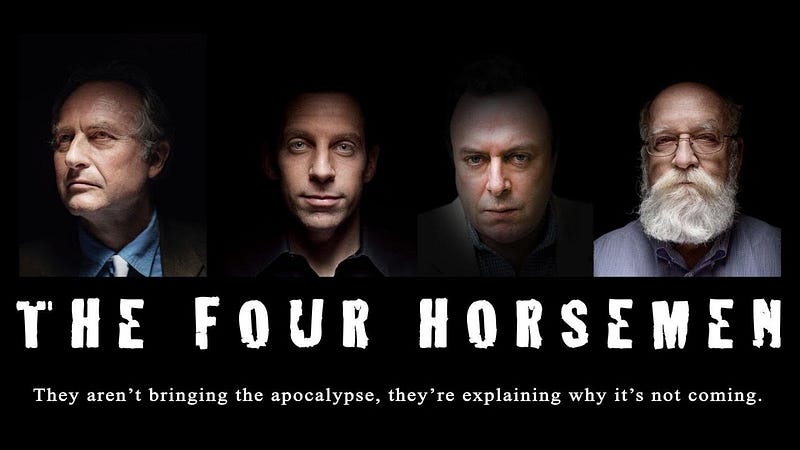
The alt-right activist and author who’s commonly called “Vox day” (as though he were the voice of God, as in Vox Dei) wrote in 2008 the book The Irrational Atheist: Dissecting the Unholy Trinity of Dawkins, Harris, and Hitchens. This was one of many post-9/11 pro-religion books aimed at countering the new atheist movement, which was in full swing at the time.
Subsequently, the new atheist movement splintered along political lines, and other tribal movements have since captured the media’s attention, such as Trumpism and Wokeness, although the new atheists’ work in smacking down religious fundamentalism after 9/11 was largely accomplished.
Mind you, George W. Bush’s neoconservatives disgraced Western secularism with their amateurish lies about WMDs and with their quixotic crusade against Iraq and by extension the whole Muslim world. Still, with the returning absurdity of warring monotheists in the Arab-Israeli conflict, perhaps atheists will have to rise to the cultural forefront again, in which case the provocations of Vox Day might likewise resurface.
I should say at the outset that I agree with the gist of Day’s claim “that this trio of New Atheists, this Unholy Trinity [Richard Dawkins, Sam Harris, and Christopher Hitchens], are a collection of faux-intellectual frauds utilizing pseudoscientific sleight of hand in order to falsely claim that religious faith is inherently dangerous and has no place in the modern world.”
It’s not that those three were frauds, but that the media turned them into leaders of a social movement, whereas they were only scientists, authors, or journalists. Still, the new atheism movement was tainted by its scientism, as I’ve written elsewhere.
But Day’s framing of the issues is incoherent and unsustainable, given his theoretical commitments. He’s an amusing writer, though, which is rare for an authoritarian conservative. So, when he says, “Sam Harris is so superlatively wrong that it will require the development of esoteric mathematics operating simultaneously in multiple dimensions to fully comprehend the orders of magnitude of his wrongness,” that’s pretty funny.
I’m not going to address everything in his book here; instead, I’ll just touch on how he frames the problem of atheism.
The oxymoron of “Christian libertarian”
Day is upfront about his twin commitments:
I am a Christian. I’m also a libertarian. I believe in free will and in allowing you to exercise it. I believe that our free will is a gift from our Creator and that He expects us to use it. I believe in living and letting live. If you’ll leave me alone, I’ll be delighted to do you the courtesy of leaving you alone in return.
Thus, he says, “All I ask, all the vast majority of the billions of people of faith on the planet ask, is to be left alone to believe what we choose to believe and live how we decide to live.”
Now, this makes Day what I’ve called elsewhere an “Americanized Christian.” In case you’re unfamiliar with that queer species, it’s the one that would be shuddering under a rock were Jesus to return since obviously the poor-in-spirit Christ would begin his reign by blasting to ashes secular empires like the United States.
But as an alt-right dude, Day is caught between a rock and a hard place. As a conservative, he needs to stay true to some tradition, and the older and more archaic the tradition the better since that would make his irrational faith in it seem more honourable and manly.
Yet the perpetration of right-wing prejudices in the modern context calls for secular rationalizations such as Ayn Rand’s libertarian credo or neoclassical economics. Those secular instruments will have precious little to do with anything that could reasonably be considered authentic Christianity.
Economics, for example, is supposed to be a science, and Jesus and the Church have had no interest in the scientific spirit. In so far as reason could be twisted with casuistry to support Church dogma, the Church could call itself “rational” in a sophistical sense. But the scientific methods that would reshape the West after the Protestant Reformation were driven by a resurgence of ancient Greco-Roman humanism and skepticism, the latter being patent sins, according to Christians.
Day seizes, though, on something the Christian and the libertarian seem to share: an aversion to being persecuted. Even as the oxymoronic Christian empires rose and fell, Christians could identify with Jesus if they could be seen to be persecuted in some way. So even as America became the world’s premier superpower after the collapse of the Soviet Union, American Christians could think of themselves as halfway Christ-like if the liberal elites picked on them for some of their First World failures. Of course, this is just the Fox News canard, developed in the 1990s to capture the attention of the televangelist charlatans’ “moral majority.”
And libertarian individualists cherish their liberty to rise and to fall in a social Darwinian struggle for survival, as though the social contract had never occurred and humankind hadn’t learned the benefits of pooling resources, long before capitalism empowered predators and parasites to rig society for their advantage.
Now, some years after he published his book on new atheism, Day apparently left behind libertarianism for far-right authoritarianism or “Christian nationalism.” But if he was confused about libertarianism’s inconsistency with Christianity, he’s just as likely to be blind or indifferent to nationalism’s inconsistency with that religion.
Atheistic aggression?
In any case, this is how Day frames the rise of new atheism: as a secular form of persecution, which should thus provoke not just Christians but libertarians. It was a rallying cry for all American conservatives, against the specter of new atheism.
As Day says, his problem is that
the Unholy Trinity have no intention of leaving me alone. Richard Dawkins accuses me of child abuse because I teach my children that God loves them even more than I do. Sam Harris declares that I should not be tolerated and suggests that it might be ethical to kill me in preemptive self-defense. Christopher Hitchens asserts that I am a form of human Drāno, poisoning everything I encounter.
Here Day forgets that new atheism arose as a defense of liberalism against the religious fundamentalism that surged in the 9/11 attacks on the United States. Liberals would indeed leave conservatives alone — unless the latter were to turn into authoritarian fundamentalists who threaten American democracy, which is what happened under Donald Trump’s demagoguery.
The problem, then, was that Islamic fundamentalists opposed modernity, yet their regimes happened to control much of the world’s oil on which modernity runs. The US needed to stabilize the region, given the potential of another 1973 oil crisis.
And Christian fundamentalists also oppose modernity, as indicated by the Republican Party’s Trump cult. This implicit opposition to modernity is what Vox Day and the alt-right share with al Qaeda. To be sure, Day would insist that as a former libertarian, he had no problem with science or with personal liberties. It’s just that the more he’d emphasize those aspects of modern liberalism, the less Christian he’d sound — and thus the more likely you’d find him hiding under a rock were Jesus to return.
(Ayn Rand was more consistent in this respect since she repudiated the blatant irrationality of Christian theology.)
Day thought he could be a Christian libertarian because both groups stand for freewill, the so-called “gift” from our Creator. But the Church’s conception of human freedom is narrow since the Church is concerned only with the choice to accept its archaic dogmas, and thus to exchange your personal integrity for the comfort of belonging to a group.
By contrast, Jesus was concerned with the freedom to reject everything that seemed natural (and thus demonically controlled), including the norms of human civilization, in favour of spiritual “poverty,” an all-consuming love of God that humiliates and crucifies the faithful.
As for libertarian freedom, this is about liberty in a secular humanistic context, including the liberty to say and to think whatever you want, given the liberal’s harm principle, and the liberty to express yourself in your purchases and in your votes, thanks to the respective powers of capitalism and democracy.
These religious and secular contexts are alien to each other, so Day’s reconciliation between Christianity and libertarianism was superficial at best.
Atheism and liberalism
Still, let’s assume for the sake of argument that “atheists” just won’t leave religious and conservative folks alone, calling for Day’s heroic stand for freedom. What’s Day’s case against atheism?
If you think it would be a case for theism, you’d be mistaken. Here’s Day on his book’s purpose:
This is not a theological work. The text contains no arguments for the existence of God and the supernatural, nor is it concerned with evolution, creationism, the age of Earth, or intelligent design. It contains no arguments from Scripture; in attacking the arguments, assertions, and conclusions of the New Atheists, my only weapons are the purely secular ones of reason, logic, and historically documented, independently verifiable fact. This is not a book about God, it is about those who seek to replace Him.
Alas, this sets up Day for some crude, crass confusions about the nature of atheism. Being an authoritarian “conservative,” it’s understandable that Day would be crude enough to confuse atheists with atheism, and thus to criticize some leading new atheists or the social movement of new atheism rather than the philosophical issue of atheism itself. But that’s not where Day’s confusions end.
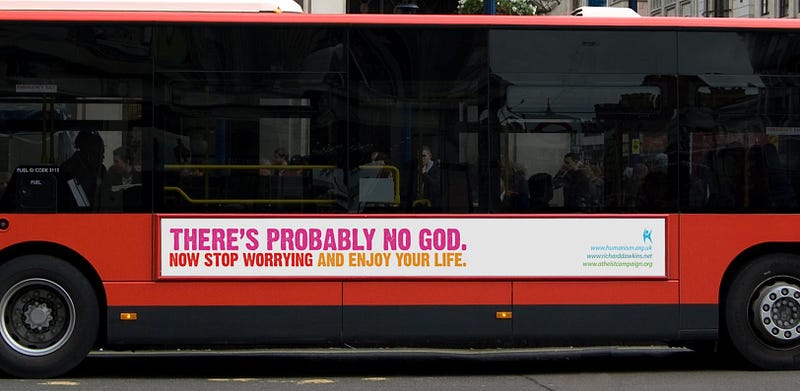
The point of atheism is that God doesn’t exist, or that theistic beliefs are dangerously irrational. All new atheism added to atheism was a social movement to communicate that message. “Look what religious literalism did in the form of the 9/11 terrorist attacks! Notice how deranged Islamists and their medieval totalitarian regimes are and see how they threaten the liberal bastion of Israel in the Middle East.” That was the upshot of new atheism.
To argue against the atheistic core of new atheism, you’d have to show that theistic beliefs are rational, after all, or that the Arab world poses no threat to Israel or to Western liberalism. Day doesn’t do that. Instead, he argues that “atheists” are irrational — except that by “atheists” he means something like liberals, and by “irrational” he usually means hypocritical.
For instance, Day says, “While the atheist may be godless, he is not without faith, because he puts his trust in the scientific method and those who use it, whether he understands their conclusions with regards to any given application or not.”
Yet atheism entails nothing about science or about the importance of scientific culture. Day’s thinking, rather, of liberalism or secular humanism.
Atheistic irrationality?
But let’s leave that semantic issue aside. Here’s Day on the supposed irrationality of atheism:
The fundamental irrationality of the atheist can primarily be seen in his actions, and it is here that his general lack of intellectual conviction is also exposed. Whereas Christians and the faithful of other religions have rational reasons for attempting to live by their various moral systems, the atheist does not. Both ethics and morals based on religion are nothing more than manmade myth to the atheist: he is therefore required to reject them on rational materialist grounds.
Moreover, Day says, “One need only ask an atheist what his morality is and inquire as to how he developed it and why it should happen to so closely coincide with the dominant societal morality to discover that there is nothing rational about most atheists’ beliefs.”
Day seems to be thinking of something like John Gray’s Nietzschean argument that liberals take their morality wholesale from Christendom even as their skepticism undermines the foundations of the Christian worldview.
But that argument is as fallacious as Nietzsche’s social Darwinism. Contrary also to David Bentley Hart, Christians didn’t invent morality. All civilized cultures grapple with human social instincts, suppressing some and emphasizing others. Christian egalitarianism came at the tail end of the Axial age’s moralistic reforms. Also, ironically, the Christian conception of the equal value of everyone — which conflicts utterly with the libertarian’s antisociality — benefitted from ancient Rome’s imperial policy of toleration, or from its industriousness that gave short shrift to theology.
So, if early modern thinkers drew from Christianity in critiquing that former culture, early Christians drew from Zoroastrianism, Judaism, Stoicism, and Neoplatonism, which in turn drew from the Upanishads and from earlier civilized reckonings with self-awareness, empathy, reason, and the imagination.
The notion that atheists have no independent basis for morality is silly. Note first the difference between historical and logical independence, something Nietzsche neglected with his genealogical fallacies. Logically, if not always historically, Aristotle’s virtue theory, Immanuel Kant’s duty-based moral arguments, and John Stuart Mill’s arguments for liberal utilitarianism are independent of Christian theology. More generally, secular humanism is based on a scientific understanding of human nature and of history and our place as a species in a material universe.
Far from clarifying morality, theism confuses the issue by injecting an all-powerful deity’s dominance into the picture. Should we obey God’s commandments because they’re right or because we fear being punished by an irresistible ruler? Does might make right? Are God’s commandments arbitrary or is he himself bound to issue them because they’re justified apart from his willing of them?
In any case, if the liberal atheist is being hypocritical in espousing demystified Christian egalitarianism, the Christian must have been hypocritical for claiming to follow Jesus and the Holy Roman Catholic Church, the latter having inherited the might of the very empire that crucified Jesus. In either case, the charge of hypocrisy is beside the point and is liable to be juvenile ad hominem, unless it’s paired with a critique of liberal or Christian doctrine.

The independence of atheistic morality
Yet Day’s more concerned about what he hints at towards the end of the above passage. He spells it out here:
But the ultimate atheist irrationality is the idea that Man himself is rational. Despite the fact that many of our behavioral sciences are founded on this principle, including the dismal science so dear to me, almost all the observable evidence, scientific and anecdotal, forces one to conclude otherwise…You need only look around to see hundreds of examples of totally irrational human behavior every single day.
Note, in passing, the allusion there to “the dismal science so dear to me,” that being economics and specifically the free-market libertarian wing that supports this budding authoritarian’s antisocial prejudices, such as that the poor should be left to fend for themselves, and that capitalism should be allowed to grind to a halt, turning into neo-feudalism as the plutocratic monopolists naturally acquire the power to override the regulators and to circumvent the democratic institutions.
The early cheerleaders for capitalism posited Homo economicus, contending that capitalism is self-regulating precisely because everyone’s instrumentally rational, meaning that we calculate the means of most efficiently maximizing our utility, or of achieving our goals. Hence, again, Day’s traditional Christian emphasis on faith conflicted with his modern libertarianism, and this conflict reared its head in his recognition of capitalism’s laissez-faire rationalizations of plutocracy.
Regardless, the main “irrationality” (hypocrisy) here is supposed to be the “atheist’s” (secular humanist’s or liberal’s) contention that people are generally rational, that we should aspire to that ideal, or that a society could be established on principles of reason.
As Day says, it’s just as well “that so many atheist individuals nevertheless continue to openly adhere to conventional religious morals and ethics that they have no rational grounds for respecting,” since people generally aren’t so rational.
If everyone’s fundamentally irrational, as Day suggests, do Christians have some advantage over atheists?
As quoted above, Day contends that “Christians and the faithful of other religions have rational reasons for attempting to live by their various moral systems,” whereas “the atheist does not.”
Yet the Christian’s “reasons” here must have to do with mere consistency. It’s not that Day has shown that the Christian creed is itself rational since that would be a tall order. But at least the Christian is forthright about his or her reasons for being moral. By contrast, Day wants to say, the “atheist” rejects all theologies, and thus stands forlorn, waiting for Godot after God’s died.
- And indeed, you could say the Christian is being sociologically rational in espousing certain virtues by holding up Jesus as his or her model. But then the logic would be that of the virtue theorist’s, which pre-existed Christianity by several centuries.
- Or you could say the Christian is being rational in obeying God, by carrying out his or her duty as mere clay in God’s hands. Yet the logic there would be deontological, which Kant showed is independent of theism.
- Or you could say the Christian is being instrumentally rational in being “moral” to get into Heaven and to avoid Hell in the afterlife. Alas, the logic there would be consequentialist, which would make for an independent basis of morality, as Mill pointed out.
Why Day thinks the Christian ought to be emphasizing the “rationality” of his or her faith is a mystery, considering that Jesus said his followers should be childlike in their abandonment of mainstream, hypocritical lifestyles (Mark 10:14), and chided doubting Thomas for seeking physical proof of his resurrection (John 20:29). Likewise, Paul said Christianity is about spiritual, not natural wisdom, the latter being foolishness to God (1 Cor. 1, 2). The Christian’s (proto-Gnostic) “spiritual discernment” has little to do with logic or science.
Indeed, this is even more mysterious since, on conservative grounds that are surely meant to be consistent with his alt-right prejudices, Day himself contends that people are generally irrational. Yet his book’s title is The Irrational Atheist — as if irrationality were a bad thing.
Exercising some charity, what Day must be saying is that “atheists” are more hypocritical than Christians since the latter are fine with saying that we’re prone to sin, whereas liberals and secular humanists make a show of being rationally self-restrained.
Humanistic aspirations
But this is all adolescent nonsense. Liberals and secular humanists take onboard the scientific conception of our nature, which means they understand that we derive from animal species and that our bodies are mammalian. The Pauline doctrine of original sin is hardly needed to understand the scientific grounds for saying that humans are fundamentally animals and thus liable to be irrational.
Does that mean we shouldn’t strive to be rational, or that we shouldn’t create institutions that help us be rational, institutions such as science, the academy, and a free press? Only if you go along too far with conservativism and commit the naturalistic fallacy of inferring that what’s natural is automatically right.
We may struggle to be rational, especially when liberals must tolerate the disinformation of alt-right provocateurs like Vox Day who wrote on his blog that Donald Trump “was a great President, genuinely the greatest U.S. President since Andrew Jackson.” It’s hard being rational with libertarians in the mix who cheer on America’s hyper-capitalism that fosters a dehumanizing culture of consumerism. And it’s hard to be rational when religious fundamentalists are the loudest voices in the room even though they still don’t understand the difference between myths and literal truths, not even after centuries of scientific clarification of what it means to speak of facts.
Yeah, it’s hard, but liberals and humanists can try, as onerous as it can be with those albatrosses around their necks.
By the way, Day wrote in that same blog that as great as Trump’s “presidency” was, “we’ve finally had to give him up.” Why? What was the straw that broke the camel’s back for Day? It was Trump’s “continued support for the vaccine fraud that has transformed the erstwhile God-Emperor into a squirming proto-sandworm.” This is the evidence Day uses to speak to Trump’s “management skills, nepotism, and negotiator’s instincts” that “failed him in the end.”
The problem for Day, then, isn’t just with questions of basic critical thinking. It’s more a question of judgment or character that should concern his liberal atheistic critics. If you think the main problem with Donald Trump is his boast that his Covid vaccine worked, there’s a chance your priorities are skewed beyond repair.
That would be another reason for atheists to want to leave alone these cave-dwelling alt-right, “Christian libertarian” types. Just observe the juvenile red herrings and slowly back away.
I collect my Medium writings in paperback and eBook forms, and I put them up on Amazon. Check them out if you’d like to have them handy and to support my writing in that way. The newest one is Questing for Epiphanies in a Haunted House, and its 600 pages include 99 recent, wide-ranging articles of mine.