
Waiting for Godot in the Middle East’s Holy Wars
Monotheism and the clash between Jewish and Islamic idols
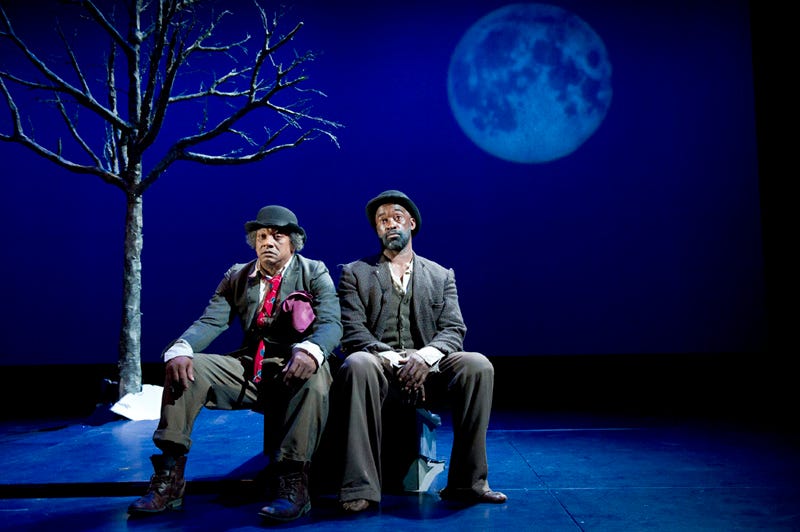
“Let’s go.” “We can’t.” “Why not?” “We’re waiting for Godot.”
“What are we doing here, that is the question. And we are blessed in this, that we happen to know the answer. Yes, in the immense confusion one thing alone is clear. We are waiting for Godot to come.” ― Samuel Beckett, “Waiting for Godot”
In all the mainstream coverage of Israel’s conflict with Palestinians, we hear a lot about land and terrorism, international law and occupations, historical grievances and peace plans, politics and collateral damage.
One thing we don’t hear about enough in that context is God because God’s name is written all over the Arab-Israeli wars. And no discussion of those conflicts’ religious dimension would be complete without emphasizing the absurd spectacle of monotheists fighting over the right to be favoured by the same (nonexistent) deity.
Jews and Muslims are both monotheists, and it’s not as though Muslims developed their religion with no input from Judaism. Islam is supposed to be the fulfilment of the Abrahamic lineage that stretches from Judaism through Christ to Muhammad.
But Jews and Muslims generally hate each other, at least since the rise of nationalism in the early twentieth century.
Granted, the hatred takes different forms. Muslims hate Jews out of burning jealousy and indignation since Israel’s success as a superpower that outclasses the whole Arab world in all measures of modern progress has humiliated these Muslims. And with their cultural and historic ties to the Bedouins, Muslims care about honour.
Meanwhile, Jews only condescend to Muslims, associating their totalitarian regimes more with animal infestations than with respectable states that have caught up to the zeitgeist. That belittlement is evident from Israel’s decision to use its military to punish all of Gaza, in effect, for the savage Oct 7 terrorism of Hamas.
The problem is that the Arab world is premodern, as in medieval in the pejorative sense of being staunchly, dogmatically illiberal. What most Jews hate and can’t tolerate isn’t so much Muslims as persons but their medieval cultures.
Oddly, the Western and Muslim worlds have been like ships passing in the night, heading towards opposite destinations: the West started off medieval (benighted a hundred times over, passing into a dark age) and turned modern, whereas the Muslim world started off as relatively modern (free thinking and intellectually and morally advanced) and ended up stagnating in a swamp of medieval theocracies even as liberal states flourished around them in Europe, Asia, and the Americas.
But if Israel is the vanguard of modernity — that is, of some combination of liberalism, secular humanism, freedom of thought, capitalism, democracy, rule of law, and technoscientific empowerment — in the Middle East, how can God’s name be written on Israel’s conduct with the Palestinians?
No one knows the First Cause’s true name, of course, since the supernatural would have to retreat from nature, lest “God” overwhelm this material realm of shadows. Hence, Jews and Muslims imitate their deity by retreating in turn, albeit to different idols.
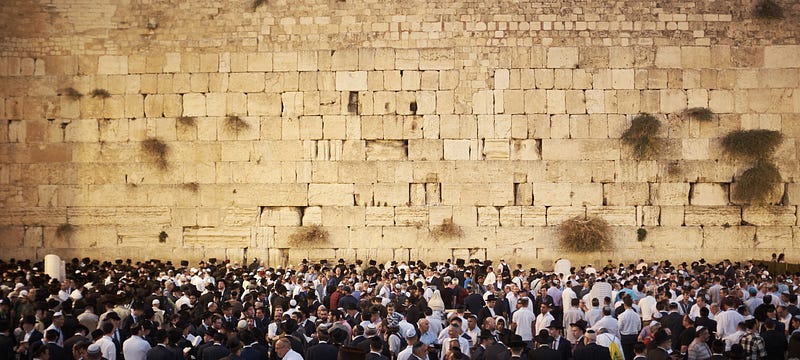
The Jewish idol
Most Jews don’t take theism so seriously, meaning that they don’t spend much time thinking about theology. Whereas God is the protagonist of most of the Jewish scriptures, as Jack Miles explains in God: A Biography, the scriptures that have influenced Jews the most over the two millennia have been Job and Ecclesiastes. These books spell the end of Jewish theology, that is, the practical death of God, and the start of a pragmatic naturalizing of religious morality.
Most Jews are deistic in practice. They don’t think we can relate personally to the Almighty in this life, or that God’s at their beck and call, answering prayers and intervening with miracles. They think their religious traditions afford them some sensible moral principles, and rituals and holidays that distinguish their culture. But their attitude towards God is like that of Qohelet, the attributed narrator of Ecclesiastes, or like someone who’s been humbled, having read the tea leaves of the Book of Job.
The upshot of Jewish monotheism or of the repudiation of idols is that God’s so great, he’s irrelevant. He’s so far away that he doesn’t matter to us, so we need to solve our problems in this life and can’t count on miracles. In short, Jews found that they need to think like secular humanists.
But this makes for a special kind of duplicity, for the kind you see in Lloyd Blankfein’s assurance that banks like Goldman Sachs are doing “God’s work.” On the one hand, Jews take the license to live like secular hedonists and materialists. On the other, “God” pops up out of nowhere whenever Jews feel inclined to reassure themselves that their tribe is still righteous and at one with their maker.
Most Jews want it both ways. They pretend that theology doesn’t matter because they’ve outgrown the childish need for fundamental certainty on philosophical questions, but they want to be esteemed as wise, not just for being professionally successful.
The Jewish idol, then, is the Jewish people as God’s chosen one. To be sure, Jews don’t think God favours Jews with the assurance of success in all their endeavours. Jews have suffered a lot in history. Instead, this is a Christ-like favouritism: God chose the Jews to suffer on behalf of a moral code, to stand for something other than the natural tendency for strong nations to dominate the weaker ones.
Jews worship not God the clownish tyrant of the Hebrew Bible but the sacredness of “the Law,” of legalistic morality, of a holy set of traditions.
Hence, Israeli condescension to the Muslim world is about the Jewish pride of feeling entitled to superpower status, even as Israelis understand that the United States backs them largely on anti-Jewish, Evangelical Christian grounds.
From a Jewish standpoint, the problem with most Muslims is that they take their religion far too seriously. Muslims should understand that the one true God is hidden from this world, so they should get on with solving their problems, picking themselves up from their state of medieval poverty and incompetence and progressing in the modern fashion.
In practice this means that whatever Jews do, they can see God’s will in it, because Jews are the ones doing it, connected as they are to their ancient traditions. If Israel kills thousands of Palestinian civilians in the quest for vengeance against Hamas, that’s God’s will. And if Israel had instead been more cautious in declining to reduce much of Gaza to rubble, that would have been God’s will too.
The idol that matters to Jews is their traditional identity, so however that identity is expressed in politics, war, or business, that’s God at work. All that matter to Jews is that their culture somehow endures, as it’s endured for thousands of years.
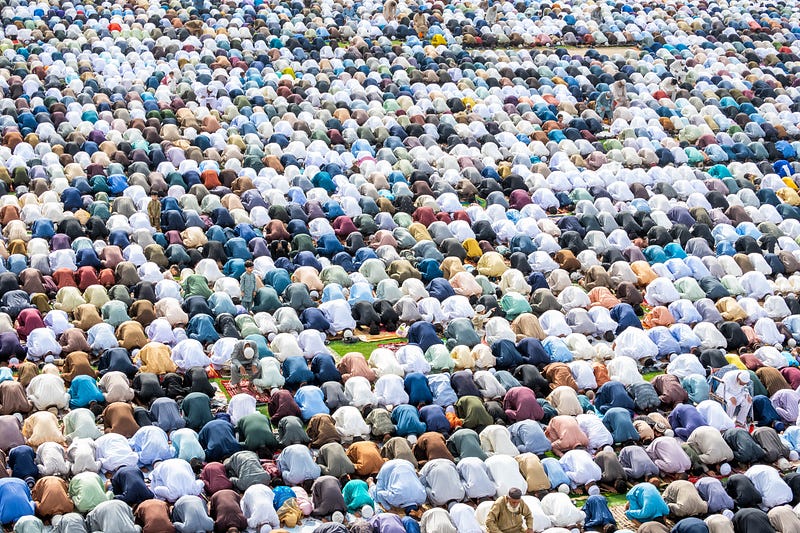
The Islamic idol
Islamic idolatry is easier to discern.
Of course, Muslims would vehemently deny that they’re idolaters. Only Allah and his prophet Muhammad are on their mind. One reason they’re content with their medieval theocracies, though, is that they mean to sacrifice their earthly life for the promise of eternal paradise in the afterlife. They restrain themselves here and now, living simply, focussing on their religious obligations to pray, to fast, to give alms, and to make pilgrimages.
The point of those sacrifices is to demonstrate the faith that God is great, meaning that God is far greater than we can comprehend, so our purpose should be to submit to God. “Islam” means “submission.”
What matters to Muslims, then, isn’t God directly since as strict monotheists, Muslims know that God can’t be equated with any mere human concept or material practice. Still, implicitly, what Muslims value most is their behavioural pattern of submission. And submission is a political act. The weak submit to the strong, not the other way around.
God is uppermost in Muslims’ minds when they’re astonished that they’re not dominating the planet in God’s name since the Western and Eastern superpowers have surpassed the Arab world in knowledge, wealth, and military supremacy. For Muslims nothing is plainer than that God ought to rule and that he will necessarily rule over all, in that everyone will submit to Allah. Yet this love of God, of the slave for his master, turns to resentment when God’s being dishonoured, when blasphemous liberals ride roughshod over the faithful.
The Muslim world’s war against Jews began with its early condemnation of Zionism and its rejection of the Balfour Declaration and of the UN’s partition plan for Palestine. That antagonism which has continued almost unabated for over a century has fuelled what most Muslims in the Middle East take to be a holy war against the existence of Israel.
When Muslims were dominant in the medieval period, they could afford to condescend to Jews and show them mercy, treating them better than Christians did. But now that the tide has turned, after the revolutions of “modernity” and the loss of the Ottoman Empire, when Muslim countries would be as dirt poor as much of Africa were it not for their oil industries, thanks to many Muslims’ antimodern fundamentalism, Israeli dominance takes on an acceptable religious significance.
The reason Arabs can’t tolerate the existence of a Jewish state in the Middle East is that Israel is too modern, which makes Islamic dictatorships and Allah himself look bad by comparison. The Muslims’ war to destroy Israel is meant to promote Islam and to honour Allah, to end this baffling humiliation for Allah’s willing servants. As the Quran stresses, submission to God means fighting jihad against those who slight the Prophet or who threaten the dignity and integrity of Islam.

The absurdity of fighting for Godot
As impure or idolatrous as this holy war may be, we shouldn’t overlook the conflict’s profound irony.
Granted, Jews and Muslims have different styles of inconsistency in their rejection of more universal, collaborative kinds of mysticism. Nevertheless, as I said, nominatively, as least, Jews and Muslims are both monotheists who are part of the same religious family. They even share their failure to understand the essence of monotheism.
Yet they’re always at war.
Proper monotheism turns eventually into atheism, not just Jewish deism, since a transcendent deity would have to be impersonal, falsifying the plain meaning of theism. Consequently, exoteric monotheism for the masses is self-refuting. Yet even as secular as most Israeli Jews are, they still use their scriptures as pretexts to idolize their traditions and their tribal identity.
Thus, the Arab-Israeli conflict is between monotheistic idols, and the conflict will be as endless as that toxic religious hypocrisy.
After all, the God that’s supposed to unite Jews and Muslims is just Godot, not any real supernatural character residing over the rainbow. Jews and Muslims are waiting and fighting for Godot, for an absurd nonentity, not for the Yahweh or Allah of their archaic imaginings. These tribes have tied themselves into knots, struggling to understand Godot’s will, prostrating themselves before this invisible creator, deeming themselves mature in rejecting the most literalistic theology or relishing the chance to commit to a holy war on Godot’s behalf.
The war between Israeli Jews and Palestinian Muslims is as absurd as the riots that break out on some European football fields, between fans who take the game too seriously.
The point of sports is that they’re supposed to substitute for war. You cheer for your home team because it’s fun, not because it’s life or death since unlike war, sports don’t really matter. Killing because your favourite team has lost a mere game betrays a gross failure of perspective. The difference between professional football teams is superficial since the players are playing the same sport in the same league and abiding by the same set of rules. In that sense, professional sports are like oligopolies.
Similarly, Jews and Muslims are both supposed to be Abrahamic monotheists. Their religious stylings differ, but they’re meant to trust that the universe is in the same mysterious deity’s hands. They loathe or resent and kill each other because of what that divine mystery entails: the monotheist’s God is so hidden that the faithful must turn to idols to satisfy their religious impulses, and those idols are tribal monstrosities that might offend the real deity.
Of course, divine punishments and rewards are entirely in the heads of the faithful. We interpret nature’s impersonal patterns to boost our self-image, and we do so with the freedom of a powerful imagination, so that we can construe even unfavourable situations to our liking. The full absurdity of these religious conflicts, then, lies in the fact that so many prayers and battle cries have fallen on such deaf ears.
I collect my Medium writings in paperback and eBook forms, and I put them up on Amazon. Check them out if you’d like to have them handy and to support my writing in that way. The newest one is Questing for Epiphanies in a Haunted House, and its 600 pages include 99 recent, wide-ranging articles of mine.


