
The Twin Cults of Trumpism and Wokeness
The mystery of why these political cults arose almost simultaneously in the United States

Why did two insane cults arise on the opposite sides of the American cultural spectrum, at roughly the same time, namely the cults of Trumpism and Wokeness?
Is this some reverse Axial Age effect? The Axial Age of the first millennium BCE was the dawning of spiritual or existential revelations in disparate parts of the world, from Laozi and Confucius to Zoroaster and the Buddha to the Jewish prophets and the Presocratics. Did the late-modern so-called liberals and conservatives in the United States decide spontaneously and perversely, then, to attempt to outcrazy each other?
The “libertarian” Tea Party Movement
The cults arose within the last decade, as of this writing, so the causes are still apparent. Trumpism began as the Tea Party movement, which arose in 2009 as a white supremacist reaction to Barack Obama’s election as president, although the Tea Party masqueraded as a libertarian fight for “freedom.” Rather than caring about principles of small government, the Tea Partiers voiced their “libertarian” concerns only as an anti-Democratic tactic.
President Donald Trump lost no so-called “libertarian” support, although his tenure increased the national debt by 36%. Candidate Trump promised to “drain the swamp” in Washington, meaning he’d eliminate the corruption from lobbyists and the revolving door between the public and private sectors. But when in office he did the opposite, appointing mainly sycophants, family members, and acting members (without Senate confirmation), who had to prove their loyalty to him personally by looking the other way when he openly perpetrated his graft at Mar-a-Lago. And there was no discernable libertarian outcry.
So, we can dispense with the myth that there’s a movement of principled libertarianism in the US. Libertarianism itself is rather a cult of selfishness, a shade of “conservatism’s” social Darwinian antipathy towards modernity/humanism/liberalism.
But what sparked the vehemence of the Tea Party in 2009 was Obama’s Blackness. There was certainly no political or economic reason for the Republicans’ rabid contempt for Obama, as though Obama were Bernie Sanders or an extreme left-winger whose radicalism had to be countered by an extreme push to the right. Obama was a centrist, as evidenced by his protection of the banks in the Wall Street crash of 2008. He bailed them out with no strings attached, on the grounds of a Reaganian trickle-down theory: to save the American economy, Obama had to save the banks, the latter being the drivers of the deregulation that was the calamity’s primary cause.
Perhaps a principled libertarian would have preferred that Obama let all the big banks go bankrupt. Fair enough — except that, once again, there was no such complaint when President Trump interfered with the “free” market in a thousand ways, from picking winners and losers in his speeches and tweets, to waging a tariff war with China, to pumping “a staggering $6 trillion of liquidity into the economy since the coronavirus pandemic began,” a move which Deutsche Bank said is “the end of the free market.” (That’s the same bank, mind you, that was the source of Trump’s dark money, his lender of last resort.)
Foreign Policy points out that Trump governed as a mercantilist, not as a free trader:
the Trump administration’s economic prescription is increasingly to turn its back on the free market and adopt an ever-growing role for the government in the day-to-day workings of the economy, a situation experts say is nearly without precedent in modern U.S. history.
Since taking office, Trump has unilaterally levied legally dubious tariffs on friends and rivals alike that have created distortions throughout the economy and forced many firms to beg the government for hard-to-get exclusions. When China retaliated against U.S. tariffs by boycotting U.S. farm goods, Trump used government money to bail out farmers.
He has sought, like mercantilists centuries ago, to manage trade at a government-to-government level; a big part of the looming China trade deal is expected to include Chinese commitments to purchase U.S. commodities [which China didn’t end up purchasing, by the way]. He is forcing companies to tear up their existing supply chains and make manufacturing more expensive. He has tried to interfere in the electricity sector by offering government support for politically favored sectors like coal.
And on and on it goes. As far as libertarians should have been concerned, President Trump was the Antichrist. The only difference between Trump and a full-blown communist president would be that Trump wanted to personally call all the shots like a superheroic CEO, whereas a communist would say the workers should collectively organize the economy. Both kinds of president would be just as opposed to laissez-faire markets.
Perhaps the so-called libertarian Tea Party railed against centrist Obama for bailing out the too-big-to-fail banks, and thus for enabling the bankers to carry on with the plutocratic and oligopolistic frauds that can be expected from any “free,” weakly regulated market. (The banks only got bigger in 2020 and are still, in 2022, too big to fail.) But Trump had full control over the Republican Party, and more Americans voted for him in 2020 than for any Republican presidential nominee in American history (he received over 74 million votes).
Again, then, there’s no principled, “libertarian” basis for the Tea Party’s hatred of Obama. The simpler explanation is to posit plain, unconscious racism.
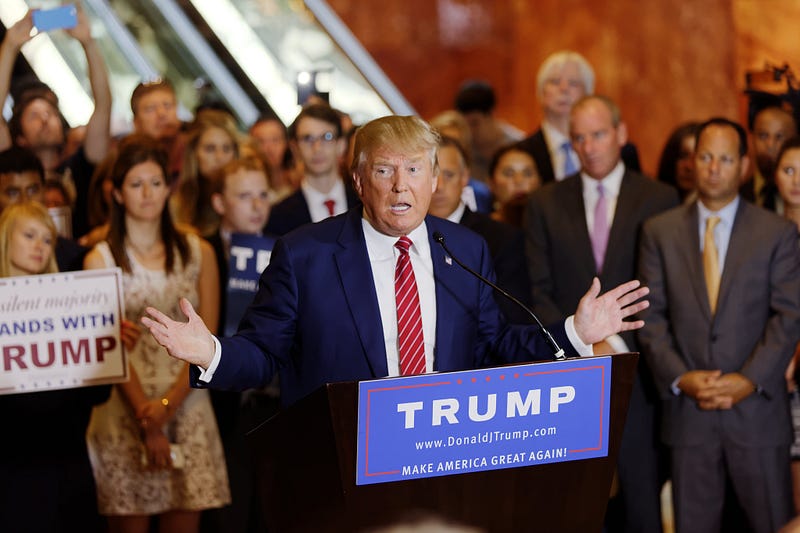
The cult of Trumpism
In any case, the Tea Party morphed into Trumpism, the connecting tissue being candidate Trump’s harnessing of the racist Birther movement as early as 2011.
Now, Trumpism is just obviously a cult. It’s a cult that’s taken over the Republican Party. Imagine if Scientology had done the same with the Democrats. Suppose Hollywood Scientologists somehow captured the liberal public, forcing Democratic politicians to do Scientology’s bidding, installing e-meters in Congress and the White House. That’s the equivalent of what happened to the Republicans under Trump.
The Trump cult is a right-wing populist movement flirting with authoritarianism. That is, millions of Americans are evidently tired of the democratic, neoliberal status quo of politicians on both sides serving the plutocrats at the expense of the failing middle class, and of rising multiculturalism, which racist White Americans resent. Above all, “conservative” Americans are embarrassed that their “policies” or prejudices aren’t popular enough for Republicans to win elections and to govern without cheating via gerrymandering, Electoral College shenanigans, the filibuster, the bizarre apportionment of US senators, and attempting to steal elections to combat nonexistent voter fraud.
Still, this populist movement isn’t united by sane, responsible policy goals, but by fealty to Donald Trump. The cult operates as a trolling stunt, as a bitter, anarchical takedown of America, as a vote for “None of the Above” to throw a monkey wrench into the machinery — rather like how Vladimir Putin threatened to destroy humanity in a nuclear holocaust instead of admitting that he erred in invading Ukraine in 2022. Trump is the bull in the China shop, and although his stated goal is to “make America great again,” even Trump’s supporters should understand by now that that’s only an Orwellian slogan. Supporting Trump’s political agenda is palpably destructive, not constructive.
The Trumpian Republican cult is thus akin to what, after 9/11, was sometimes called the “death cult” of jihadist terrorism. True, the Islamists believed in a creed and wanted to convert humanity to their religion or to kill the remainder, whereas Trumpians are just nihilistic, trolling millenarian anarchists. But both cults are forces of chaos and destruction, nemeses of a progressive global order.
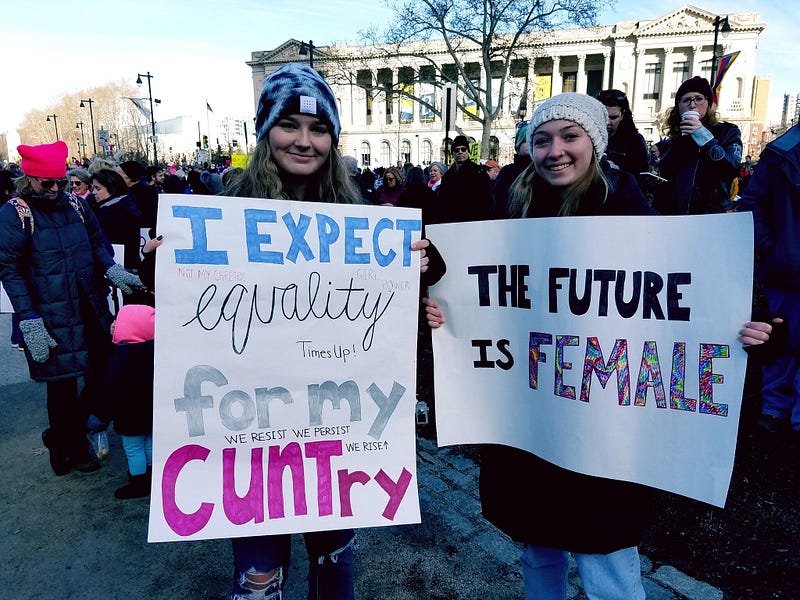
The cult of Wokeness
Likewise, the cult of Wokeness had its forerunners. The phrase “Stay woke!” originated in the early twentieth century, to call attention to racist threats against African Americans. Unlike the Tea Party, of course, that phrase’s original meaning, especially in the early twentieth century, was perfectly valid. Racist Whites were literally walking around in scary Klu Klux Klan outfits and lynching Blacks in the US.
But when this slogan of being “woke” went viral in 2015, and Wokeness fused with the Black Lives Matter and the MeToo movements, it became a toxic cult too. To be sure, American police forces have become militarized, and their shooting of unarmed Blacks speaks to a broader societal problem. Moreover, MeToo featured a parade of celebrities getting caught committing sexual abuse, beginning with Harvey Weinstein in 2017. Obviously, sexual assault and the disproportionate number of Blacks in prison (often for smoking cannabis) are legitimate grievances.
Yet these grievances merged with a sinister, nihilistic ideology that began with neo-Marxist resentment in the Frankfurt School; Michel Foucault’s neo-Nietzschean talk of the omnipresence of power dynamics; critical race theory; and radical feminism (the latter two replacing “power” with “racism” and “sexism” in Foucaultian sociology).
Having been in philosophy classes as an undergraduate in the late 1990s, I recall this “postmodern” turn in Western thought. At the time, analytic philosophers (of which I was one) regarded that Marxian or Nietzschean ideology as “Continental,” meaning that its leaders were often French (Jean-Francois Lyotard, Jacques Derrida, Michel Foucault), and there was a wall between those two kinds of philosophy departments. The analytical philosophers were empirical, progressive, science-centered clarifiers of concepts, whereas the continental philosophers were cynical, literary obscurantists and firebrands.
But the Continental school seems to have won the academic culture war. Regardless of the state of analytic philosophy departments, entire universities have been taken over by Wokeness. Stand-up comedians complain that woke college students have lost their sense of humour, while free-speech advocates report that these colleges have lost the plot entirely since they don’t respect debate. Wokesters believe they already know everything, so they needn’t go to college to search for the truth.
And now “Stay woke!” means not just being alert to overt crimes of racism or sexism but staying hypervigilant to pseudo-crimes such as so-called microaggressions or offensive speech. The fact that “defund the police” could arise as a Black Lives Matter slogan means that that once-legitimate movement has jumped the shark. In Woke Racism, John McWhorter shows how this movement operates as a fundamentalist religion.
Whatever it once was, Wokeness is now a left-wing cult of political correctness and of feminizing (maternal and overprotective) infantilization of consumers. Whereas Trumpism thrives in rural zones, Wokeness flourishes among urban professionals.
A clash of cults
This raises the question, though, of whether the joint ascent of these cults could be coincidental. Is there, rather, some underlying process that provoked or tainted these movements? Here are some hypotheses.
Wokeness could have arisen in opposition to Trumpism. That is, seeing the monstrous state of their opposition, liberals and centrists might have decided at least unconsciously to fight fire with fire. To defeat Trumpism, Democrats would have to become as rabid and irrational as their Republican counterparts. You’d need a cult to defeat a cult.
Such a conviction would, of course, betray the liberal’s Enlightenment principles. The faith of secular humanism was supposed to be that Reason would save the day: everyone has the potential to understand the truth, so we should freely debate and let the best argument win. Yet Trumpism itself made nonsense of that faith. There was no reasoning with Trumpers because trolls don’t argue in good faith. The white supremacist, authoritarian agenda is obviously un-American and atavistic, so real Americans may have been traumatized by Trump’s defeat of Hillary Clinton in 2016.
“No Drama” Obama’s tenure led directly to this appalling backlash. There was no Republican appreciation of Obama’s technocratic centrism and statesmanship. Instead, Republicans reacted with childish resentment, as though they were vampires who were repulsed by the light. Republicans had become toxic since Newt Gingrich’s demagoguery in the 1990s, so afterward they couldn’t hope to govern with even Obama’s superficial showing of competence and good faith. Obama’s persona represented an American ideal that had to be demonized to protect the self-image of the deranged rural have-nots whom Hillary Clinton presciently called a “basket of deplorables.”
Trumpism was thus a defeat not just of Hillary Clinton but of secular humanism and thus of the Democrats’ big-city brand. Unconsciously, perhaps, American liberals may have suspected that they’d have to become zealots to stand up to Trumpism. Hence the comparable lunacies of Wokeness.
However, Trumpism likely also reacts to Wokeness. Trumpian trolling is a response to elite smugness, as the trolls take themselves to be living down to the elite’s condescending expectations of rural America. The sentiment is something like, “If the elites expect us to be monsters, that’s what they’ll get from us.” The choice is to take the low road because that’s the road the elites offer.
Both cults have forerunners, as in less crazy instantiations that could have repulsed and galvanized the opposition. Before “wokeness” became a meme, there was still an annoying movement of political correctness backed up by the smugness of liberal professionals and consumers. And before Trumpism there were the lunacies of libertarian, Randian selfishness and of Evangelical Christianity (Creationism, fundamentalism, and so on).
Blaming one side entirely for the rise of the other is a dubious proposition. The grievances and mutual antagonism may go back decades or even centuries to the Civil War. Either way, there’s the mystery of how the earlier stages metastasized and became full-blown cults at roughly the same time and place in 2015.

Consumerism turbocharged by high-tech social media platforms
Another possibility is that there are societal undercurrents that gave rise to both cults, in which case consumerism is a leading contender. For many decades, corporate advertisements have encouraged folks effectively to be infantile. The Bernaysian trick was to bypass our capacity for rational thought, to appeal to our unconscious impulses and prejudices, to manufacture desires to sell stuff we don’t need, using a full gamut of sophistry.
Salespeople are hardly less condescending in person. You walk into a store, and the salesperson often puts on an act with fake smiles and ASMR-like verbal stroking and reassurances. You feel like a dictator, like you’re the center of attention — because in capitalism the customer is always right. And that’s a recipe for mass infantilization.
Consumerism is a product of neoliberalism in that accelerating privatization has meant that capitalism’s standard of egoistic materialism has infiltrated much of our private world. Thus, public relations, advertising, and the other economic forces of consumerism have been eroding our maturity and independence since the early twentieth century.
We’ve come to depend on our machines, which has emasculated blue-collar male workers, sending desperate young men in the Middle East to Islamism, and in developed countries around the world to populist or nationalist movements drummed up by Vladimir Putin, Jair Bolsonaro, Viktor Orban, Recep Tayyip Erdogan, Matteo Salvini, Narendra Modi, Rodrigo Duterte, Xi Jinping, and Trump. Similarly, the disaster of WWI sent the disenchanted masses to the fascists who started WWII. Women outnumber men in higher education in the US, but our growing reliance on algorithms may eventually treat women and many white collar professionals to the same obsolescence.
But consumerism has only more recently been turbocharged by the rise of social media, and this tribal form of consumerist distraction might account for the timing and for the American setting of these opposing political cults. The leading social media companies are based in Silicon Valley, and traditionally, Americans prize freedom of speech and capitalist competition.
However, those liberal values aren’t necessarily self-sustaining. If you defend freedom of speech, does that mean you should defend the rights of those who seek to end that freedom? Shouldn’t we be free to self-destruct? And competition between businesses generates monopolies, just as the law of oligarchy (a principle of concentrating power in the hands of a leader to efficiently manage an organization) plainly operates within corporate hierarchies.
The consumer’s narcissism and infantilization, tribal squabbling, and populist lunacy are thus foreseeable outcomes of liberal society. Social media technologies exacerbate these trends by empowering everyone, creating network effects that circumvent what Chris Hedges called the “brakes” and “pressure valves” of centrist liberalism.
In the popular imagination, there are no more respectable authorities or elite thought leaders since everyone is free to have his or her moment in the spotlight: just start a blog, a YouTube channel, a Facebook page, or a podcast. The internet drowns us in information so we feel we know everything and shouldn’t have to compromise in the liberal fashion. We needn’t tolerate or respect any opposition since we’re used to retreating to our respective informational silos in cyberspace, to our “safe spaces” and our algorithmically cultivated echo chambers.
If the drivers of liberalism — as in democratic demagoguery, consumerist egoism, and industrial capitalistic progress — have thusly undermined the liberal’s founding, humanistic ideals, we might be witnessing the birth of a late-modern, postindustrial culture, a kind of cybernetic tribalism.
Regardless of whether we think of ourselves as liberal or conservative, we who read articles on the web and who are thus members of developed societies are subject to these sea changes in economics and technology. As the “leader of the free world,” the US acts as a canary in the coal mine. Thus, we see there high-tech, secular tribalism that turns people into frenzied proponents of some harebrained ideology that’s supposed to preserve our dignity even as both the artificial and natural environments are passing us by.
The two cults in question, Trumpism and Wokeness, may be deranged masculine and feminine expressions of an underlying infantile unwillingness to reckon with the downside of modern progress.