The Fall of the Empire: Russia
It is difficult to find an event in Russian, and perhaps in world history, which would be more politicized than the Russian Revolution. The legends and myths created by the Bolsheviks and their opponents during the long 70 years of Soviet power are still alive in Russia and around the world. Unfortunately, even today, these myths can be found in the academic (and non-academic) works of many contemporary historians. One of the most enduring myths is the following statement:
The imperial authorities missed the time to transform Russia into a constitutional monarchy, to transfer power to parliament and to increase public control over the government. Had the Tsarist regime been more far-sighted and made concessions, the revolution would have never happened.
But this approach completely ignores the social aspect of revolutionary upheaval. It does not take into account the enormous destructive power of outraged human anger that came out in the streets and squares of Russia in 1917. The force, in the words of the American journalist John Reed, that determined the fate of humanity in the 20th century during the famous “Ten days that shook the world”.
For hundreds of years, an elite, glorious and awesomely wealthy Tsarist regime ruled Russia, the rest of which largely consisted of peasants. That all came to an end during the February Revolution of 1917, which was precipitated by a number of social, economic, and political causes. It seems that February is indeed a critical month in Russian history. Ironically, the revolution began on International Women’s Day, March 8, which in the pre-revolutionary Russian calendar was February 23. The confusion of names (contemporaries called it the March Revolution) seemed to symbolize the tectonic break between two eras, the cold but stable Russian winter and the early spring, which brought with it a whirlwind of political change.
On the eve of the revolution, 85% of Russia’s population lived in the countryside. The urban population grew rapidly through urbanization, but was still only 15%. Traditional peasant Russia was a powerful force of many millions, and many nationalities poorly controlled by the government. The Russian state bureaucracy, contrary to popular myths, was weak and underdeveloped. If we look at the statistics of the Russian Empire, we will be deeply surprised, because the number of employees of the Ministry of Internal Affairs on the eve of the revolution barely exceeded 80,000 people. This was not enough to run a country of 165 million.
Elements of Europeanization and modernization, especially visible in St. Petersburg, Moscow, and other major cities, were poorly reflected in the everyday life of the Russian peasants. Throughout most of the vast Russian Empire, the peasantry continued to live within the framework of traditional culture. The First World War, a conflict unprecedented in history and involving 38 nations with a population of 1.5 billion people, was an ordeal for the peasantry.
As Russia became engulfed in World War I, over fifteen million men joined the army, which left a shortage of workers for the factories and farms. This led to widespread shortages of food and materials. As goods became more and more scarce, prices went through the roof, and soon the first signs of famine appeared in Russian cities.
The tsarist government undoubtedly tried to prevent the impending catastrophe. It fought inflation, kept food prices down, helped the families of soldiers, and even prohibited the mobilization of workers engaged in military production. The question arises, however, whether enough was done at that time.
An original attempt to answer this question was made by an influential figure in Russian politics, the British Ambassador to Russia, George William Buchanan. In January 1917, at his last meeting with Nicholas II, the ambassador told the emperor, discarding the usual diplomacy and conventions of etiquette:
I can but plead as my excuse the fact that I have throughout been inspired by my feelings of devotion for Your Majesty and the Empress. If I were to see a friend walking through a wood on a dark night along a path which I knew ended in a precipice, would it not be my duty, sir, to warn him of his danger? And is it not equally my duty to warn Your Majesty of the abyss that lies ahead of you? You have, sir, come to the parting of the ways, and you have now to choose between two paths. The one will lead you to victory and a glorious peace — the other to revolution and disaster. Let me implore Your Majesty to choose the former.
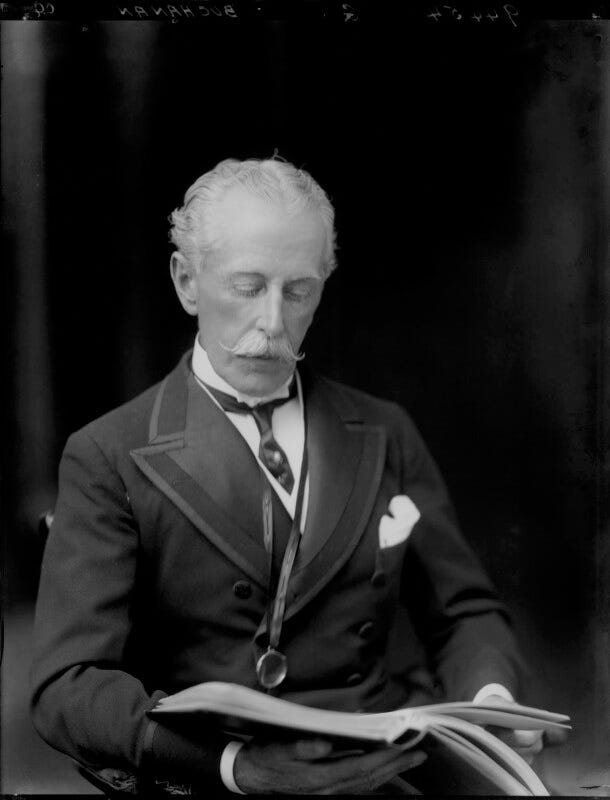
The ambassador spoke, among other things, about the activities of the Minister of Internal Affairs, A.D. Protopopov, which caused the greatest indignation in society. During Protopopov’s tenure as minister, there was a complete loss of control of the government over public sentiment, which, according to Buchanan, could lead to revolution. It was thus not a question of a constitution, but of undermining the authority of the monarchy, which was becoming a major threat to the empire.
Buchanan began to fear that Tsar Nicholas II might be overthrown and urged him to bring in reforms. He reported on a meeting he had with the Tsar in January 1917: “I went on to say that there was now a barrier between him and his people, and that if Russia was still united as a nation it was in opposition to his present policy. The people, who have rallied so splendidly round their Sovereign on the outbreak of war, had seen how hundreds of thousands of lives had been sacrificed on account of the lack of rifles and munitions; how, owing to the incompetence of the administration, there had been a severe food crisis.” Buchanan urged the Tsar to take notice of what was being said in the Russian parliament, the Duma: “The Duma, I had reason to know, would be satisfied if His Majesty would but appoint as President of the Council a man whom both he and the nation could have confidence, and would allow him to choose his own colleagues.”
However, there was too little time to maneuver. A month later, Buchanan himself witnessed the unfolding political catastrophe in St. Petersburg, the capital of the Russian Empire.
On February 27 the Duma met, and the opening sitting, which I attended, passed off so quietly that I thought I could safely take a short holiday in Finland. During the ten days which I spent there no rumours reached me of the coming storm. It was only as my wife and I were returning on Sunday, March 11, by the last train which got into Petrograd, that my servant brought us news, as we were nearing the capital, of a tramway and isvostchick (cab) strike.
The part of the town through which we passed on our short drive to the Embassy was perfectly quiet, and, except for a few; patrols of soldiers on the quays and the absence of trams and isvostchicks, there was nothing very unusual about its general aspect.
The situation, nevertheless, was already serious. Owing to the coal shortage referred to in my telegram quoted above, some of the factories had to close down, and there were consequently several thousand workmen unemployed. This fact, taken by itself, would not have been very alarming, as they had been paid and were not out to make trouble. But they wanted bread, and many of them, after waiting for hours in the queues outside the bakers’ shops, had been unable to get any. On Thursday, March 8, there had been a stormy sitting in the Duma, in which the Government had been violently attacked on account of its failure to revictual Petrograd; and it was the bread shortage that was at the root of the agitation which began on the same day to manifest itself among the workmen. In the evening several of the bread shops in the poorer quarters of the town were looted, and a patrol of Cossacks was for the first time seen galloping down the Nevski.
On the following day the agitation increased. The people wanted an assurance that something would be done to relieve the food crisis, but none was forthcoming. Groups of workmen and students paraded the streets, followed by a crowd of men, women and children who had come out of curiosity to see what was going to happen. But for the most part it was a good-humoured crowd that made way for the Cossacks when the latter were ordered to clear some street, and even occasionally cheered them as they passed. The Cossacks, on their side, were careful not to hurt anybody and — what was of bad omen for the Government — laughed and talked with those near them. It was only towards the police, with whom they had several collisions in the course of the day, that the crowd adopted a hostile attitude. In some of the streets also tramcars were broken and overturned.(…)
According to George Buchanan, the greatest share of the responsibility for the revolution that broke out was borne by the ministers of the tsarist government, as well as the military. However, it is unlikely that the Russian authorities were able to keep in obedience to the 150,000-strong garrison of St. Petersburg, consisting mainly of former peasants.
The Government, supine and incapable, had mismanaged matters from the first. A strong energetic Minister like Stolypin could, with tact and firmness, have kept the movement within bounds; but the Government failed altogether to reassure the people with regard to the food crisis, while they adopted ineffective measures to restore order that did but serve to exasperate the masses and to play into the hands of the real revolutionaries. Finally, by ordering the troops to fire on the people, they fanned the prevailing discontent into a blaze that spread with lightning speed over the whole town. But the initial mistake lay with the military authorities, who ought, had they not been altogether lacking in foresight, to have left a small body of well disciplined and reliable troops to maintain order in the capital. As it was, the garrison — some 150,000 in all — was composed solely of depot troops. They were all young soldiers, fresh from their villages, and undergoing training prior to being sent to fill up the gaps made in their regiments at the front. The corps of oJBBcers entrusted with their training was far too small to handle so large a body of men. It consisted of men who had been invalided home on account of their wounds, and of inexperienced boys from the military schools who were quite incapable of maintaining discipline when the crisis came.
Although a man of deeply held conservative views, Buchanan developed good relationships with liberal politicians in Russia after the revolution and welcomed the appointment of Prince George Lvov as head of the new Provisional Government in Russia. G. Lvov refused to withdraw the country from the First World War, which seemed to be a good sign for Buchanan. George Buchanan, who served the British monarch, King George V and the British government, was interested in ensuring that Russia remained an ally of Britain in the war with the Central Powers. The United States entered the war on the side of the Entente in April 1917, but the arrival of American troops on the European continent was expected a few months later. Buchanan informed the British government: “Lvov does not favour the idea of taking strong measures at present, either against the Soviet or the Socialist propaganda in the army. On my telling him that the Government would never be masters of the situation so long as they allowed themselves to be dictated to by a rival organization, he said that the Soviet would die a natural death, that the present agitation in the army would pass, and that the army would then be in a better position to help the Allies to win the war than it would have been under the old regime.”
The new Russian prime minister was just an idealist. By the summer of 1917 George Buchanan realized that the democratic experiment in Russia had failed.
The military outlook is most discouraging. Nor do I take an optimistic view of the immediate future of the country. Russia is not ripe for a purely democratic form of government, and for the next few years we shall probably see a series of revolutions or counter-revolutions. A vast Empire like this, with all its different races, will not long hold together under a Republic. Disintegration will, in my opinion, sooner or later set in, even under a federal system.
This article is part of a new project: The Fall of the Empire, in which we will tell the story of the fall of European empires through the mouths of their contemporaries. We will speak about the last days of Imperial Russia, Kaiser’s Germany, the Dual Monarchy, and the Ottoman Empire. Four once-influential powers, as if frozen in their glorious past.
Our experts will be an experienced British diplomat, the chief of the German General Staff, an Austrian writer and journalist, and a Turkish politician, the founder of the new Turkish Republic. What all four have in common is not only that they lived 100 years ago. Their ideas are especially relevant today in an era of global challenges and military conflicts. Subscribe so you don’t miss a thing.


