avatarErie Astin

Free AI web copilot to create summaries, insights and extended knowledge, download it at here

4296

Abstract

um.com/v2/resize:fit:800/1*f4mj6QlIqQ8lF4rcxFB4sg.jpeg"><figcaption>“A breath between the trees.” Palatine Hill. © Erie Astin</figcaption></figure><p id="5b76">Eventually, I left the Forum to take a breath between the trees on Palatine Hill. Once home to the palaces of the rich and famous, of Caesar and Cicero, Antony and Octavian, Emperors Tiberius and Nero and Domitian, it now rests quietly above the tumbling, crumbling forum.</p><p id="2f46">Or so it seems. Those palaces left loose bricks, broken foundations, fallen archways, holes in the ground. The Palatine was a crowded district, as Rome’s rich were many, and they all had to have the best real estate.</p><p id="0c5f">Now I could hardly walk without tripping over a palace or two — and from which era, who knew? Nobles piled palaces one on top of the other. Where once they found an obstacle to their power, they razed and rebuilt, and though the grass may be greener and the air fresher up on the Palatine, still Rome’s chaos tumbled on.</p><figure id="b387"><img src="https://cdn-images-1.readmedium.com/v2/resize:fit:800/1*tOjM3rPpD2xX9kruJyQVDw.jpeg"><figcaption>“Ancient apartments and marble columns.” Rome. © Erie Astin</figcaption></figure><p id="bbe8">Striding away from the Forum and Palatine Hill to explore more of the city, I found more of that famous red brick in an ancient apartment complex. Again, I thought those were modern things.</p><p id="ac02">Of course, the Romans had to live stacked on top of each other — <a href="https://www.britannica.com/facts/Rome#:~:text=In%20133%20BCE%2C%20Rome%20became,population%20of%20one%20million%20people.">by 133 BC</a>, a million people lived there and it was the most populous city in the world.</p><p id="14c0">Photogenic, intact marble pillars made their appearance here, too. Even they couldn’t help but show their underbellies. Pieces lay at their bases like chipped-off teeth, and piles of broken marble were shoved back into the shadows as if no one would notice — and which pillars did they come from?</p><p id="5713">Such were the endless riddles in this constant, forward-rushing, chaotic Rome. Incidentally, the city was as chaotic and forward-rushing as the Vespa driver who nearly flattened me as I crossed this very street.</p><figure id="5763"><img src="https://cdn-images-1.readmedium.com/v2/resize:fit:800/1*klF69FSRG3p2CGyLHPMarA.jpeg"><figcaption>“Window views of Roman ruins.” Near the Forum Boarium. © Erie Astin</figcaption></figure><p id="e231">From ancient apartments to modern ones… I couldn’t believe that people actually lived with window views of Roman ruins! For instance, in these beautiful apartment buildings, painted rust and yellow, near the ancient Forum Boarium down by the River Tiber.</p><p id="5c5f">The broken ruins flowed on and on, with no place to put them but right in the street. With that metal pedestrian bridge in the background, it’s a scene reminiscent of Venice, only the water in the “canal” that flowed through time immemorial was made of brick and stone.</p><figure id="d23b"><img src="https://cdn-images-1.readmedium.com/v2/resize:fit:800/1*NdK1qRaCG68IBbskTuKFZg.jpeg"><figcaption>“Miraculous apartment views.” Near the Forum Boarium. © Erie Astin</figcaption></figure><p id="e68d">Here, again, I saw miraculous apartment views in the Forum Boarium area. To me, the modern buildings were blatant encroachers. Look at that building on the right, with the facade two-thirds ancient, one-third modern! A fully functional building made in the Renaissance or Baroque periods, no doubt, when repurposing classical ruins was completely acceptable.</p><p id="89a4">In my imagination, I thought that if only the crown of that building crept away, the ancient structure could re-sprout in all its splendor. Whatever marvelous construction bolstered by the pillars across the street could magically burst into being. The yellow building behind it would have to crumble away, taking its own turn to lie in ruin while old Rome rose once again.</p><figure id="ccc6"><img src="https://cdn-images-1.readmedium.com/v2/resize:fit:800/1*aNhwVl3oYPkFnD65rA3dBg.jpeg"><figcaption>“Roma Caput Mundi.” Roman Forum. © Erie Astin</figcaption></figure><p id="2fa2">I got in the habit of staying in the main Forum each day until they roped it o

Options

ff before dusk, squeezing out as much time there as possible during my week-long stay in Rome. Oh, we walked fifteen miles a day, we saw the whole city, but we always returned to <i>Roma Caput Mundi</i>, the “head of the world.”</p><p id="df7a">One night, I sat on the sidewalk outside the Forum after it had closed and settled in to write in my notebook until darkness fell. I don’t remember why my dad left me alone, or where he had gone off to.</p><p id="7bc4">I sat and relaxed in the warm Mediterranean air. The Forum no longer shocked my eyes. I rested in it. The chaos had become home.</p><p id="7095">Thank you to the editors at Globetrotters (<a href="undefined">JoAnn Ryan</a>, <a href="undefined">Anne Bonfert</a>, <a href="undefined">Jillian Amatt - Artistic Voyages</a>, <a href="undefined">Adrienne Beaumont</a>, <a href="undefined">Michele Maize</a>) for this month’s challenge on the ruins of the world:</p><div id="283e" class="link-block"> <a href="https://readmedium.com/may-monthly-challenge-ruins-of-the-world-do-not-publish-yet-f1a521a86d44"> <div> <div> <h2>May Monthly Challenge — Ruins of the World</h2> <div><h3>We want to hear about ancient and prehistoric ruins or whatever else you found</h3></div> <div><p>medium.com</p></div> </div> <div> <div style="background-image: url(https://miro.readmedium.com/v2/resize:fit:320/1*h1OFIMRNiC4UfC05AT1omA.jpeg)"></div> </div> </div> </a> </div><p id="13ef">We’re only a few days into the challenge and already I’ve read some great articles. <a href="undefined">Mariana Gonzalez</a> shared her experiences with ruins in Peru that I didn’t even know about:</p><div id="a1dd" class="link-block"> <a href="https://readmedium.com/ruins-in-peru-beyond-machu-picchu-d8cefbf57929"> <div> <div> <h2>Ruins in Peru: Beyond Machu Picchu</h2> <div><h3>My first visit to South America started with this magical place</h3></div> <div><p>medium.com</p></div> </div> <div> <div style="background-image: url(https://miro.readmedium.com/v2/resize:fit:320/1*bpibnYEirbpv6VLmwGSbPg.jpeg)"></div> </div> </div> </a> </div><p id="5558">And <a href="undefined">Scott-Ryan Abt</a> included some spectacular photos in his article about the ruins of Amman:</p><div id="2644" class="link-block"> <a href="https://readmedium.com/room-to-roam-you-are-free-to-wander-among-the-ruins-of-empires-in-the-centre-of-amman-de1c8827f651"> <div> <div> <h2>Room to Roam: You are Free to Wander Among The Ruins of Empires in the Centre of Amman</h2> <div><h3>Globetrotters May Writing Challenge — Ruins of the World</h3></div> <div><p>medium.com</p></div> </div> <div> <div style="background-image: url(https://miro.readmedium.com/v2/resize:fit:320/1*QAKWaAGhJVBr1T3Upw8FAA.jpeg)"></div> </div> </div> </a> </div><p id="534e">Soon I’m going to finally write my <b><i>“Globetrotters Writers Spotlight”</i></b> for myself, and I’ve decided to take the plunge and begin the <b><i>“Favorite Travel Destinations: A-Z”</i></b> challenge — although not in order, because I hate doing things in order. (My elementary school piano lesson books can attest to that.)</p><p id="03fa"><b>Meanwhile, you can read all of my published travel articles in this list:</b></p><div id="27c0" class="link-block"> <a href="https://medium.com/@ErieAstin/list/36e5498d46fe"> <div> <div> <h2>Travel</h2> <div><h3>Edit description</h3></div> <div><p>medium.com</p></div> </div> <div> <div style="background-image: url(https://miro.readmedium.com/v2/resize:fit:320/0*a9033d446b891f849b51a0f63f4556bbe0d92672.jpeg)"></div> </div> </div> </a> </div><p id="5941"><b><i>— Erie Astin</i></b></p></article></body>

TRAVEL, PHOTOGRAPHY

The Eye-Catching Chaos of Rome’s Ruins

A fanciful stroll through the crumbling Eternal City
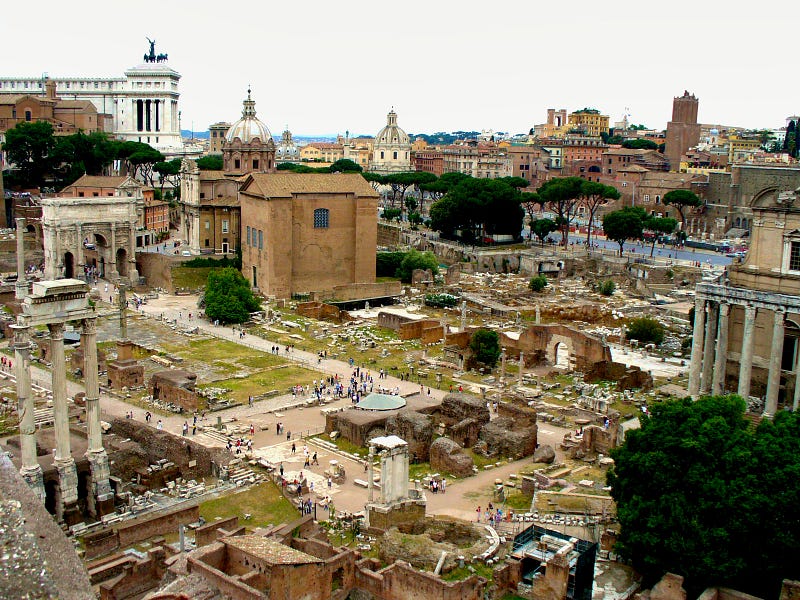
“No expectations.” Roman Forum. © Erie Astin

The first time I saw the Roman Forum, I bounded out of Hotel Giubileo, right outside the stunning Basilica Maria Maggiore, and strolled down the Esquiline Hill, breathing in short, quick bursts.

I was twenty years old and had never seen a photo or drawing of the Forum. I had no expectations. If I’d been expecting anything at all, it wouldn’t have been what I saw.
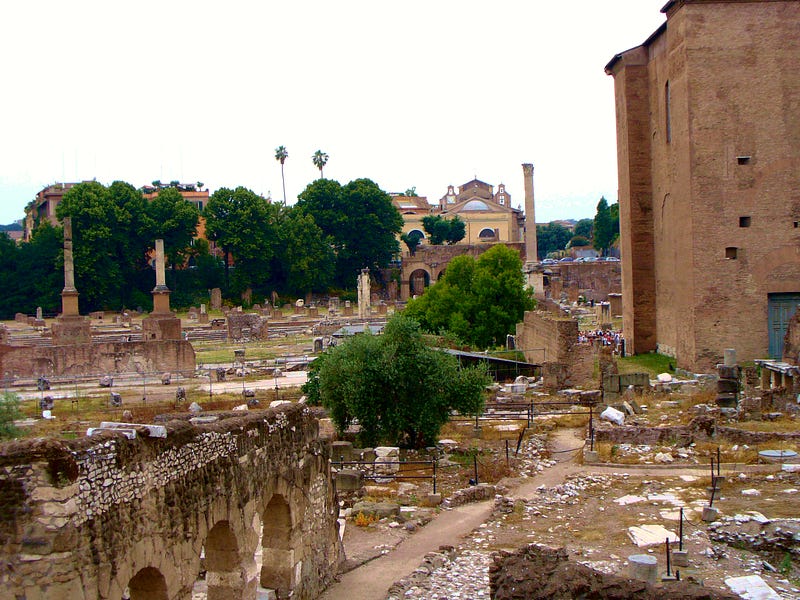
“Total chaos, blinding the senses.” Roman Forum. © Erie Astin

My heart jumped in shock. Rather than a small, orderly patch of stately pillars, the Forum was cluttered and eclectic in color, with lots of white and decaying grey, and reddish ground. Everywhere I looked, pieces of the empire were strewn like crumbs on a table, waiting to be swept away after a feast.

My eyes cried, “Too much, too much!”

Too much was exactly what I craved. I’d wanted something big from Rome, something beyond my imagination. In hindsight, it could only have been this — total chaos, blinding the senses, turning my world upside down.
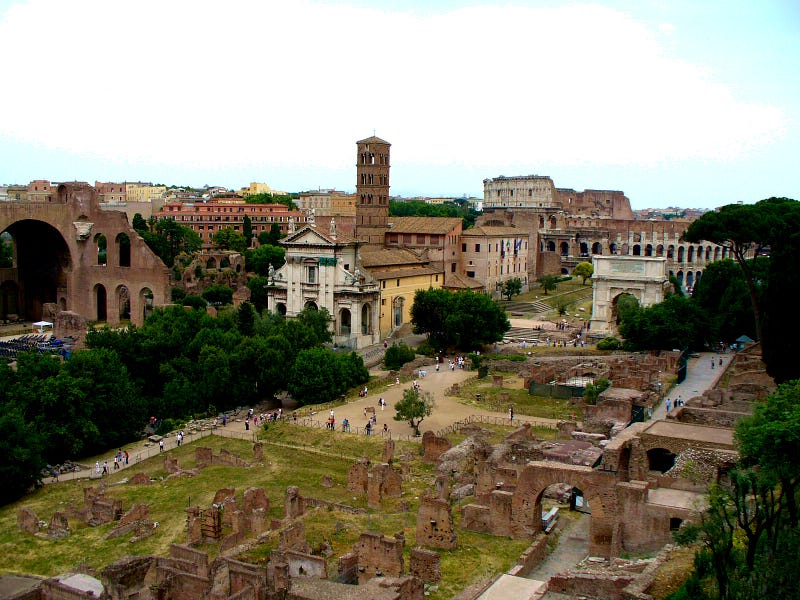
“The glorious mess.” Roman Forum. © Erie Astin

In the top right of the photo above, the Colosseum oversees the glorious mess. Here or there, a “modern” church or basilica crops up in the distance. I couldn’t quite compute the dissonance of Christian life flourishing right on the edge of ruined pagan Rome.

Nature, too, invades the scene, with the fluffy green trees of June. (Yes, we were silly enough to go to Rome in late June. We melted.)

From the Middle Ages up to the Eighteenth Century, the entire Forum belonged to nature. I tried to imagine the expanse as a pleasing pastoral green, for it was communal grazing land — the Campo Vaccino (Cow Field) — for many centuries.

The mere thought of that gets my heart pumping hot. Such an outrage against Western history and the striving of humankind! But it’s fitting, I suppose, that this most chaotic of places came down through the ages not as a museum, but as ground where people did whatever they pleased.
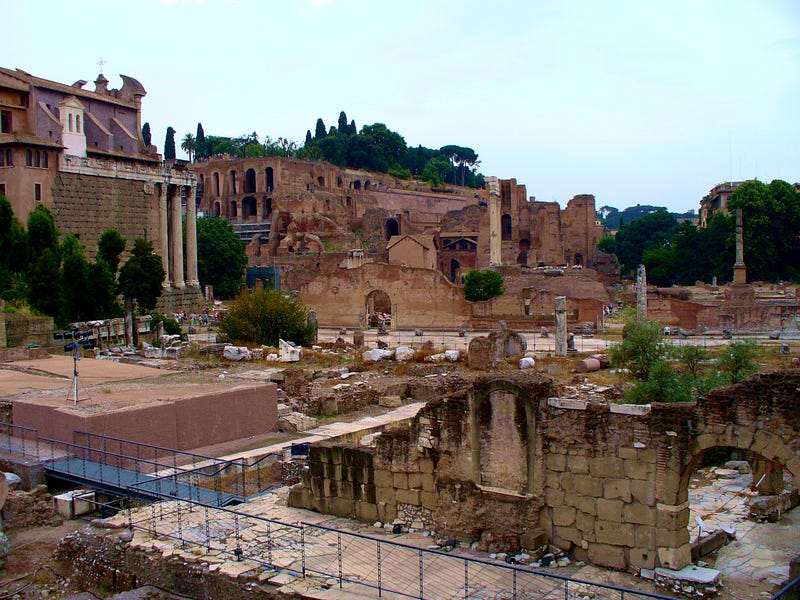
“The ubiquitous red brick.” Roman Forum and Palatine Hill. © Erie Astin

The ubiquitous red brick of Roman ruins fascinated me. Weren’t bricks a modern invention? (I had not yet done my graduate degree in Classics, so I was ignorant of so much about the ancient world.)

Now those bricks lay crumbling, adding to the rainbow of colors and layers of history. I fantasized that I could put them back together like Legos and build the world’s greatest civilization again.
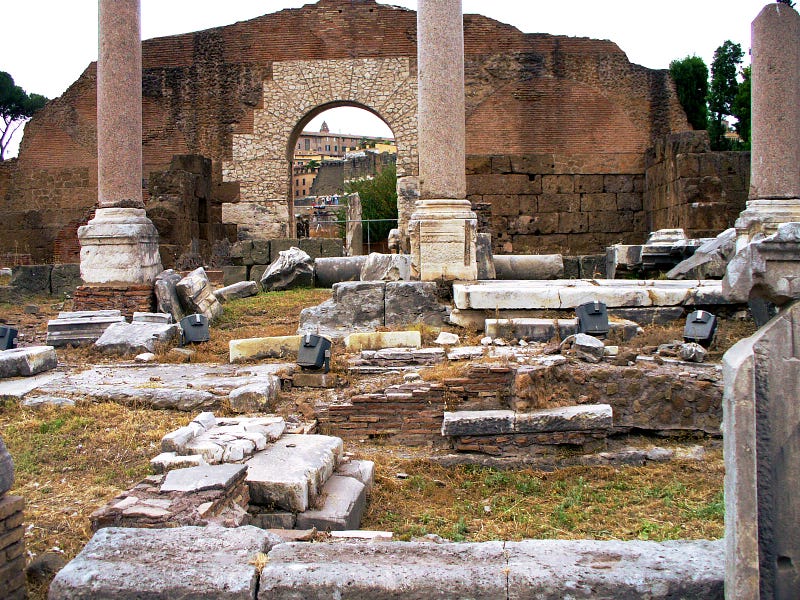
“Fallen marble pieces.” Roman Forum. © Erie Astin

The fallen marble pieces that I found everywhere — some white, some weathered, some fractured, some smooth — became my seats for resting and writing passages in my journal about rebuilding the glory of Rome.

My voice was young and naive, but the spirit of the Eternal City grabbed hold of grown men in the Renaissance, too. Artists, aristocrats, and statesmen strove to build cities as majestic as the Rome they found in ancient ruins.
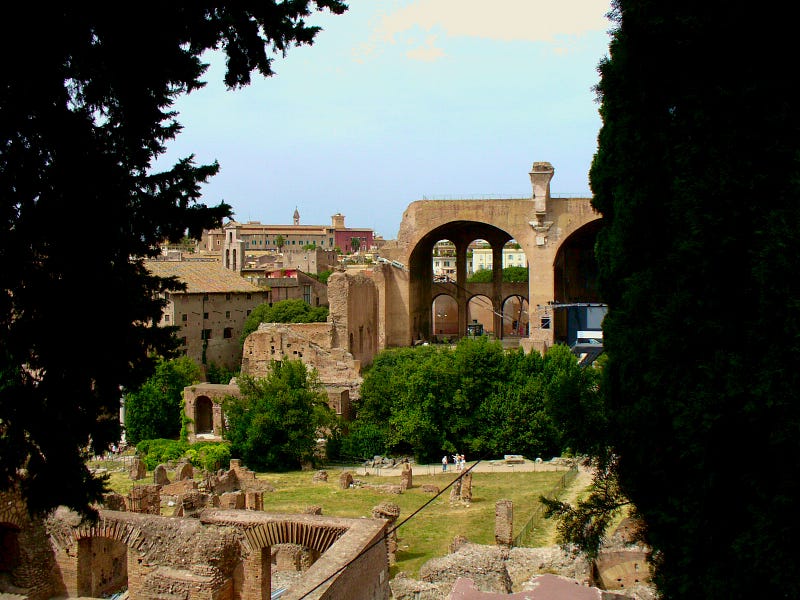
“A breath between the trees.” Palatine Hill. © Erie Astin

Eventually, I left the Forum to take a breath between the trees on Palatine Hill. Once home to the palaces of the rich and famous, of Caesar and Cicero, Antony and Octavian, Emperors Tiberius and Nero and Domitian, it now rests quietly above the tumbling, crumbling forum.

Or so it seems. Those palaces left loose bricks, broken foundations, fallen archways, holes in the ground. The Palatine was a crowded district, as Rome’s rich were many, and they all had to have the best real estate.

Now I could hardly walk without tripping over a palace or two — and from which era, who knew? Nobles piled palaces one on top of the other. Where once they found an obstacle to their power, they razed and rebuilt, and though the grass may be greener and the air fresher up on the Palatine, still Rome’s chaos tumbled on.
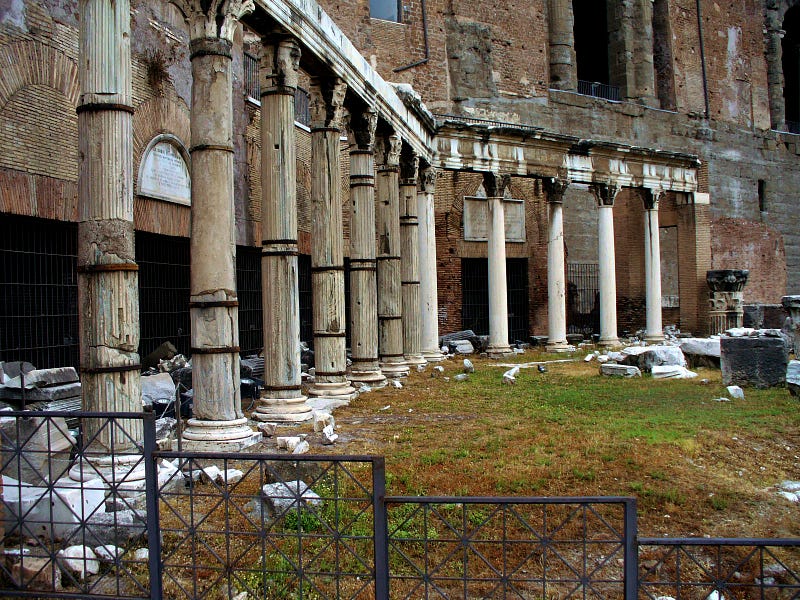
“Ancient apartments and marble columns.” Rome. © Erie Astin

Striding away from the Forum and Palatine Hill to explore more of the city, I found more of that famous red brick in an ancient apartment complex. Again, I thought those were modern things.

Of course, the Romans had to live stacked on top of each other — by 133 BC, a million people lived there and it was the most populous city in the world.

Photogenic, intact marble pillars made their appearance here, too. Even they couldn’t help but show their underbellies. Pieces lay at their bases like chipped-off teeth, and piles of broken marble were shoved back into the shadows as if no one would notice — and which pillars did they come from?

Such were the endless riddles in this constant, forward-rushing, chaotic Rome. Incidentally, the city was as chaotic and forward-rushing as the Vespa driver who nearly flattened me as I crossed this very street.
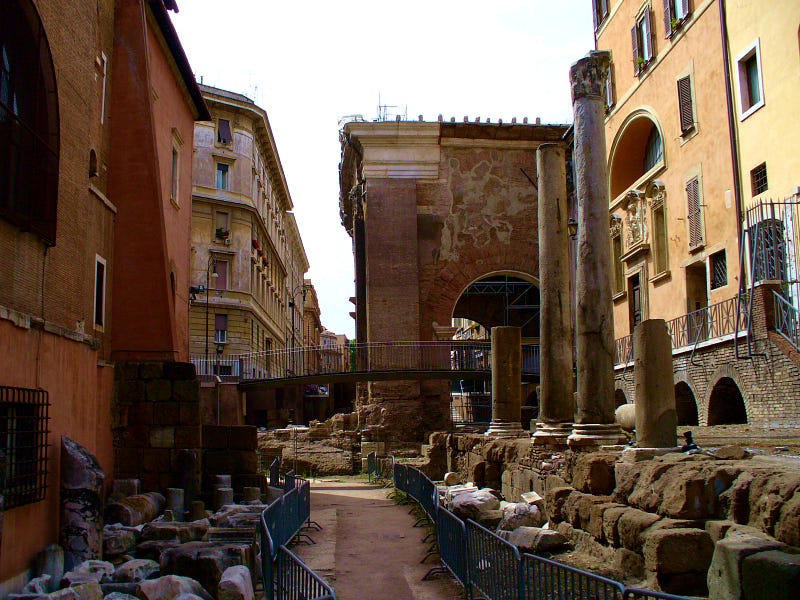
“Window views of Roman ruins.” Near the Forum Boarium. © Erie Astin

From ancient apartments to modern ones… I couldn’t believe that people actually lived with window views of Roman ruins! For instance, in these beautiful apartment buildings, painted rust and yellow, near the ancient Forum Boarium down by the River Tiber.

The broken ruins flowed on and on, with no place to put them but right in the street. With that metal pedestrian bridge in the background, it’s a scene reminiscent of Venice, only the water in the “canal” that flowed through time immemorial was made of brick and stone.
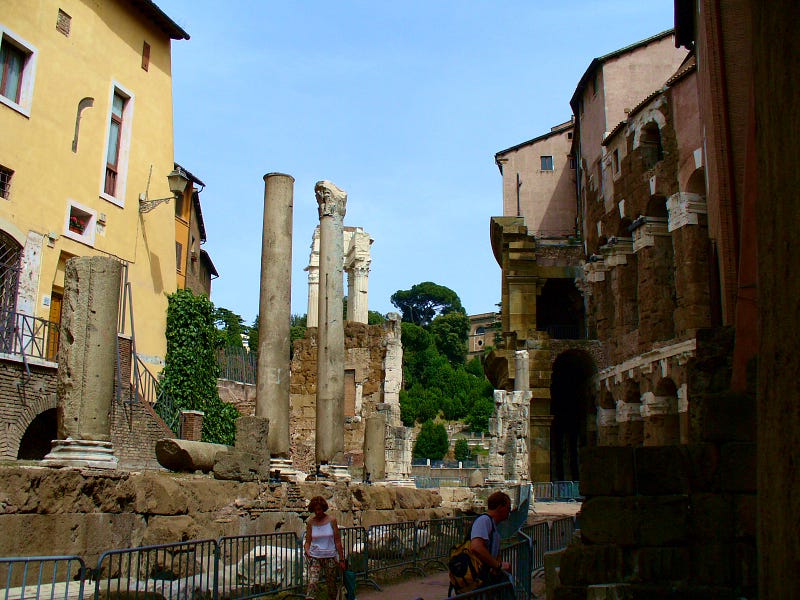
“Miraculous apartment views.” Near the Forum Boarium. © Erie Astin

Here, again, I saw miraculous apartment views in the Forum Boarium area. To me, the modern buildings were blatant encroachers. Look at that building on the right, with the facade two-thirds ancient, one-third modern! A fully functional building made in the Renaissance or Baroque periods, no doubt, when repurposing classical ruins was completely acceptable.

In my imagination, I thought that if only the crown of that building crept away, the ancient structure could re-sprout in all its splendor. Whatever marvelous construction bolstered by the pillars across the street could magically burst into being. The yellow building behind it would have to crumble away, taking its own turn to lie in ruin while old Rome rose once again.
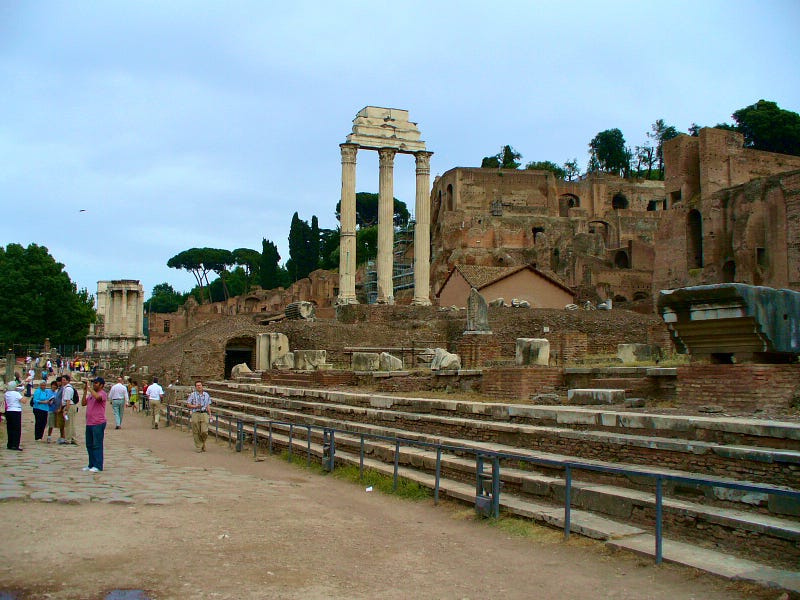
“Roma Caput Mundi.” Roman Forum. © Erie Astin

I got in the habit of staying in the main Forum each day until they roped it off before dusk, squeezing out as much time there as possible during my week-long stay in Rome. Oh, we walked fifteen miles a day, we saw the whole city, but we always returned to Roma Caput Mundi, the “head of the world.”

One night, I sat on the sidewalk outside the Forum after it had closed and settled in to write in my notebook until darkness fell. I don’t remember why my dad left me alone, or where he had gone off to.

I sat and relaxed in the warm Mediterranean air. The Forum no longer shocked my eyes. I rested in it. The chaos had become home.

Thank you to the editors at Globetrotters (JoAnn Ryan, Anne Bonfert, Jillian Amatt - Artistic Voyages, Adrienne Beaumont, Michele Maize) for this month’s challenge on the ruins of the world:

We’re only a few days into the challenge and already I’ve read some great articles. Mariana Gonzalez shared her experiences with ruins in Peru that I didn’t even know about:

And Scott-Ryan Abt included some spectacular photos in his article about the ruins of Amman:

Soon I’m going to finally write my “Globetrotters Writers Spotlight” for myself, and I’ve decided to take the plunge and begin the “Favorite Travel Destinations: A-Z” challenge — although not in order, because I hate doing things in order. (My elementary school piano lesson books can attest to that.)

Meanwhile, you can read all of my published travel articles in this list:

— Erie Astin

Travel
Photography
Italy
Monthly Challenge
History
Recommended from ReadMedium