
The End of the Anthropocene Approaches
Gaia’s Triumph and the Vanishing of Homo Sapiens
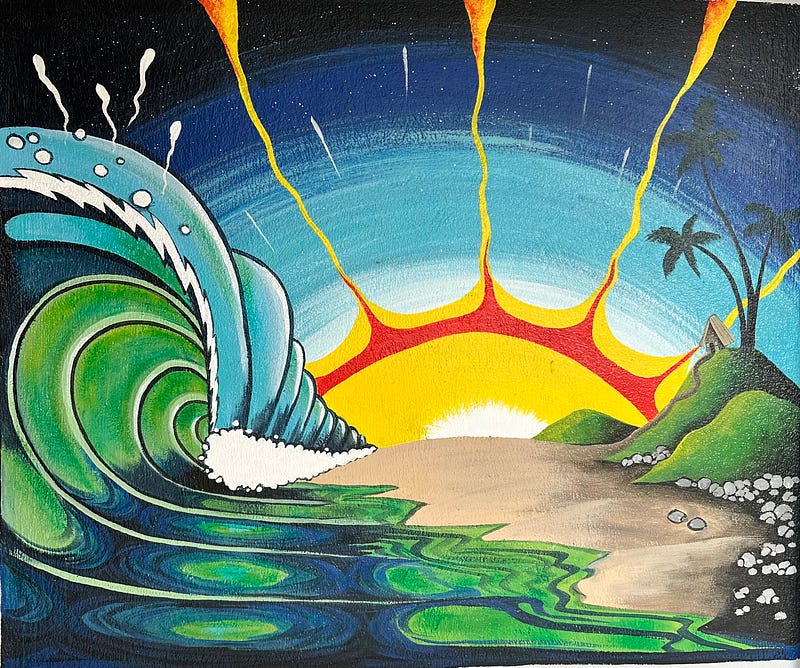
For several years I have been thinking about Mother Earth/Madre Tierra/Gaia, and how She lovingly looks after all the beings that inhabit Her. Some decades ago, James Lovelock, a British chemist, and Lynn Margulis, an American evolutionary biologist, co-developed the Gaia Theory, which postulates that the Earth itself is alive, functioning as a self-regulating system, maintaining ecological equilibrium.
This idea seemed particularly striking to me during the time of the global pandemic, and the deeper we sink into the current quagmire of global politics the more relevant the Gaia Theory becomes.
What does Gaia have to do with politics?
Since the Book of Genesis was written — and certainly even before that — “Man” has considered himself above Nature rather than a part of it. Further, he has for thousands of years considered himself to be in command of Nature, particularly in more modern cultures.
Further, the idea of “go forth and multiply” was faithfully (no pun intended) adopted to the extreme, particularly by certain religious leaders whose income depended on tithes, the quantity of which depended on the number of their followers. So, more babies equals more revenue. To encourage more babies, rules about having sex were instituted. Sex is for making babies, not for making whoopee.
Then, in the modern era, Republicans, to support corporate growth (based on population growth and growth in consumerism), instituted anti-abortion policies and legislation. Abortion laws are not about women’s bodies ultimately. They are about consumerism and corporate profits continuing to grow so investors can make more money. The prime indicator is the Dow Jones Industrial Index, where every time an abortion is prevented, the stock market goes up.
So what does this have to do with Lovelock’s Gaia Theory? I’ll get to that in a minute.
First, let’s talk about Robert Malthus, an economist and demographer who theorized that population growth will always tend to outrun the food supply and that the betterment of humankind is impossible without strict limits on reproduction.
… population growth generally expands in times and regions of plenty until the size of the population relative to its primary resources causes distress. — Malthus, “An Essay on the Principle of Population,” 1798
Malthus, in his 1798 book, “An Essay on the Principle of Population,” postulates that a population will grow and expand when resources are plentiful, and become stressed when the size of the population outpaces its ability to feed itself. He argued that two types of checks hold a population within resource limits: positive checks, which raise the death rate; and preventive checks, which lower birth rate. Positive checks include hunger, disease, and war — sources of misery. Preventive checks include birth control, celibacy, and postponement of marriage.
Some might argue that celibacy could also be considered a source of misery, but that would be a separate discussion.
The relationship between population and economics
Malthus wrote that when the population of laborers grows faster than the production of food, real wages fall because the price of food goes up — supply and demand. Difficulties of supporting a family eventually reduce the rate of population growth (forgetting for the moment about the Catholic “sins” of birth control and illegal abortion) until the falling population again leads to higher real wages, i.e., the food supply becomes more plentiful and prices go back down.
The main point of his essay was that population multiplies geometrically and food arithmetically; therefore, whenever the food supply increases, population will rapidly grow to eliminate the abundance. In other words, the population would continue to grow until there is not enough food to feed humanity and people would starve.
Populations tend to grow until the lower classes suffer hardship, want, and greater susceptibility to famine and disease.
Malthusian Trap: People use abundance for growth rather than to maintain a high standard of living.
To err is human, or, why are humans so stupid?
Long fascinated by the reluctance of humans to recognize real limitations on infinite population growth, I once read a study by John B. Calhoun about his observations of rats kept in confined spaces but given more food and water than they needed for survival.
He observed that, quickly, the overfed rats multiplied until their contained space became overcrowded, to the point that some rats couldn’t even keep their feet on the bottom of the cage. Further, his study showed that overpopulation, even when food was plentiful, caused aberrant behaviors — females not breeding, social issues (fighting), homosexuality, etc.
Does this study remind you of anything?
Overpopulation also sets the stage for outbreaks of disease (pandemics, e.g., COVID), which can spread much more rapidly in overcrowded conditions, such as high-population cities.
In the wild, animal populations never outpace the resources they need to survive and reproduce. This includes indigenous human populations that continue to live with minimal contact with civilization. Why are “civilized” humans so different?
Whether or not one believes that Earth is a living entity and will preserve itself (the Gaia hypothesis), according to Malthus resources are not limitless and people will starve when the population grows beyond Earth’s capacity to feed humanity.
Putting all this together, and where we’re headed
With overpopulation, famine, disease, anti-abortion laws, religion, and human arrogance, the end result should be clear if population growth is not checked. Following are some of the pressures on humans to reproduce and the results when they do:
Religion — belief in God(s) and the superiority of Man over all other creatures and the encouragement to reproduce at all costs. To disobey brings only punishments (excommunication, illegal abortions, prison) for having sex without making more babies. Wars: When resources become scarce, competition and aggression to forcefully acquire more resources, already occupied by others, are increasing.
The Economy — Capitalism, which is based on growth and allowed to run unchecked, will do itself in by starving the lower classes and killing off all its productive workers.
Politics — Economic growth is favored over the well-being of humans. When legislators are more influenced by corporate moguls than by the voters who put them in office. See “The Economy” above.
Bottom line: Population and the economy are linked as surely as the moon orbits the earth. And each has a profound effect on the other.
Richard Powers, in his Pulitzer Prize-winning novel The Overstory, calls it the “suicide economy,” where “exponential growth inside a finite system leads to collapse.”
“Earth will be monetized until all trees grow in straight lines, three people own all seven continents, and every large organism is bred to be slaughtered (The Overstory, p. 348).
Where will it all end?
“Growth,” like cancer, will kill us in the end. Everyone knows that the Earth cannot sustain an unlimited population. Perhaps this is why filthy rich morons are investing in colonizing other planets. Yet, meanwhile, they continue to extract whatever resources they can from whatever growth they can profit from here on Earth.
Those who support cancerous corporate growth also oppose abortions, because abortions slow population growth, which directly decreases consumerism and, therefore, profits.
Meanwhile, Gaia waits, watches, and sends warnings. She tells us the planet is warming by sending storms and melting ice sheets. She sends plagues and other infestations. She sees global deforestation, microplastics, overfishing, desertification of farmlands, and vanishing freshwater systems.
The science is clear: We have to stop growing, NOW. A different kind of economy, not based on consumerism, profits, or growth, must emerge. Otherwise, our kids and grandkids will go extinct or be forced to colonize a different planet.
The only “goddess” we should be worshipping now is Gaia, because She rules, above all. Gaia will survive and the planet will thrive regardless of what humans decide to do, and the Anthropocene Era will become a plastic-infested layer in the strata of deep time.
I sincerely hope I’m wrong about this, but I know I’m not.
Author’s note: Thanks for reading. Now, please get out there and start talking to everyone you can reach about what’s happening right before our eyes. ❤


