
CLIMATE CRISIS
Blue Carbon: What Is It And Why Do We Want More Of It?
Is it better to be blue than green?

Recently on my way home from errands, I got stuck for a while behind a garbage collection vehicle on a busy two-lane country road. With little else to do other than watch the grindingly slow mechanical collection process, I noticed the proud banner painted on the back of the truck that claimed, “Powered by clean-burning natural gas!”
The entire vehicle was painted forest green, a color designed to convince us that the collection of garbage and recycling bins does NOT contribute to global warming/climate change, nor does it pollute the atmosphere.
I call this “natural gaslighting.” Slogans like this are marketing ploys to cause us to believe that burning natural gas—methane, a fossil fuel—is good for the planet.
Well, maybe it’s not as heinous as belching fumes and soot from gasoline and diesel engines, but it’s not good. The combustion products from burning natural gas are carbon dioxide—a greenhouse gas—and water, exactly the same as burning most any other fossil fuel.
This is blatant and obnoxious “greenwashing,” which, according to Wikipedia, is “a form of marketing spin in which green PR and green marketing are deceptively used to persuade the public that an organization’s products, aims and policies are environmentally friendly.”
Rather than traverse that lumpy road, let’s talk about what carbon really is and why carbon-based fuel has so much heat in it, making it ideal for energizing every aspect of our daily lives.
Let’s start with elemental carbon itself, which comes in various forms from diamond to coal. In diamond, every carbon atom has four other carbon atoms strongly attached to it, making a very stable and hard crystal.
Remember in the comics when Superman would take a lump of coal and squeeze it with all his might until it became a diamond? He was pretending to create the same conditions that elemental carbon (coal) finds in the center of the earth, where it’s squeezed and heated until it’s compressed into the most perfectly compact and beautiful form of carbon that exists.
Diamonds are usually created in volcanos, under tremendous heat and pressure, and we find them in places where there have been certain kinds of eruptions. There’s a fascinating read in Smithsonian Magazine about how diamonds are formed. Once formed, a diamond is literally forever.
Coal is another form of elemental carbon, created from the decomposition of organic materials in the absence of oxygen. Although relatively stable compared to other fossil fuels, meaning it’s not likely to ignite in your hand, a lump of coal has a lot of energy stored inside it, energy that’s released when it burns. We can see and feel this energy when elemental carbon reacts with oxygen in the air to produce carbon dioxide, a much more stable carbon compound. Once CO2 is formed, it’s going to be around essentially forever, floating in the atmosphere, taken up by green plants, or dissolving into the ocean.
Methane, or natural gas, is produced through the breakdown or decay of organic materials. For example, cow burps are loaded with methane from their digestive process. Plant material decaying in wetlands also produces methane. According to the Environmental Protection Agency (EPA), the largest sources of methane emissions from human activities in the United States are oil and gas systems, livestock enteric fermentation, and landfills.
Methane is the smallest and simplest of the fossil fuels, so named because they are all generated by the decay of ancient life over millenia, by natural processes, and naturally locked away underground—until humans unearth them.
Methane and its larger cousins—from ethane, propane, butane, gasoline and other petroleum products to mineral oil, crude oils, and waxes—are all simple compounds containing only the elements carbon and hydrogen. Collectively we call these “hydrocarbons,” and hydrocarbons contain even more energy stored inside their molecules than coal does. When they burn, they release this energy by producing prodigious amounts of heat, with the principal byproduct being the same CO2 as with coal, but also producing H2O. You can see this water vapor frozen into contrails as kerosene-burning jets pass overhead.
Simply put, coal will heat your house just fine, but hydrocarbons will heat it much more efficiently, producing far more BTUs per unit, with less mess. But all burning hydrocarbons produce carbon dioxide, a dangerous greenhouse gas, currently at critical levels in our atmosphere.
So, what color is carbon, then?
Basically, we want to keep carbon, in whatever form it comes, in the ground, in the ocean, or inside plants and animals, and not in the atmosphere where it absorbs and holds heat from the sun and makes our planet hotter.
When we take carbon-containing compounds, including trees, out of the earth or the forest and burn them, all the carbon they contain is converted to CO2 and released into the atmosphere.
With our sewage plants, garbage dumps, agricultural and ranching practices, methane is produced in copious quantities also, a substance that would otherwise be naturally stored within the earth.
Why is this a problem?
In our atmosphere, a so-called “greenhouse” gas — carbon dioxide, methane (natural gas), and others — acts just like the glass walls of a land-based greenhouse. It lets light and heat in but traps and holds the heat. Without any greenhouse gases, it would be freezing on our planet! With just the right amount of greenhouse gases, we have been enjoying living in the “Goldilocks zone” where life has evolved for millions of years.
However, when too much carbon dioxide or methane is allowed to escape into the atmosphere, the planet heats up, ice caps melt, plant and animal life begins to suffer, and eventually, if left unchecked, life on Earth would be in very big trouble. We are already in big trouble in the USA.
Why is methane considered “green”?
There is nothing environmentally friendly about the burning of methane. It is sometimes hyped as a “green” fuel because it is “clean burning” compared to coal, which can have other impurities in it that “burn dirty.” Pure methane produces only pure carbon dioxide and pure water. But the devil is in the details about where that CO2 goes. When we burn methane, we pollute the air with a greenhouse gas that is warming our planet. There is nothing “green” about “natural gas.” Methane itself is a greenhouse gas far more heat-absorbing than CO2.
How is blue carbon any different?
“Blue carbon” is simply the term for carbon dioxide that is captured from the atmosphere by the world’s ocean and coastal ecosystems and stored in the form of biomass and sediments.
The good news is that our oceans and coastal wetlands provide a natural way of reducing the impact of these gases on our climate through sequestration (or capturing) of this atmospheric carbon.
Sea grasses, mud flats, kelp and tidal marshes along our coasts capture and hold carbon, acting as a carbon sink. These coastal systems, though much smaller in size, sequester this carbon at a much faster rate than rain forests, and can continue to do so for millions of years. Most of the carbon taken up by these ecosystems is stored below ground where we can’t see it, but it is still there locked safely away.
Let’s talk about the basics of carbon capture.
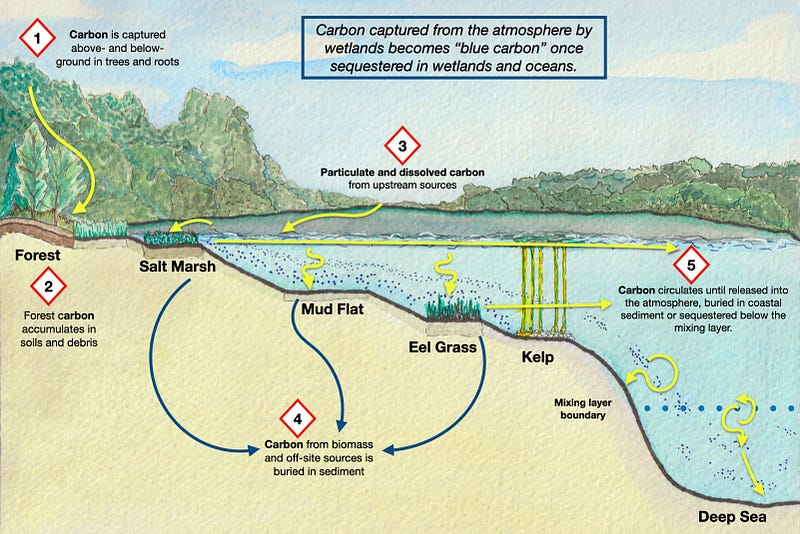
Referring to the illustration above, the entire process begins in upland forests and other upstream sources. All those dead leaves, needles, and branches that you walk on or step over on your forest walks are in the process of becoming deep ocean sediments.
As trees, shrubs, and animals die, the carbon compounds in their leaves, limbs and bodies slowly decompose and return to the earth where the rains wash them downhill to rivers and streams, stopping in wetlands along the way.
Eventually, this “recycled” carbon reaches marshes and estuaries, becoming food for other creatures or being stored long-term in sediments. Over time, this carbon-containing biomass reaches the deep blue sea, where it is held safely away for a very long time.
Consider for a moment how this would be different if the trees in the upland forest were burned instead of living out their natural lives. Instead of being used and reused and ultimately stored safely away at the bottom of the sea, the carbon in those trees would have gone directly into the atmosphere, adding to the greenhouse effect and continuing to overheat our planet.
What is the US Government doing about this greenhouse gas threat?
For more than 40 years, scientists have been warning about greenhouse gases, begging the world leaders to step up and take action. On this particular point, regarding “blue carbon,” there is recent legislation that gives me hope, but only if the study periods don’t last more lifetimes than we have remaining under current circumstances.
The Blue Carbon for Our Planet Act would create a national map and inventory of coastal blue carbon ecosystems and their sequestration potential, study the effects of climate change and other environmental stressors on rates of carbon sequestration, improve and expand protections for existing coastal blue carbon ecosystems, and restore degraded ecosystems.
It ain’t over ’til it’s over, but it’s almost over
Aside from trying to elect responsible, sane, intelligent congresspeople, and then pestering them to move forward on the climate—forward, beyond more studies and committees and reviews and other useless thrashings—we can individually change the ways in which we fuel our own lives.
How can we do this?
We can drive electric cars, we can shift to wind, hydroelectric, and solar generators to power our homes and offices, we can compost our organic waste rather than dumping it in the garbage to rot in landfills, we can stop eating so much meat (those methane producers).
We can become aware and use our individual powers to make these changes in our own lives, poco a poco, before it’s too late.
Let’s do this!
Thanks for reading. This is more important and more urgent than most people seem to realize. If you are reading the latest news about the weather in the southern USA, it’s real, it’s deadly, and it’s coming for all of us.
Adelia Ritchie, PhD