
The Drama Triangle Theory of Couple Counseling:
How Couples Play the Blame Game
The fundamental flaw in couple counseling is the number three: two competing parties seek to pull the third party onto their side. Wherever they go, the ‘insider’ is created. The ‘outsider’, left alone, is triangulated against.
I often do pick sides in couple counseling, but not to meet my needs. The dominant partner who refuses to take accountability creates a disequilibrium — however stable between fights — premised on power. There’s nothing wrong with a relationship based on hierarchy, provided that is how you love. It worked for my parents. That was two generations ago, when men didn’t lack feelings, women didn’t complain openly about inequality, children didn’t wonder why dad rarely engaged, and mothers sought community in each other through the collective trauma bond of acquiescing. As Oscar Wilde said,
Be yourself. Everyone else is already taken.
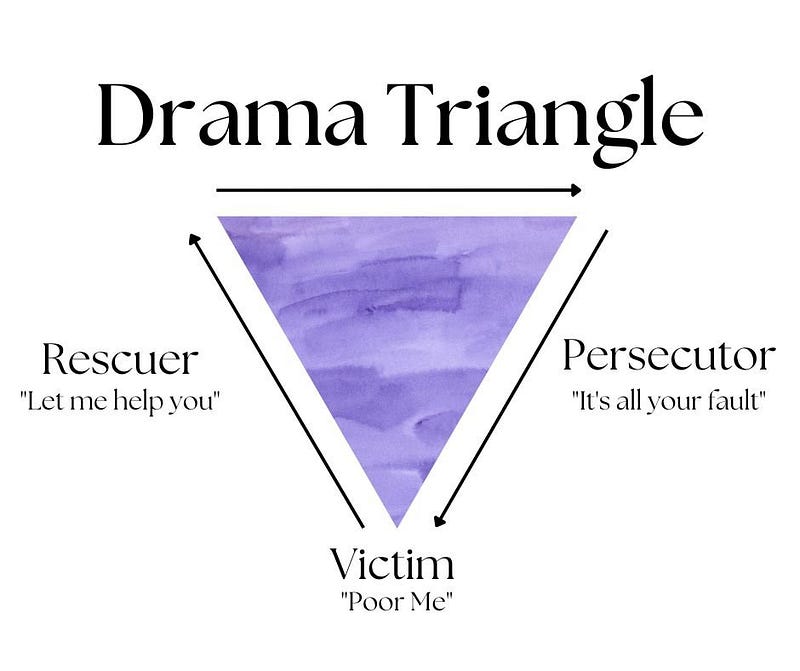
What I do consciously, couples often do unconsciously: argue over who gets to be the victim. The victim, whether through dominance or martyrdom, gets to bemoan their needs being unmet. You can build a tower out of your unmet needs: from which to attack, in which to hide, from which to judge. Look how good you made me at blaming you!
The persecutor is blamed for being the destroyer of all things love. They accomplish this by not meeting the victim’s needs. And so the victim’s pain becomes the persecutor’s fault. The victim can blame the persecutor aggressively — You are such an asshole! — or passively — You must hate me to treat me like this. As Atmosphere raps:
She was aggressively passive.
The persecutor is pressured into meeting the victim’s needs: by turning into the rescuer. Baby, I’ll be nice to your mom. Baby, I’ll text you more. Baby, I’ll pleasure you without you asking. Baby, I’ll do whatever you need — just don’t go.
Don’t go becomes the great barter of our lives, one that transforms fear of abandonment into fulfillment of needs. We domesticate our partners by projecting our pain. As they internalize their pain, we weaponize ours. The victim…is no victim.
The problem with this dynamic is that the rescuer does not meet their partner’s needs out of love, compassion or even compromise, but to get out of pain. If pain is the best way you know to create change in your relationship, you’re going to see a lot of pain. Some relationships metabolize pain because it’s the only form of energy they understand, uniting the master and the slave in their tireless role-play.
Not all persecutors are so obedient! They may indeed agree to entering a Drama Triangle — but with the roles reversed.
Partners often react to criticism with criticism. This mirroring of shadow causes no one to feel met. Some people feel defensive because they perceive their partner as offensive. Some people feel defensive because, decades before you met them, when they were small and soft and scared, they were not loved.
If you didn’t feel safe when you were small, someone small inside you does not feel safe. They come out when they are attacked.
The wounded inner child may capitulate to submit to the aggressive partner who has taken the place of the aggressive parent. Or, the wounded child inverts to the immense protector. This is why Chewbacca is so big, why Dobby so powerful when protecting Harry from Malfoy: the child’s protector shows the aggressive parent they can aggress no longer. In protecting someone small, Chewbacca and Dobby both go to war.
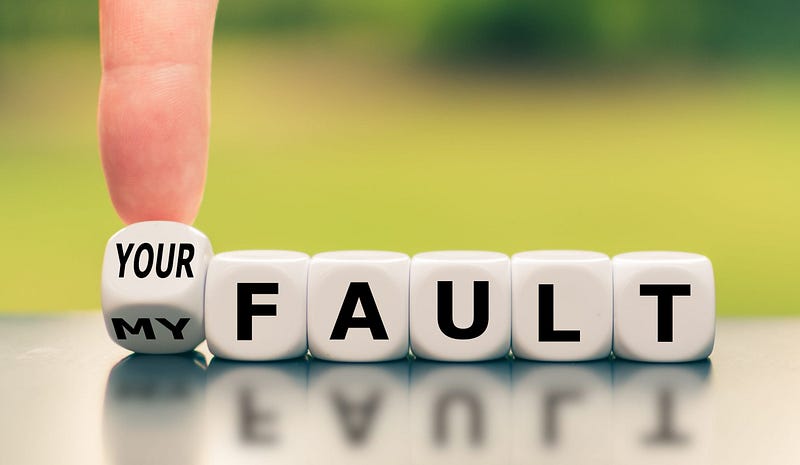
The protector pushes back, telling the victim: No! It’s your fault you’re unhappy. It’s your fault I’m unhappy. It’s your fault that you don’t know it’s your fault.
In these moments, the persecutor agrees to enter the Drama Triangle, but with the role-reversal of claiming the power of victimhood for themself. That is when fights escalate quickly. Rather than fulfill preconceived roles, the partners fight over them.
After 5 years of marriage and 15 years of practicing therapy, I have learned why couples fight:
I get to be the victim because you’re more scared of my pain than I am willing to be vulnerable.
Also read There are Exactly Two Attachment Styles and Everyone has Both and The Heart’s Gatekeeper
To follow me: https://medium.com/@myartman