
The Cynics: The Dogs of Philosophy
The Ancient Way of Life that Gave Birth to Stoicism
Comfort is not the same as happiness. Deep down we all know that. But we often slip up and come to realise we’re comfortable and miserable, or worse: we’re miserable trying to find comfort.
How many of us have well-paid jobs we despise? Is it worth having that BMW outside your big house when you can barely get yourself out of bed in the morning because you’re dreading the day ahead?
In the modern world we’re bombarded with the temptation to find salvation in things: designer clothes, soft beds, gleaming cars, huge plasma televisions. These are material comforts that make us lazy and give us the fleeting satisfaction that we’re keeping up with those we envy.
We distract ourselves from living a worthy life with comforting beliefs and customs. We tread the road well-trodden, yet never feel any better for doing so. Why don’t we just give up on doing what is expected of us?
There’s an episode of Seinfeld in which George Constanza bemoans that every decision he has ever made has been wrong. He complains that his life is the exact opposite of what it should be. He’s miserable when he should be happy.
Jerry Seinfeld tells him that “if every instinct you have is wrong, then the opposite would have to be right”.
George experiments with doing the complete opposite of what he would do normally. He orders the opposite of his habitual lunch. From that point on a chain of events occur that propel George to happiness.
He introduces himself to a beautiful woman who happens to order the same lunch. Instead of trying to impress her, he says, “My name is George. I’m unemployed and I live with my parents.” She is impressed by his candour and agrees to date him. George steps out of his comfort zone and things suddenly go his way.
For hundreds of years in the ancient world, there was a school of thought that condoned doing just the opposite of conventional thinking.
The Cynics embraced poverty and physical and mental discipline. They disdained comfortable beliefs and societal conventions in their quest for virtue. Happiness, the Cynics demonstrated, can be found where you least expect it.
To be a “cynic” (small “c”) today makes you a person who sees the worst in others. The modern pejorative meaning of cynicism derives from the Roman satirist Lucian, who criticised false Cynics — those who exploited the philosophical way of life to get free food and shelter. Lucian’s criticism came to characterise Cynics as a whole and so the word has taken on a negative meaning.
This is a shame because Cynicism is a school of philosophy that is perhaps the most practical of all. It’s has a direct lineage to Socrates, the great moral philosopher, and its overall mission is to reconcile man with nature through reason. The core beliefs and practical ethos of Cynicism gave birth to Stoicism.
Both schools thrived in the Roman world, though because of the anti-theoretical attitudes of the Cynics, there is little written material except for the extraordinary fables and anecdotes of its most famous practitioners. The famous Roman Stoic, Epictetus, wrote admiringly of the ancient Cynics, demonstrating the respect Stoics had for the older school.
The Dogs
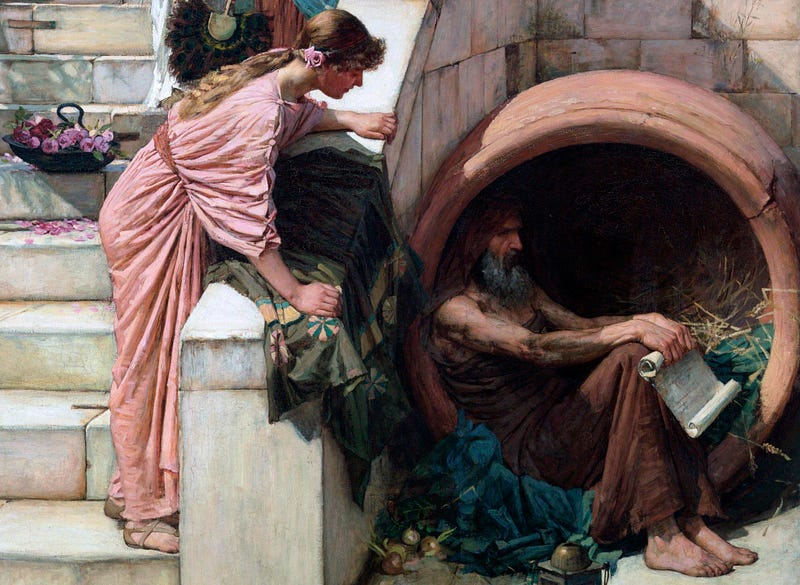
The most famous of the Cynics, and the philosopher from whom they took inspiration, was Diogenes of Sinope. Diogenes was born in around 404 B.C.E. and lived his adult life in Athens and Corinth.
It seems Diogenes was known exclusively as “the Dog” — kynicos in Greek — which is where we get the word “Cynic” from. Even Aristotle refers to Diogenes only as “the Dog” when he mentions him in passing (and for the first time on written record) in his book Rhetoric.
The nickname, which Aristotle did not bother to explain, must have stuck. Diogenes was likely a famous character in Athens at the time of Aristotle writing. Calling somebody a dog would have been as much an insult in ancient Athens as it is now.
Diogenes positively appropriated the insult. The philosopher admired the shamelessness of dogs. Dogs had integrity in showing their likes and dislikes, they survived on very little food and were happy with that. Dogs live fully in the present, free of the anxieties of status and wealth that human beings lose sleep over. The stray dogs of Athens, Diogenes reasoned, demonstrated in plain sight that living off nature was sufficient for happiness.
The Cynics, inspired by Diogenes, lived outdoors with only a rough cloak — no tunic or shoes — for protection against the elements, they lived off simple grains and pulses and drank water from natural springs. Leisure came in the form of long walks, discussion and sunbathing.
This extreme way of life was not merely “dropping out” as modern people would understand it. It was philosophy in practice, not theory. The Cynic way was built on the intellectual innovations of Socrates. Its goal was simply finding happiness (“eudaimonia”) and the central tenet of Cynic philosophy was that a life lived in accordance with nature guaranteed happiness. To live life in accordance with nature was to live in virtue.
Living in accordance with nature was to live shamelessly, self-sufficiently, and, above all, freely. In Ancient Greece, citizens were expected to take an active part in the governance and protection of their city-states. The Cynics, following the example of Diogenes, declared independence from their respective states and instead declared that they were “citizens of the world” (this is where we get the word “cosmopolitan” from: “polis” — city and “cosmos” — world or universe).
This amounts to a rejection of any kind of nationalism or patriotism in favour of a universal community of human beings. Philosophically, it’s also an oath of allegiance to nature itself. We’re all in this life together, so why do we make arbitrary distinctions of tribe or nation?
To live in accordance with nature is to look beyond borders. This was all an affront to conventional social values. The Ancient Greeks took patriotism very seriously. City-states like Athens and Sparta, jostling for influence and wealth, were in constant competition and this often led to war.
The Cynic’s idea of freedom of speech was to say it like it was. There is a famous anecdote that Alexader the Great, fascinated by the stories of Diogenes, went to visit the philosopher, who was sunbathing at the time. Alexander — at the time prince of the Macedonian Kingdom — told Diogenes that he would grant him any wish that was within his power.
Diogenes, unimpressed by the presence of the rich and powerful young man, asked him to get out of his sunlight. Awed by the sheer gall of Diogenes’s response, Alexander told the gathered crowd that if he were not Alexander, he would choose to be Diogenes. Diogenes retorted that if he were not Diogenes, he would still want to be Diogenes.
Diogenes wasn’t merely being nonchalant nor even deliberately insolent, his attitude stemmed from a transcendent understanding of humanity. The Cynics saw everybody as equals. Everybody could be spoken to with the same candour.
The preoccupation with power, fame, and reputation to the Cynics was “smoke” — “Tuphos”, a confusing muddle without substance. It was the same for wealth and luxury. Any distraction from virtue was mere smoke. Beneath luxurious clothes, behind high reputations, people are the same.
The historian Diogenes Laërtius wrote of the philosopher, “He sneered at high birth, honours and all such worldly distinctions, calling them camouflage for vice. The only genuine country consisted of the world as a whole.”
Self-sufficiency
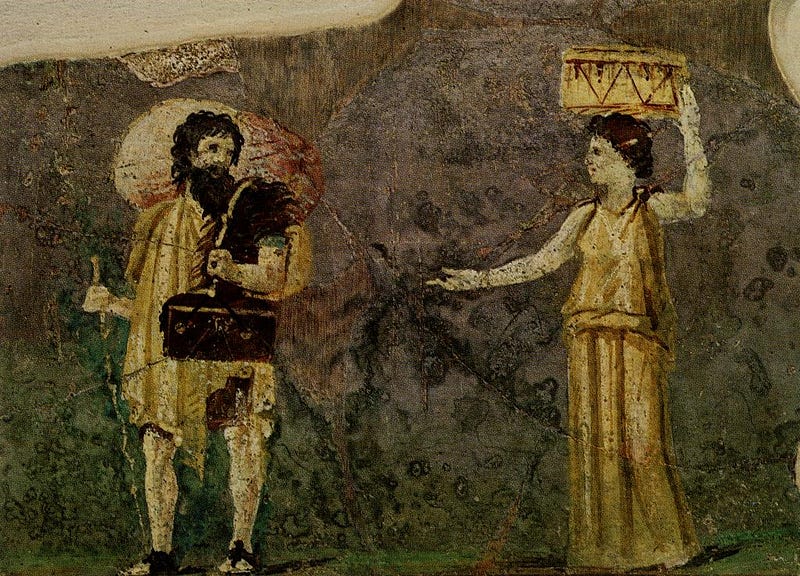
Minimalism is the modern movement of owning little in the way of possessions. Freedom from clutter helps free the mind. The Cynics took this mindset to the limit, living in the same squalid fashion as the destitute.
All that Diogenes owned he carried on his person. His cloak was his bed, and he held a knapsack to carry the food that he had foraged. Another anecdote of Diogenes’s life tells us that he carried a bowl to drink from, but when he saw a child drink from his cupped hands, he looked at his bowl and said, “Why was I lugging you around with me all this time?” The philosopher went barefoot through all the seasons and over the hundreds of miles he walked from city to city to preach the Cynic way. His example inspired many others.
Crates of Thebes, a student of Diogenes, was a wealthy landowner who gave his entire fortune away and embraced a life of wandering the streets. He composed verses to espouse the philosohical life.
Remarkably, Crates gained the affections of a younger aristocrat, Hipparchia, who wanted to marry him. Her scandalised parents refused. Even Crates, conspiring with her parents, tried to dissuade her, but Hipparchia threatened suicide if Crates’ hand was denied to her.
The couple entered into a Cynic marriage, living on the streets. Crates was known for his benevolence, helping to mend family rifts and cure social problems. Hipparchia is perhaps the first philosophical feminist. In Cynic-style, she openly defied the sexist circumscriptions of Athenian society.
On her tomb, it was supposedly written:
“I, Hipparchia chose not the tasks of rich-robed woman, but the manly life of the Cynic. Brooch-clasped tunics, well-clad shoes, and perfumed headscarves pleased me not; But with wallet and fellow staff, together with coarse cloak and bed of hard ground, My name shall be greater than Atalanta [a mythical huntress]: for wisdom is better than mountain running.”
The Birth of Stoicism
Another of the initiates to Cynicism, taken on by Crates, was Zeno of Citium. Zeno, like Crates, was formerly a rich man. The Phonician merchant had lost his cargo and his fortune in a shipwreck.
At this low ebb in his life, Zeno travelled to Athens where he came across accounts of Socrates in a bookshop and was taken aback by the fortitude of the philosopher. He asked the bookseller where he could find a philosopher like Socrates, the bookseller pointed to Crates.
Crates schooled Zeno in the hardships of the Cynic way. As Zeno learned more of philosophy, he began to develop his own ideas. Zeno started a school under the Stoa Poikile — “painted porch” — besides the Athenian marketplace. The school took the core idea of Cynicism — that one must act in accordance with nature to be virtuous — as its own first principle but built its own system of ideas about the universe.
The very idea of creating a philosophical system diverged from Cynicism, which was wholly against dogmas of any kind. Cynicism is a philosophical way of life rather than a set of ideas. The Cynics believed only in attaining virtue. Zeno’s school, therefore, became a new kind of philosophy, a branch from Cynicism, that became known after the physical location of the school: Stoicism.
Both Cynicism and Stoicism endured for hundreds of years. Though they shared the same core value — acting in accordence with nature as the path to virtue — Stoicism evolved into a quasi-religious philosophy of the universe, complete with a set of beliefs. Cynicism kept up its obstinate aversion of dogma.
Perhaps the most marked way Stoicism diverged from Cynicism is its embrace of the state and good citizenship. The Roman Stoics prized devotion to the community through military or civic duty. Even in the Roman empire, the Cynics maintained a distaste for politics and civic life, but were nevertheless very public figures.
Setting a High Bar
Diogenes Laërtius explained the extreme behaviour of the Cynics was to set the bar for virtue high. He wrote that Diogenes of Sinope “used to say that he followed the example of the trainers of choruses; for they set the note a little high, to ensure that the rest should hit the right note.” In this sense, the Diogenes and the Cynics set an extreme example so that people may aspire to virtue.
Diogenes would indulge in seemingly masochistic behaviour — rolling in hot sand, for example , or embracing statues in the snow — to show the capacity of human beings to endure pain and hardships. Such displays were evidently intended to make people feel better.
Even the Roman Emperor Julian the Apostate, writing hundreds of years after Diogenes’ death, praised the extremities of Cynic behaviour as an practically unacheivable ideal that everyone could nevertheless take inspiration from.
Endurance was important to the physically-fit Cynics. The mythical hero Hercules was considered a patron of their ways for the example he set with his twelve labours. These labours were as much about hard work and perseverance as they were about the swashbuckling bravery that modern people understand of Hercules.
One of the tasks of the demi-god was to clear out the dung of the Augean stables — supposedly home to three thousand cows. It was a task that was both physically gruelling and humiliating.
The Cynics endured heckles, humiliations and even physical attacks, but they persevered, believing that they were revealing the way to virtue, dispelling the “smoke” of false beliefs and desires. This was not to save their own or others souls in a religious sense, it was to help make the cosmopolis — the city of the world — a better place.
The modern reader would hardly relish the idea of living in the streets, wearing rough clothes or walking hundreds of miles in a week. The point of the Cynics was to show how remarkable human beings can be, and how happiness can be found in discipline. Just as a small number of professional athletes inspire millions of amateurs, Cynics knew that they were exemplars and did not expect people to wholly embrace their way.
Nothing in life, Diogenes claimed, has any chance of success without self-discipline. With it, almost anything is possible. He proclaimed that his life had the stamp of Hercules, since he valued nothing more than freedom.
Thank you for reading. I hope you learned something new.
If you enjoyed this article, you may also enjoy:


