
Diogenes and Cosmopolitanism
The Dream of a World Community has Ancient Origins
On December 7, 1972, the crew of Apollo 17, the last manned lunar mission, took their spacecraft out of a parking orbit of the Earth and blasted to the Moon.
Almost two hours into the flight, Harrison Schmitt took a photograph of the planet he had just left. It was an opportunistic shot. Schmitt was untethered, floating upside down in space with a handheld camera.
The image he captured is the first full image of our planet. It is perhaps the defining image of our age, the Mona Lisa of the twentieth century. It’s affectionately named The Blue Marble.

There were whole-Earth images before The Blue Marble and many since, but all have been taken by machines. All of them have been composited in a way that doesn’t quite match the intimacy of Schmitt’s idle moment, the analogue purity of the light-to-paper shot.
The Blue Marble was an overnight sensation and came fortuitously at the burgeoning of the environmental movement who adopted it as a symbol. It’s a portrait of us, in our home — the ecosystem that is Earth.
Only the so-called Pale Blue Dot, an image of the Earth taken by the Voyager 1 probe from 3.7 billion miles away, has come close to filling us with similar awe-struck wonder. The Pale Blue Dot shows the Earth as a distant pinprick of blue-white beyond a band of sunlight reflected in the lens.
Of this particular photo, Carl Sagan wrote of the earth as “a mote of dust, suspended in a sunbeam.” “To my mind,” he added, “there is perhaps no better demonstration of the folly of human conceits than this distant image of our tiny world.”

Another image taken from a lunar orbit in 1969 of the Earth rising over the horizon of the Moon was described by Galen Rowell as “the most influential environmental photograph ever taken.”
The astronaut Willian Anders, who took several pictures of our planet from the Moon, commented, “we set out to explore the moon and instead discovered the Earth.”
Anders’ point is clear: what these images show us is that we are one people inhabiting a globe in the cold vastness of space. There is no more powerful representation of cosmopolitanism, the idea of being a citizen of the world above all else.
Ancient Origins
The word “cosmopolitan” and the very idea it represents comes from ancient Greece. Kosmopolitês: “kosmo” meaning “cosmos” or “world”, and politês meaning “citizen”.
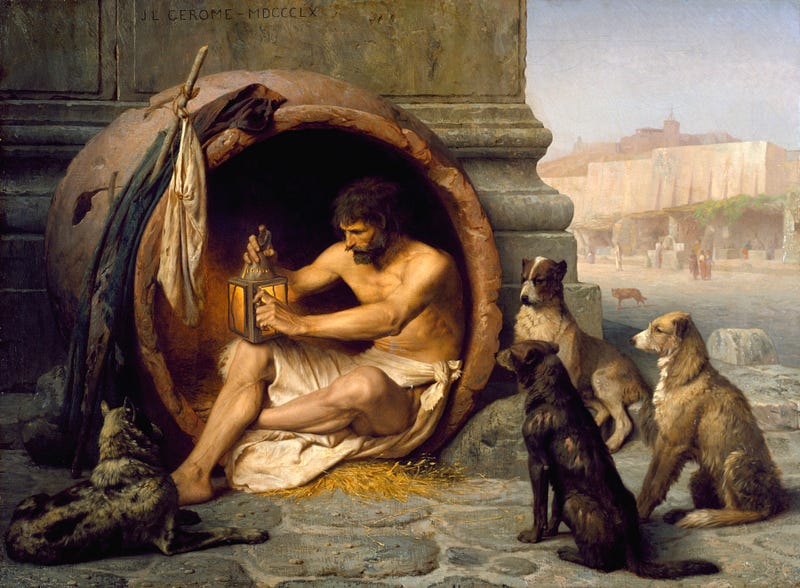
The word was coined by Diogenes of Sinope, an extraordinary philosopher born around 423 BCE. When somebody asked him where he was from, he replied that he was “a citizen of the world”.
He was among the first of the “Cynic” school, a movement of philosophers that followed the ethical lessons of Socrates.
The Cynics were not cynical in today’s sense of the word. They diligently pursued the idea of virtue as living in accordance with nature. This meant embracing poverty since the pursuit of riches was deemed to be unwise.
The word “cynic” came from the Greek word for “dog” — kynicos. Diogenes had a shocking disdain for social conventions, so people likened him to a stray dog. He was eccentric by any standard, living in a wine tub dumped outside the walls of a temple, he was frequently naked in public, and relieved himself in the street.
Diogenes seemed to embrace the comparison with dogs. He thought that humans would do well to learn from the dog’s shamelessness. Dogs live fully in the present, free of the self-imposed anxieties that people inflict on themselves. Dogs don’t care about abstract concerns such as reputation, self-dignity, wealth or national pride.
The philosopher’s ideas and exacting reason defied any attempt to write him off as insane. He used irony and humour to drive his ideas home. He would walk around at midday holding a lit torch, telling people he was searching for an honest man.
He mocked Plato during the classes of the Academy. When Plato defined a man as a “featherless biped”, Diogenes arrived at his school holding a plucked chicken, exclaiming, “Behold! I’ve brought you a man.”
Diogenes’s reputation spread far and wide. So famous was the philosopher that Alexander the Great, the leader of a vast empire of which Athens was part, paid him a visit in the city of Corinth in 336 BCE when he was the Prince of Macedon.
Radical Ideas
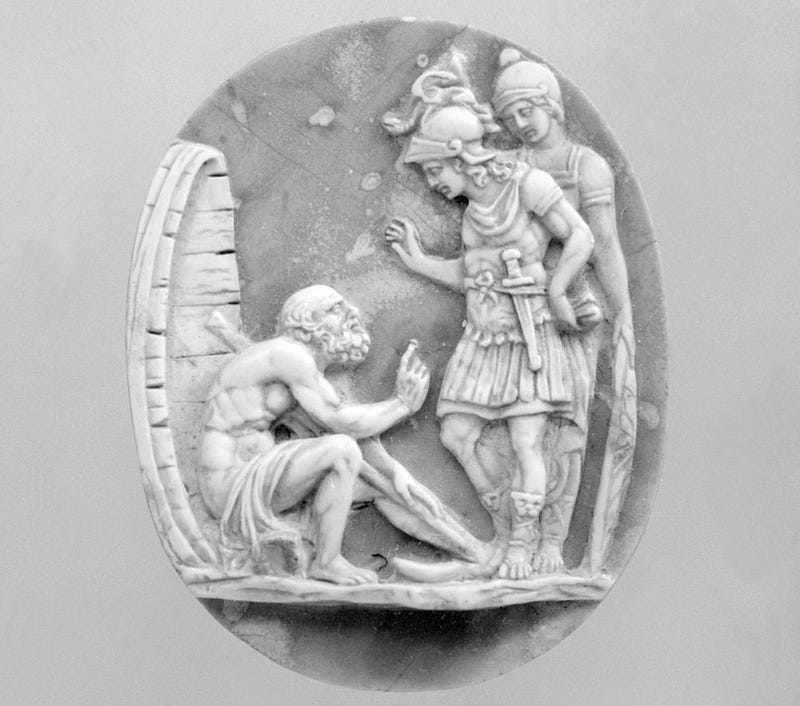
Standing at the opening of Diogenes’s tub, Alexander asked him if he wanted anything at all since the enormously rich prince could probably grant his wish. Diogenes replied, “yes, stand out of my light.”
The prince took the quip well and was so struck by the wisdom of the philosopher that he said, “If I were not Alexander, I wish I were Diogenes.” To which Diogenes replied, “If I wasn’t Diogenes, I would be wishing to be Diogenes too.” The story is apocryphal but gives a good idea of Diogenes’s outlook.
Little of Diogenes’s thought has survived, we only have anecdotal evidence of his body of knowledge. The philosopher is believed to have written as many as ten books and several plays. Cynicism, however, is a largely demonstrative philosophy — it’s how it is lived that is important. What we know of the sage’s actions are sufficient to have a good idea of his beliefs.
Diogenes inspired a rich man named Crates to give up everything he had to be a Cynic philosopher. Crates became the mentor to Zeno of Citium, the founder of the Stoic School. Stoicism, a system of thinking that would flourish over the next millennia, counting among its adherents slaves (Epictetus) and emperors (Marcus Aurelius), is ultimately a branch of Cynicism.
For the Cynics, wisdom is found when we abandon the artifices of man. Diogenes is thought to have said, “Humans have complicated every simple gift of the gods.”
Property rights, nationality, politics, reputation and decency were scorned as irrational. To be rational was to live in accordance with nature, and nature has no need for such artificial concepts that only stoke our irrational desires.
Contentment, according to Diogenes, can be found in self-sufficiency, austerity and shamelessness.
A Powerful Idea
Of what is known of Diogenes’s ideas, cosmopolitanism is the most powerful. It would have been an extraordinarily radical and even dangerous idea to hold at the time.
Greek city-states and the Macedonian Empire in which they were subsumed were fiercely competitive and demanded the total loyalty of their citizens.
Hierocles, the Stoic philosopher following Diogenes, conceived of the self as dwelling within concentric circles of belonging, the first being family, then extended family, then townspeople, then countrymen, then humanity.
The task of those who want to be wise, according to Hierocles, was to draw those circles to the centre, so that we may regard the rest of humanity with the same affection with which we regard our immediate family.
The cosmopolitan ideal has a powerful effect on people. Once the spell of belonging or loyalty is lifted, other attachments fall like dominos. When we consider the world our home, all the trappings of materialism and our allegiances seem shallow and petty.
While most of us wouldn’t want to follow Diogenes into a dog-like existence, his ideas give us some release from what weighs us down. We can attach ourselves to things for the sake of pragmatism, but we are not trapped by obedience to those things.
Many have embraced cosmopolitanism since, not so much for practical reasons, but for the transcendence it enables us. James Joyce wrote in his semi-autobiographical novel, A Portrait of the Artist as a Young Man,
“When the soul of a man is born…there are nets flung at it to hold it back from flight. You talk to me of nationality, language, religion. I shall try to fly by those nets.”
This transcendence gives us a refreshing perspective on some of the most pressing problems we face. The world as a whole is our environment and we are interdependent when we are faced with its destruction.
When we see the world alone as our home, we understand that we as humans are one. From there we’ll regard others with mutual respect, even if we disagree with them.
All nations crumble in time. No matter how tight you pack the sand, your castle will be lost to the beach the following day. National pride, allegiances and loyalties to geographies or groups offer no better future to humanity.

Of course, many nations practice good values like freedom, equality and democracy. We are tempted to argue that national pride is important if we are to propagate those values to other unfree, unequal, and undemocratic nations. But it would do us better to swear allegiance to those perfect values than to our nations that realise them imperfectly.
Besides, while great values endure, nations slowly die.
How many men swear their vehement loyalty to Roman Empire now? It was once the greatest empire the world has known, and now tourists stand on the dust of its remains.
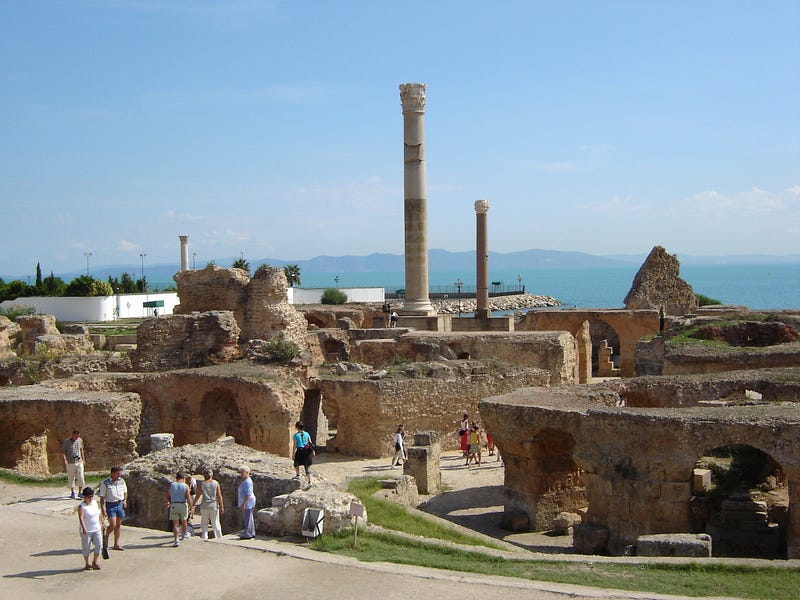
What of mighty Carthage, of Assyria, of the Aztecs? Or the great Babylonians? In all these societies people no doubt believed things would remain the same. Most believed their societies to be the best, to be the freest, the home of the bravest and smartest.
The same will happen to the United States, to China, to the United Kingdom, to France and to Russia. All these empires will wash away in the tide of history.
Diogenes’s request to Alexander to get out of his light could be read figuratively as well as literally. Alexander represents nationhood, empire and power; Diogenes represents pure humanity, stripped of all the trappings of authority and obedience.
If we are to survive as a species, at this time of existential threat from global warming and weapons of mass destruction, perhaps it’s time to give Diogenes the light of adulation that we’d normally reserve for emperors.
Thank you for reading.
If you enjoyed this article, you may like my article on Seneca and Time:


