
The Colorful Connection Between Bloom’s Taxonomy & Student Participation
A colorful look at how teachers can ask better questions in the classroom.

It was probably in my tenth year of teaching when I realized just how much of an interesting dialogue can come out of me asking my students one simple question;
“What comes to your mind when I say….”
and it just takes one word.
In looking for descriptive words, I like to begin with a simple game.
“I say apple…you say…..” (imagine you are the student here)
Asking questions to keep students interested in the lesson can benefit students in building their critical thinking skills.
I’ve often started a class by creating a mind map on the board around one keyword that embodies the lesson for the day.
I would say I got there by making colorful uses of Bloom’s taxonomy as a guide to building the right kinds of questions to allow for greater student participation in my classroom.
This has allowed students to build their critical thinking skills by encouraging them to get creative with their responses.
When student participation increases, this also opens up the levels of communication between teachers and students.
And that’s what teachers need to enjoy most with their students: the improved level of communication!
But before I continue, let’s pause for a short history lesson.
What is Bloom’s Taxonomy?
In 1956, Benjamin Bloom along with fellow contributors, developed and published a framework of educational goals that has since been used by teachers and college instructors in the K-12 education system worldwide.
The original framework consisted of six categories written as nouns: knowledge, comprehension, application, analysis, synthesis, and evaluation.
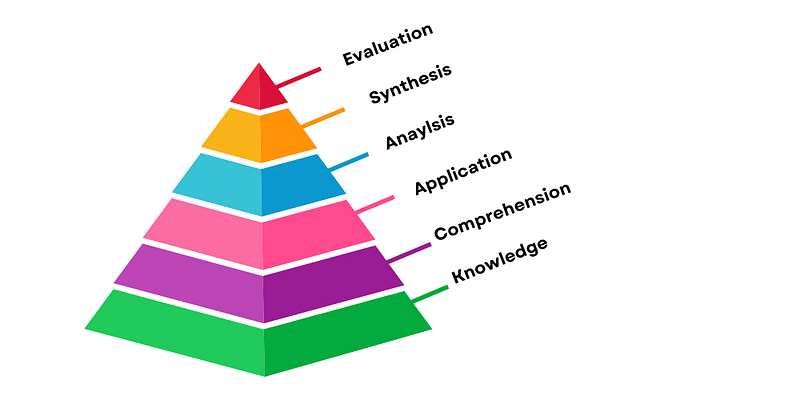
It was seen as a pyramid with the notion that there must be a solid foundation before moving to the higher level of things.
In 2001, Bloom’s taxonomy was revised to appear less constricting in its expectations and exchanged the final two levels to have synthesis (create) come above evaluation.
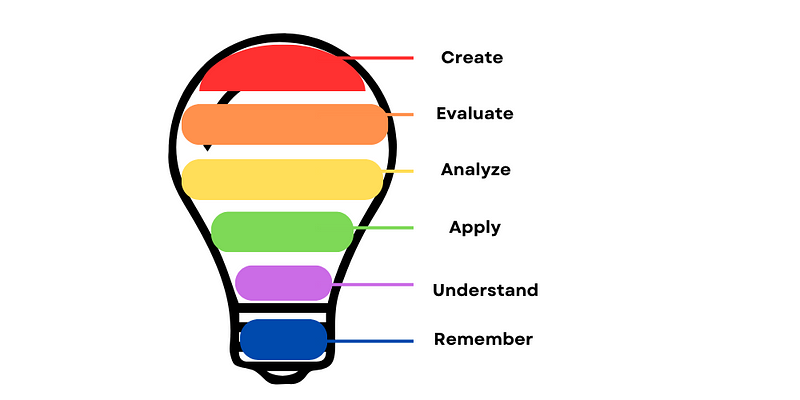
The names were also changed to appear more actionable (the words now appear simpler and in verb form).
Why Use Bloom’s Taxonomy?
Education, like most other fields, works on using effective approaches to get results.
Bloom’s Taxonomy is often referenced because it is meant to guide educators with the questions that help to identify what goals students of varying levels can achieve and how to create plans to meet them.
This approach allows educators to use formative assessments to encourage students to reflect and improve on their progress.
Note: As with any approach used in education, it is important to exercise caution and not rely on assumptions that could lead to stereotypes when it comes to student levels in terms of expectations.

I will now look at colorful ways teachers can use the six levels of Bloom’s taxonomy to help increase student participation and learning.
Level 1: Remembering
At this level, students are asked simple factual questions to show that they can answer questions about who, what, when, and where.
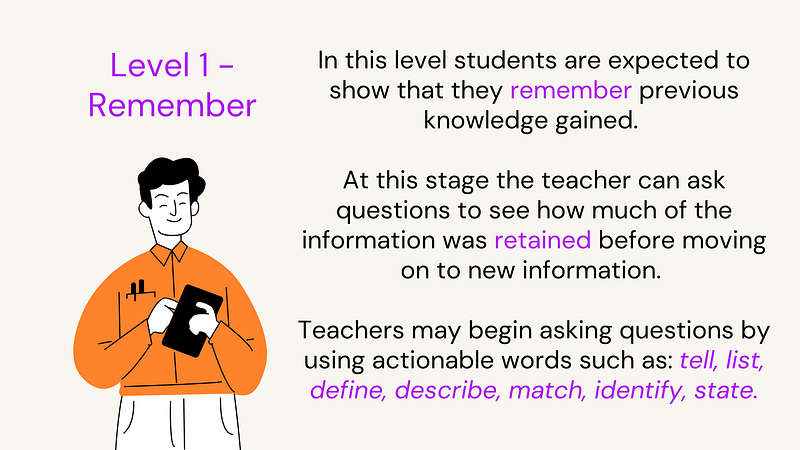
It is always a good strategy to have students go back to this stage if they are having trouble understanding new material so they can understand exactly where they are having trouble.
Example: Stating rules or steps before carrying out any activity.
An example of having students demonstrate that they remember what they learned is to state rules to an activity or steps to a solution before beginning to take action. This is so that they are prepared to go to the next level of understanding.
Level 2: Understanding
At this level, students are capable of expanding on knowledge gained by answering questions about why and how.
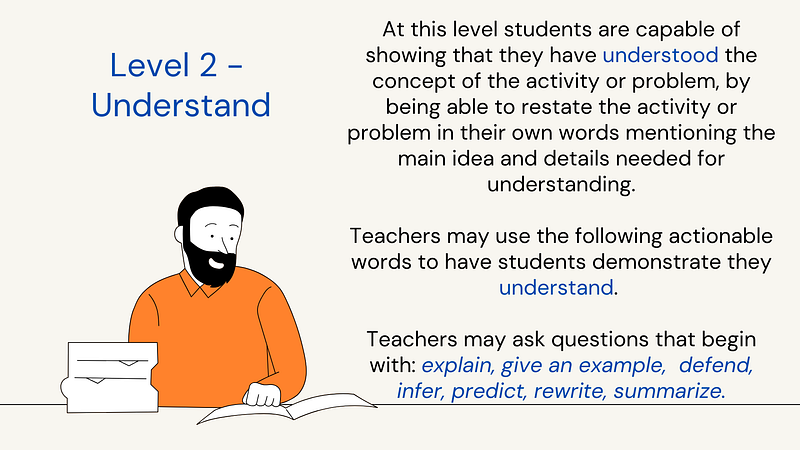
If students are having trouble with showing understanding of new material, prompt them with questions from the previous stage by having them recall previous knowledge (what they already know) and have them understand that they are building on what they know.
This way students can gain the confidence to demonstrate that they are understanding the new knowledge.
Example: Explaining or demonstrating rules or steps in their own words.
An example of having students demonstrate that they understand new knowledge is to explain or demonstrate the rules of the activity or steps to a solution in their own words.
This is so that they are prepared to go to the next level and apply the new knowledge they have gained.
Level 3: Applying
At this level, students are ready to apply the new knowledge gained through words or actions.
Teachers may use the following actionable words to have students show how they can apply new knowledge gained.
Teachers may ask questions that begin with: apply, demonstrate, show, prepare, produce, relate, solve.

If students are having trouble with applying the information they understood, it is important teachers, first ask students to demonstrate understanding once again.
Next is to demonstrate how to use the knowledge gained in applying it to get results or outcomes. This way, students can gain the enthusiasm to apply the knowledge they gain in their own way.
Example: Applying the rules or steps needed to complete or solve the activity with productive outcomes or correct and logical results.
An example of having students apply new knowledge is having the students write down or present their understanding of the rules to an activity or steps to a solution through using materials or manipulatives.
This is so that they are able to communicate how they are applying the new knowledge gained in order to go to the next level of analyzing the relevance or value of the new knowledge gained.
Level 4: Analyzing
At this level, students are ready to explore deeper meanings behind the knowledge they gain specifically, asking why or how this information is relevant to themselves and society in general.
Teachers may use the following actionable words to have students show how they can analyze new knowledge gained.
Teachers may ask questions that begin with: analyze, compare, contrast, identify, illustrate, outline.

If students are having trouble with analyzing the information, teachers may ask students to apply their knowledge to give more examples.
Doing so will help students begin to use their critical thinking skills to analyze the relevance of the knowledge gained so that they can begin to evaluate further meaning behind the knowledge gained in their own way.
Example: Analyzing whether a different set of rules or steps is needed to complete or solve the activity may also result in productive outcomes or correct and logical results.
An example of having students analyze new knowledge is having the students begin to use their critical thinking skills to compare and contrast whether new approaches will yield the same outcomes and positive results.
This is so that they are able to begin to appreciate that there can be more than one way to approach and retain new knowledge in order to go to the next level of evaluating which approach works best for the individual student.
Level 5: Evaluating
At this level, students are ready to form their own judgements on new knowledge gained and how they may relate the knowledge to their benefit both inside and outside the classroom.
Teachers may use the following actionable words to have students show how they can evaluate new knowledge gained.
Teachers may ask questions that begin with: evaluate, conclude, justify, relate, summarize, support.

If students are having trouble with evaluating the information, teachers may ask students to reanalyze their information and see if they need to gain more information.
Doing so will help students further use their critical thinking skills to create ways in which others may learn from as well.
Example: Evaluating whether their different set of rules or steps needed to complete or solve the activity may be understood by other students as well.
An example of having students evaluate their new knowledge is to have students share or demonstrate their approaches with others and see if others are able to yield the same outcomes and positive results.
This is so that they are able to begin to see how others may benefit from their approach in order to go to the next level of creating ways others can also benefit.
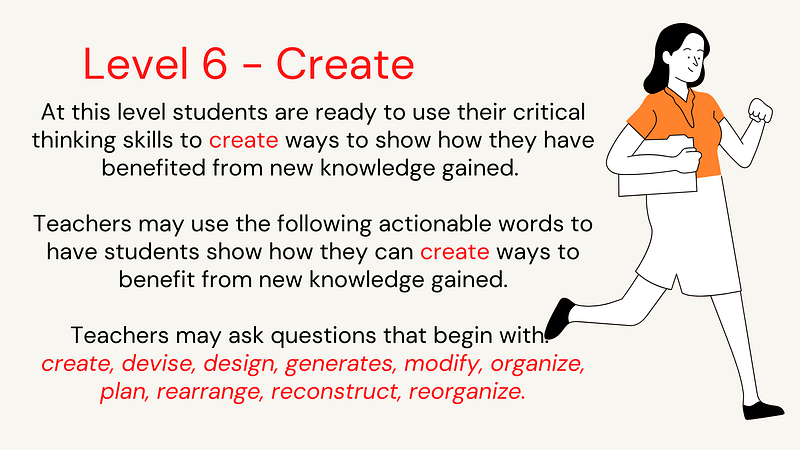
Level 6: Creating
At this level, students are ready to use their critical thinking skills to create ways to show how they have benefited from the new knowledge they have gained.
Teachers may use the following actionable words to have students show how they can create ways to benefit from new knowledge gained.
Teachers may ask questions that begin with: create, devise, design, generate, modify, organize, plan, rearrange, reconstruct, reorganize.
If students are having trouble with creating new ways to present knowledge gained, teachers may ask students to re-evaluate their information and see how they can present the new information.
Doing so will help students further use their critical thinking skills to create ways in which others may learn from as well.
Example: Creating new opportunities to see if fellow classmates can follow their different set of rules or steps needed to complete or solve the activity.
An example of having students create new opportunities to make use of their new knowledge is to use creative outlets ( games, comics, plays, music, dance) to see if others are able to follow the new set of rules.

It is important to also remember to have students enjoy their time in class, so in increasing student participation, what role does emotion play in asking questions.
The Role Emotions Play In Asking Questions
The role of emotions in the classroom has finally evolved to the point where it is seen to be an important part of learning.
When teachers allow for emotions to be acknowledged and communicated, students can feel safe to share more of what they are thinking.
If students are not comfortable expressing their emotions, consider having them write them down in a personal journal.
As students share more of what they are thinking teachers can make students see that any negative emotions they are feeling are perhaps because of not being able to ask the questions they have wanted to ask earlier.

If teachers are able to change students’ perceptions from what they don’t know to what they do know, then true learning can begin to grow within the students.
Teachers who recognize the excitement students get when they feel like they are really learning something will see it in their eyes and level of participation.
How to Increase Student Participation
If you have made it this far into the article, you will have seen how I relate to you and how to increase student participation.
It is through acknowledging emotions and allowing students the time and freedom to move through the levels of reaching their educational goals using Bloom’s taxonomy.
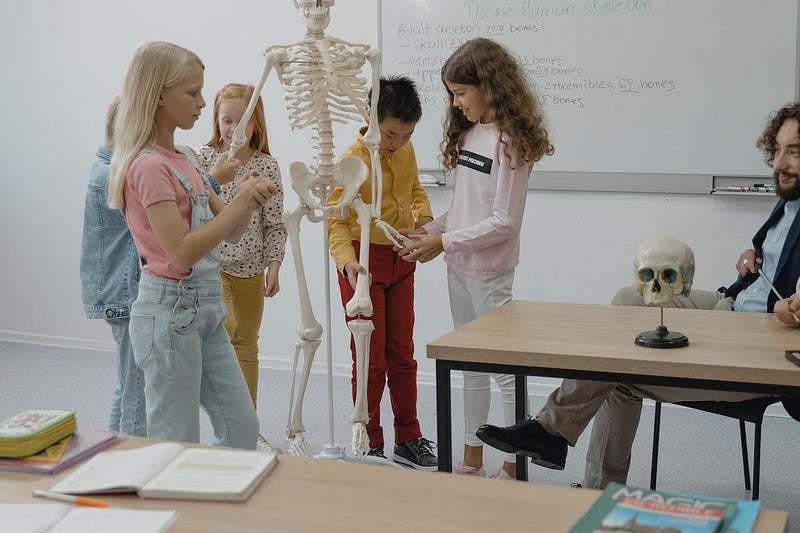
Teachers who accept flexibility in their classroom when it comes to students asking questions will find that students want to increase their level of participation on their own.
YouTube Videos
Watch this article come to life in my video below on how to use Bloom’s Taxonomy in the classroom.
And here is another video as to how to connect it to increased student participation.
Final Thoughts…
Teachers who expect students to pass through the stages of Bloom’s taxonomy at their pace instead of at the student’s own pace will find time with students in the classroom to be challenging.
Classroom management may suffer, and issues with behavior may begin to arise.
Students are in the classroom to learn, and if they feel that they are being judged because they cannot meet the level of others in the classroom, teachers may find only one or two students showing participation in the class.
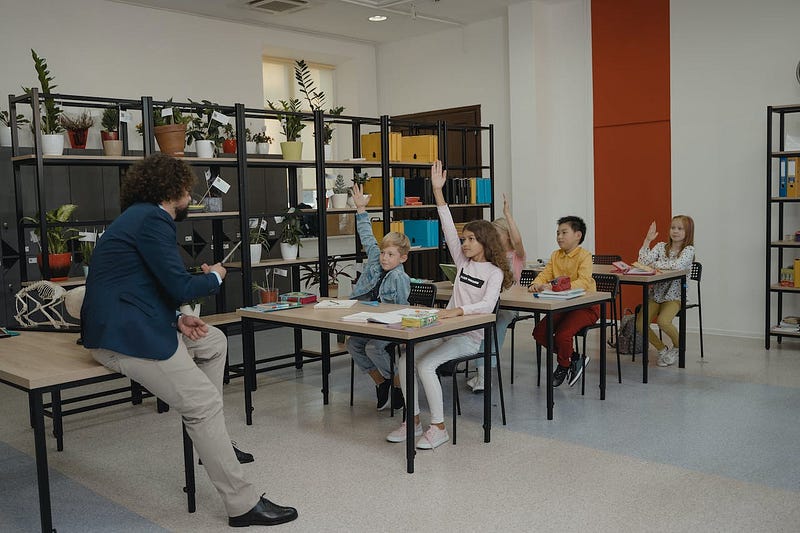
Therefore, the best way to avoid cricket sounds in the classroom is for teachers to be flexible with their questions to allow students time to build their confidence and enthusiasm for being in the class and participating in the lesson.
By building students’ enthusiasm for being in class, teachers are also laying the foundations for building long-lasting teacher and student relationships.
If you enjoyed reading this article, please consider reading my other articles that help connect and build relationships between teachers and students.
References
Relevant information used in this article can be found by visiting the link on Facilitating Learning.
My Bloom Taxonomy slides used in this article can be found by visiting my TpT store here!


