Science, Theories
The Clathrate Gun Hypothesis or Why Methane “Burping” is Cause for Concern
Why should YOU be worried?
The Clathrate Gun has already been fired.
The video below shows a lead researcher breaking down while reading out the results of her study which concludes that the Clathrate Gun has been already been fired.
So what is the hypothesis specifically? The Clathrate Gun Hypothesis suggests that the release of methane from the earth due to warming could cause a massive increase in temperatures within a lifetime (‘gun’ because the process can’t be stopped, the process is irreversible).
Now let’s break it down.
Methane.
There are a couple of things to know about methane. It’s a colorless greenhouse gas 24 times more potent than carbon dioxide. That being said, methane can be a problem in the atmosphere, even in small quantities.
Alright, next: Clathrates.
For our situation, methane in ‘ice’ = clathrate. Now, clathrates are stable in cold temperatures or under high pressure. One cubic meter of clathrate could release 164 cubic meters of methane. It’s quite a bit. To put that in perspective, that’s 43,324.2 gallons.
Simple enough.
So Methane Clathrate is simply ice holding a lot of methane within its crystal structure.
Next. Where is this thing found?
Methane clathrate is found in seabed permafrost. Essentially, it’s mainly found on the ocean floor, however, there isn’t a consensus on just how large these deposits are.
We’ll jump back in history to grasp the scale of this theory. Apparently, some scientists theorize that the violent degassing may have affected the planet significantly. They suggest it could have resulted in the Eocene hothouse period. Eventually, the period of great warmth gave way for the cooling climate.
The large extinction occurred near the end of the Permian period about 250 million years ago. The damage to marine life was great; more than 94 percent of all species then abruptly disappeared as oxygen levels sank. It took at least 20 million years, and in special cases over 100 million years for environment diversity to recover. All of this happened simply from a temperature increase less than 6.5 degrees Celsius.
So how would methane clathrate figure into all of this?
The release of methane from the methane clathrate could increase global temperatures. An increase in global temperatures would release even more of the compound increasing temperatures further. An abrupt release could drastically impact the environment. Even if a runaway effect is unlikely, as postulated by few, it could still ocean acidification and alter the atmosphere. During a period of the Glacial Minimum, the temperatures went up 6 degrees Celsius.
Side note: The release of methane from the compound can be referred to as methane degassing or “burping.”
So, the trapped methane from the seabeds may have caused the End-Permian Extinction. Alright, that covers all the basics. We’ll delve further into the issue.
By using a process called ebullition, researchers could find the density of bubbles from the permafrost and found 100–630 mg of methane per square meter is released daily from the East Siberian Shelf into the water column. It basically suggests that methane release is gradual, not abrupt. However, events such as arctic cyclones could increase the rate of methane being released.
Another thing to consider is that clathrates can also exist not just in seabed permafrost. They can be found in water if the temperature is lower. Also, the methane could be contained by a ‘lid’ of permafrost.
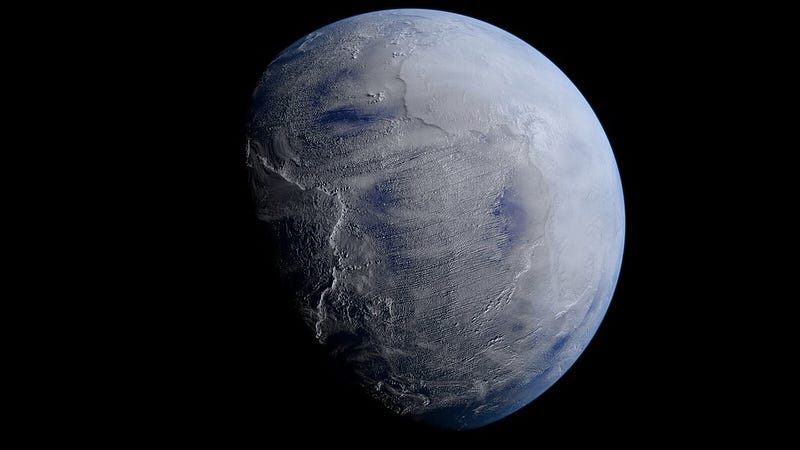
In light of this info, let’s investigate Snowball Earth. About 630 million years ago, it’s believed the earth’s surface was almost entirely frozen. The frozen ice sheets of the planet would’ve had quite a bit of methane trapped within. However, because these sheets were unstable, they would collapse after growing big enough, releasing methane into the atmosphere. Temperatures increased, melting more sheets, releasing more methane, increasing temperatures further bringing the Snowball Earth to its end. It is thought that the last ice age was not brought to its end by methane-related warming.
Many of the methane clathrate deposits are in sediments that are too deep to be released suddenly. Furthermore, in the overall scheme of warming, the effect of methane would not be drastic. This is due to the fact that they destabilize from the deepest part of their stability zone, which is usually 100 meters below the seabed. It will surface eventually, but not as rapidly as previously thought.
Our Current Situation
Around 2008, there was research in the Siberian Arctic which claimed millions of tons of methane were escaping through breaches in the seabed permafrost. In certain areas, the concentrations of methane hit 100 times normal levels.
There’s a release of .5 metric tons of methane per year. Also, 50 gigatons of it are risked to be released at any moment. What if that happened? The amount of methane on the planet would increase by a factor of 12.
Miscellaneous:
There’s also a trapped gas deposit off Canada in the Beaufort sea. Considered to be the shallowest known deposit of methane, it lies 290 meters below sea level.
Along the eastern continental slope of the United States, destabilizing methane hydrate can be found, about 2.5 gigatons worth. It’s still unclear whether it would reach the atmosphere.
Although there isn’t exactly a consensus on the Clathrate Gun, after all, it is a hypothesis, it’s nonetheless good to be informed about the current state of our planet and how it’s evolved in the past and may change in the future.
Thanks for reading!
Read more: My newsletter.


