The Chameleon: The Spirit Animal of Borderline Personality Disorder
How we blend and camouflage into different environments and why it’s ultimately unsuccessful.
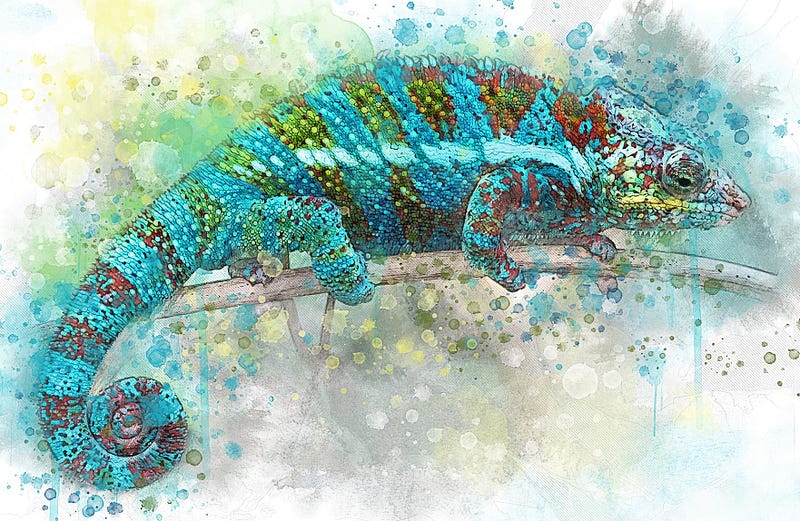
Are you a chameleon? If you have Borderline Personality Disorder chances are you might be. At the very least, this spirit animal has given you the superpower of blending in.
Individuals with BPD have no inherent sense of self: Washed away somewhere in childhood, peek inside the heart of a person with BPD, and you’ll find nothing but emptiness. However, in this void, there’s enough space to fill the whole room. In fact, we’re so well-versed in this clever display of hollowed-out performance art that we can fit into any environment. That is until the disguise just slips away.
Life is like a jungle
Pioneer female psychoanalyst Helene Deutsch was the first to spot the BPD chameleon, in 1942, labelling us As If Personalities. We live ‘as if’ we’re in the world but actually quite detached. ‘It’s like the performance of an actor’ she wrote, in the end ‘something intangible obtrudes between the person and his fellows and invariably gives rise to the question “What is wrong?”’ Deutsch decided the answer was dissociation. Through elaborate displays of mimicry and impersonation, the individual with Borderline Personality Disorder adapts to all environments. However inside they feel nothing at all. That’s the chameleon for you. And don’t knock it — many of us survive like this, high on the branch above, watching the world below. However, what happens when the camouflage stops working?
Angry outbursts, tearful remonstrations, and sometimes acts of self-destruction — Even when you push it down, suffering comes out sideways. You’re always the one drinking too much, a little too impulsive, a little too crazy. It hurts to pretend like this. To shore up the heart with makeshift scaffolding only to mess up once and watch it crumble — the question is why do we do it? Why do we use this unskillful means of adaptation when we know it ultimately fails?
Poor sense of self
The BPD chameleon is born out of what the DSM IV refers to as a ‘markedly and persistently unstable self-image or sense of self.’ This identity disturbance results in a personality that changes like the weather — or rather like the environment. We can spend a lifetime changing colours in order to match our surroundings just to fit in.
According to psychodynamic theorists, the disturbed sense of identity seen in those of us with BPD is due to an inability to form an accurate view of ourselves in relation to other people. Psychiatric luminary Dr Otto Kernberg (1967) expanded on this further arguing splitting, the process by which we alternately divide the world and ourselves into all-good or all-bad representations depending on the mood, is at the heart of the diagnosis and determines how we behave. The psychoanalysts looked for answers in childhood, claiming a failure in mother-infant bonding led to confused boundaries, where on the borderline, identity is broken into fragments.
The psychodynamic view remained unchallenged until the 1990s when a new wave of behaviourists led by renegade psychologist, Dr Marsha Linehan (1993) broke ranks. According to Linehan individuals with BPD grew up in an invalidating environment; that is to say, an environment that systematically, pervasively and chronically invalidated our thoughts, emotions, beliefs and behaviours. You were told ‘Quit being a baby.’ ‘You’re lying.’ ‘It didn’t happen.’ ‘Say that again I’ll smack you.’ You’re the sum of all parts, and in this case, the sum is constructed from the pieces of jagged feedback you receive from others. The final equation is identity disturbance — a self that’s in fragments because it was never built up in the first place.
You’d logically conclude that a child who’s continuously told they're wrong would grow up with a feeling of wrongness. Indeed, that is perhaps the only identity someone with Borderline Personality Disorder tends to have; and yet at the same time, those with the condition often live with the dissonance of believing, and even knowing, that they are right. Individualistic, headstrong, and struggling to break free, as children they had parents that would punish them in private, in public and lavish them with praise. Mollycoddled then rejected, the sense of self inevitably becomes mixed up because the environmental feedback is too.
Emptiness
Another reason for the chameleon is BPD symptom emptiness. Even the experts have struggled to quantify this one. Psychodynamic therapists have argued individuals with BPD lack what’s called a soothing introject (Adler, 1972); a silly word that simply means in times of upheaval, we are unable to conjure the image of someone who can comfort us. A mother, a father, sibling, girlfriend, boyfriend, husband, wife, even the bloody pet dog — most people have a picture, but because of childhood trauma, individuals with BPD constantly feel under attack, and therefore the chameleon has its camouflage.
Just imagine though, how impoverished life must be, that when we cry, there’s just an empty space — That’s Borderline Personality Disorder for you. It’s one explanation of the so-called ‘intolerance of aloneness’ (Gunderson, 1996) and why real or perceived abandonment often leads to gratuitous acts of self-harm. When a relationship is imperilled the individual with BPD confronts the abyss inside themselves, and so changes colours to match the environment. My needs are subordinate to your expectations. It’s the only way to get by and also gives a fleeting feeling of fitting in.
Behaviourists, on the other hand, believe emptiness is the result of trying to suppress emotional pain. Dr. Marsha Linehan argued individuals with BPD hide their flaws behind a wall of apparent competency and are so well-versed in inhibited grieving they’ll smile even on the cusp of breaking down. Again this once again goes back to the idea of an invalidating environment: If a child finds their thoughts, feelings and beliefs denied, or worse still punished, they’ll likely suppress them. The result is a lifeless, detached zombie-like state similar to Winnicott’s False Self (1960) that numbs us even going into adulthood.
We’ve come full circle and are once again back with Helene Deutsch, who first saw the chameleon motley display of colours and said it was pretending.
Reclaiming your life
Sure, being a chameleon once helped: It was a survival skill you most likely learnt in childhood. When you saw the people around you were so capricious, you performed to match their expectations. However, by the time you reach adolescence and adulthood, you may not have a clue who you are. You’ll constantly look to others to tell you: A friend, a partner, a doctor, a psychiatrist: Who am I? How should I think, feel and act?! The first thing to remember is other people aren’t always right. The second thing is that you aren’t always wrong. You are more just a label, more than a set of dysfunctional behaviours — The chameleon is your attempt to try to be normal, but normalcy begins when you trust yourself.
The first sign of recovery is no longer looking to the environment to find validation. It means having the ability to stand up and say “I accept myself as I am, with all my faults and contradictions and I know I can defend myself.” You can do this calmly. If you lash out, you crash out. Authentic interpersonal effectiveness arises from authentic self-worth. To get this you need to be fair to yourself and others. You also need to participate.
You see, the thing about the chameleon is that it is also a solitary animal. It can spend a lifetime on one branch, just watching. A delectable morsel comes along — a tasty cricket, a lovely locust — the chameleon will suck the life out of it. That’s like individuals with BPD who sequester themselves off into intense exclusive relationships too quickly. After spending so much time alone, the first sign of intimacy creates a desperate need to devour the object of affection. This is called Object Hunger and doesn’t build a sense of self, it again uses another person to shore up the ruins.
So how do you do it? How do you replace a poor sense of self with a rich one? This isn’t about just fitting in, blending-in, or hiding under camouflage, but being open and vulnerable to life’s vagaries. You have to join in.
For that, you’ll need to establish a safe and consistent environment made up of positive people who build you up rather than tear you down. Relationships play an important role in constructing a new self-identity; however before you do that, you need to validate yourself. Once you’re okay with yourself and have truly reflected on your own unique character traits, you may begin to be okay with other people. You need not look at others as terrifying predators out to destroy you, nor angels who’ll rescue you; everyone is a flawed human being just as you are. You finally need to own your life. Discover your values and priorities and use them to develop self-mastery. This is the way to build what Marsha Linehan calls a Life Worth Living.
I too was a chameleon. In fact, for fifteen years of my life, I played a part, but in the end, my suffering came out sideways. The mask slipped, and I ended up feeling more pain because of my attempts to hide it.
The good news is that eventually, the chameleon can die a death. Deep down that superpower is not so great after all. All that camouflage — you were actually hiding your true self all along.
References
DSM IV. American Psychiatric Association, 1994.
Adler, G. Aloneness and borderline psychopathology, 1979
Deutsch, H. Some forms of emotional disturbance and their relationship to schizophrenia. Psychoanalytic Quarterly. 1942
Gunderson, J. Intolerance of Aloneness, The American Journal of Psychiatry, 1996.
O. Kernberg, Borderline Personality Organisation. Journal of the American Psychoanalytic Association, 1967
M. Linehan, Cognitive-Behavioural Therapy for Borderline Personality Disorder, New York: The Guilford Press, 1993.
Winnicott D W. Fear of breakdown. International Review of Psychoanalysis. 1974