What a Toxic Environment Has to Do With BPD
It’s like being a rose that grew from concrete

One day in 2007, at a clinic in north London I was diagnosed with BPD.
My first feeling was gratitude: Finally, finally, after all this time, I had a name for this soul-devouring sickness which had eaten away the last decade of my life.
Thirteen years later, I have regrets.
Psychiatrists are doing all of us a disservice, providing a label without an explanation. We don’t just want a name, we also need a cause. What went wrong? How did your personality get so damaged?
The answer of course lies in childhood.
You are the rose
People with BPD are biologically vulnerable strong emotions. Exquisitely sensitive, we react more quickly, feel more intensely, and take longer to calm down.
Some of this may be genetic. Recent twin studies indicate the risk of inheriting BPD is around 40%. While specific genes are yet to be identified the dopamine D4 receptor and serotonin receptor 5HTT are thought to be implicated.
Prenatal stressors could also be a factor. Pregnant mothers who suffer anxiety, depression or medical complications, are 10 times more likely to have children who develop a personality disorder. While the exact mechanism by which this happens is unknown, it’s effects are well documented.
Finally, your brain may just be wired differently. The advent of MRI technology has revealed borderline brains are different from their ordinary counterparts. The amygdala, the part of the brain regulating fear and aggression, is hyperactive. The prefrontal cortex, the part of the brain promoting rationality is sound asleep. There are conflicting theories as to why, nonetheless the biological signature cannot be ignored.
This is the Concrete
When a biologically vulnerable individual is placed in an invalidating environment, exquisite sensitivity becomes emotional instability. The sense of self is warped out of shape, and the chances of acquiring a personality disorder suddenly become high.
First proposed in 1991, by medical luminary Dr Marsha Linehan, expert psychologist and founder of DBT, the invalidating environment is an environment which consistently and pervasively invalidates your emotions by denying them, ignoring them, minimising them, mislabelling them, or outright punishing them.
This has two effects. Firstly it teaches you, that what you think and feel is wrong. Secondly, it labels some personality traits as socially unacceptable.
Common examples of invalidation
“Oh look crocodile tears. You’re pretending to be upset.”
“Quit being a baby. Crying is for weaklings.”
“You’re lying. That’s not what happened.”
“She’s doing it to get attention.”
“You are deliberately doing this to hurt me”
“You’re not trying hard enough.”
“You’re manipulative”
“You’re a fool to think this is a good thing.”
“If you cry in front of the neighbours I’ll hit you harder next time.”
Invalidating environments come in many shapes and sizes: from the playground to the workplace. However invalidation, usually starts at home within families.
Family portraits, broken homes
Chaotic families often live in a state interpersonal chaos. Caught up in their own affairs, parents struggle with problems such as marital breakdown, mental illness, substance abuse or poverty. As a result, children are left to fend for themselves. They are invalidated simply because they are forgotten.
Perfect families, on the other hand, exist to maintain order. Uncompromising ideas of perfection, mean parents will do whatever they can to suppress public displays of negative emotion in their children. As a result, children will be obliged to hide feelings of shame, anger, guilt or sadness. This rejection of “bad” emotions, is another form of invalidation.
Controlling families are perhaps the worst. They present a public facade a perfect family to the outside world, but privately behind closed doors, subsist on chaos. Here children are not only forced to hide negative emotions but feign happiness in order to avoid punishment. This is extremely damaging. When children’s thoughts, feelings, beliefs and behaviours arise out of forced compliance, invalidation is catastrophic.
Typical families are essentially western families. Usually benign in outlook, they emphasise self-control, discipline, effort and ambition. The unquestioning drive to success and status, means parents too can also be unintentionally invalidating to their children. If there’s a poor fit between a typical family, and an atypical child, then the child grows up believing they cannot live up to the standards, and is therefore irrevocably flawed.
The role of trauma
80% of individuals with BPD will have experienced some form of childhood trauma. Incidences of chronic, sexual, physical, and emotional maltreatment, are in fact rife in the case histories of individuals diagnosed with BPD. There are all sorts of reasons for this, biological, psychological and social, but on a simple cognitive-behavioural level, what could be more invalidating than abuse?
Any act which violates the physical or psychological integrity of an individual is by nature extreme invalidation. Furthermore, if a child speaks up, but has their experience ignored, denied, minimised, mislabelled or punished, invalidation is compounded further.
The role of trauma in BPD is yet to be fully elucidated, however, a 100-year history of the diagnosis, attests to its prominent role in disease aetiology.
Tangled Roots
Many people with BPD, end up incapacitated by emotional, behavioural and cognitive instability. In and out of hospital, day patient, in-patient, incarcerated or trapped in crisis, 10% will, in fact, commit suicide. How does it get so bad? The level of severity is not only determined by biological vulnerabilities, or invalidation, but how the two factors interact. This is called the transactional vicious circle.
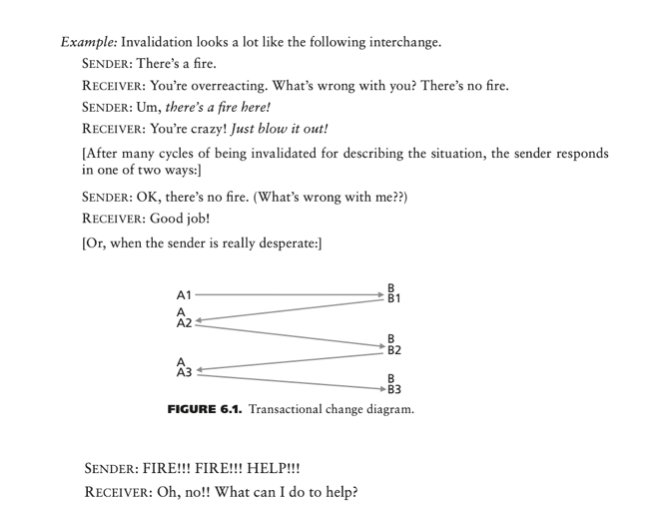
When a sensitive child is placed in an invalidating environment; they find their cries for help go unanswered. As a result, their distress gets higher, and the volume gets louder. The invalidating environment will work even harder to enforce silence. The child again, ups the ante, as does the environment, creating a transactional vicious circle – or spiral – of ever degenerating emotions and behaviours.
BPD perpetuates itself through this give and take process of character deformation. The more negative emotions are invalidated the more prominent they become, and the more the environment fights back to keep them in check. This escalation is the main reason personality disorder destroys families – it’s not just disease, but the interpersonal context in which it operates. When the BPD’s individual emotions are behaviours are too extreme to be ignored, intermittent reinforcement, turns them into a character trait.
Damaged Petals
The consequences of chronic invalidation is a child who grows up unable to label or regulate their emotions. This leads to emotional instability; emotional instability leads to behavioural instability, cognitive instability, stormy relationships, interpersonal chaos, and an incoherent sense of self. Finally, frequent invalidation, renders sensitive individuals like emotional burn victims, raw to even the slightest touch, suicidal behaviour becomes a natural response to severe pain but also chronic mis-recognition.
If you have Borderline Personality Disorder it’s not your fault! Like a rose that grew from concrete, you survived, and so when you look at yourself; don’t just see the jagged thorns and wilted petals, see to the miracle of your existence. That you blossomed, bloomed, and in spite of adversity, incline towards the sun.
Roses, are of course pretty, but only the ones that grow from the cold granitic earth, are beautiful. Remember all those positive character traits that have gone unaccounted for; your love, kindness, courage, empathy and resilience — these are not symptoms of a disease, rather who you are as a person. They belong entirely to you.
If you have Borderline Personality Disorder, don’t give up. Just as the illness emerged from chronic invalidation, finding an environment which validates your existence, will lead to recovery. Even amidst the heavy footfall and trampling feet, the rose that grew from concrete, lives on. It’s always striving to find the light.