avatarØivind H. Solheim

Free AI web copilot to create summaries, insights and extended knowledge, download it at here

5286

Abstract

https://climate.nasa.gov/evidence/</a></i></b></p><figure id="d63d"><img src="https://cdn-images-1.readmedium.com/v2/resize:fit:800/0*9-FJ9r-8wQJodkLI"><figcaption><i>Image: Flowing meltwater from the Greenland ice sheet <a href="https://climate.nasa.gov/evidence/#footnote_1"></a></i><a href="https://climate.nasa.gov/evidence/#footnote_1">C</a>redit: <a href="https://climate.nasa.gov/evidence/">NASA</a></figcaption></figure><p id="547e">We live on a blue planet where humans have lived for hundreds of thousands of years. There have been changes, there have been periods of ice age, periods of strong heat, and now we are clearly in something completely new — a long period of increasing global warming.</p><p id="6b8c">What is so special about this? According to what science has found out and documented, what is happening now with global warming is very special. The climate crisis and its consequences can lead to conditions that in large parts of the world are not to live with.</p><p id="ccfc">The amount of carbon dioxide in the atmosphere around the globe has been stable below a certain level for the last 600,000–700,000 years. Around the middle of the last century, something dramatic happened. Around 1950, the curve showing the amount of carbon dioxide in the atmosphere indicates a steep rise.</p><p id="ac79" type="7">“The last decade is quite likely the hottest the planet has been in 125,000 years.” The New York Times</p><p id="f943">The brutal truth is that there is now a global warming that may seem unstoppable. Global warming is happening today, and global warming is going to continue. The only question is how much the temperature will rise.</p><p id="022c">The room for maneuver that man on earth has revolves around how much or how little the global temperature will rise. This depends in part on what humans do with the problem over the next 10 to 20 years.</p><p id="39af">Over the last century, the <a href="https://clintonwhitehouse4.archives.gov/Initiatives/Climate/last100.html">average surface temperature of the Earth has increased</a> by about 0.55 degrees Celsius.</p><p id="edcf">This global warming may, at worst, rise to three, four or even 5.5 degrees over the next hundred years.</p><div id="752f" class="link-block"> <a href="https://www.nytimes.com/2021/08/09/climate/climate-change-report-ipcc-un.html"> <div> <div> <h2>A Hotter Future Is Certain, Climate Panel Warns. But How Hot Is Up to Us.</h2> <div><h3>Some devastating impacts of global warming are now unavoidable, a major new scientific report finds. But there is still…</h3></div> <div><p>www.nytimes.com</p></div> </div> <div> <div style="background-image: url(https://miro.readmedium.com/v2/resize:fit:320/0*U3R2lKqwio9yPrrz)"></div> </div> </div> </a> </div><p id="4d03">We can ask: “Is it so bad? 3 ° or 4 ° Celsius temperature increase is not so much”, we can think.</p><p id="2747">But it’s actually a lot. Three or four degrees of temperature rise will mean that large parts of the planet in the belt around the equator and north and south will become uninhabitable.</p><p id="dc66">This also means that there will be great unrest globally, with, among other things, large mass migrations of people fleeing the unbearable heat.</p><p id="9ecf">It is also unfortunately likely that new wars will break out and that large groups of people will stand against each other in the struggle to have control over livable land and resources in the north and south.</p><p id="df73">When Putin began bombing Ukraine, he also attacked one of the world’s most important food producers. Ukraine is a major producer of wheat, and the country accounts for 13 percent of world corn exports. We can look at the Russian war of aggression against Ukraine as a result of Russia / Putin’s desire to gain control of the rich wheat fields in Ukraine.</p><p id="cfe7">In the future, millions of people will be forced into something as terrible as a life-and-death struggle to survive.</p><p id="96a3">We can already see a foretaste of this on the Indian subcontinent. There they experience heat waves up to 50 ° C, and it is at the limit of what humans can tolerate. In India, they are living under strong pressure from global warming, but they are holding out for the time being.</p><div id="1fa3" class="link-block"> <a href="https://scied.ucar.edu/learning-zone/climate-change-impacts/predictions-future-global-climate"> <div> <div> <h2>Predictions of Future Global Climate</h2> <div><h3>Climate models predict that Earth's global average temperate will rise in the future. For the next two decades warming…</h3></div> <div><p>scied.ucar.edu</p></div> </div> <div> <div style="background-image: url(https://miro.readmedium.com/v2/resize:fit:320/0*4PJjqiBpGaasuWM9)"></div> </div> </div> </a> </div><h1 id="4dcf">Our challenges</h1><p id="66cb"><b><i>To meet these enormous challenges, all people on earth need their own action plan: How can the indi

Options

vidual best contribute to reduced increased warming?</i></b></p><h2 id="9b93">It’s about facts</h2><h2 id="84a2">— hard facts</h2><h2 id="40ae">— tons of clear facts that we cannot ignore</h2><h1 id="d0b5">What is the climate crisis?</h1><p id="8ea7" type="7">How will global warming affect different parts of the world?</p><p id="78c1" type="7">How will 1, 2, 3 or 4 degrees Celsius global warming over the next 50–60 years be expressed?</p><p id="187c" type="7">What will be the concrete consequences for humans in the equatorial belt, in temperate zones, and in other habitable areas in the north and south of the earth?</p><p id="8795" type="7">How can we as individuals and together with others in our environment contribute to reduced global warming?</p><p id="0615" type="7">What kind of conflicts between groups of people must we be on guard against and prevent?</p><p id="b56d" type="7">How should we expose and combat misinformation and untruths about the climate crisis?</p><p id="1271" type="7">How are we to reveal and take influence from conspiracy theories?</p><p id="758c" type="7">How will we be able to combat the rise of fascism, which unfortunately is also a fairly inevitable consequence of the climate crisis?</p><p id="5940" type="7">Share if you like!</p><div id="8f96" class="link-block"> <a href="https://readmedium.com/is-man-like-an-ostrich-sticking-its-head-in-the-sand-1490fd6fae7f"> <div> <div> <h2>Is Man Like an Ostrich Sticking Its Head in the Sand?</h2> <div><h3>We live in exceptional times. In the last 700,000 years, the planet has never experienced such strong global warming…</h3></div> <div><p>medium.com</p></div> </div> <div> <div style="background-image: url(https://miro.readmedium.com/v2/resize:fit:320/0*4dEb542M14qDYWxv)"></div> </div> </div> </a> </div><div id="f760" class="link-block"> <a href="https://readmedium.com/dead-falcons-falling-from-the-sky-fb3bd9524432"> <div> <div> <h2>Dead Falcons Falling from The Sky</h2> <div><h3>We must acquire precise information about the climate crisis, and we must engage politically</h3></div> <div><p>medium.com</p></div> </div> <div> <div style="background-image: url(https://miro.readmedium.com/v2/resize:fit:320/0*npMR1MJGpK8DgRzS)"></div> </div> </div> </a> </div><h2 id="fb3e">— Want to know more?</h2><h2 id="0035">Listen to</h2><p id="d980"><i>Top Economist umair haque <a href="https://twitter.com/umairh">@umairh</a> chats with veteran broadcaster Anthony Davis about America’s Mass shooting crisis, American Exceptionalism, and why climate change is the number one issue facing humanity today. <a href="https://twitter.com/hashtag/TheWeekendShow?src=hashtag_click">#TheWeekendShow</a></i></p><h2 id="4259">or read umair haque’s essay:</h2><div id="d8e4" class="link-block"> <a href="https://eand.co/a-conversation-about-civilizational-collapse-3754b6b0396e"> <div> <div> <h2>A Conversation About Civilizational Collapse</h2> <div><h3>This Is How Civilizations Collapse, And Why Ours Feels Like It’s Beginning To</h3></div> <div><p>eand.co</p></div> </div> <div> <div style="background-image: url(https://miro.readmedium.com/v2/resize:fit:320/1*Z03C0bZX-If1V49FMj3kXA.png)"></div> </div> </div> </a> </div><p id="07df"><a href="https://oivind47.medium.com/"><i>Øivind H. Solheim</i></a><i> — Norwegian author and nature photographer. Writes in Norwegian and in English: novels, short stories, creative short prose, poems, essays, and articles. Has since 2017, published stories on medium.com. He has published six novels, two non-fiction books, and a collection of poems.</i></p><blockquote id="d34e"><p><a href="https://oivind47.medium.com/"><i>Visit Øivind H. Solheim’s profile</i></a></p></blockquote><p id="bd89"><i>You can become a paying member of Medium and support the author Øivind H. Solheim with <b>referred membership</b>. Your membership fee ($ 5.00 / month) directly supports Øivind H. Solheim and other writers on Medium. You will also have full access to all the content on Medium. <a href="https://oivind47.medium.com/membership">https://oivind47.medium.com/membership</a></i></p><div id="7043" class="link-block"> <a href="https://oivind47.medium.com/membership"> <div> <div> <h2>Join Medium with my referral link — Øivind H. Solheim</h2> <div><h3>As a Medium member, a portion of your membership fee goes to writers you read, and you get full access to every story…</h3></div> <div><p>oivind47.medium.com</p></div> </div> <div> <div style="background-image: url(https://miro.readmedium.com/v2/resize:fit:320/0*rUL59fcizXX1rQbN)"></div> </div> </div> </a> </div></article></body>

FUTURE

The Blue Planet Needs You

“The planet’s average surface temperature has risen about 2 degrees Fahrenheit (1 degrees Celsius) since the late 19th century, a change driven largely by increased carbon dioxide emissions into the atmosphere and other human activities.4 Most of the warming occurred in the past 40 years, with the seven most recent years being the warmest. The years 2016 and 2020 are tied for the warmest year on record.” 5
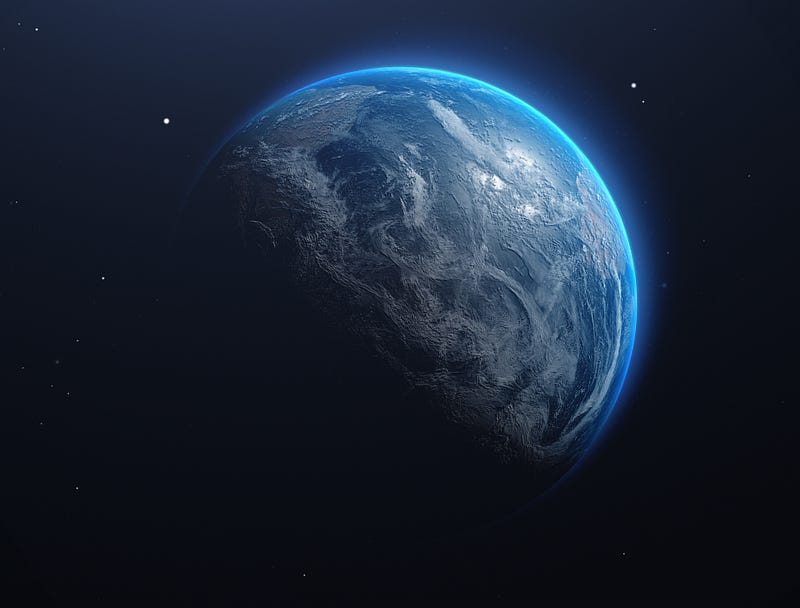
Photo by Javier Miranda on Unsplash

This is why global warming is an issue you cannot ignore

Humans living on a Blue Planet

Humans Dreaming Blue Dreams

— Dreaming of Blue Ice

Melting Blue Water

Humans Living under Blue Skies

Dreaming of a Blue Future

— Blue Insights

We live on a blue planet where humans have lived for hundreds of thousands of years. There have been changes, there have been periods of ice age, periods of strong heat, and now we are clearly in something completely new — a long period of increasing global warming.

What is so special about this? According to what science has found out and documented, what is happening now with global warming is very special. The climate crisis and its consequences can lead to conditions that in large parts of the world are not to live with.

The amount of carbon dioxide in the atmosphere around the globe has been stable below a certain level for the last 600,000–700,000 years. Around the middle of the last century, something dramatic happened. Around 1950, the curve that shows the amount of carbon dioxide in the atmosphere changes dramatically. We see a steep climb.
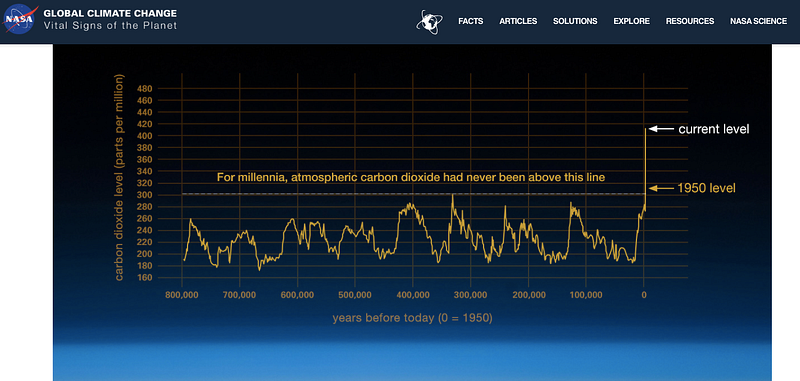
Source: https://climate.nasa.gov/evidence/

Earth’s climate has changed throughout history. Just in the last 650,000 years there have been seven cycles of glacial advance and retreat, with the abrupt end of the last ice age about 11,700 years ago marking the beginning of the modern climate era — and of human civilization. Most of these climate changes are attributed to very small variations in Earth’s orbit that change the amount of solar energy our planet receives.

The current warming trend is of particular significance because it is unequivocally the result of human activity since the mid-20th century and proceeding at a rate that is unprecedented over millennia.1

It is undeniable that human activities have warmed the atmosphere, ocean, and land and that widespread and rapid changes in the atmosphere, ocean, cryosphere, and biosphere have occurred.

Earth-orbiting satellites and other technological advances have enabled scientists to see the big picture, collecting many different types of information about our planet and its climate on a global scale. This body of data, collected over many years, reveals the signals of a changing climate.

The heat-trapping nature of carbon dioxide and other gases was demonstrated in the mid-19th century. 2

Their ability to affect the transfer of infrared energy through the atmosphere is the scientific basis of many instruments flown by NASA. There is no question that increased levels of greenhouse gases must cause Earth to warm in response.

Ice cores drawn from Greenland, Antarctica, and tropical mountain glaciers show that Earth’s climate responds to changes in greenhouse gas levels. Ancient evidence can also be found in tree rings, ocean sediments, coral reefs, and layers of sedimentary rocks. This ancient, or paleoclimate, evidence reveals that current warming is occurring roughly ten times faster than the average rate of ice-age-recovery warming. Carbon dioxide from human activity is increasing more than 250 times faster than it did from natural sources after the last Ice Age. 3

The Intergovernmental Panel on Climate Change (IPCC), which includes more than 1,300 scientists from the United States and other countries, forecasts a temperature rise of 2.5 to 10 degrees Fahrenheit over the next century.

Source: https://climate.nasa.gov/evidence/
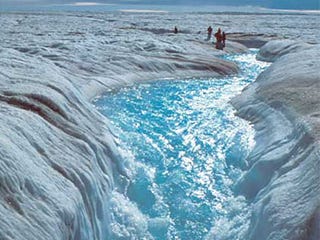
Image: Flowing meltwater from the Greenland ice sheet Credit: NASA

We live on a blue planet where humans have lived for hundreds of thousands of years. There have been changes, there have been periods of ice age, periods of strong heat, and now we are clearly in something completely new — a long period of increasing global warming.

What is so special about this? According to what science has found out and documented, what is happening now with global warming is very special. The climate crisis and its consequences can lead to conditions that in large parts of the world are not to live with.

The amount of carbon dioxide in the atmosphere around the globe has been stable below a certain level for the last 600,000–700,000 years. Around the middle of the last century, something dramatic happened. Around 1950, the curve showing the amount of carbon dioxide in the atmosphere indicates a steep rise.

“The last decade is quite likely the hottest the planet has been in 125,000 years.” The New York Times

The brutal truth is that there is now a global warming that may seem unstoppable. Global warming is happening today, and global warming is going to continue. The only question is how much the temperature will rise.

The room for maneuver that man on earth has revolves around how much or how little the global temperature will rise. This depends in part on what humans do with the problem over the next 10 to 20 years.

Over the last century, the average surface temperature of the Earth has increased by about 0.55 degrees Celsius.

This global warming may, at worst, rise to three, four or even 5.5 degrees over the next hundred years.

We can ask: “Is it so bad? 3 ° or 4 ° Celsius temperature increase is not so much”, we can think.

But it’s actually a lot. Three or four degrees of temperature rise will mean that large parts of the planet in the belt around the equator and north and south will become uninhabitable.

This also means that there will be great unrest globally, with, among other things, large mass migrations of people fleeing the unbearable heat.

It is also unfortunately likely that new wars will break out and that large groups of people will stand against each other in the struggle to have control over livable land and resources in the north and south.

When Putin began bombing Ukraine, he also attacked one of the world’s most important food producers. Ukraine is a major producer of wheat, and the country accounts for 13 percent of world corn exports. We can look at the Russian war of aggression against Ukraine as a result of Russia / Putin’s desire to gain control of the rich wheat fields in Ukraine.

In the future, millions of people will be forced into something as terrible as a life-and-death struggle to survive.

We can already see a foretaste of this on the Indian subcontinent. There they experience heat waves up to 50 ° C, and it is at the limit of what humans can tolerate. In India, they are living under strong pressure from global warming, but they are holding out for the time being.

Our challenges

To meet these enormous challenges, all people on earth need their own action plan: How can the individual best contribute to reduced increased warming?

It’s about facts

— hard facts

— tons of clear facts that we cannot ignore

What is the climate crisis?

How will global warming affect different parts of the world?

How will 1, 2, 3 or 4 degrees Celsius global warming over the next 50–60 years be expressed?

What will be the concrete consequences for humans in the equatorial belt, in temperate zones, and in other habitable areas in the north and south of the earth?

How can we as individuals and together with others in our environment contribute to reduced global warming?

What kind of conflicts between groups of people must we be on guard against and prevent?

How should we expose and combat misinformation and untruths about the climate crisis?

How are we to reveal and take influence from conspiracy theories?

How will we be able to combat the rise of fascism, which unfortunately is also a fairly inevitable consequence of the climate crisis?

Share if you like!

— Want to know more?

Listen to

Top Economist umair haque @umairh chats with veteran broadcaster Anthony Davis about America’s Mass shooting crisis, American Exceptionalism, and why climate change is the number one issue facing humanity today. #TheWeekendShow

or read umair haque’s essay:

Øivind H. Solheim — Norwegian author and nature photographer. Writes in Norwegian and in English: novels, short stories, creative short prose, poems, essays, and articles. Has since 2017, published stories on medium.com. He has published six novels, two non-fiction books, and a collection of poems.

Visit Øivind H. Solheim’s profile

You can become a paying member of Medium and support the author Øivind H. Solheim with referred membership. Your membership fee ($ 5.00 / month) directly supports Øivind H. Solheim and other writers on Medium. You will also have full access to all the content on Medium. https://oivind47.medium.com/membership

Humanity
Life
Climate Change
Global Warming
Blue Insights
Recommended from ReadMedium