
The Best Possible Video Game For THE FLASH Already Hit The Indie Best-Seller List
Only one game has broken through the speed force since 2008
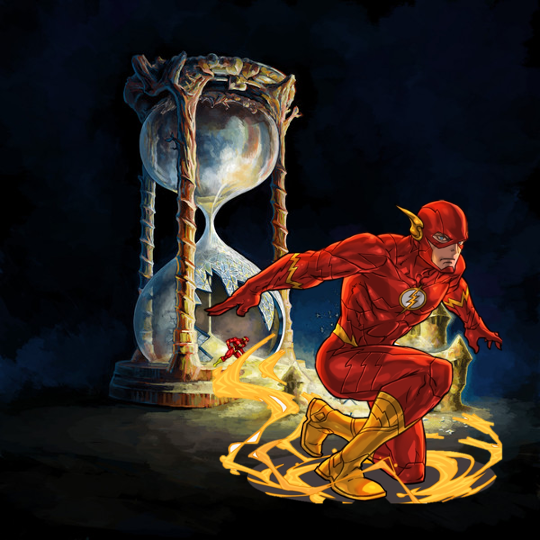
Side-scrolling adventure platform games hooked me with Mario and sorta went somewhere else as soon as 3D entered the mix. Gamers like me went along for the ride because those were the only games in town. It took indie game developers to bring us back to what hooked so many of us into playing in the first place.
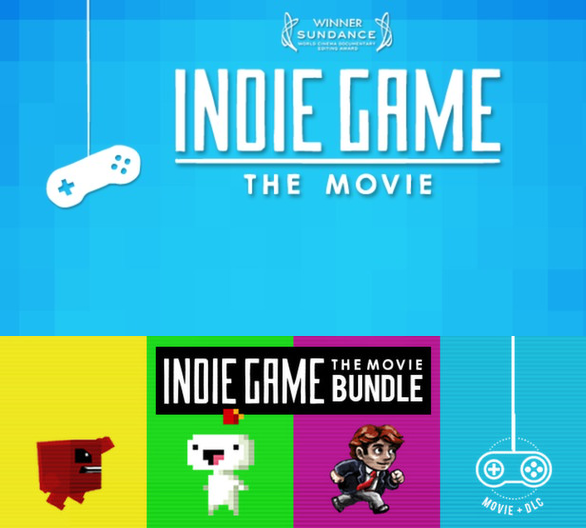
Super Meat Boy, Fez, and Braid stand out among any game you put them up against. They might not be to your taste — they probably are — but it’s Braid in particular that needs a few minutes of our time.
Braid is the key to us finally getting a video game for The Flash. It’s not as though studios haven’t tried before. And we’ve gone along for the ride because, like with Mario turning 64, most gamers had no better options.
We’ve seen the Flash in all sorts of games, but almost never one where he’s the lead, and even rarer still to get a game that makes us FEEL like the Flash. The closest we’ve ever come is maybe the very best Sonic the Hedgehog games, and maybe a game like that would be fun, but Sonic and Tales aren’t exactly going to send you into an existential crisis.
But playing Braid?
Braid is almost guaranteed to send you into an existential crisis.
BRAID
I’m going to walk you through how the game provides the foundation for the perfect video game for the Flash. But first…nothing beats the game designer’s own pitch (offsite to YouTube and below).
What’s Your Super Power? Besides Being Rich
Other DC heroes have found incredible innovations to bring us into the experience of being those superheroes until our thumbs give out. But for a video game about the Flash, it’s not enough to take the world design and mechanics of Arkham City and transfer them to Central City. The Flash is not Batman. As Degenerate Jay points out in his video (offsite YouTube) why it’s so hard to make a good video game for the Flash, Batman is ultimately a mere mortal. You shoot him, he dies.
A superhero like the Flash, however, has a wide array of powers that make him a kind of god. Depending on the writer, the Flash is nearly immortal. He moves faster than Superman (bet), he heals faster than Wolverine, he can travel through time, he can sorta make clones of himself by creating something called a time remnant…
Video game designers continue to face this same kind of problem designing a game for Superman. How does a character who doesn’t face mortal obstacles face a challenge humans will relate to? That humans will WANT to relate to?
What’s the payoff to living and breathing as this character?
And what hooks players into getting there no matter how much TIME it takes?
The Best Stories Have HEART
The best stories about the Flash — just as the best stories about Superman — invert the very expectations the audience has for why stories about gods among men aren’t interesting. For movies like Man of Steel and Justice League, audiences show up to see gods punch each other, to reign destruction, to destroy the city. But that’s voyeurism, not empathy.
(I’m extremely afraid of you if you empathize with breaking necks and destroying cities in the name of anything lol. What’s next? You’ll scream Martha instead of saying you’re sorry?!)
The challenge isn’t in who has the strongest powers. It’s in figuring out what to do with those powers. It’s in determining how to manifest the things that matter most to that character. That person.
And nothing ever mattered more to Barry Allen than going back in time to save the people he loves.
But as the comics, the TV show, and the upcoming movie have made clear, messing with the timeline always has unforeseen consequences. Most of them disastrous. And it’s in this exponentially disastrous (and thus immersive) game design that Braid shows us how to finally make a Flash game that will stand the test of time.
The Flash: Braidpoint
[Braid] features traditionally defining aspects of the platform genre while also integrating various novel powers of time-manipulation. Using these abilities, the player progresses through the game by finding and assembling jigsaw puzzle pieces. — Wikipedia (sourced 4/30/22)
For me, I couldn’t help but remember one other game that didn’t just reward players for revisiting old obstacles, old locations, old enemies. Winning the game required you to do so.
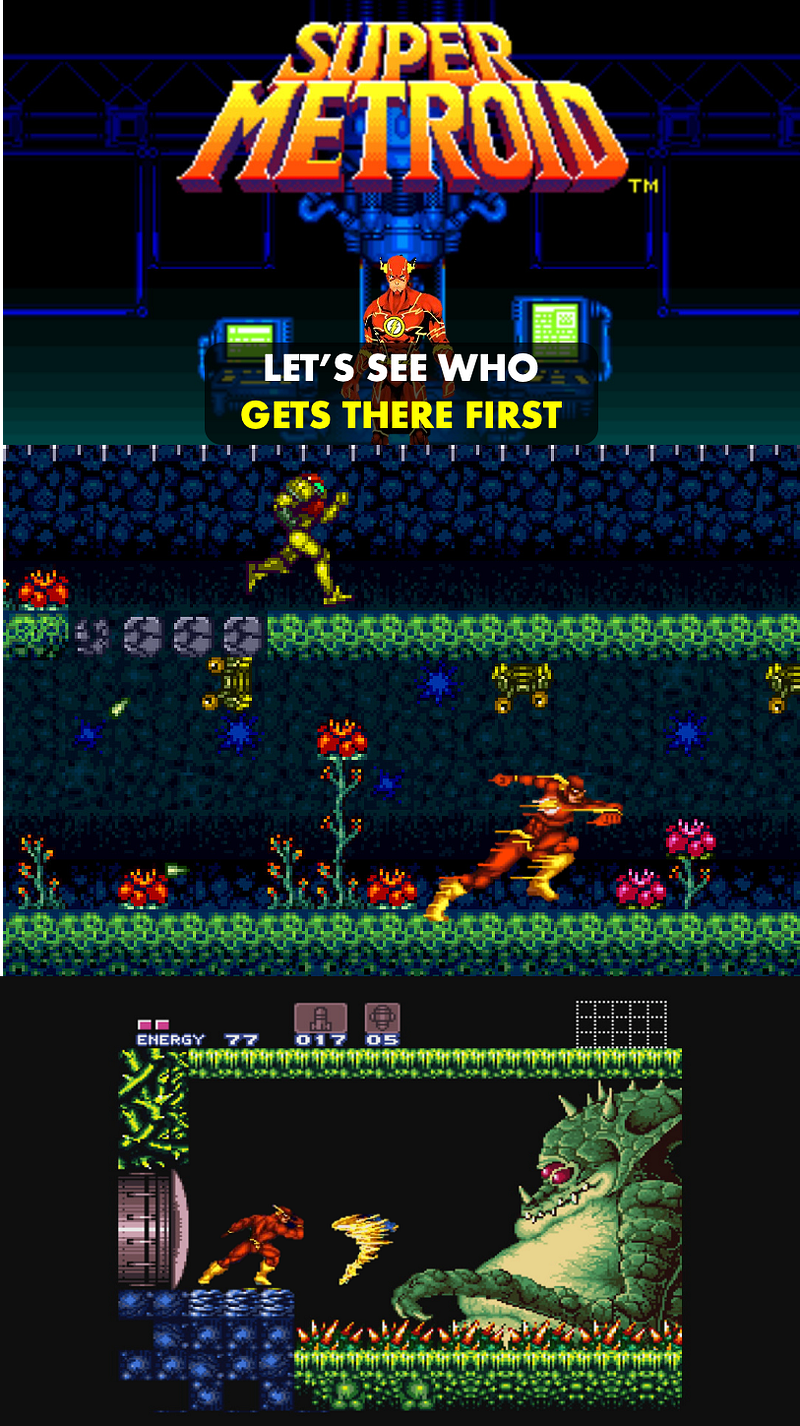
While I think you could easily start off a game for the Flash with our hero already having all of their powers, I would start off with Barry early in his role.
The player has certain abilities already, but their powers are more in scale with a character like Mario. A little above human, able to jump a little higher, run a little faster, but it takes a tragedy as unpredictable as a lightning strike to ignite Barry’s potential for more.
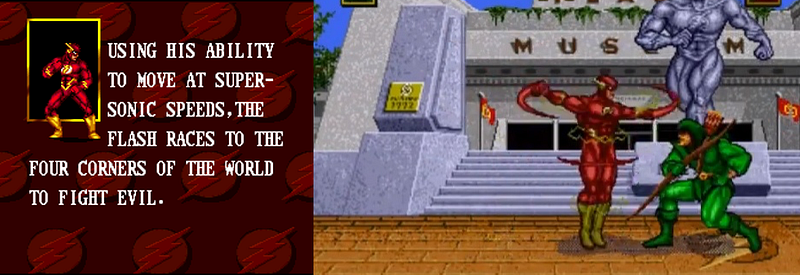
FLASHPOINT BEGINS THE GAME
After facing a devastating loss, we chase down an enemy who disappears first through walls — then through time.
As fun as it was merely racing around the neighborhood with the supersonic speed of a hedgehog, we now need to learn how to use the Flash’s powers as well as develop the ability to use them.
Once you develop each new ability, you can go into previously unexplored parts of the world, such as when you learn how to phase shift through objects/walls.
Players may already be familiar with this mechanic from Super Metroid. Braid shows us how to take it to a new level altogether.
A defining game element is the player’s unlimited ability to reverse time and “rewind” actions, even after dying. The game is divided into six worlds, which are experienced sequentially and can be entered from different rooms of Tim’s house; the player can return to any world previously visited to attempt to solve puzzles they missed. — Wikipedia (sourced 4/30/22)
THE GAMEPLAY IN ACTION
Here is a fascinating look at a brief stage of the game illustrating the “rewind” mechanic. What fascinates me more than anything isn’t just that the rewind mechanic plays a vital function in solving this puzzle.
It’s that patience is a vital component to the solution. Without it, the solution would just…pass you by. In the below portion of the game, it’s only when the player sits in frustration that they see running forward as fast as you can isn’t always how to beat the game.
The Flash and Braid might have a god-like ability, but they are still functioning with a human mind. They still have to look around them, put the pieces together, solve the puzzles.
You can defeat the Flash as long as you can outsmart him. It doesn’t matter if he has all the time in the world if he can’t figure out what to do.
WITH GREATER POWERS COME GREATER COMPLICATIONS
As the game progresses and the character grows in their powers, obstacles they face will grow in complexity.
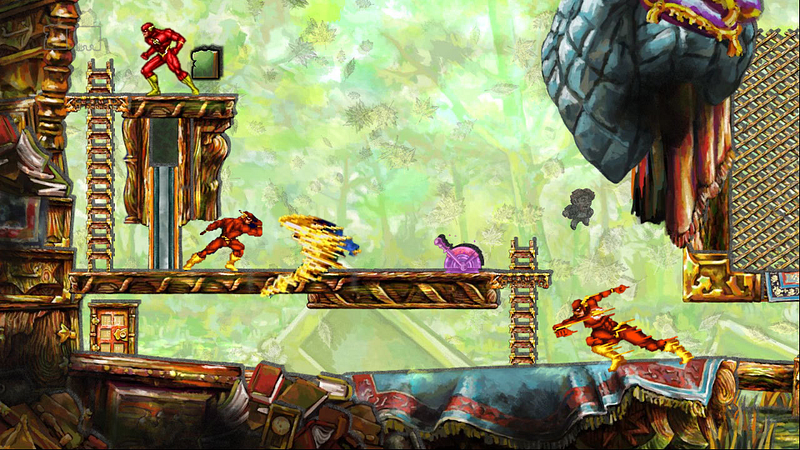
GAME MECHANIC
Time and Place links the passage of time to the player character’s location on the horizontal axis. As the player moves toward the right, time flows forward, while moving toward the left reverses the flow; standing still or moving vertically will pause time. The player’s location must be carefully managed in relation to enemies and objects. — Wikipedia (sourced 4/30/22)
GAME MECHANIC
Hesitance provides the player with a magic ring which, when dropped, warps the flow of time around itself; the closer moving objects (including Tim) are to it, the slower time passes for them. The regular rewind control remains available. — Wikipedia (sourced 4/30/22)
SIDE GAME
Perhaps there could be bonus levels where you first play through the level as Old Batman/Michael Keaton? He says, “It’s gonna take me a second to figure this out.”
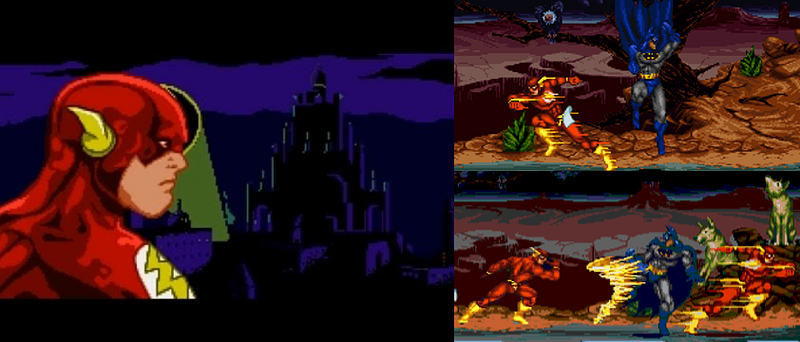
But then Flash rewinds time and replays the level — with Batman as one of the characters he needs to move around and avoid being seen by. The Flash needs to alter how the level plays out in a way the player first discovers through Old Batman’s POV.
This could lead to some pretty funny gags with Batman that allow him to play it completely straight in the VO dialogue. It’s sort of like Tommy Lee Jones. The reason it’s funny is because he refuses to participate in the joke.
The gags, of course, are just a distraction.
There was always going to be a final confrontation.
Given enough time, there always is.
Given enough time, we see that the greatest enemy we need to face is the one we wake up to in ourselves.
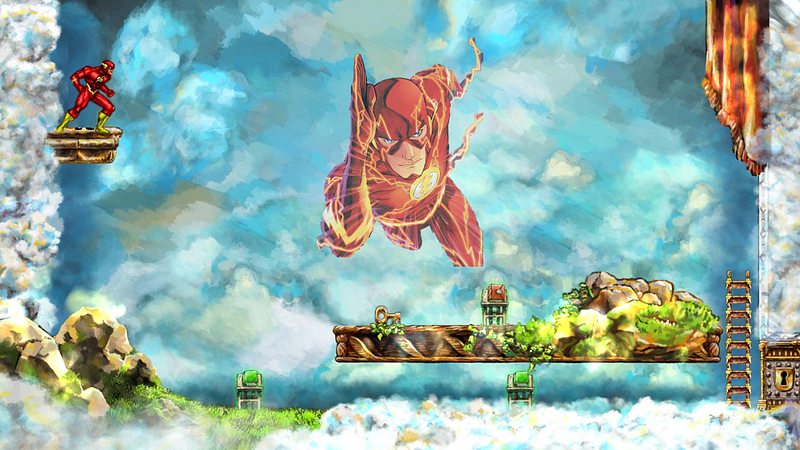
THE BIG BAD AT THE BEGINNING IS THE BIG BAD AT THE END
Time and Mystery introduces objects surrounded by a green glow that are unaffected by time manipulation; for example, switches will remain flipped even if time is rewound to before the action occurred. Rewinding can thus be used to change the synchronization between objects that can and cannot be rewound, the basis of many puzzles in this section. This theme is also used in later worlds to denote objects unaffected by the player’s time manipulation. — Wikipedia (sourced 4/30/22)
It would be AWESOME to have objects affected by a RED glow instead of a YELLOW glow. These objects are unable to be affected by time manipulation. We find out that the person behind this…is Reverse Flash.
Braid already developed a mechanic for that, too.
Time and Decision involves a “shadow” of the player character appearing after the player rewinds time and performing the actions that the real player character rewound; if the timeline expires, the shadow will complete any initiated falls and jumps but will otherwise stand still before disappearing. Things coloured in violet can interact both with the main character and his shadow at the same time. Puzzles in this section revolve around using this mechanic to carry out multiple actions at once. — Wikipedia (sourced 4/30/22)
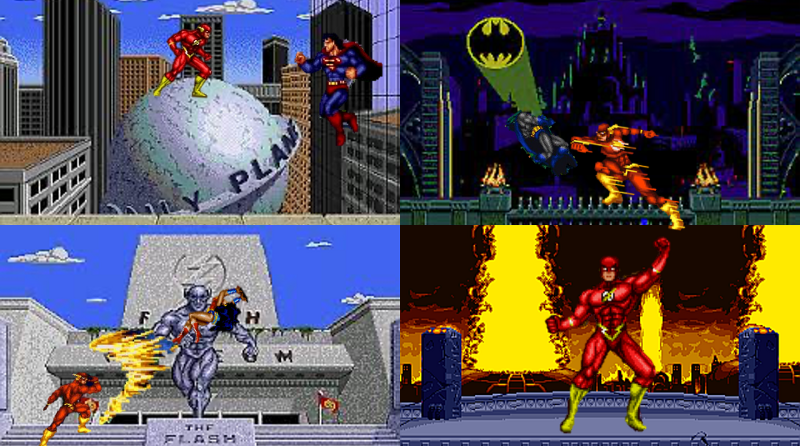
Setting Things Back To Right
The final world [in Braid] is labeled simply “1.” In this world, time flows in reverse. Rewinding time returns the flow of time to its normal state. — Wikipedia (sourced 4/30/22)
This would make a GREAT final stage for our new video game for the Flash.
The Flash thinks he has fixed things, but when he tries to return to the present, something has changed. Something has flipped. The world has reversed.
Or rather…HE has reversed.
Time is flowing in the right direction, but he has turned into a Reverse Time Flash.
You can reverse the game and play again, but running forward to repair your connection to the flow of time — to face whatever the present brings and what you bring to face it — means you must run so fast into the speed force that Transgender Soapbox will lose sight of you.
We won’t know what happens unless you return to tell us.
But Once You Do
At the end of the game, you discover that even if you’d started with ALL of your powers (because you can now go rewind time so that you can), you would never have been able to end things differently. Your journey was always going to be to rewind time and let things happen exactly as they were supposed to happen.
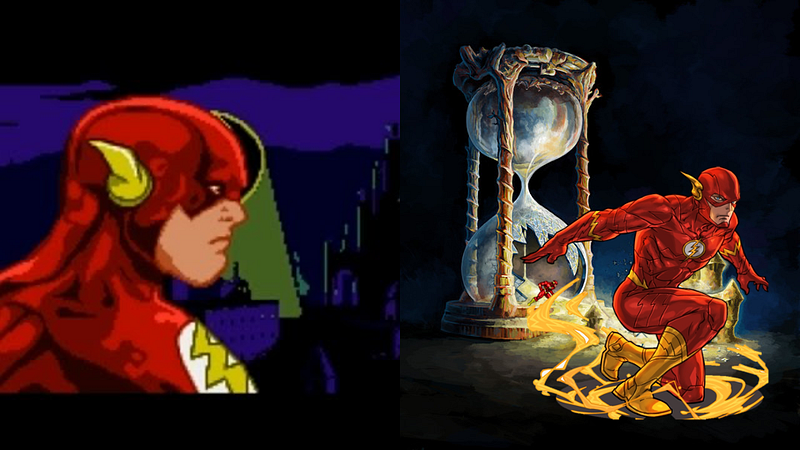
The problem, however, is that you’ve already been playing the game. You can’t undo that without undoing your entire existence. There is, instead, a paradox that allows you to set things right.
But only if you’re willing to confront yourself.
The final stage forces the player to rewind the game ALL the way to the beginning. You find out that everything you experienced and rewound to change in order to progress and make things PERFECT so you could move forward to do everything you always wanted to do — the only way to accomplish what you really wanted to do is to go back to the beginning and stop yourself from trying to alter time in the first place.
So you lead Barry back to the moment that started the game — the one that motivated Flash to go back in time and create Flashpoint — and this time you both allow that moment to play out. To see what happens next. To process the grief and find the acceptance it brings.
So much of our lives is beyond our control. So much is best let go even if it was within our power to change it.
But where to find the balance? What involvement is right for this hero? What do they let go of? How do you know what’s right for you?
In recovery circles, we have a tweaked version of the serenity prayer. It’s the one that guides me to the way I’d like to end the video game (and this article).
Oh mighty Speed Force, grant me the Serenity to accept the timelines I cannot change, the Courage to change the one I can, and the Wisdom to know none of them can be. Not even mine.
As the man in that special episode of Euphoria said, you have to lean into the poetry of it all.
Or rather…run into the poetry, Barry. RUN.
POST-ARTICLE COMMENTARY
It’s been a long time since 2008.
Has it been long enough to repackage Braid? I don’t mean erase it from existence. Just treat it like Super Mario Bros 2 treated Doki Doki Panic. Leave virtually everything in the game exactly as it already is. All you need to change are the sprites.
Maybe change the background wallpaper, the sprites for the enemies, the storyline so that it fits Flashpoint at least a little.
But I don’t think even that much is necessary. Some wizard savant will be along to replace the sprites in a ROMhack to rival all ROMhacks.
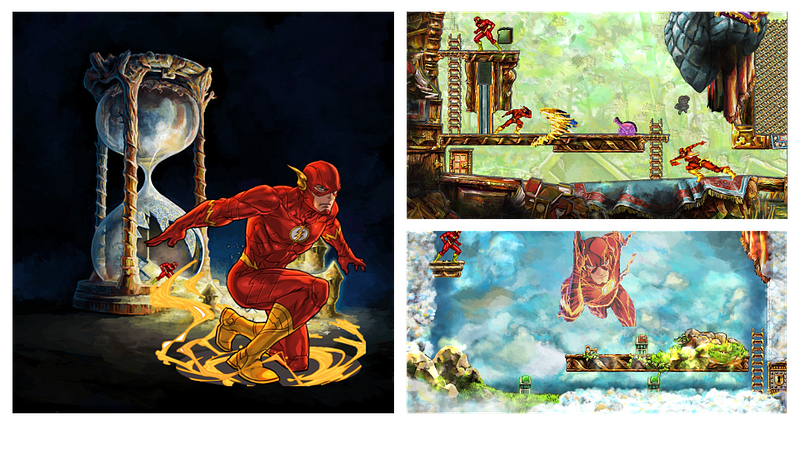
Until then, you’re familiar with the multiverse, aren’t you? In one episode of the Flash on the CW, one variant of the Flash discovers other versions of himself are much older. Much younger. Some of them don’t even have the same name.
In one of those alternate realities — a deleted scene — the speed force let Barry pause long enough to see Jonathan Blow, his best-selling indie game Braid, and how perfectly that game illustrates the experience of being the Flash.
The feeling of recognition in his heart said it wasn’t just deja vu. In a multiverse where all things are possible and all things have happened, this was a different version of himself.
It’s not just a representation. It’s not just an illustration.
In this universe, Braid is already the perfect video game for the Flash.
In this universe, Braid isn’t FOR the Flash.
That’s who Braid already is.
BUY BRAID ON STEAM (offsite)
ADDITIONAL READING
FOR MORE ON TIME TRAVEL The Way Things Were (a visit to the past to meet my former self) By Amanda Roman
EGG_IRL By Cassie LaBelle
FOR MORE ON RE-SKINNING AN EXISTING GAME FOR ANOTHER FRANCHISE
Check out Oscar’s article on how to re-skin the game Spectaculars to reshape the Marvel Multiverse into a great game
ADDITIONAL VIEWING
Braid: Time Means Nothing (YouTube)
AND NOW FOR…
SOMETHING FUN: Why THE VILLAGE (2004) is M Night Shyamalan’s Only True Horror Movie (Stephenie Magister)
SOMETHING SERIOUS: What Do I Do Now That The World Didn’t End? (…yet) (Stephenie Magister)
THE END (DAMN GIRL, THAT’S DARK)
Stephenie Magister is a transgender author, teacher, writing coach, business owner, and mother of one daughter in college (with three fur babies at home). Her work has been featured in Writer’s Digest, Script Magazine, and ScreenRant (offsite links). She uses her ten plus years of experience to empower diversity throughout media. She has served as a managing editor for magazines, an acquiring and developmental editor for USA Today best-selling and award-winning authors, and as a general media consultant helping storytellers in all formats find their voice and monetize their brand. She continues to run Stephenie Edits, serves as an editor for Impacting Millions and Inkers Con, and manages her Medium columns for Transgender Soapbox, Dear Cisters, and random quizzes to tell you what your favorite Mario Power Up says about your personality type.


