
The 4 Interconnected Reasons Why Humanity Cannot Solve Climate Change
The stage has woken up
Humankind once resided firmly and irresistibly within nature. Our existence ebbed and flowed to the heartbeat of the natural world and we were forever at the mercy of its wiles and whims. Predation, starvation, the might of the elements, brutalisation at the hands of our fellow humans, and an endless list of cruel and excruciating diseases — these were our constant companions from the very moment we were born right up until we drew our last breath.
Much like the life of a child is wholly cocooned within that of its parents for its first years, humanity was wholly and hopelessly subsumed within a world whose forces and dictates we could little comprehend and barely resist.
As we progressed things began to change.
We learned how to use tools and manipulate the world around us, and, with time, our mastery came to be ever more impressive. In tandem, our knowledge and understanding of our environment grew ever deeper and more comprehensive. These processes were inextricably entwined with our ability to communicate and the social structures we lived in; both of which became ever more complex and sophisticated.
At a certain point, such was our mastery over Mother Nature, such was our skill at putting so much of the natural order of things in abeyance, that we stepped out of this world and into the human world, so to speak. Now we had one foot in nature and one foot in a world of our own making. Sure, certain limits and immutables still applied, but a great deal had been pushed back to a safe distance.
The epic tale of humanity, written by us and told to us, now swallowed the totality of life on our planet, with the human animal as a demi-god striding across the stage of nature, bending, breaking, utilising and reshaping all that formerly stood to constrain his cosmic destiny.
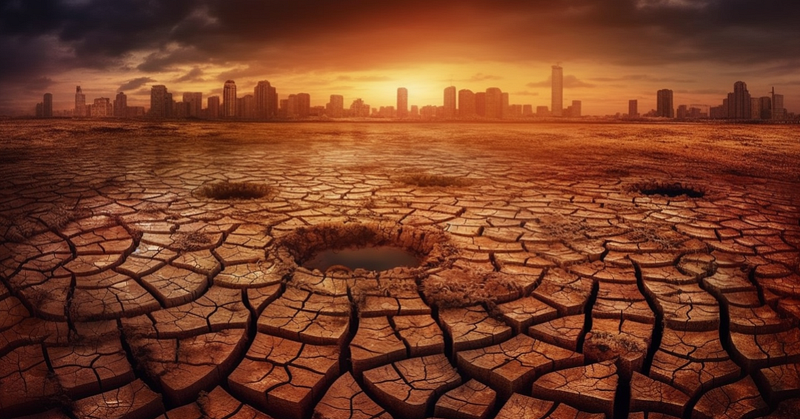
The climate catastrophe is the obliteration of this presumption of passivity. Climate change is the stage waking up to again claim its role as the central actor in the play of existence.
This was the zenith of the Age of Anthropocene and its central presumption was that nature is essentially static and could not but bend to the will of a species that had stepped beyond all others to look its maker in the eye. Nature was a thing to be acted upon, a substrate to be used and utilised, and an object to be chopped up, rearranged and pushed around.
The climate catastrophe is the obliteration of this presumption of passivity. Climate change is the stage waking up to again claim its role as the central actor in the play of existence. The rise of our species has seen the advent of great knowledge, great power, great technology and great progress. Its central myth, however, that nature could be conquered and placed in service to humanity as a thing of utility, is a dangerous and futile impossibility, whose vanity has been put to the sword by a planet that has begun to react to human activity.
And if the myth of the Age of Anthropocene, to tame nature and place it in servitude to man, is deliquescing before our very eyes, can we take the good of the human world and bring it back in line with the laws and limits of the planet we live on?
I would answer this in the negative for these 4 interconnected reasons.
(A belated shout-out to Bruce Coulter and Randy Pulley who inspired me to finally write an article on climate change; you can read them ponder this biggest of all questions here and here. Cheers lads).
1. Economic-political
The difference between the rich and the non-rich has been growing steadily since the 1970s in the US, with inequality off the charts for the western world in general. Such disparities have become so ridiculous that the 1% now has its own 1%, which is best attested to by the mind-boggling fact that 8 men possess the same wealth as the poorest half of humankind.
CEO pay has gone stratospheric over the last seventy years whilst average folks have barely seen their wages budge in real terms since the 1960s.
Home ownership among younger generations is also steadily dropping from the US to Europe to Australia whilst ever greater debts continue to pile up, with the United States recently reaching $17 trillion for the debt burden of its citizens.
In short, the rich are getting richer, the poor are getting poorer, the middle class is being hollowed out and the whole of society is being stretched.
Socialism for the wealthy, the demise of unions, political corruption, massive-scale lobbying and the almost messianic belief that the megarich should not be touched means that society continues to be dragged in the same direction; to the benefit of the few, to the detriment of the many.
This is the economic-political complex made up of big business and the politicians beholden to it. They have even come to believe that massive inequality is but a natural property of the world, something like gravity or evolution.
There is nothing natural or inevitable about it. This model of civilizational development, however, with its gods of wealth, production and consumption, and its all-encompassing mantra of more and more, is having rather quite a large effect on the planet we live on and its climate.
We are also complicit, in a manner of speaking, too. We love things, gadgets, possessions, the newest this, the best that, and always more and more. This fetishisation of commodities has been conditioned, but may also be innate to some extent.
Our present model of free-market capitalism is having a devastating impact on the environment. This is the cause of climate change.
To change course, the powers that be and general public must be sufficiently motivated. Politicians and business elites must be shocked from their slumber and made mightily afraid in order to break the spell that greed has over them.
We should be very afraid which means we should be very motivated. The reason we’re not is our next factor.
2. Cognitive-perceptual
Homo sapiens live relentlessly in the present. When the sun shines on a glorious day, it is hard for us to imagine storm clouds and rain. When all is swallowed by ominous skies and darkness, it is hard for us to fathom that soon that erstwhile glory will return.
We know a great many things about the world, but this knowledge does not always permeate the entirety of our being to establish itself as an absolute truth. We do not feel the future with sufficient tactility for it to entrench itself in our reality.
We can foresee a lot about the future, what will happen and what is likely to happen. The rational part of our brain is perfectly aware that what the vast majority of scientists say is going to happen to the Earth’s climate will come to pass.
However, the irrational part doesn’t care much for as-of-yet-non-existent metaphysical realities and, taking care of 95% of our lives, this is the part in the driving seat, unfortunately. Until the subconscious mind gets blasted with what our planet is going to throw at us in the present, it really doesn’t matter how much we know, we will not act like the world is on fire.
To really feel the future as a species of the present, it may necessitate a far greater intelligence than that possessed by the human animal. When seeking to adopt the right level of fear and alarm at the looming spectre of climate change, we come up against the limitations of our own minds. It really doesn’t matter if you’re a scientist or a politician or a billionaire or any member of the public, we are blighted with the same barrier. The only way we really embrace the future is when the future becomes the present and that will be simply too late.
Our perennial prejudice in favour of the here and now is demonstrated by the present bias. People will very often accept less now instead of more later. This sort of proclivity makes sense in a chaotic and uncertain world because there are few guarantees that later will make good on its promise. However, apropos the impending climate catastrophe, this intrinsic human tendency is a fatal weakness.
There is an additional component to our mode of thinking, which is that we tend to use the past to map the future.
Human thought is contiguous in that we don’t perceive past and present events in isolation, but instead connect all the dots together to create patterns which help us understand our reality and divine what’s going to happen in the future. This is a wonderful skill which makes us inordinately prepared when things go according to plan and pattern. And luckily, mostly things do unfurl as we expect them to.
At the same time, this very skill lulls us into a fall sense of security and makes us inordinately unprepared when things don’t go according to our cognitive map. This makes us very vulnerable to black swans and sets us up for a fall when it comes to outliers — rapid climate change being the biggest fall imaginable.
This tendency in human thought is revealed by both the normalcy bias and the turkey illusion.
The former states that humans tend to, as a rule, underestimate and underprepare for crises and disasters.
Our situation is more tragic, for we are the turkey that knows all about Christmas but is powerless to do anything.
The latter uses the metaphor of the Christmas turkey. The turkey is well fed and well taken care of and naturally with every passing day it becomes ever more confident in its worldview. Right up until the day of its slaughter when its world is shattered.
Our situation is more tragic, for we are the turkey that knows all about Christmas but is powerless to do anything. Our house is on fire and we know all about the coming conflagration. Sadly, we just don’t feel the flames enough to do anything.
3. Socio-psychological
The notion of an individual self-conscious inhered with autonomy, a moral conscience and the right to make its own choices is an exceedingly powerful idea and one that underpins many societies around the world. This concept of the individual did not come naturally to us, however, and had to be invented.
In actuality, ours is a story of the group, and we owe our success to just how well we work and communicate with one another. As individuals, we are extremely underwhelming and would not survive long under most conditions. As individuals, we also doubtless would never have developed any of the facets of higher intelligence that are our quintessence— sophisticated language, complex systems of thought, wonderous problem-solving skills, mastery over much in our environment. Together we have become, by far, the most successful multicellular creature on our planet.
This social nature engenders a number of propensities.
The first is that humans follow social norms and mores far more than they don’t. For group life to have stability, strength, cohesion and really make any sense, we need to be built this way.
Tigers aren’t built this way. Tigers are ultra-aggressive with each other almost always, apart from when female tigers raise their cubs. Tiger society, were it to exist, would rip itself apart the very moment it was born.
Of course we have our iconoclasts, our rule-breakers and revolutionaries. Interestingly, it may take from just 3.5% to 25% of the population to precipitate massive social change. These are invariably in the minority though.
What this inclination towards following rules and norms means for climate change is that, along with the cognitive-perceptual difficulties we experience attempting to feel the future with any urgency, we have yet another limiting factor to action and change.
The majority will have to be cattle-prodded from below by revolutionary and radical movements or shepherded in the right direction by virtue of enough politicians finally seeing the light and being motivated to smash the status quo. I hold almost no hope for the latter; for the former, it remains to be seen how this will take shape.
On top of this social dimension, we also have a psychological component. This is the will to social recognition, the need to be respected, the desire for praise, acclaim and acceptance.
The Ancient Greeks called this thymos (the concept is broad with many interpretations and implications) and it relates to our innate self-worth, sense of justice and dignity. The thymos can cause us to feel huge outrage at life’s injustices, but often it makes us want to succeed and be recognised in society more than it makes us want to question the flaws and failings of society.
We see evidence of this psychological phenomenon in closed institutions such as the army where soldiers will shut their mouths, close their eyes and put up with a great deal of abuse because they identify with the values of the institution and seek the respect and acceptance of their superiors. The same can be said for Hollywood, the Catholic Church, the vast majority of popular sports, and even in the most abominable events in history, such as the Holocaust.
Here, yet again, we see the very human nature that has made us so wildly successful becoming an intractable hurdle towards change when we need change most of all.
4. Scale and structure
There is an additional element that makes changing society eminently difficult. This is the sheer scale and structural complexity of our social arrangements.
The scale and complexity of even one country make the introduction of essential changes extremely piecemeal.
Eric Hobsbawm, the esteemed British historian, claimed, based on consumption rates, that the living conditions of workers didn’t rise from 1790–1840 during the Industrial Revolution and may have actually deteriorated in Britain.
Yet, trade unions were only legally established in 1867 and the NHS was founded in 1948. This helps to illustrate that essential social and institutional safeguards, in general and following periods of tectonic change, take a long time to be brought in. And once again, this is just one country/union of countries.
Further evidence of this is the history of the seatbelt.
Despite being invented in the 1880s, with the three-point seatbelt being invented in 1958, American states only started making them mandatory to wear in the 1980s and 90s. Even with research in the forties and fifties proving the efficacy of seatbelts, the automobile lobby and private citizens (which is redolent of facemasks and vaccines) resisted the introduction of something that was going to save lives and make society better.
And we are looking at single societies here. Imagine how difficult it will be to achieve any consensus among 200-odd countries which diverge dramatically in terms of cultural values, worldview and levels of economic development? And imagine just how long it would take for them to enshrine this consensus in a binding document and then implement that document, were they to reach any agreement in the first place?
I think of such an undertaking and see Sisyphus pushing a boulder up a hill.
Last thoughts
There are of course many more factors at play than those adumbrated above. Moreover, every factor could be written about ad infinitum. Regardless, these are my reasons for why humanity is unlikely to come to terms with climate change before it’s too late.


