
The Twin Faces of Freedom
A brief discussion of liberalism
Liberalism is one of those most elastic of words, like happiness or goodness, which really means what the speaker wants it to mean at the time of saying it.
It is inextricably entwined with freedom, but freedom is an even trickier customer to pin down.
We can view the concept from opposing angles. We may see it as freedom “from” something, on the one hand, or as freedom “to do” something, on the other. This “from something” or “to do something” will then give colour to the content.
We may think of liberalism in terms of politics and focus on fundamental rights in the Anglo-American tradition — the presence of protections in essence.
Or, we may take an economic bent and think of the free market, free trade, and laissez-faire economics — the absence of restrictions.
In the continental tradition, freedom may be much more about self-realisation and freeing oneself from the notions which serve to chain one’s thinking. For the German idealist philosopher Georg Wilhelm Hegel for instance, freedom is the unfurling of higher expressions of consciousness as the contradictions that constrain the mind dissolve; something akin to the evolution of conscious being.
For these reasons and more, liberalism, as an ideology and philosophy, represents an extremely packed pond, teeming with an array of species and odd specimens that don’t often quite see eye to eye, to put it mildly.
There are classical liberals, progressive liberals, neoliberals, libertarians, social liberals, and many more.
Many of these are both liberal and illiberal at the very same time.
The word conservative is often antonymous apropos liberalism, yet the Conservative Party are the most liberal party in the U.K. in terms of economics.
The Republican Party in the U.S. are an even more extreme version of this seeming contradiction, with many Republicans being deeply conservative on social matters and wildly liberal on matters concerning the economy.
In the first half of the 1800s, the U.S. South vehemently opposed tariffs; an economically liberal position. Yet, it also opposed the abolition of slavery — the most abhorrently illiberal position one could imagine. What a terrifying collision of views and values could produce such a Frankensteinian devil as this?
One final illustration of the quandary we find ourselves in when trying to get a handle on matters is that those who are known in the U.K. as liberals, are almost the polar opposite of those who are known as liberals in the U.S.
Liberals in the U.K. seek a small state with limited government interference. They tend to oppose anything other than basic support for individuals but are in favour of support for big business. They are pro-free trade and typically socially conservative.
Liberals in the U.S. seek a larger state with significant government interference. They tend to espouse more wide-ranging support for individuals but oppose it for big business. They are pro-economic regulation and are socially progressive.
So, there you go — quite the quagmire.
Let us continue.
Democracy vs liberalism
It is likely that aspects of democracy come to many people’s minds when they think of liberalism — elections, voting, multiple parties, a competitive political marketplace, etc. This is quite natural as the two make for very good bedfellows and are almost always encountered together.
As with liberalism, democracy lacks any unanimously agreed-upon definition.
Those doing the defining tend to vacillate between narrow definitions that are easier to observe and operationalise and those that seek to cast their net wide to grasp the aspirational fullness of democracy. The former secures testability but lets slip from its grasp those less tangible elements which are doubtless paramount for a functioning democracy. The latter secures the broad “soul” of democracy but loses empirical tangibility in the process.
What we can say for sure is that democracy is definitely a system of government — free, fair, and frequent elections, open channels of information, universal suffrage, equality of voting, and strong rule of law to guarantee the preceding — and not an ideology or philosophy in and of itself.
In fact, democracy (rule by the people) without liberalism, would be mob rule (ochlocracy) for the very fact that whatever the majority voted for, would go. This is the fatal flaw of democracy.
Let’s take an example: if the majority wanted to vote for a party that proposed to burn every brown-eyed citizen in a purely democratic system, there would be nothing to technically circumvent such barbarism.
Why? No bill of rights, no inviolable protections, nothing to debar whatever madness the majority could dream up.
This intrinsic bias towards the majority is why countless thinkers throughout history, from Plato to Hamilton, have pilloried democracy as a system of government.
For democracy to come into its own, rights and basic protections for all citizens are required — this is where liberalism raises its multifarious head, to which we now return.
The two faces of liberalism — negative
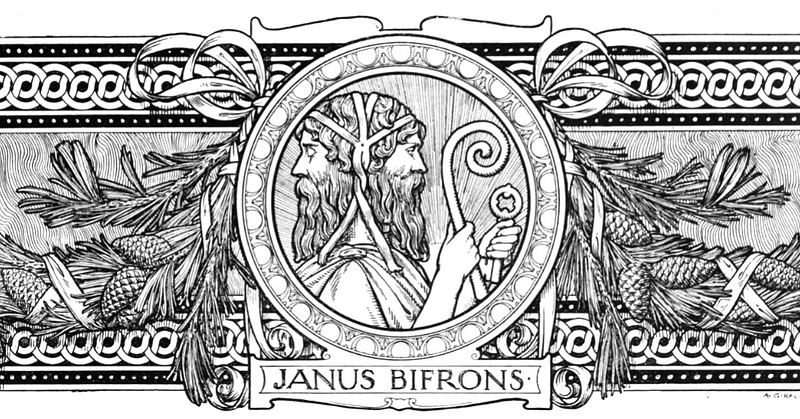
Just like Janus, liberalism has two faces — a positive and a negative. Let’s take a look at the negative first, which provides the sort of rights that prevent society from executing all its brown-eyed citizens.
History can be viewed as a struggle between the group and the individual, nonetheless, for most of history, no such notion of the individual existed — it had to be invented.
History can be viewed as a struggle between the group and the individual, nonetheless, for most of history, no such notion of the individual existed — it had to be invented.
We may look to Ancient Greece to anchor our ethico-political world, but despite the existence of Athenian democracy and the like, the notion of an individual moral self-consciousness with the right and agency to choose for itself was both alien and monstrous to the Ancient Greeks. This was why Socrates represented a threat of such enormity to their core values.
In actuality, the idea of the individual was grown over millennia, and its biggest growth spurt came with classical liberalism in the 18th and 19th centuries.
Classical liberalism is all about protecting the freedom and autonomy of the individual from the state, the church, and the tyranny of the majority. It does this by invoking the natural rights of all humans to form a “protective bubble” around each and every individual in society.
Henceforth a new moral order was to permeate society which proclaimed the existence of a certain set of unbreakable rights to be enjoyed by all citizens by virtue of their humanity. The state cannot take the life or property of its citizens, it cannot torture them, and it cannot tell them what to say or think or who to worship — this central core bound all to its dictates.
The fact that many of the Founding Fathers of the United States were slave owners contravenes a great many of the above tenets and illustrates just how little classical liberalism practised what it preached, nonetheless, these ideas were deeply transformative and are invaluable for the liberal order of today.
These sorts of rights are defined in the negative, hence why we talk about “negative” liberty and “negative” rights. Although, this reclassification of classical liberalism only appeared with the advent of positive liberalism.
Classical liberals see the tyranny of an untamed Leviathan as the single greatest threat to the individual. However, they also recognise that nothing other than a tamed leviathan can guarantee rights, law and order, national security, education, and the basic requirements of a laissez-faire economy. Accordingly, a good state should be small and self-limiting in order to rid itself of itself with itself.
The two heads of liberalism — positive
Unfortunately, for purist classical/negative liberals and many species of libertarians, the technical and moral realities of making such a complex organism as a nation-state livable for most or even some of its inhabitants, whilst also protecting it from invasion, have necessitated the evolution of a far larger and far more interventionist state than they would desire.
Grand. What’s the point in all these great protections preventing others from stealing your stuff and burning down your house when you’ve got next to nothing in life? What’s the use of formal abstractions when you’re one hundred steps behind from the get-go? What’s the use in a state too small to function?
This is where positive liberalism has emerged to remedy the vast inequality and unevenness of life, both as a natural fact and as a consequence of market capitalism.
It does this by imposing a great many rules, regulations, and requirements on society, which means encroaching upon the protective bubble of citizens, often more on some than on others. The rationale and reason for this is that one needs to be free from a number of conditions — poverty, ignorance, sickness, pollution, and crime — for one’s freedom to have any real meaning.
Most tax systems across the Western World, the welfare state, health and safety, vaccines, and modern education — are all examples of positive liberty. They are designed, in theory, to ameliorate the sort of social and economic inequalities which may reasonably constrain an individual’s capacity for self-realisation and/or to facilitate the effective management of a state-level society.
If we take education as an example, no one has the right to force you or your kids into education according to negative liberty. However, if most people fought for this right, our societies would likely fall and everybody would be walking around lesser versions of themselves.
Luckily, most agree that a little force is both rational and justified because education provides people with invaluable skills and limits ignorance and joblessness (improving both individuals and society as a whole in the process).
In the same way, a decrease in ignorance is an increase in enlightenment and employability, a decrease in addiction is an increase in self-sufficiency and vitality, and a decrease in poverty is an increase in potential, mental potency, and whole plethora of other factors.
So, in terms of education, a little force equates to an increase in freedom because it leads to greater self-mastery and greater self-realisation. This is the logic of positive freedom and it can be approximately equated to dieting and going to the gym for the very fact that the logic is inversely proportional: as a person loses weight and gets fitter, they not only lose weight but gain health, strength, life expectancy, mobility, endurance, and so on.
In the same way, a decrease in ignorance is an increase in enlightenment and employability, a decrease in addiction is an increase in self-sufficiency and vitality, and a decrease in poverty is an increase in potential, mental potency, and whole plethora of other factors.
A short-hand way of understanding the two is Isaiah Berlin’s aphorism — I am no man’s slave (negative) — I am my own master (positive). Berlin’s “Two Concepts of Liberty” is perhaps the best place to start for a deeper investigation of these two faces of liberalism.
The liberal paradox
It is plain that the two faces of liberalism contain the potential for paradox; by ensuring the one, we may destroy the other.
Let’s take one or two examples:
- Forcing a food addict to stop eating would be a fundamental contravention of their negative liberty (nobody has a right to decide for them what they put in their body). However, allowing them to continue their gluttony unabated would be an affront to positive liberty (the person is destroying their life, greatly limiting their potential and likely placing a future burden on the healthcare system).
In this case, I would come down on the side of negative freedom. The addict’s eating habits probably won’t harm others enough and forcing them to stop is closer to a breach of their basic rights than a reasonably justifiable intervention to free the person from their own desires.
But if we change food to heroin? Is it the same? Most governments uphold positive liberty in the case of drugs but negative in the case of food. Is this correct, what do you think?
- A high-income citizen being forced to pay higher taxes than a low-income citizen is an impingement of the former’s negative liberty (all citizens have an equal right to their property). However, pretending that both citizens (and their children) have an equal opportunity to become as good as they can would not fly from the perspective of positive freedom (all citizens should have an as-equal-as-possible right to realise their potential and all should be freed from the self-limiting scourge of poverty).
I would come down here firmly on the side of positive freedom, within reason: perfect equality is neither possible, nor desirable. Poverty severely limits a person’s chances of enjoying what may be called a “free” life and their ability to self-realise. Taking some from those who already have a surplus in terms of opportunity and security in order to raise others up, as it were, is justifiable for the reason that no breach of inviolable rights has taken place, we may call it more a tolerable encroachment. And, more importantly, negative liberty becomes naught but a meaningless abstract if some citizens are simply left to fester in lives of great suffering.
We may also talk about how poverty affects the economy, breeds crime, and adduce a whole host of attendant issues which make some form of progressive tax system a no-brainer for a society.
Overall, it is obvious that the positive-negative liberty calculus is an extremely tricky balancing act, and depending on who you talk to, you will think there’s too much of the one and not enough of the other.
Last thoughts
- Liberalism views the individual as the rational and moral centre of society.
- It has a strong relationship with democracy, but they are not one and the same.
- The state is essential for all forms of liberalism but also stands as its mortal foe.
- Liberalism has two faces — positive and negative — that sometimes come into direct conflict with one another.
- If the pendulum of liberalism swings too far in the positive direction without its negative counter, it will end in tyranny and totalitarianism. If too far in the negative direction without its positive counterbalance, both state and society will no longer exist.
- This positive-negative dichotomy is the main reason for the myriad offshoots of liberalism.
- All liberal states contain a negative liberal core with basic inviolable rights cocooned within many layers of social engineering driven by positive liberalism.
Thank you very kindly for reading and in my next article on the subject we’ll take a look at what happens when liberalism goes overseas and my concept of “megaloliberalism.”


