
The 19th Amendment Did Not Liberate Black Women
Assessing the Roles of Sojourner Truth and Harriet Tubman
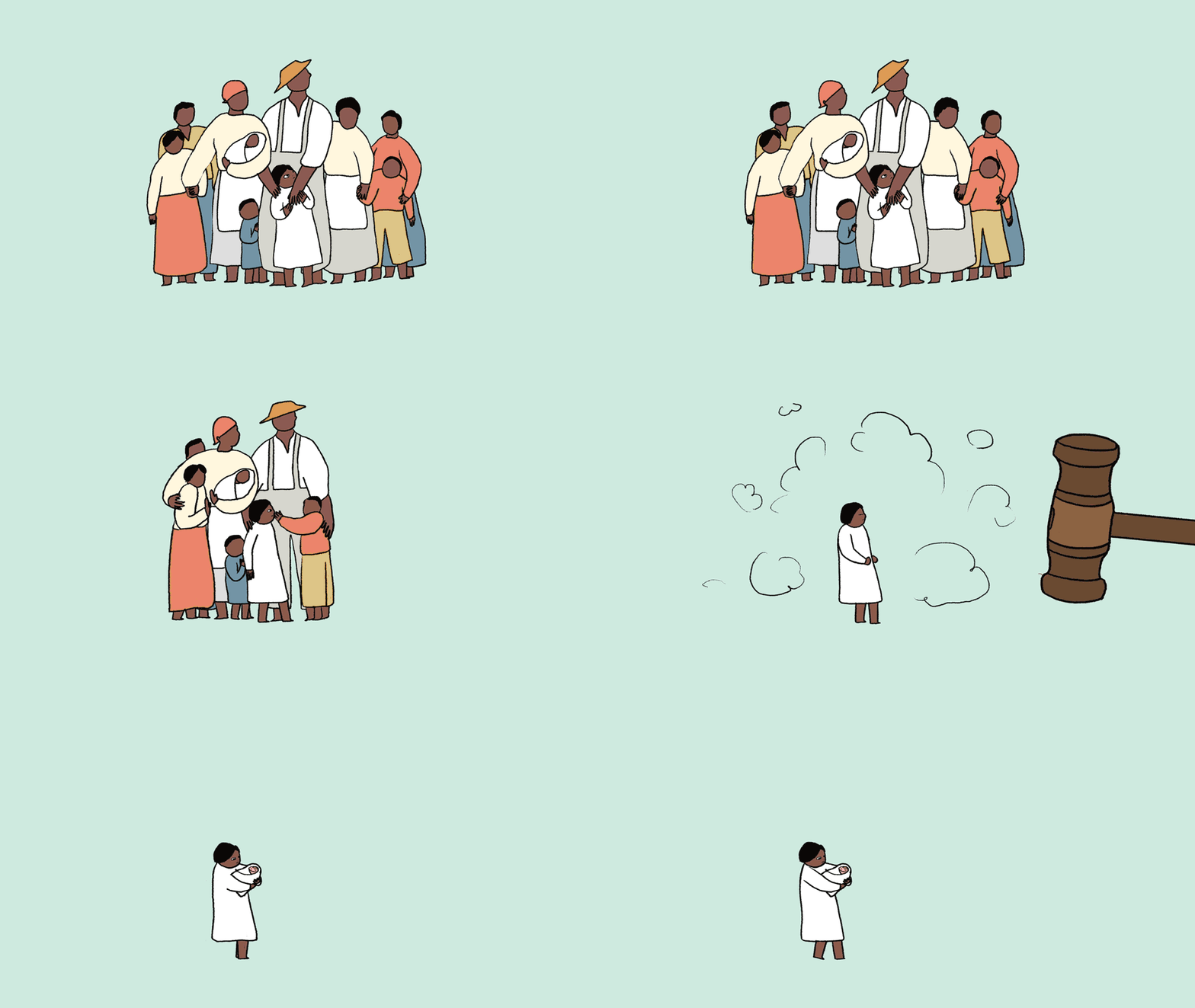
“This week marks the 100th anniversary of the passage of the 19th Amendment. And we celebrate the women who fought for that right,” Harris said. “Yet so many of the Black women who helped secure that victory were still prohibited from voting, long after its ratification.” — Kamala Harris (Tensley 2020)
The heroes a society accepts say a lot about the values they share. The original American heroes, the Founding fathers, were white men who never regarded Black people or women equally. Despite their violent, sexist, and racist ideology, Americans continue to put these men on pedestals, capitulating to their determination to commit genocide against Indigenous people and exalting them despite their embrace of slavery. These men are not heroes to Black people, and they should not be heroes to many Americans. Turning a blind eye to tyranny is not chivalrous; it’s obscene.
Forced to endure low wages, high maternal mortality rates, and overt acts of racism and sexism, Black women and women of color still find themselves at the bottom of the social pecking order. Long before Black women gained representation in Congress through Shirley Chisholm’s historic run in 1968, women like Harriet Tubman and Sojourner Truth fought for women’s suffrage and the abolition of slavery the 1800s. Unable to separate their race from their sex, Black women and women of color must always fight a two-headed dragon.
The fight for women’s suffrage, often portrayed as a unifying moment, usually leaves out the struggle of Black women who fought for the advancement of all women and all Black people. Modern, intersectional feminism acts to address the needs of non-white women. However, if the past is any indicator of the future, this will be a steep climb.
What is Freedom?
Freedom is the ability to define oneself and act following one’s beliefs without external limitations. Possessing unclipped wings, free people can live, laugh, and love freely. It is worth fighting for and yes, even dying for.
Bound to generations upon generations of enslavement, Black people suffered systematic abuse and racism. In response to these horrors, white and Black abolitionists worked together to free enslaved African people. Their efforts show that some Americans have always tried o live up to shared values- that all men were created equal. In the modern era, the increased efforts of white allies stem from the seemingly never-ending struggle to create a just nation.
Who was Sojourner Truth?
Sojourner Truth, a former slave, initially named Isabella, challenged the limited interpretations of Black women. In 1827, New York State passed an Anti-Slavery law. Still, many slave owners refused to honor this law. In response, Truth walked away from the confinement in an action of revolutionary dissent.
“I did not run away, I walked away by daylight….” (Truth 1851)
During this period, morality, frigidly observed through the lens of religion. As a profoundly religious woman, Sojourner Truth spoke about Christianity as a liberating force for women. She believed that women deserved justice and equal treatment in society.
“Then they talk about this thing in the head; what’s this they call it? [member of audience whispers, [‘Intellect’] That’s it, honey. What’s that got to do with women’s rights or negroes’ rights? If my cup won’t hold but a pint, and yours holds a quart, wouldn’t you be mean not to let me have my little half measure full?” (Truth 1851)
During that time, white men denied the rights of minorities and women by saying they lacked intelligence. In reality, they lacked equal educational opportunities, which further perpetuated the concept of their intellectual inferiority. Unfortunately, prominent Black men of the era also doubted the intellectual merit of Black women.
“Sojourner Truth first met the abolitionist Frederick Douglass while she was living at the Northampton Association. Although he admired her speaking ability, Douglass was patronizing of Truth, whom he saw as “uncultured.” Years later, however, Truth would use her plain talk to challenge Douglass. At an 1852 meeting in Ohio, Douglass spoke of the need for blacks to seize freedom by force” (The Good Faith Project, 2003).
His inability to see the Black woman as entirely deserving of equal rights undermined Black women. As a victim of white supremacy himself, Douglass did not pull himself entirely away from the bigotry that created such an unjust system of government. He understood his struggle but did not care to understand or empathize with the one Black women faced. Using her bravery and tenacity, she advocated for the abolition of slavery and the acknowledgment of women as deserving of freedom, equal opportunities, and justice. Many women of the day would wait for a man to lead the way. Soujourner Truth was unique in her ability to act autonomously despite fierce opposition. She certainly would not wait for men to say it was okay to fight for women’s rights. Truth never backed away from her insistence in doing right for righteousness sake and became the first Black woman to win a case against a white man.
“After the New York Anti-Slavery Law was passed, Dumont illegally sold Isabella’s five-year-old son Peter. With the help of the Van Wagenens, she filed a lawsuit to get him back. Months later, Isabella won her case and regained custody of her son. She was the first black woman to sue a white man in a United States court and prevail” (History.com, 2009).
While we should admire the strength and determination of women during this time, it is not without heartbreak. White women only used Black women to rally support for their cause. Susan B. Anthony, often hailed as a feminist hero, betrayed Black women, failing to support the 14th Amendment. She refused to support it because it did not give women the right to vote. Instead, Black men gained the right to vote. Unless women won the right to vote on the same bill, she would not support it. Susan B. Anthony also opposed the bill because it included the word “man” in the constitution. The term “man” was left out previously. She saw this word as a setback for women’s fight for full citizenship.
Many Black critics of the feminist movement feel slighted by white women who demonstrated a willingness to maintain the slavery system if it meant they would get their rights before Black men. White women desired equal rights but fought at the expense of others. For white feminists of the time, it did not matter that Black men would remain disenfranchised. They withdrew their support, and while some historians gloss over this, they should not. It is a crucial schism that never fully healed.
Thirty-seven years after Soujourner Truth died, the 19th Amendment passed but left Black women behind. They simply refused to fight for Black women’s rights as if they were unqualified to be women. As Truth asked in her infamous speech, “Aint’ I a woman”?
“In the case of the 19th Amendment, even as it’s ratified in August of 1920, all Americans are aware that many African-American women will remain disenfranchised. The 19th Amendment did not eliminate the state laws that operated to keep Black Americans from the polls via poll taxes and literacy tests — nor did the 19th Amendment address violence or lynching. Some African-American women will vote with the 19th Amendment. Some are already voting in California, New York and Illinois where state governments have authorized women’s votes. But many Black women faced the beginning of a new movement for voting rights in the summer of 1920, and it’s a struggle they will wage alone because now the organizations that had led the movement for women’s suffrage are disbanding” (Waxman, 2020).
During this period, white feminists betrayed Black women twice: once by not supporting Black men’s enfranchisement and refusing to fight for their voting rights once they already had theirs. In essence, white women betrayed Black women to get what they wanted and cast them aside. Their support was not sisterhood; it was pragmatic. Was their movement for justice and equality or self-aggrandizement and power?
White women desired equal rights but fought at the expense of others.
Who was Harriet Tubman?
“Harriet Tubman was an escaped enslaved woman who became a “conductor” on the Underground Railroad, leading enslaved people to freedom before the Civil War, all while carrying a bounty on her head. But she was also a nurse, a Union spy, and a women’s suffrage supporter. Tubman is one of the most recognized icons in American history, and her legacy has inspired countless people from every race and background” (History.com Editors, 2009)
Born into slavery, Harriet Tubman decided to take a different path than white supremacists had in mind for her. Like Truth, she believed that Black people deserved freedom and that women should have the right to cast their votes. Her efforts to free others after receiving freedom demonstrated her selflessness. Unlike Susan B. Anthony, who did not want to fight for the liberty of others, Tubman worked to free Black men and women and fought for all women’s rights. Her heroic actions did not come without personal strife.
At age five, her slave master forced her to care for a young infant. At that moment, her childhood died. Like many Black women of the time, white people forced her to take care of their kids, give birth to many of their own, and work hard without rest or consideration for their personal development. This process denied their humanity.
“She recalled being on duty at nights to make sure the baby did not cry, she had to continuously rock the baby’s cradle or hold her in her arms. Every time a cry was heard her mistress, Miss Susan, would whip her around the neck” (Historical Society).
Imagine being five years old and being beaten because a baby is crying. This abuse went on for years. At age twelve, her undying empathy began to reveal itself. Despite the indignity she suffered, she cared about other slaves. Tubman put herself in danger by jumping in front of a weight a slaveowner threw at another slave.
“The weight broke my skull and cut a piece of that shawl clean off and drove it into my head. They carried me to the house all bleeding and fainting. I had no bed, no place to lie down on at all, and they laid me on the seat of the loom, and I stayed there all day and the next” (Harriet Tubman — Historical Society).
Her injury had lasting damage. After this incident, Harriet Tubman would often fall asleep without warning; modern illness doctors would call narcolepsy. Despite her neurological struggles and enslavement, she lives her life as a warrior, willing to lay down her freedom and be on the line to save others. Harriet Tubman is an American hero who fought against slavery when it was unpopular to do so. She never accepts the hand she was dealt with, suffered, and fought for Black people, and women, in particular, could have a voice in American society.
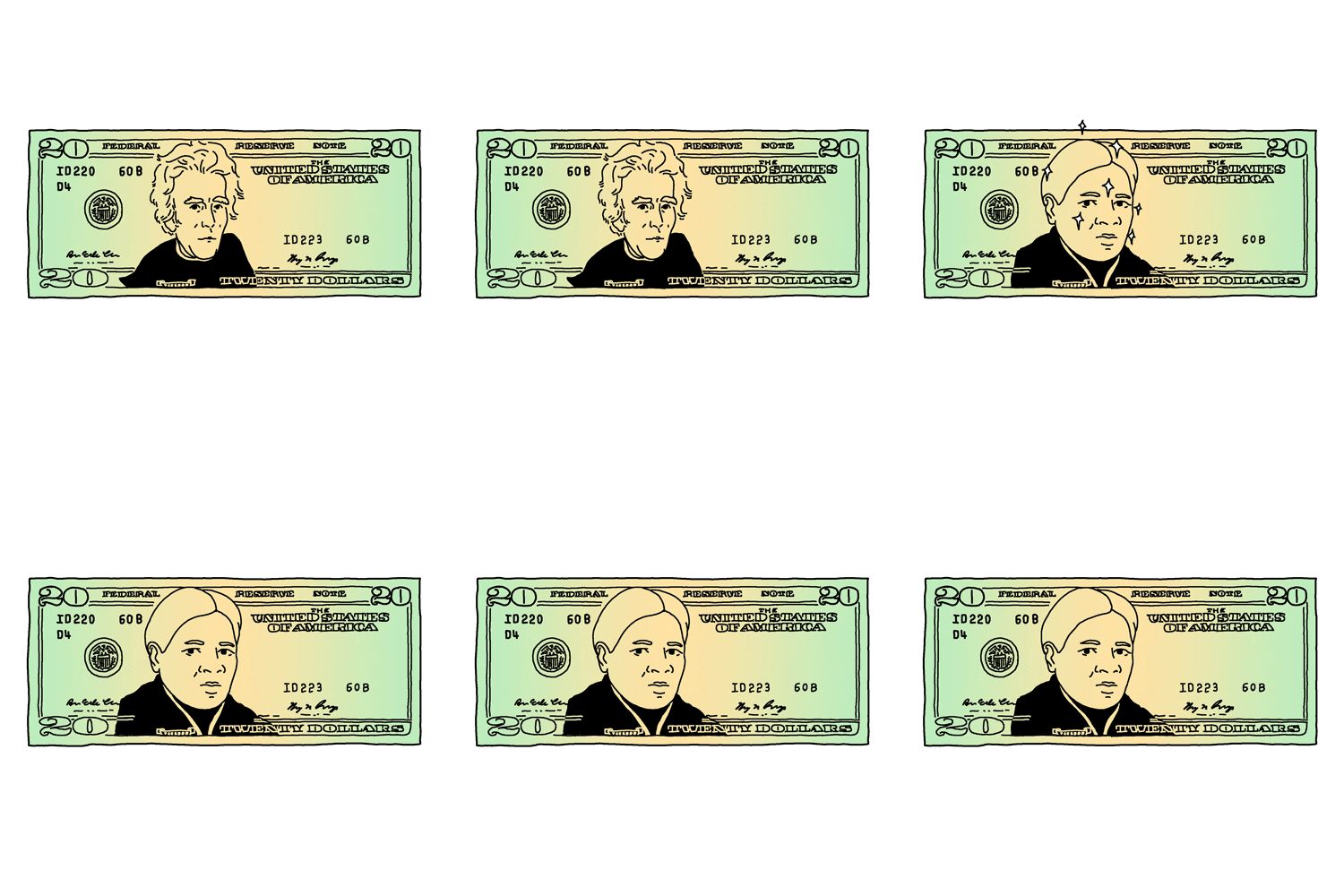
Obama’s administration aimed to honor Harriet Tubman by placing her face on the twenty-dollar-bill. This decision was groundbreaking because white supremacist historians often leave daring Black women out of American history. Also, this would directly counter the narrative that the founding fathers were the true American heroes. In 2016, the Obama administration announced these changes.
“Treasury Secretary Jacob J. Lew on Wednesday announced the most sweeping and historically symbolic makeover of American currency in a century, proposing to replace the slaveholding Andrew Jackson on the $20 bill with Harriet Tubman, the former slave and abolitionist, and to add women and civil rights leaders to the $5 and $10 notes (Calmes, 2016).
As many Americans know, the Trump Administration did not implement these changes. Treasury Secretary Steve Mnuchin said that this would not occur until after Trump’s presidency. Americans have not acknowledged Black women who fought heroically. Four years after the announcement, the government is no closer to implementing these changes.
While the story of Harriet Tubman inspires many people, many still oppose her fight for abolition and women’s suffrage.
The Disrespect by Kanye West
Recently, Kanye West criticized Harriet Tubman’s actions for undermining her efforts as a freedom fighter. I know that many feel the inclination to protect him, nurture him, and not admonish him for his statements. However, psychologists do not pander to or baby mentally ill people, nor do they dismiss their words as irrelevant. It is disrespectful to him not to take his words as meaningful, and it shows how woefully uninformed Americans are about mental health problems. Bipolar disorders are mood disorders that cause an individual to experience highs and lows. This disorder impacts their feelings, not their ability to determine fact from fiction. While schizophrenia is a mental disorder that causes people to lose touch with reality, Bipolar disorder does not work like that. To call him generally crazy as a pejorative term denigrates him, so Americans should not do that.
“People with bipolar disorders have extreme and intense emotional states that occur at distinct times, called mood episodes. These mood episodes are categorized as manic, hypomanic, or depressive. People with bipolar disorders generally have periods of normal mood as well. Bipolar disorders can be treated, and people with these illnesses can lead full and productive lives” Parekh 2017)
Kanye West is running for President; Americans need to assess his statements for what they are, without the cloud of illness preventing a dialogue about it. He tried to assert that Harriet Tubman made slaves go work for other white people, but history shows that she did not force newly freed Back people into forced labor of any kind.
“West, declaring onstage that famed abolitionist Harriet Tubman, who has been called ‘the Moses of her people,’ “never actually freed the slaves.”
“She just had the slaves go work for other white people,” West said (Chiu, 2020).
This outburst was not the first statement he made to denigrate the abolitionist movement. He also asserted that slavery was a choice. Some lined up in defense of his comments and others to condemn those who felt outraged at a mentally ill person’s expression. However, Black men, such as Ben Carson, made similar statements meaning it is not indicative of mental illness but rather an ideology that embraces the white narrative. Those who line up to support him also believe that narrative, so while it is true that he is struggling with some issues, this does not negate his efforts to denigrate Black women and the anti-racist movement.
Slavery was not a choice, and the statement is absurd. To hear this rhetoric from a Black man is genuinely disparaging. However, throughout history, white supremacists have used token Black people to push counterproductive messages. If slavery was a choice, then they hold no guilt. However, slave owners like General Robert E. Lee beat his slaves for wanting freedom during the Civil War. White supremacists often landed pre-emptive abuse on slaves, despising their desire for liberation. Furthermore, hundreds of slave riots counter his misleading narrative.
To distort the very definition of freedom is beyond ridiculous. The torture that enslaved Africans endured should not be ridiculed or undermined to fit white narratives. No American should support the whitewashing of history, which is counterproductive in creating a more perfect and powerful union. While on its face, it seems to be the ramblings of someone who has bipolar disorder, his statements come from a more profound void than that. He wanted to poison the well of Black minds yearning to create a perfect union by undermining a strong Black woman’s activism. Like an enemy amongst the people, he aimed to discredit and maim her legacy.
“There’s something about that little, petite, black woman, who did so much, that seems to bother him,” said Kate Clifford Larson, author of the 2003 biography “Bound for the Promised Land: Harriet Tubman, Portrait of an American Hero.” Larson noted that West had referenced the abolitionist critically in past years” (Chiu 2020).
While white supremacists usually further this rhetoric, Kayne proves that white supremacy is an ideology, not always identifiable by race. Any person can spread misinformation about the fight for Black liberation. Those who adhere to the white supremacist ideology often claim that slavery was not wrong, that racism does not exist, that Black people are their own worse enemy. These are all vicious attacks on the dignity of Black and white abolitionists who gave their lives just to vote, be seen, and valued.
Black Women’s Liberation Going Forward
Americans cannot continue to view feminism through rose-colored glasses. Black women fought alone throughout most of history. That is not to say they did not appreciate the help when received because they did. However, white women organized and fought against Black women and the fight for racial justice. If the point of all the fighting is to give women rights, then why weren’t Black women viewed as part of the fold?
“Suburban women nationwide especially led the charge, creating an alphabet soup of acronym-bearing organizations like Michigan’s NAG (National Action Group against Busing) and Boston’s ROAR (Restore Our Alienated Rights) to preserve and protect whiteness” Cirillo, 2020).
Intersectional feminists, interested in reaching across the aisle, should study Susan B. Anthony’s mistake and learn from it. The movement will forever wear the scar caused by overlooking the rights of Black people. In America, Black women have many allies, but few accomplices committed to making this country more just. The only way forward is through honest evaluation and commitment to do better.
More Articles Curated in Race, Equality, and Women
References:
Calmes, J. (2016, April 20). Harriet Tubman Ousts Andrew Jackson in Change for a $20. Retrieved August 19, 2020, from https://www.nytimes.com/2016/04/21/us/women-currency-treasury-harriet-tubman.html?module=inline
Chiu, A. (2020, July 20). ‘Woefully uninformed’: Kanye West slammed for saying Harriet Tubman ‘never actually freed the slaves’. Retrieved August 09, 2020, from https://www.washingtonpost.com/nation/2020/07/20/kanye-harriet-tubman/
Cirillo, F. (2020, August 07). Perspective | Colorblindness has become a conservative shield for racial inequality. Retrieved August 15, 2020, from https://www.washingtonpost.com/outlook/2020/08/07/colorblindness-has-become-conservative-shield-racial-inequality/
Historical Society, H. (Ed.). (2020). Early Life. Retrieved August 19, 2020, from http://www.harriet-tubman.org/early-life/
History.com Editors. (2009, October 29). Harriet Tubman. Retrieved August 09, 2020, from https://www.history.com/topics/black-history/harriet-tubman
History.com Editors. (2009, October 29). Sojourner Truth. Retrieved August 15, 2020, from https://www.history.com/topics/black-history/sojourner-truth
Johnson, S. A. (2005, July 13). Truth and Tubman: Women who fought against slavery. Retrieved August 16, 2020, from https://www.austinweeklynews.com/News/Articles/7-13-2005/Truth-and-Tubman:-Women-who-fought-against-slavery/
Parekh M.D., M.P.H., R. (2017). What Are Bipolar Disorders? Retrieved August 15, 2020, from https://www.psychiatry.org/patients-families/bipolar-disorders/what-are-bipolar-disorders
Tensley, B. (2020, August 20). Analysis: Why Kamala Harris’ shoutouts to AKAs and HBCUs matter so much. Retrieved August 20, 2020, from https://edition.cnn.com/2020/08/20/politics/kamala-harris-dnc-aka-hbcu/index.html
The Good Faith Project (Ed.). (2003). This Far by Faith . Sojourner Truth. Retrieved August 14, 2020, from https://www.pbs.org/thisfarbyfaith/people/sojourner_truth.html
Truth, S. (1851, June 21). Sojourner Truth: Ain’t I A Woman? (U.S. National Park Service). Retrieved August 16, 2020, from https://www.nps.gov/articles/sojourner-truth.htm
Quotes. (2020). Retrieved August 01, 2020, from https://www.malcolmx.com/quotes/
Waxman, O. (2020, August 14). When Did Black Women Get the Right to Vote? Suffrage History. Retrieved August 19, 2020, from https://time.com/5876456/black-women-right-to-vote/


