
The 10 YC Companies (W20) I’d Invest In
It’s Demo Day (again)!
But first, here are my past YC posts if you want to check how my picks have done. If you want to skip to the bottom, you can also see my own evaluation of my past picks for S19, W19, S18, W18, and S17 (wow, I’ve been doing this for quite some time!)
YC’s Winter 2020 class was ENORMOUS (again)! 197 startups, representing 32 different countries, “pitched” virtually on 3/16/20 (due to COVID-19/Coronavirus).
Quick diversity stats on W20:
- Female founders: 20.9% of the companies have a female founder, 11.3% of the W20 founders are women
- Black founders: 8.6% of W20 companies have a Black founder; 7.6% of the W20 founders are Black
- Latinx founders: 9.0% of W20 companies have a Latinx founder; 8.9% of the W20 founders are Latinx
This was definitely a non-traditional demo day, to say the least, but let’s get to it, I’m excited to share my favorites!
Interested in Investing in Startups Like These?
Check out the Mitchell Ventures syndicate on AngelList here: https://angel.co/mitchell-ventures/syndicate
The Top 10 Companies I’d Invest In
- Pilot — Payroll, Benefits, and Compliance for Remote Teams
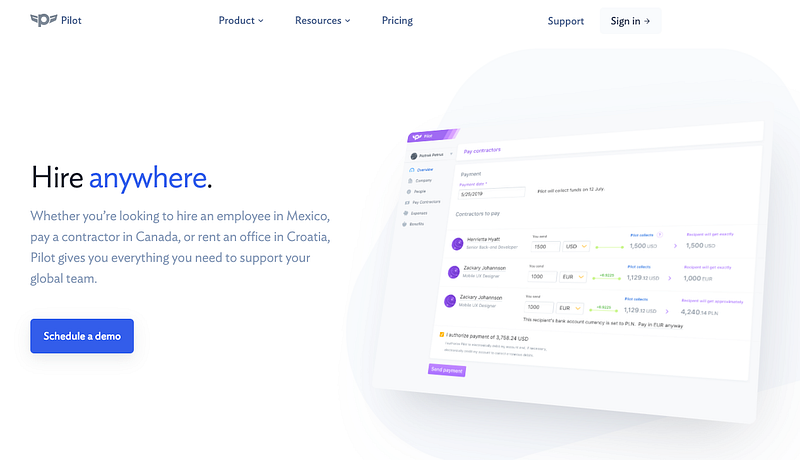
TechCrunch Description: Pilot handles payroll, benefits, and compliance for hiring remote contractors. Companies pay $60 per contractor per month for Pilot to help treat contractors like full-time employees by offering benefits, stock options, and expense reimbursements. With COVID-19 quarantines familiarizing more companies with remote work, there could be a big market for ensuring their retention and productivity by making them feel like part of the team.
Why I Would Invest: It’s no secret: Remote work is accelerating rapidly. Pilot is definitely in the right place at the right time, radically simplifying the decision to hire remote contractors while also offering those contractors benefits, options, and more. Win-win.
2. Grain — Transform Your Debit Card into a Credit Card
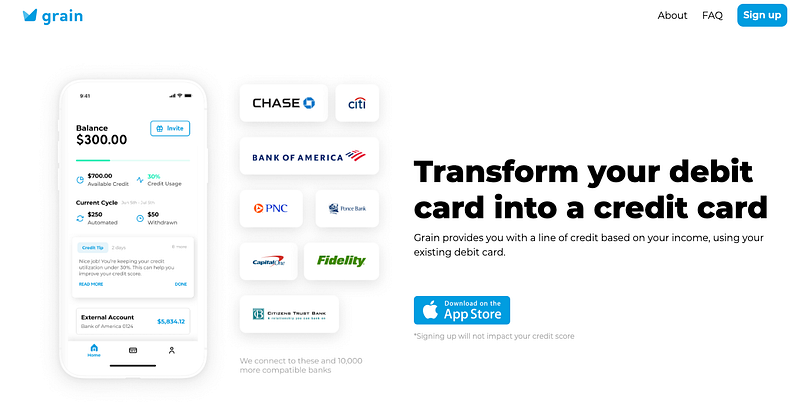
TechCrunch Description: Grain hooks your existing debit card to a “responsible” amount of credit (currently capped at $500, and based on your income/cash flow), helping those with minimal/bad credit build up their credit report over time. In the three months since launch, the company says it has signed up 1,000 customers and expects to make around $80 per customer per year.
Why I Would Invest: Grain is one of those “I wish I thought of that” kind of ideas. By connecting your debit card, Grain learns everything they need to know about your income and expenses.
From that understanding, Grain can start extending you small, free lines of credit. This credit could be all a consumer needs to avoid overdraft fees. Additionally, this “responsible” borrowing also provides a consumer with the beginnings of a credit history.
Love this idea, love the potential if they can get the risk models right!
3. Spenny App — Acorns for India
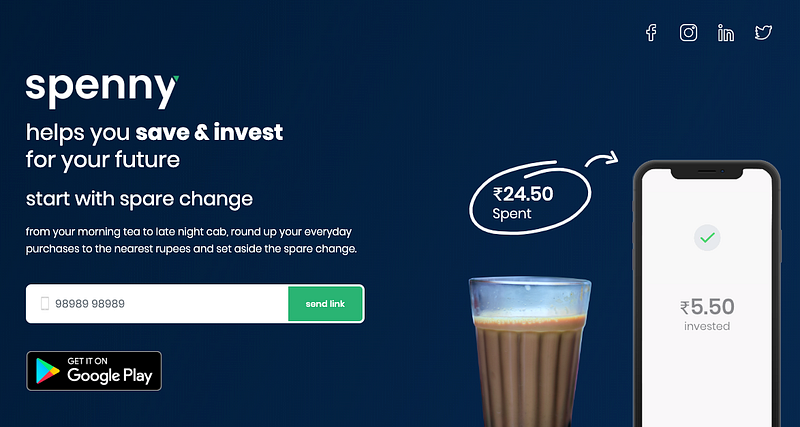
TechCrunch Description: Spenny is a savings tool for Indian consumers that lets customers start banking money away by rounding up their purchases.
Why I Would Invest: Based on their January 2019 raise, Acorns is valued at close to $1B. All it took was transporting Bank of America’s Keep the Change campaign into an app.
Spenny is taking this same idea international (Acorns only operates in the US today). The concept is so simple, so intuitive, and so delightful that I’m highly optimistic they can pull it off with a few localization tweaks (ex. allowing investment in gold, which is highly appealing to local consumers).
P.S. In another sign that all YC companies are connected, Spenny uses several Piggy services on their backend! In case you forgot, Piggy was in my Top 10 for the YC S17 class.
4. Handl — Turn Paper Documents Into Structured Data
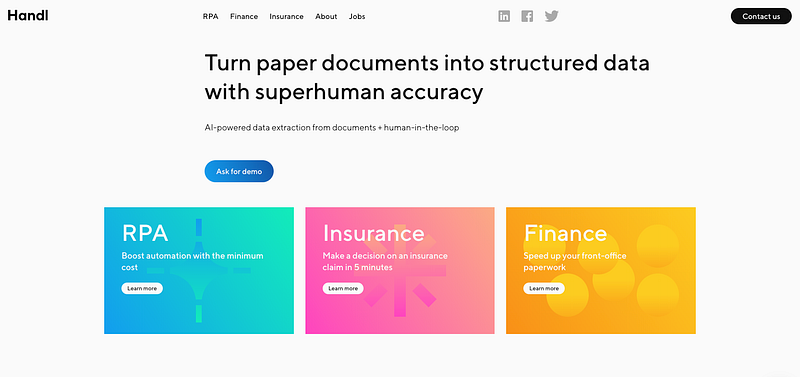
TechCrunch Description: An API for turning paper documents — including handwritten ones — into structured data ready to be plunked into a database or CRM. While the company says that around 85% of its processing is handled by their AI, it’s backed by humans to validate data when the AI’s confidence is low. Nine months after launch, the company is seeing an ARR of $0.9 million.
Why I Would Invest: Silicon Valley may have a hard time understanding this, but so much today is still done with old fashion paper documents and handwriting. Whether it’s real estate contracts or order forms, we haven’t been able to escape handwriting quite yet.
Handl solves this problem by providing an API for turning paper documents into structured data at scale with high accuracy. I absolutely love how scalable this business is and I also love that they’ve already hit $1MM ARR less than 1 year after launch!
5. Trimwire— Truebill for Businesses
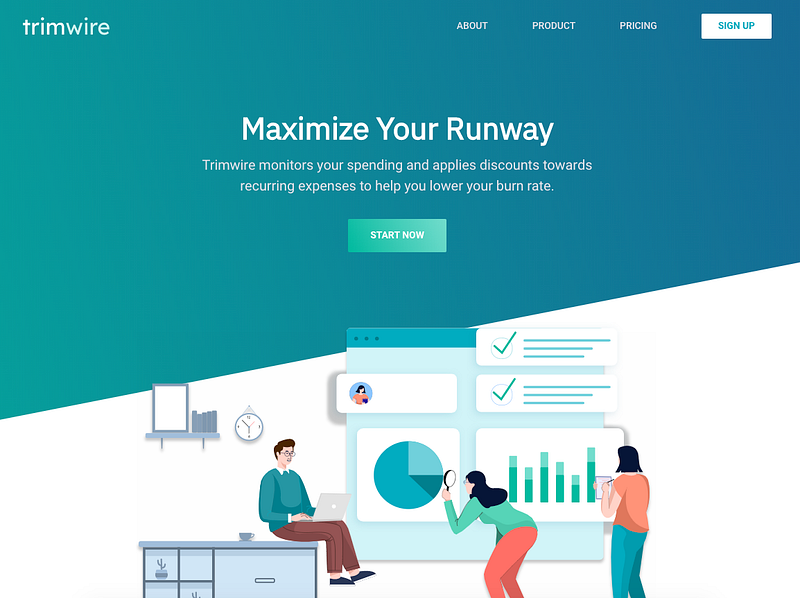
TechCrunch Description: Hooks into a company’s bank accounts and credit cards to automatically reduce monthly costs by flagging anomalies and hunting for potential savings on recurring expenses (such as forgotten subscriptions).
Why I Would Invest: Truebill firmly planted its flag as the leader in consumer subscription and bill management when they announced their $15MM Series B round in late 2019.
Trimwire brings a similar set of skills plus a few new ones to businesses. While consumers are often somewhat aware of what bills they are paying (Netflix, Amazon Prime, Hulu, etc.), businesses can pretty easily lose track.
First, there are a LOT of bills to pay. Second, lots of hands touch these bills and context can be completely lost along the way (Why are we paying x?). Finally, businesses often overpay for these services by failing to negotiate. Trimwire is designed to solve all of these challenges plus more for businesses, automatically.
📣 Thanks for reading! If you’re enjoying this post, I know you will find major value in Africa: The Big Deal Startup Deals Database! And, even better, you’ll get 10% OFF with my special link below:
In the Big Deal Database, you’ll find:
- A monthly updated Excel database listing ALL $100K+ funding deals secured by startups in Africa
- Included with your initial subscription: The entire dataset from Jan 2019 to December 2022
- The database includes critical details like the number of employees, funding amounts, type of deal (Seed, Series A, B etc.), whether this transaction was an exit, startup valuation (when disclosed), investors, and much, much more!

If you’re investing or building in Africa or simply want to become as educated as possible on the fastest-growing startup ecosystem, you need the Big Deal Database!
6. Dashworks — Connect SaaS Tools and Find Insights Quickly
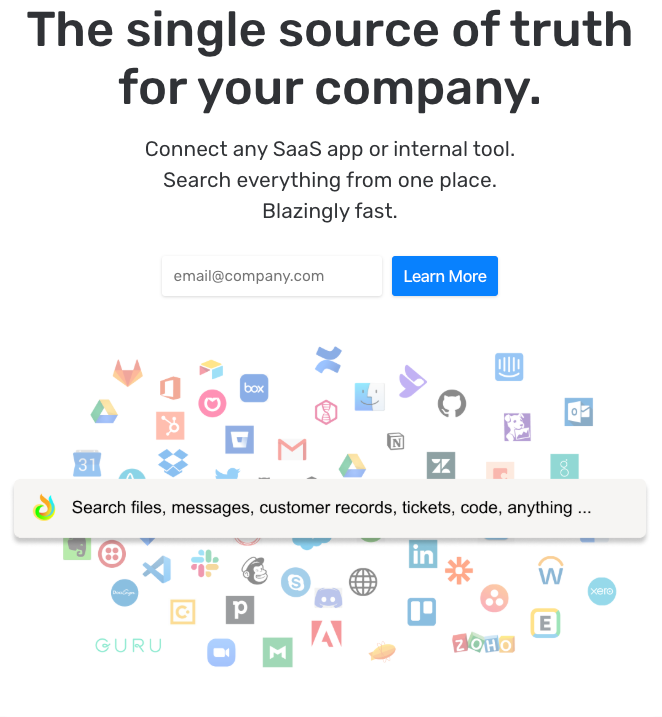
TechCrunch Description: Dashworks is aiming to build a search tool that brings together all of the information from your various collaboration tools and databases. The platform relies on deep integrations across a wide variety of apps and boasts customers including Zapier, Stanford and Armory.
Why I Would Invest: We are at peak SaaS tools. Just ask your local Product Manager how many different SaaS services they use in an average day and your mind will be blown.
With all of these services, it’s easy to lose information and it’s hard to find what you’re looking for. Dashworks brings search to all of your tools and databases, allowing you to quickly find all of the information about a particular customer, marketing campaign or design.
Dashworks is Google for your tools and databases.
7. Onetool — All SaaS Apps You Need for 1 Monthly Subscription
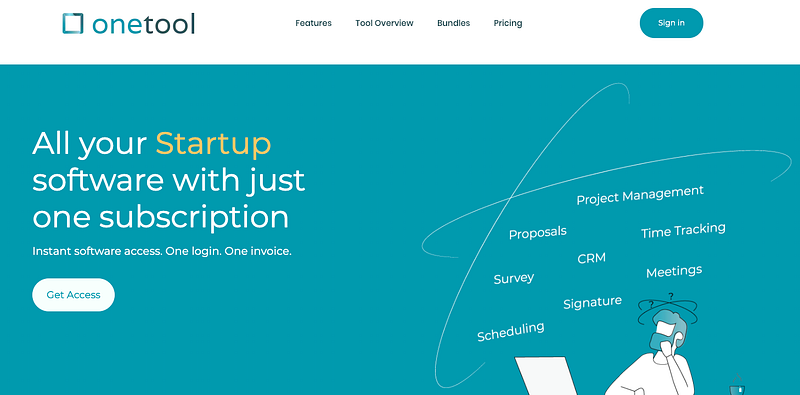
TechCrunch Description: Onetool is building an all-in-one platform that allows startups to subscribe and save, paying for a single subscription while using a variety of vendors to meet their needs. The company hopes its platform can boost the discoverability of new SaaS tools and simplify the lives of founders who are having to manage so many subscription services.
Why I Would Invest: If you’ve been reading closely so far, you’ll notice that Onetool capitalizes on similar together macro trends as Dashworks (too many SaaS tools) and Trimwire (difficult to manage subscriptions and bills). Onetool provides packages of services at startup-affordable rates. I love how they’ve bundled these services into persona-based categories (Startup, Content Marketing, Sales, Outreach) to make it dead simple to find the services you’re looking for.
On top of these bundles, Onetool also provides a single sign-on experience for all products, one place to manage teammate access, and one place to pay. Even better, all bundles are monthly subscriptions (not annual) and you can add and remove services as you need.
8. Robotire — Robotic Auto Maintenance
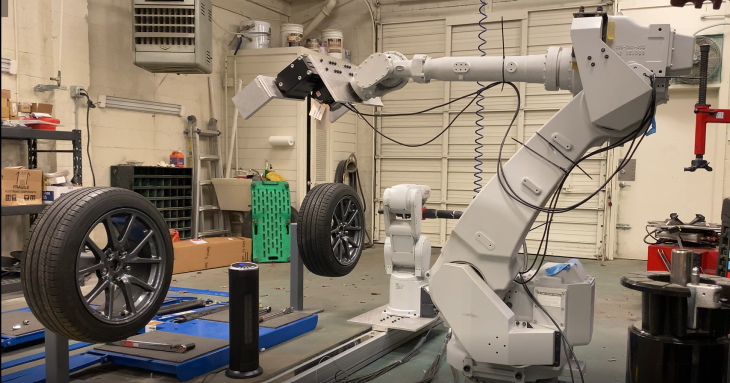
TechCrunch Description: Anyone who’s ever sat in a service shop waiting room knows how time-intensive the process can be. RoboTire promises to cut the wait time from 60 minutes down to 10 for a set of four tires. The company has begun piloting the technology in locations around the U.S. Find previous coverage of RoboTire here.
Why I Would Invest: Seriously, have you ever been to a service shop? I really want RoboTire to succeed in this space (tires are just the start!).
It will be very important for the company to drive down the costs of the machines as much as possible and also to increase the speed of the tire changes. As cool as robots are, there are very few consumers who will pay more for a robot tire change compared to a good old human one.
9. ZeoAuto— Fleet Management in India
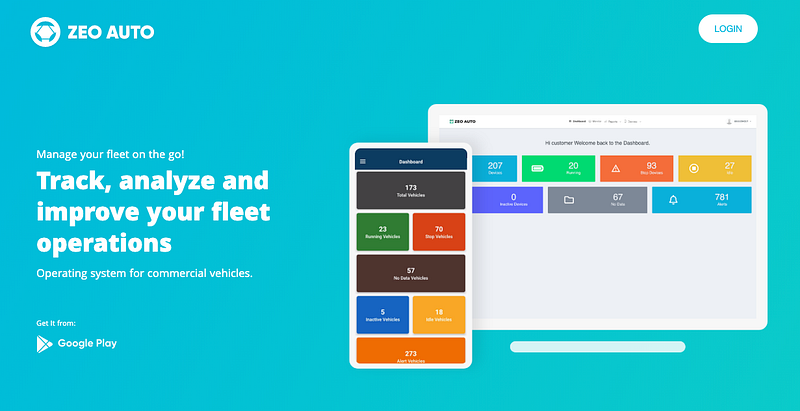
TechCrunch Description: Fleet management and tracking for companies with automative fleets in India, allowing them to do things like view current vehicle position, replay past trips, calculate fuel costs, etc. Compatible with over 50 different GPS devices. The company says it has onboarded 2,000 fleet owners, bringing 30,000 vehicles onto the platform.
Why I Would Invest: ZeoAuto is far from the first fleet management company. In fact, I’ve written quite a bit about fleet management companies in China, LATAM, and India in my earlier posts.
However, there are a few things that stood out to me and give them a strong chance to succeed in India. First, they are device agnostic; instead of an expensive, custom device, fleet owners can use devices they already have or purchase ones that match their budgets. Additionally, the company has onboarded 30k vehicles from 2k fleet owners. This shows both that they can scale their model rapidly and that they’ve managed to onboard 2k owners!
Many fleet management companies I’ve seen in other countries have only a few big partners, each requiring a custom implementation. ZeoAuto appears to have already figured out how to onboard at scale and also how to manage smaller business owners, a massive opportunity in India.
10. ElectroNeek— No Code Robotic Process Automation (RPA)
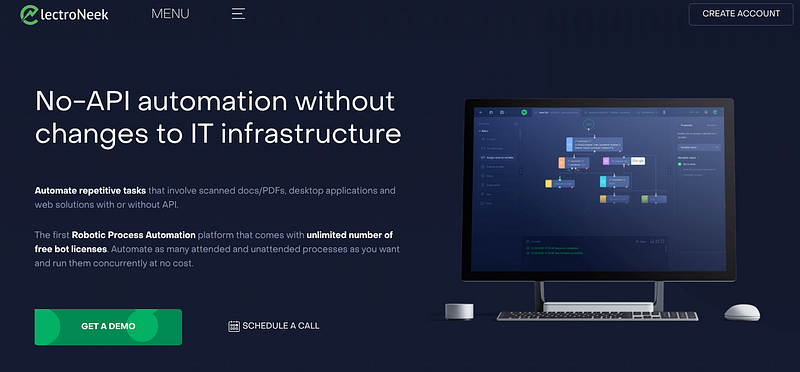
TechCrunch Description: Everyone agrees that robots are the future of automation, but actually deploying the technology often requires a great deal of expertise. ElectroNeek is building a desktop and cloud-based interface designed to help streamline the automation process for IT employees and business professionals without a robotics background.
Why I Would Invest: Have you seen how fast RPA startups have scaled? UIPath has raised $1B and is currently at a $7.5B valuation. Automation Anywhere is currently sitting pretty at a $6.8B valuation.
However, both of these startups require sophisticated setup and configuration by highly trained experts. ElectroNeek is dramatically lowering the bar for RPA, offering a drag and drop interface that almost anyone can use. RPA is still an emerging industry, and I strongly believe ElectroNeek’s novel approach will help them scale rapidly and bring RPA to more mainstream users.
Honorable Mentions
- GigiBenefits: Financial Solutions for Freelancers + Gig Workers
- Mistro: Benefits for Distributed Teams
- Turing: Make R&D Decisions 10x Faster
- Datasaur: Tools for Structuring Unstructured Data
- Potential: Jobs for Formerly Incarcerated
- GetHelpNow: Ambulance Service in India
- VisualOne: Upskill Your Surveillance Cameras with AI
- Taiv: Replace Live TV Commercials With Your Advertisements
- Somatic: Commercial Cleaning Robots
- Homestead: Convert Garages to Income Generating Apartments
- 99minutos: Rapid Delivery Service for LATAM
- HealthLane: OneMedical for Africa
- GuruHotel: Shopify Meets Small Hotels
- HireSweet: Identify Highly-Targeted Passive Candidates
- LegionFarm: Gaming with Pros (ARR of $7.2 million!)
How Have My Picks from Past YC Classes Done?
S19
Too soon to report on the good, the misses, and the ?’s from the S19 YC class! Check back in a few months.
W19
The Good
- CareerKarma: Raised $1.5MM seed round in July 2019
- Superb-AI: Raised $2MM seed round in February 2019
- YourChoice: Raised $1.6MM seed round in January 2019
- FlowerCo: Raised $2.8MM seed round in July 2019
- Boundary Layer Technologies: Raised $2.3MM seed round in March 2019
- Pronto: Raised undisclosed seed round March 2019
The Misses
- Modern Labor: Website doesn’t load and I don’t see any signs of life :’(
The ?’s
- Cherry: Only has raised $150k from YC
- CareerTu: Only has raised $150k from YC
- Skill-lync: Only has raised $150k from YC
S18
The Good
- OKCredit: Raised $1.7MM seed round in August 2018 and a $15.5MM Series A in June 2019. Raised $67MM Series B in 2019 (!)
- Alpha Vantage: Raised $2.2MM seed round in 2018, nothing raised since
- Goodly: Raised $1.3MM seed round in March 2019, nothing raised since
- CSPA: Raised $1.5MM seed round in September 2018, nothing raised since
- Inscribe: Raised $3MM seed round in December 2018, nothing raised since
- Togg: Raised $4MM seed round in September 2018, nothing raised since
- Berbix: Raised $2.5MM seed round in July 2019, nothing raised since
- Scanwell Health: Raised $3.5MM seed round in November 2019
- Kyte: Originally a Smart SMS inbox for India — rebranded as KhataBook, raising a $25 Series A round in September 2019
The Misses
- Cambridge Glycoscience: Has not raised a seed round. 2 employees, calling this one dead
W18
The Good
- Juni Learning: Raised an additional $790k in January 2018. Scaled to 222 employees
- Veriff: Raised a $7.7M Series A in June 2018. 229 employees on LinkedIn
- HelloVerify: No fundraising since YC, but scaled to 113 employees (LinkedIn)
- Reverie Labs: Seed round raised in March 2018 (undisclosed). 10 employees on LinkedIn
- OpenLand: Raised $2.3M in August 2018 and pivoted into a messaging app.
- NextGenT: Raised $2MM in January 2018. 53 employees on LinkedIn
- Sheerly Genius: Rebranded as Sheertex, raised undisclosed Series A in September 2019. 40 employees on LinkedIn
The Misses
- Onederful: No fundraising since YC. 4 employees on LinkedIn. Calling this one dead.
The ?’s
- Memora Health: No fundraising since YC. 17 employees on LinkedIn
- Lawyaw: No fundraising since YC. 8 employees on LinkedIn
S17
The Good
- Standard Cognition: Raised $5MM (October 2017) from Charles River, Initialized Capital, and YC. Raised $40M Series A in November 2018. Raised $35MM Series B in July 2019
- PayFazz: 444 employees on LinkedIn and closed a convertible note after YC (September 2017). Raised $21M Series A in November 2018.
- PullRequest: Raised a $2.3MM seed round from Google’s Gradient Ventures in December 2017 and then raised a $10.4M Series A in April 2018.
- Dahmahkan: Raised $5MM Series A in May 2019. Raised $18MM Series B in February 2020.
- 70MillionJobs: Finalist in the Social and Culture Technologies Category at SXSW Accelerator Pitch Event. Raised $150k from Quake Capital Partners in March 2019. 11 employees on LinkedIn.
- Zendar: Incredibly difficult to find information on this company over the past year, but they raised a $10.5MM Series A round in March 2019.
The Misses
- Ubiq: Little to no press since YC. Last blog post on the website is 10/30/17. I’m calling this one dead.
- Net30: Similar to Ubiq, little to no press since YC. Down to 2 employees on LinkedIn. Haven’t raised money post-YC. I’m calling this one dead.
- Plasticity: Only 6 employees on LinkedIn, no money raised since YC. No press since 2017. I’m calling this one dead.
The ?’s
- Piggy: 22 employees on LinkedIn, but no money raised since YC. No press since 2017.
Interested in Investing in Startups Like These?
Check out the Mitchell Ventures syndicate on AngelList here: https://angel.co/mitchell-ventures/syndicate
More from Alex Mitchell on Medium
Disclosure: Some of the links in this post are affiliate links, meaning that at no additional cost to you, I earn a commission if you click them and purchase a product.
📝 Save this story in Journal.
👩💻 Wake up every Sunday morning to the week’s most noteworthy stories in Tech waiting in your inbox. Read the Noteworthy in Tech newsletter.


