
Hong Kong English/Cantonese (XVII)
A Nickname for Our Lovely Country in “Milk Tea Alliance”
Sorry Thais
Let me tell you a piece of news happening recently around (South) East Asia.
When a Thai star talked with her girlfriend about her dressing style that day, it irritated some “NMSLese”[note 1] as the girlfriend insisted that she was dressing in a Taiwanese style.

Those NMSLese climbed over their Great Firewall to Instagram and Twitter and then set fire everywhere, sparking outrage trying to irritate Thai people and show the world how great their country China is.
However, knowing that these battlegrounds are advantageous to Thai people (because they use them a lot more than NMSLese), Thai could easily defeat them using seas of memes.
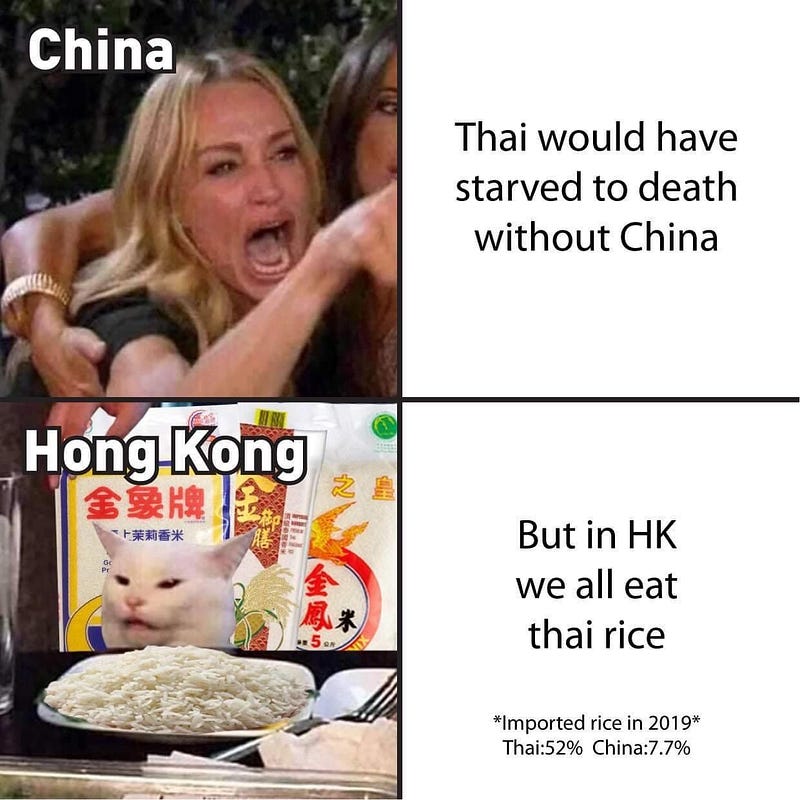
We Hongkongers and our friend Taiwanese have been fighting against those blindly patriotic Chinese people for long, but we were in awe seeing how Thai dealt with NMSLese. Therefore, we chanted our appreciation to Thai on Twitter and supporting them fighting against NMSLese. (Of course, NMSLese were mad again.)

Moreover, as we found that we all have our own variants in our milk tea, we started to call ourselves the “Milk Tea Alliance” here in Hong Kong.

Having Thailand popped up onto our headlines again, this reminds me of how we call the country “alternatively” as an internet slang.
We call Thailand “Cathay (秦國, Jyutping: ceon4 gwok3)” [note 2] online.
This is nothing but a typo. How we normally call Thailand is 泰國 (Jyutping: taai3 gwok3). The difference between “Cathay” and Thailand is all but a slight part at the bottom of the first word.
Well, how the two words are pronounced is so different, then why can the two words be typed wrongly? This can be related to Chinese input methods.
People can now input Chinese words according to how the words are pronounced. However, here is other common ways of input which types a word by how the word looks / is constructed.
One of them is Quick (速成) input. Using this input method, all Chinese words can be typed by putting two letters at most on the keyboard, while there are many choices for each sets of codes.
The difference between 秦 (Quick code: qd) and 泰 (Quick code: qe) lies only on letters on the next line on a QWERTY keyboard. The two words do, in fact, look similar. Therefore, it would be reasonable to not realise this typo during casual conversations like writing on internet forums.
I’m pretty sorry for the typo, but Cathay you did a great job fighting against those NMSLese.
Notes:
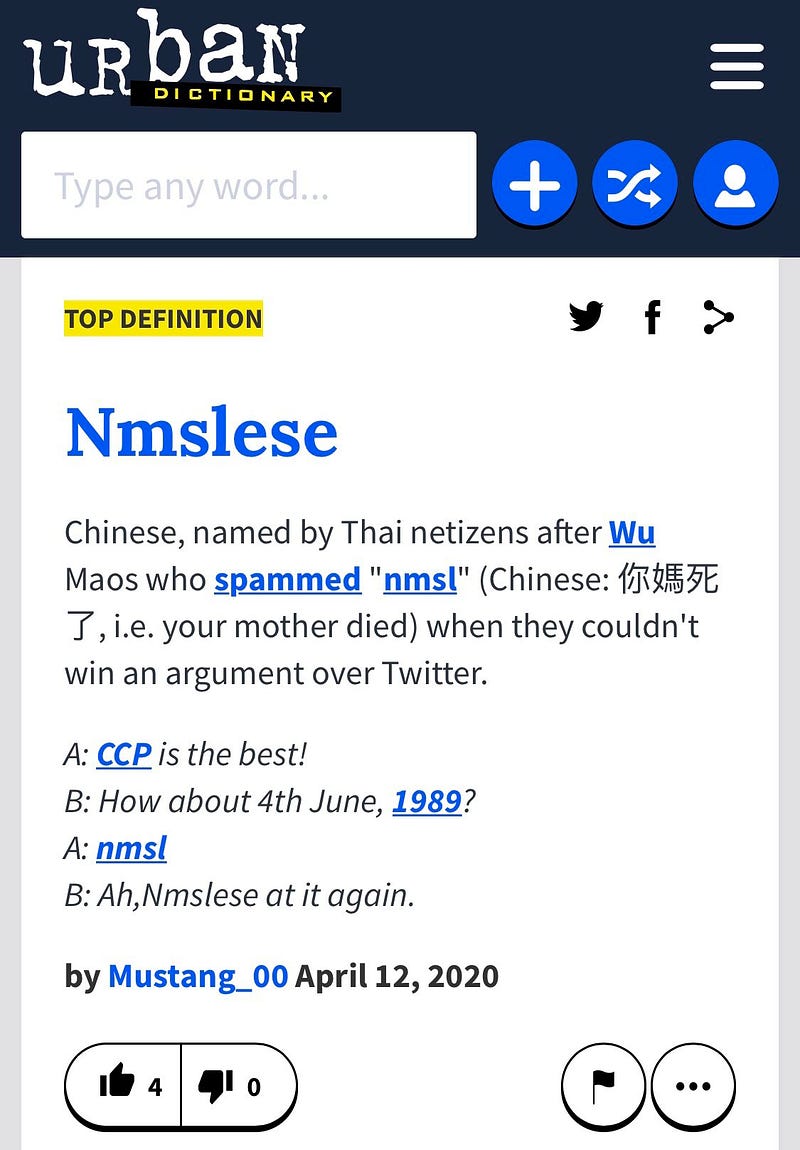
- NMSLese is a term created by Thai people during the outrage from China because the 50-cent army kept cursing Thai netizens “NMSL”, short term for “nǐ mā sǐ le (你媽死了)” which means “your mum’s dead”. Obviously, Thai people were not really mad at this but they were so annoyed by the unfruitful conversation with Chinese on the Internet. Thai people said that as Chinese use this phrase too much, they should be called “NMSLese” instead. Let me just call those 50-cent army NMSLese.
- Yes, I know the word Cathay comes from Khitan (契丹), not Ch’in China, but its spelling can show a wordplay in the Thai country name (“Thai-” vs “-thay”. Therefore, why not use it? Also, the Chinese name of Hong Kong’s Cathay Pacific Airline (though kowtowed to China) is 國泰航空. It has “泰” too!


