Technicolor Straight People
Rewatching “Pleasantville” with Modern Gay Eyes
Originally published in 2022. Read to the end for the author’s revisions and expanded commentary in 2024.
I recently rewatched “Pleasantville,” the 1998 film in which Tobey Maguire and Reese Witherspoon play 90's-era siblings magically transported inside a black-and-white 1950’s TV show, where they gradually ignite something in everyone they meet — a sexual awakening, a sense of personal agency, a willingness to be vulnerable, the courage to stand up and fight — embodied by the characters turning from black-and-white to technicolor.
“I wonder if the filmmakers had any idea how much of the story reflects the LGBTQ+ experience.”
I still cherish so much of this movie. It’s an ingenious concept, with remarkable actors, and it ranks high among the best cinema of the late-90’s, when I first started to fall in love with film. And indeed, a lot of the allegories at the heart of this film are still profoundly resonant today.
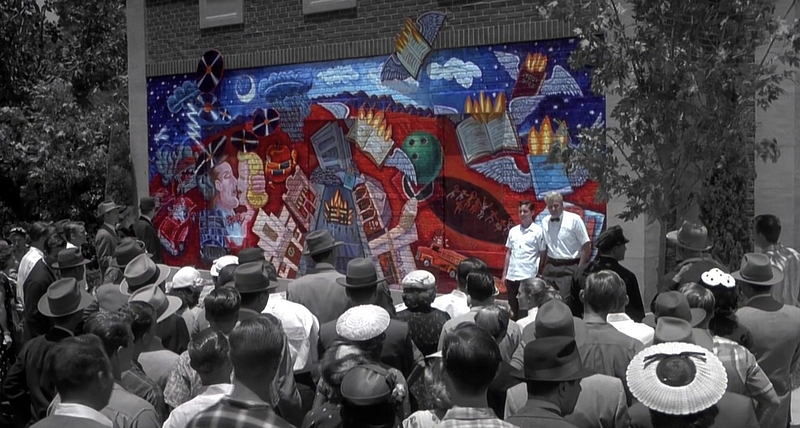
As a kid, I related to this movie because I’m an artist. Jeff Daniels’ character wants to be a painter, and when he starts painting vibrant multi-colored murals on the soda-shop window or the side of a building, everyone is scandalized and the town council tries to ban him from doing his work.
But what I didn’t understand as a kid was just how much my outrage at systemic oppression is rooted in my queerness. Since queer people have long expressed themselves through art and performance, most oppressive systems that want to censor art really want to censor sexual liberty.
After all, the residents of Pleasantville first start turning colors when Reese Witherspoon’s character introduces them to sex. And the most captivating character, played by Joan Allen, leaves her sexless marriage to have an affair. The movie is fundamentally about a society’s fear of sexuality …
But there’s not a gay person in sight.
Many journalists have written about how the film has some problematic, self-conscious allegories of the BIPOC experience. Shop-owners hang “No Coloreds” signs in their windows, and the climactic courtroom scene puts all the black-and-white white people downstairs, and all the technicolor white people upstairs in the balcony.
But I wonder if the filmmakers had any idea how much of the story reflects the LGBTQ+ experience. Even I didn’t realize it until just the other day.
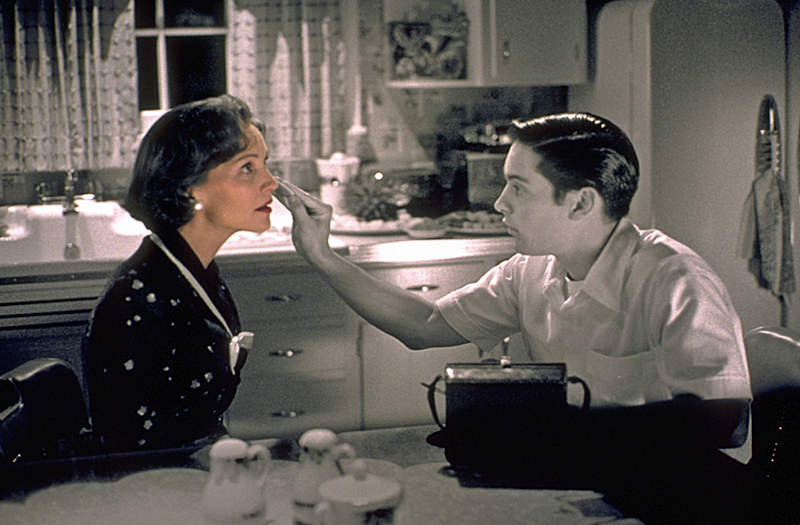
In one of the most emotionally (and technically) striking scenes, Allen’s character stands at the kitchen sink with a technicolor face, terrified her husband will reject her. So Tobey Maguire helps her cover her face with shades of grey makeup. This reminds me so much of the experience of gender-non-conforming folks who regularly have to change the way they present when they go home to unsupportive, hostile family members.
“In 2024, I’m done with allegory. It offers just enough distance from the truth of the matter for any apathetic, unaffected viewer to turn their head and look away.”
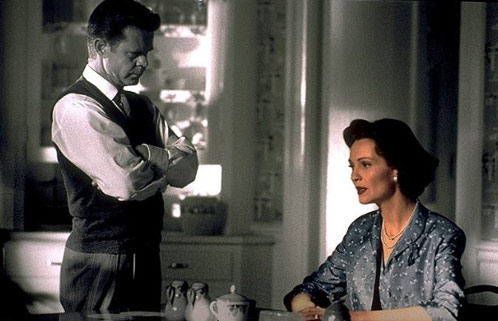
Later, when Allen’s character is openly living in color, and intends to leave her marriage, her husband, played by William H. Macy, implores her to stay and to put on some makeup — “It goes away. It’ll go away.” In the most beautifully acted moment in the film, she replies “I don’t want it to go away.” This echoes so many LGBTQ+ folks’ experience when we come out, and the people who claim to love us ask us to change, to go back to the way we used to be, to pray the gay away.
I recently wrote an article about how films of this era would perpetuate internalized homophobia by portraying sexually submissive men solely in scenes of ridicule and humiliation.
So when I first started rewatching “Pleasantville,” I was momentarily enchanted by Paul Walker’s character looking absolutely blissed out after a sexual experience where his partner was clearly the more dominant…
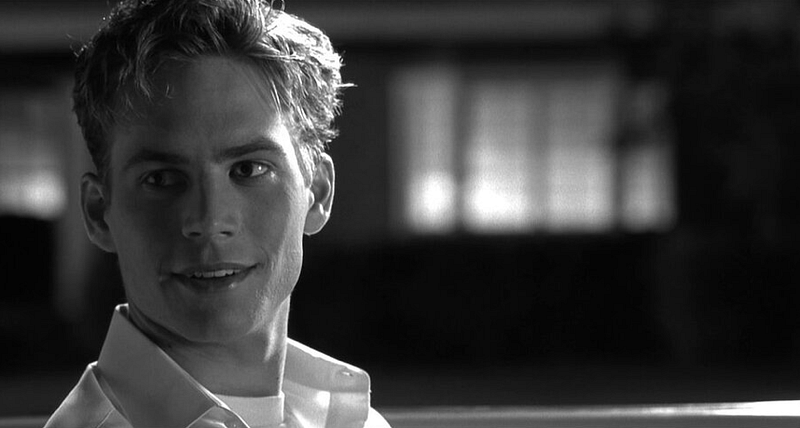
But of course, the next time we see this character, he’s throwing books on a bonfire. When this movie came out, I thought book-burnings were a thing of the past, but right now, hundreds of books featuring LGBTQ+ characters are being banned from libraries and classrooms all across the country, under the false pretense that the authors are “grooming” children.
“In a world where so many people think queer and trans folks are a danger to children and a threat to society, we need to tell the story of who we really are…”
In one of the most frightening scenes of the film, an angry mob gathers outside the soda-fountain, sneering at a nude painting of Allen’s character in the window. Someone smashes it with a brick, and they all storm inside and tear the place apart. That night, a group of technicolor folks gather to clean up the wreckage of their safe-space.
I can’t watch this scene and not think about the man who threw a firebomb in the window of a donut shop hosting a drag event in Tulsa OK, or the man who repeatedly threw bricks in the window of the gay bar Vers in NYC, or the devastating attack on Club Q in Colorado Springs. There have been so many acts of violence perpetrated on LGBTQ+ spaces recently, by people who falsely believe our sexual identities are somehow a threat to them.
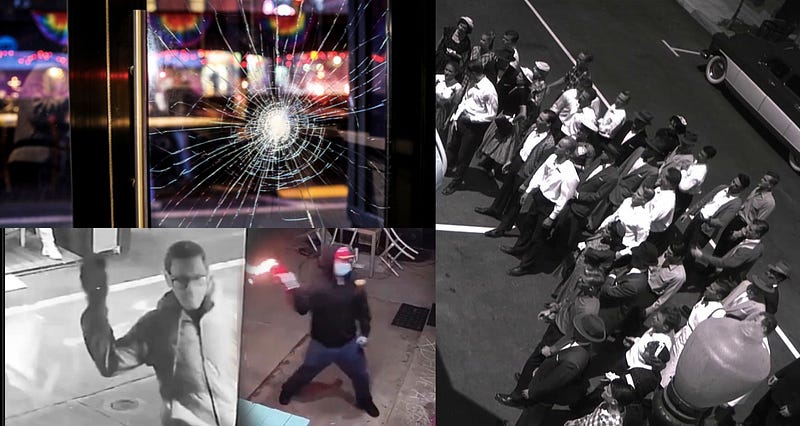
The difference is the characters in “Pleasantville,” at times, are trying to be provocative, to test the limits, rock the boat, and shake other people out of their comfort zones. But LGBTQ+ people just want to live our lives. We don’t sing and dance and hold hands and kiss in the street because we’re trying to provoke our haters — we do it because we’re human beings, who have a right to be ourselves, and to love each other fiercely, without fear.
Now, maybe one could argue that if the filmmakers had leaned too heavily into any one community’s marginalization, it’d dilute the story’s potential to encompass a myriad interconnected experiences…But in a story where the plot turns on a bunch of older folks freaking out about a bunch of younger folks making out…couldn’t at least a few of them have been queer?
Couldn’t we see a version of this story where Tobey Maguire captivates one of the basketball players, instead of the cheerleader?
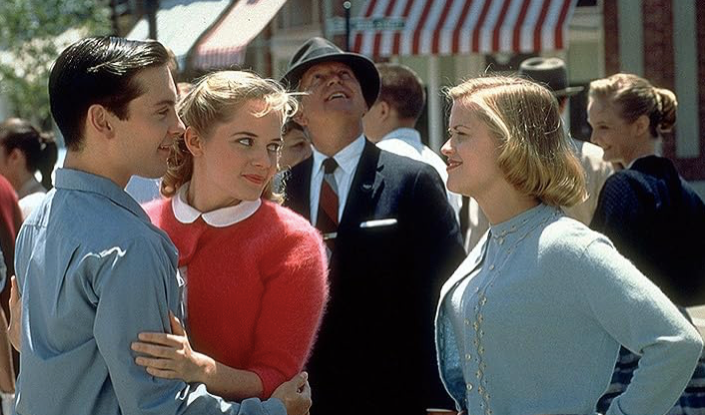
It’s really commendable how this film can be a robust allegory for so many marginalized experiences. But in 2024, I’m done with allegory. It offers just enough distance from the truth of the matter for any apathetic, unaffected viewer to turn their head and look away. I don’t want my community’s story told in a way that lets a cis-hetero audience say, “I didn’t get that at all, I think you’re just reading too much into it.”
We need to dispense with the metaphors, and tell our stories loudly, clearly, literally, and without apology. In a world where so many people still think we are a danger to children and a threat to society, we need to tell the story of who we really are, with our whole hearts, and with the support of a film industry that has historically left us out of the picture.
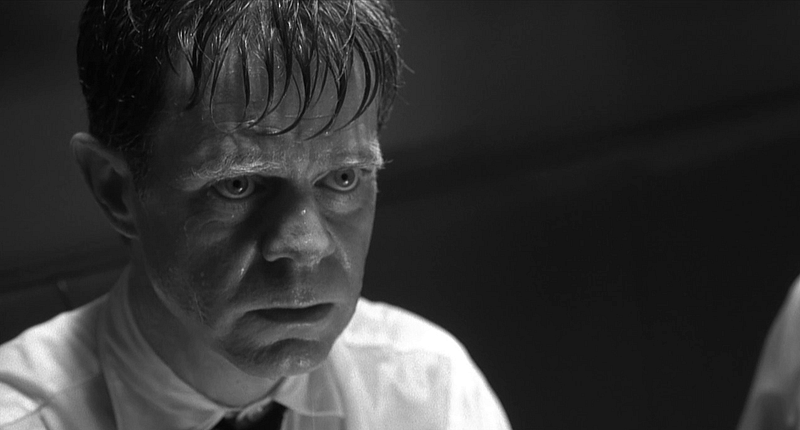
There is one moment in “Pleasantville” that is really instructive. William H. Macy’s character comes to the bowling alley, drenched with rain, and tells his friends his wife wasn’t home — “I looked and looked and looked. She was gone.” He plays it like a lost little boy, so vulnerable and frightened that the world he’s grown accustomed to is starting to change.
Most people who are animated by resentment for LGBTQ+ people are just like him: lost and confused, with no idea who they are. We’re right to be afraid of the ones hurling bricks and firing guns, but for the ones hurling epithets at the dinner table, or firing off a couple of hateful tweets — let’s leave them with their meatloaf and walk out the door. Let them hide in their bowling allies, while we dance in the rain!