ey are speaking a new language — the language of math.</p><h1 id="adfd">How Should Teachers Teach Math as a Language?</h1><p id="4222">One constant issue I faced in teaching mathematics is students' arguments that they will never use this in the real world.</p><p id="060a">My response over the years evolved to include, you may not actually use this math, but you will use your problem-solving and communication skills when facing problems in the real world.</p><p id="b703">When teachers stress that in solving applied math questions communicating steps in problem-solving skills is vital, this may help in whether students feel capable in understanding the concepts.</p><figure id="e8ac"><img src="https://cdn-images-1.readmedium.com/v2/resize:fit:800/1*TStewpcIoKep03J8bBIHiA.jpeg"><figcaption>Teacher asking a question in a math classroom — Photo courtesy of Max Fisher from Pexels</figcaption></figure><p id="9371">Math contains its own set of “vocabulary” and “symbols” and therefore, why can’t we use math in the same way as — say for example — we use English?</p><figure id="46d3"><img src="https://cdn-images-1.readmedium.com/v2/resize:fit:800/0*2nkUfcqsrpj6m_Ou.jpg"><figcaption></figcaption></figure><p id="f04c">In order to explain what we see we use math vocabulary through the medium of the English language.</p><h1 id="0246">The Benefits To Viewing Math as a Language</h1><p id="4cbc">If students were given the opportunity to see that when we use math vocabulary in writing the steps to a math solution, it is like writing an outline of an “English” paragraph, they may find the following benefits:</p><p id="f4ab">Here now is a list of what I believe brings five benefits to viewing math as a language.</p><h2 id="713a">I. Enhances Communication</h2><p id="2e60">When teachers and students continually make use of the math vocabulary in explaining answers, it may make communication of topics easier to understand between them.</p><p id="6c2d">It may also make it easier for students to explain their answers to the teacher or other students when they are comfortable using the math vocabulary.</p><p id="840e">Therefore, when teacher get students into the habit of answering or explaining math concepts, communication will be easier for all!</p><p id="3d99">When it becomes easier to explain concepts, this builds confidence and enthusiasm in students.</p><h2 id="ce32">II. Improves Vocabulary</h2><p id="c874">In explaining concepts in math, previous knowledge of vocabulary allows for teachers and students to gain understanding of new and related vocabulary in more complex concepts in math.</p><h2 id="cae4">III. Simplifies Knowledge of Complex Math Concepts</h2><p id="f046">Improving math vocabulary not only allows for better communication of concepts in math, but also makes learning more complex math concepts easier.</p><p id="9ae8">Complex math concepts build on previous knowledge, and therefore when students are comfortable communicating previous knowledge, the transition to more complex knowledge becomes easier to understand.</p><h2 id="9136">IV. Strengthens Problem-Solving Skills</h2><p id="8a69">In understanding how to approach math word problems, connections to language need to be met.</p><p id="ca3f">When attempting to answer math problems written through words, we must translate written words into math vocabulary. In being able to do so, it will make it eas
Options
ier to follow the important steps to problem-solving in math.</p><h2 id="efd6">V. Recognizes Math is a Universal Language</h2><p id="a313">When students become comfortable using math vocabulary and learning to speak math language. It makes it easier to connect with international students when it comes to math.</p><figure id="2e92"><img src="https://cdn-images-1.readmedium.com/v2/resize:fit:800/0*iv4Vgzc3Mt-Xt6e_.jpg"><figcaption>Infographic on the language of Math — courtesy of Danya Khelfa</figcaption></figure><p id="1213"><i>The image of my math infographic can be found on my <a href="https://www.teacherspayteachers.com/Store/The-Eti-Academy/Category/Mathematics-663814">TpT store</a>.</i></p><p id="eadb">Students may speak different languages outside the math classroom, but when they switch to understanding math, it may connect students from different backgrounds. Math, when seen as a “universal” language, brings students from around the world together in shared knowledge.</p><h1 id="c7ec">Final Thoughts…</h1><p id="5e05">The five benefits to viewing maths as a language mentioned in this article are really meant to show that math is not something to be afraid of.</p><figure id="16ac"><img src="https://cdn-images-1.readmedium.com/v2/resize:fit:800/0*7ZA-J-cEy9xs-KkZ.jpg"><figcaption>Student at the math board — Photo courtesy of Max Fisher from Pexels</figcaption></figure><p id="33c9">Because the truth of the matter is that math can make people feel ashamed and embarrassed about how they think if they don’t understand it.</p><p id="3769">When we allow students to take their own unique approaches to communicating what they do or don’t understand when it comes to math, then their emotions towards the subject may change for the better.</p><p id="6921">Leave me a comment below and share your thoughts on this article and my suggestions for recognizing math as a very different but special kind of language we can all learn!</p><p id="00ea">Let me know if you agree or disagree with the way I believe math should be presented to students.</p><p id="d777">If you enjoyed this article, please read my other articles that discuss math related topics.</p><div id="a6df" class="link-block">
<a href="https://readmedium.com/is-math-really-that-hard-27cb002a4fc4">
<div>
<div>
<h2>Is Math Really That Hard?</h2>
<div><h3>Let’s find out the answer to this question together, shall we?</h3></div>
<div><p>medium.com</p></div>
</div>
<div>
<div style="background-image: url(https://miro.readmedium.com/v2/resize:fit:320/1*UQ4hC3JKb3VgK1kkcLg6DA.jpeg)"></div>
</div>
</div>
</a>
</div><div id="311b" class="link-block">
<a href="https://readmedium.com/a-personal-journey-in-coming-to-love-math-40b4c224b1e1">
<div>
<div>
<h2>A Personal Journey in Coming to Love Math</h2>
<div><h3>Self-reflecting my world of math with the help of one teacher.</h3></div>
<div><p>medium.com</p></div>
</div>
<div>
<div style="background-image: url(https://miro.readmedium.com/v2/resize:fit:320/0*xYHDKpJ6uvub0WCi)"></div>
</div>
</div>
</a>
</div></article></body>
The Art of Teaching Math as a Language
In this article I debate the way math should be presented to students in the classroom to help build their math skills.

Teacher talking in the Math Classroom — Photo courtesy of Max Fisher from Pexel
I never heard of math referred to as a language, until I began teaching it in school.
My background in engineering is what lead me to approach teaching applied mathematics to students as a “language”.
Some may argue with this idea, but keep reading because I thought this through.
Note: In the videos I post below, I compare the math language to the English language.
Building Math Awareness
Watch my video below as I show how communicating using math symbols and equations, it is similar to communicating in a known spoken language.
Having students continually practice speaking the steps to finding a solution to a math word problem may also help with making math easier to learn and with improving learning goals.
Why View Math as a Language?
Students in a math class need to be able to communicate their answers in clear and easy-to-follow steps. Often times students would rather avoid communicating a response and just give the final answer.

Teacher in front of a Math board — Photo courtesy of Max Fisher from Pexels
However, when teachers insist that students communicate the steps to answers using math vocabulary, students will see (eventually) that it proves to be an invaluable tool for a solid understanding of the concepts.
How Should Students Understand Math as a Language?
I believe that it is important for the student to take the time to go through explaining each step.

Math teacher helping student — Photo courtesy of Max Fisher from Pexels
Students at first may complain or feel like it takes a long time to explain each step in answering a question for a simple answer, but as students get used to communicating the process, it will become more apparent to them that they are speaking a new language — the language of math.
How Should Teachers Teach Math as a Language?
One constant issue I faced in teaching mathematics is students' arguments that they will never use this in the real world.
My response over the years evolved to include, you may not actually use this math, but you will use your problem-solving and communication skills when facing problems in the real world.
When teachers stress that in solving applied math questions communicating steps in problem-solving skills is vital, this may help in whether students feel capable in understanding the concepts.

Teacher asking a question in a math classroom — Photo courtesy of Max Fisher from Pexels
Math contains its own set of “vocabulary” and “symbols” and therefore, why can’t we use math in the same way as — say for example — we use English?
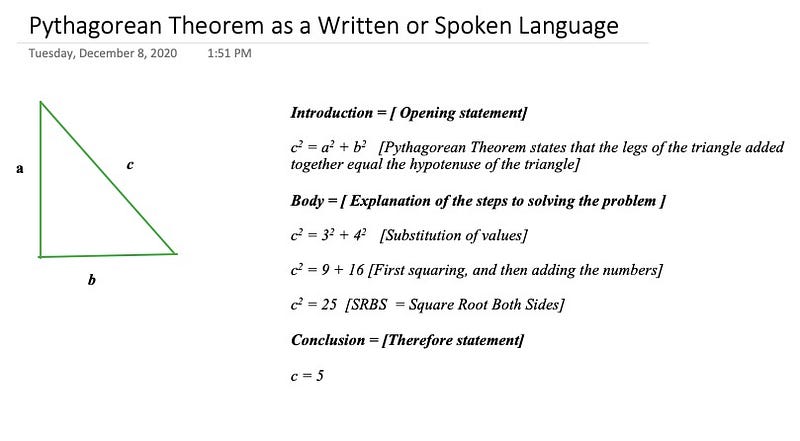
In order to explain what we see we use math vocabulary through the medium of the English language.
The Benefits To Viewing Math as a Language
If students were given the opportunity to see that when we use math vocabulary in writing the steps to a math solution, it is like writing an outline of an “English” paragraph, they may find the following benefits:
Here now is a list of what I believe brings five benefits to viewing math as a language.
I. Enhances Communication
When teachers and students continually make use of the math vocabulary in explaining answers, it may make communication of topics easier to understand between them.
It may also make it easier for students to explain their answers to the teacher or other students when they are comfortable using the math vocabulary.
Therefore, when teacher get students into the habit of answering or explaining math concepts, communication will be easier for all!
When it becomes easier to explain concepts, this builds confidence and enthusiasm in students.
II. Improves Vocabulary
In explaining concepts in math, previous knowledge of vocabulary allows for teachers and students to gain understanding of new and related vocabulary in more complex concepts in math.
III. Simplifies Knowledge of Complex Math Concepts
Improving math vocabulary not only allows for better communication of concepts in math, but also makes learning more complex math concepts easier.
Complex math concepts build on previous knowledge, and therefore when students are comfortable communicating previous knowledge, the transition to more complex knowledge becomes easier to understand.
IV. Strengthens Problem-Solving Skills
In understanding how to approach math word problems, connections to language need to be met.
When attempting to answer math problems written through words, we must translate written words into math vocabulary. In being able to do so, it will make it easier to follow the important steps to problem-solving in math.
V. Recognizes Math is a Universal Language
When students become comfortable using math vocabulary and learning to speak math language. It makes it easier to connect with international students when it comes to math.
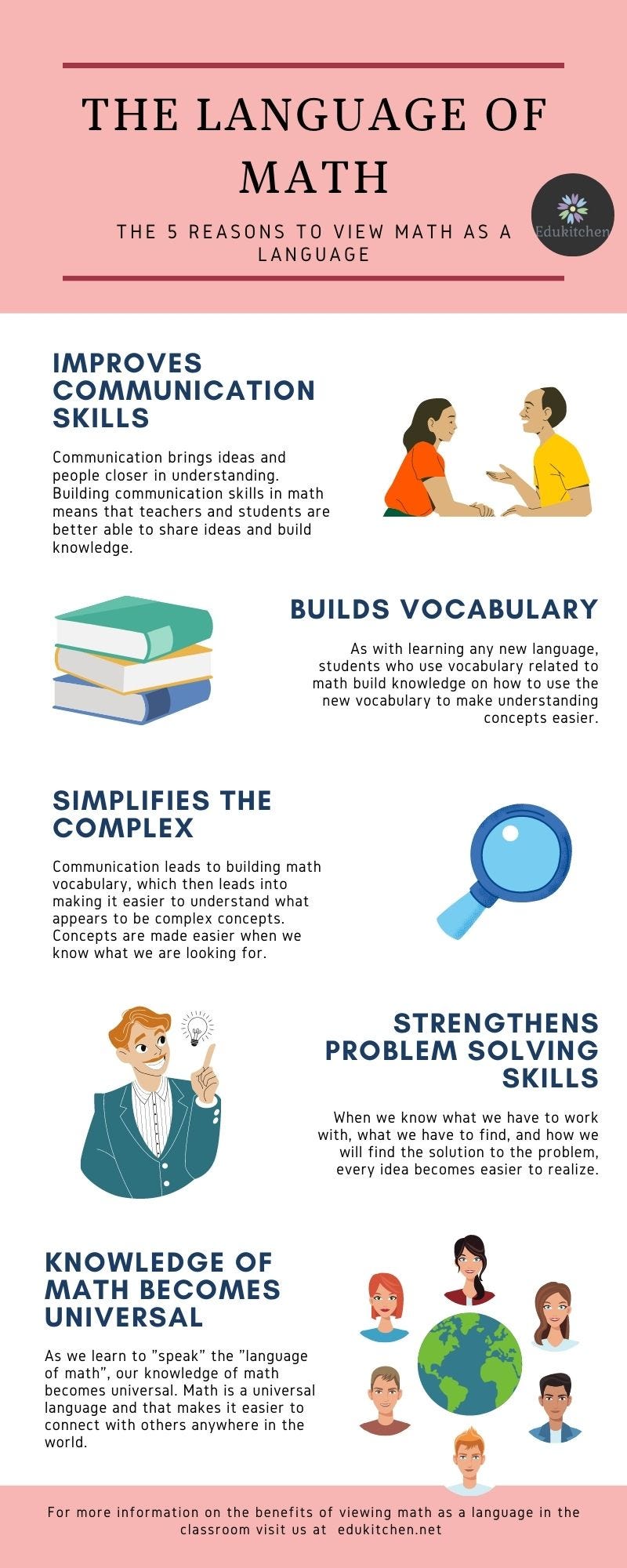
Infographic on the language of Math — courtesy of Danya Khelfa
The image of my math infographic can be found on my TpT store.
Students may speak different languages outside the math classroom, but when they switch to understanding math, it may connect students from different backgrounds. Math, when seen as a “universal” language, brings students from around the world together in shared knowledge.
Final Thoughts…
The five benefits to viewing maths as a language mentioned in this article are really meant to show that math is not something to be afraid of.

Student at the math board — Photo courtesy of Max Fisher from Pexels
Because the truth of the matter is that math can make people feel ashamed and embarrassed about how they think if they don’t understand it.
When we allow students to take their own unique approaches to communicating what they do or don’t understand when it comes to math, then their emotions towards the subject may change for the better.
Leave me a comment below and share your thoughts on this article and my suggestions for recognizing math as a very different but special kind of language we can all learn!
Let me know if you agree or disagree with the way I believe math should be presented to students.
If you enjoyed this article, please read my other articles that discuss math related topics.