
Is Math Really That Hard?
Let’s find out the answer to this question together, shall we?

In my years of teaching, I have discovered that there are two factors that generally affect students’ attitudes towards maths and their desire to learn the subject.
The two factors are;
- Math Teachers’ Influence On Students
and
- Student Expectations of Math Teachers
But before we deep dive into these two factors, let’s talk about emotions and maths.
Maths and Negative Emotions
For some students, the emotions connected to math are negative and there must be some underlying factors as to why most students see math in a negative way.
Take me for example, I HATED math in elementary school.
It wasn’t until my 10th grade that I began to see math in a new way.
It was all thanks to a math teacher whose whole life revolved around math and so he taught us math in unconventional ways.
He would {lightly} throw chalk at us if we seemed like we weren’t focused and would say, “Get back in the room.”
He would make each one of us present a question on the board each week, and have us present the answer to the other students in the classroom.
He loved math and he wanted to only teach students who loved math too.
Pretty unconventional, but chalking throwing aside, he had made me fall in love with math.
Why do some students really hate math?
Students who do not find any enjoyment in learning math will make their lack of enthusiasm known to all.
They will either make excuses to avoid answering questions, or will sit quietly and not answer any questions out of fear.
Students may be afraid to answer because they fear their answers are wrong, which shows the teacher and the rest of the class that they did not understand the question.
My comic below speaks to one student’s fear of the math classroom.
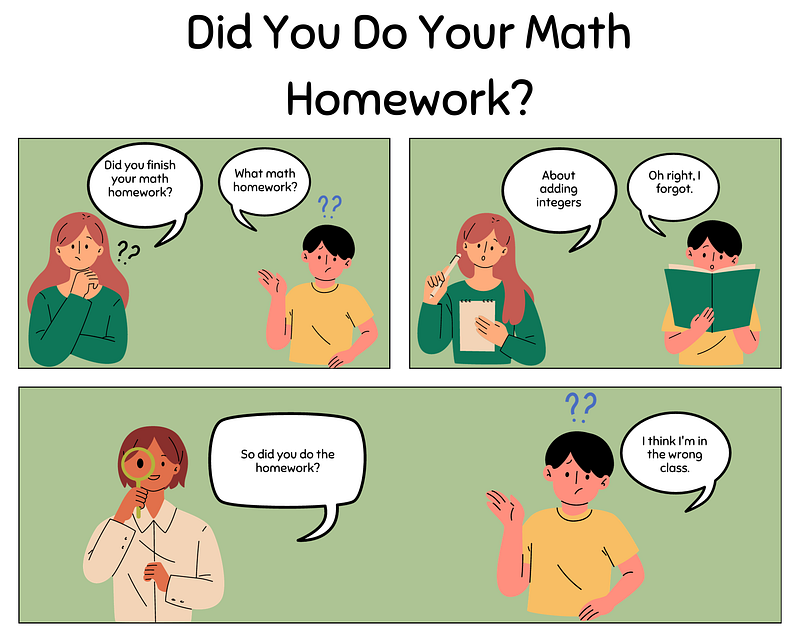
Teachers should not dismiss these students who seem to convey that they avoid or hate math, but instead have the students come to see in their own time that it’s more to do with their emotions and fears that bring on the hate.
Two Reasons Why Math is Hard for Some Students
In doing research for this article, I posed the question to teachers as to why some students may find math really hard. The answers focused on two main categories: teacher influence and student expectations.

I. Math Teachers’ Influence On Students
Research into math education often debates as to how much influence a teacher has on a subject.
Does the teacher’s style of teaching math make the student love or hate the subject?
Does the student’s interest in the subject drive their passion for learning or avoiding the subject altogether?
Teachers and tutors of math do feel that a teacher’s style of teaching does impact on a student’s interest in the subject.

If the teacher is unsure or uncaring as to how to interact with students and instead focuses on just presenting information, students may feel that the learning is square on their shoulders and that they won’t get the connections to the learning they are seeking.
II. Student Expectations of Math Teachers
Teachers may often try their best to encourage learning and critical thinking through problem-solving, and yet students sometimes still feel that what they are learning in math is a waste of time and will in no way influence what they want to do in life.
Students of the Internet generation {that’s Gen Z to you and me} find that answers to math questions are readily available through apps like Google Assistant, Siri, Alexa, and now ChapGPT.
Students who are frustrated may simply ask their teachers why such popular apps can’t simply do the work for them.

Those who are afraid of answering because they either do not understand, or are afraid to make a mistake will often refuse to answer the teacher and avoid participating altogether.
Students need to understand that by having such attitudes that they end up missing an opportunity to better their understanding and gain knowledge that they may share with others one day in the future.
They may also find that they expect their teachers to just be interested in math, and not really connect to what they are going through in trying to learn the subject.
To make learning math easier we need the right mix of teacher influence and student expectation.
How Should Teachers Respond to “Is Math Really That Hard?”
As teachers, it is our responsibility that we come prepared with the knowledge to present the information to students accurately and with enthusiasm.
Students are much more perceptive than teachers would like to believe, and so they can see right through a teacher who is disconnected from their students, or in other words — uncaring.
Teachers need to rely on their intuition in recognizing student’s emotions in relation to answering questions.

When faced with these situations in class, it is important that teachers recognize the reasons behind students’ behavior when they don’t enjoy math.
They should help students see the overall benefit when learning topics in math.
These benefits are that it helps us to become better problem solvers in life, while providing us with an opportunity to gain academic knowledge, and who wouldn’t see the benefit to both!
How Should Students Respond to “Is Math Really That Hard?”
Students should come to expect that teachers are presenting them with knowledge.
They should understand that even though what they may be learning in math may have no real bearing on their future careers, it is still an opportunity not to be wasted when it comes to learning.

It will be a means to make them better problem solver in the future, which will undoubtedly have a huge bearing on their future life!
Students also need to be able to ask and answer questions related to math in a way that helps them recognize that what they share may be helping other students learn.
The more comfortable students become with sharing information, the more enjoyable the lessons become and so what may seem hard becomes easy to understand.
My “Is Math Hard?” Video
Watch my video to see that HOW we learn math, teacher intuition, and emotions can have an important role to play in getting students help with improving their math learning goals.
The Real Answer to the Question “Is Math Really That Hard?”
Both teachers and students need to work together and come to understand what one expects from the other.
In doing so, the answer to the question “Is math really that hard?” becomes “Not if you don’t want it to be!“
After all, only if you want to, will you really learn.
Thanks for reading! If you don’t like math, maybe you will just a little bit after our time together!
I hope you enjoyed this article and please consider reading my other math related articles.


