
Tea Stain Art and Understanding Pareidolia
A visual perception of pattern.
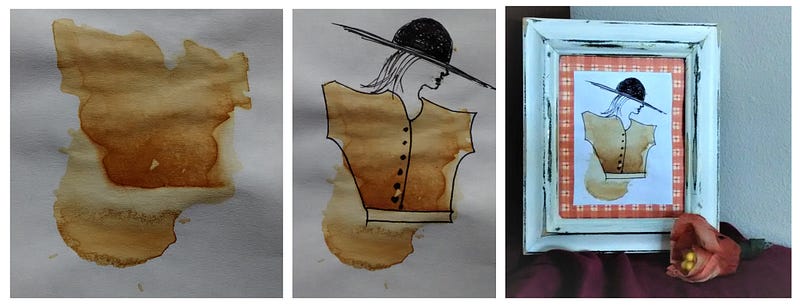
Have you ever stared at a patterned tile or a wood floor and suddenly you see an image? Have you ever looked at a wall socket and two eyes and a mouth look back at you? No, you’re not losing your mind, you’re just experiencing a phenomenon called pareidolia.
What is Pareidolia?
In the Collins dictionary, pareidolia is defined as, ‘the imagined perception of a pattern or meaning where it does not actually exist.’
The word pareidolia originated in Greece.
Para means beside or beyond and;
Eidolon means form or image.
It’s How Our Brains Are Wired
My cousin often spent summers with us. We would lie on the grass after lunch and watch the clouds roll by. Sometimes they carried a dragon on their back, or a car would blow across the sky. Our imaginations ran wild.
To see faces or objects in random places was once considered a form of psychosis, but with more recent studies scientists recognize this as a normal part of our nature. The human brain is designed (wired) to recognize pattern, shape, and most often faces. Interestingly women are more prone to recognize faces in random places than men.
Nature is a leading example of pareidolia examples. Look at the knots on trees or the way a cloud is shaped. Maybe a rocky outcrop on your favorite hiking trail looks like your larger-than-life Uncle Tommy on your mother’s side.
Some well-known and well-documented examples include:
· Old Man of the Mountain in New Hampshire
· Camelback Mountain in Arizona
· The Queen’s Head Hoodoo in New Taipei’s Yehliu Geopark
· The Old Man of Hoburgen on the Swedish island of Gotland
More examples:
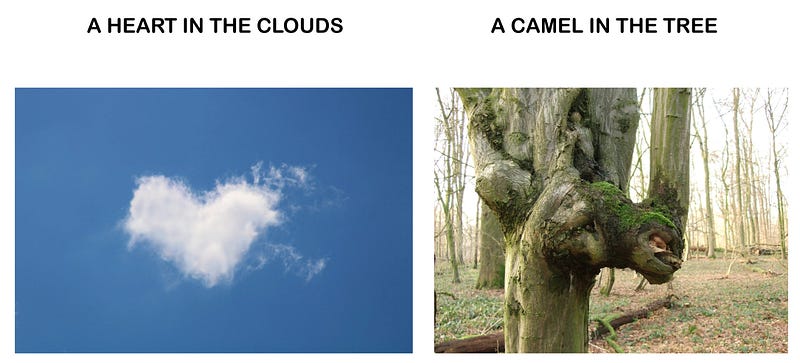
Tea Stains on Paper Can Be a Hidden Piece of Art
My pareidolia experiences are a little closer to home. I drink a fair amount of tea while I work. I don’t always want to stand up and take the soggy teabag to the kitchen. So, I dump it on a piece of paper on my desk. Then I forget about it, because that’s what I do. By the end of the day, I have a collection of dried-out teabags on crisp white printer paper.
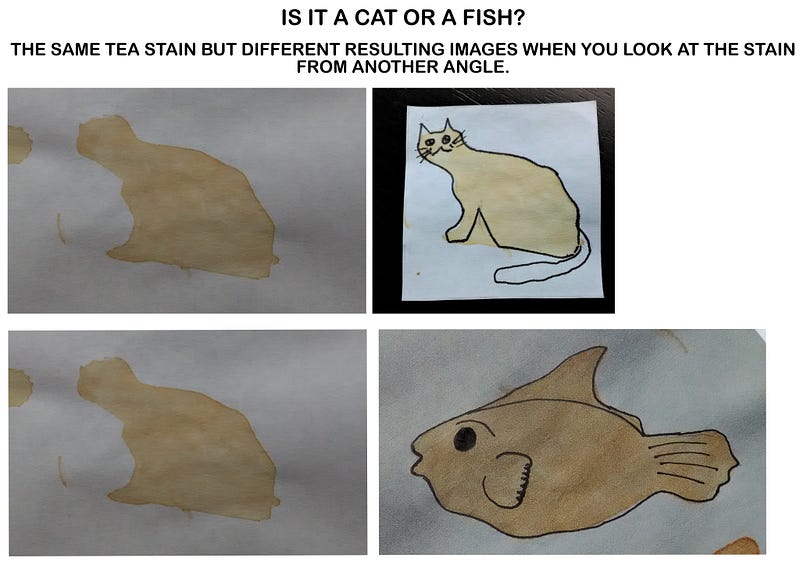
At the end of the day, I slid the paper off the desk to dump in the trash, but gradually I saw images other than tea stains. Sometimes a stain created several images as I turned the paper and viewed it from different angles.
I saved the pages until I could sit down and stare at them with enough intensity to make the crisp paper feel self-conscious. Then I gave it an identity. Some were cats or fish or classy ladies with big hats. I found ducks, teapots, and an elephant’s head. Honestly, your mind can travel with reckless abandon.
As I was sketching the cat, my son walked by and said, “Oh, a fish.” Luckily, I had photocopied the tea-stain and could trace out the fish for him.
I never throw the tea-stained paper out. When I feel a bit stressed or need a mind reset after a long day, I might pull one out and find a shape. It’s a bit like Neurographic art or doodling. I’m still doing something creative, just with a different medium.
At this angle, the fishtail in the stain is pointing to the top left corner. If you flip the tea-stain horizontally, you’ll see the fin of the fish pointing up.
Publications About Pareidolia Art
An Atom of Meaning: Playing with Pareidolia: Accidental Art for People who Can’t Draw
By Frances Culshaw published in 2013
The author looks at the phenomenon of pareidolia as an accidental work of art. She acknowledges how we see shape in everyday objects and how individualized this phenomenon is.
Pareidolia
By an author collective
A collection of stories by multiple authors who took the idea of pareidolia and turned it into a series of dark and bizarre tales.
A Final Word
In her article, ‘Your Reality Is Never About The Situation But Your Thoughts About It”, Esther George sums up how I think of pareidolia. She says, “No matter how similar they appear, no two people ever see or experience life the same way.”
I saw a cat on a tea-stained piece of paper, but my son saw a fish. It’s about perception. We are all as different as we are the same.
Go on, I know you want to. Go outside and stare at the knot patterns on your garden fence or the way that your car headlights now suddenly sit above a smiling bumper. You’re not losing it, you’re just enjoying a moment of pareidolia.
Please visit me online at:
YouTube — Where I share my creativity
Etsy — For my digital art prints


